

Connect with us

Banking

Zenith Bank to Develop SmartAfCFTA for Trade Promotion

Published

on

Zenith Bank SmartAfCFTA

By Modupe Gbadeyanka

A portal to unlock the vast opportunities for trade on the African continent is to be designed by Zenith Bank Plc in partnership with the African Continental Free Trade Area (AfCFTA) Secretariat.

The platform, SmartAfCFTA, will provide information like trade indicators, market trends, custom tariffs, trade agreements, rules of origin, market access requirements of relevant jurisdictions, export potentials, export diversification indicators and contact details of business partners in target markets and other trade-related information about Africa.

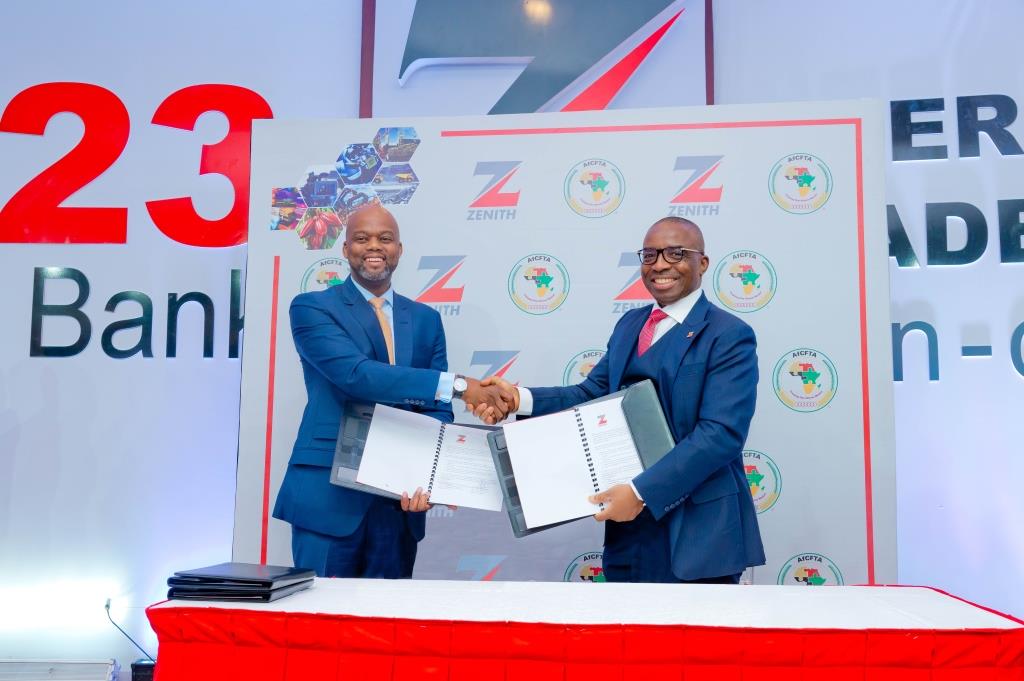
At the 8th Zenith Bank International Trade Seminar on Non-Oil Export in Lagos, both parties signed a Memorandum of Understanding (MoU) to make this a reality in order to promote trade within the African continent.

The chief executive of Zenith Bank, Mr Ebenezer Onyeagwu, said, “This collaboration aims to unlock the vast opportunities presented by AfCFTA not only for Nigeria’s economic prosperity but also for advancing trade across African countries.”

He noted the key role that the annual Zenith Bank Trade Seminar plays in deepening the conversation on promoting non-oil export in Nigeria by bringing together non-oil export practitioners and relevant government agencies to interact and explore the opportunities and proffer solutions to the challenges of non-oil export in the country, noting that previous editions’ outcomes have found expression and influenced policy initiatives.

For instance, the extension of the period of repatriation of Non-Oil Export proceeds from 90 days to 180 days, and the policy mandating shippers not to carry export without a Nigeria Export Proceeds (NXP) Form Number were recommendations from previous seminars.

Also, the need to incentivise exporters to repatriate their export proceeds through the official channels and the recommendation to create export terminals across various export hubs in the country were also from past seminars.

Also, previous editions recommended having Export Desks in commercial banks, which has now been instituted.

In his keynote address, the Secretary-General of the AfCFTA Secretariat, Mr Wamkele Mene, thanked the chairman of Zenith Bank, Mr Jim Ovia, for partnering with the AfCFTA for the development of the SmartAfCFTA Portal.

“Zenith Bank was the first bank to say we want to partner with you. We went to see the founder and Chairman, and he said that Zenith Bank wants to make a contribution to digitise trade in Africa. And so, the portal was not my idea, it was not our idea at the AfCTA Secretariat, it was Zenith Bank that stepped up and said, this has to be done! So, I want to thank you very much, GMD, for this collaboration,” he stated.

In his goodwill message, the Acting Governor of the Central Bank of Nigeria (CBN), Mr Folashodun Shonubi, represented by the Deputy CBN on Economic Policy, Mr Kingsley Obiora, commended Zenith Bank for leading Nigeria’s non-oil export promotion advocacy.

He bemoaned the 1.2 per cent non-oil export to total GDP ratio and emphasised the need for concerted efforts to boost non-oil exports in Nigeria.

Zenith Bank launched the Non-Oil Export Seminar in 2016 as an initiative to deepen the discourse on promoting the non-oil export business in Nigeria.

This year’s event was themed Nigerian Non-Oil Export Industry: The Present, The Future, and it featured several dignitaries like the Secretary of the National Action Committee on AfCFTA, Mr Olusegun Awolowo, and others.

Modupe Gbadeyanka is a fast-rising journalist with Business Post Nigeria. Her passion for journalism is amazing. She is willing to learn more with a view to becoming one of the best pen-pushers in Nigeria. Her role models are the duo of CNN's Richard Quest and Christiane Amanpour.

1 Comment

1 Comment

  1. Pingback: Zenith Bank to Develop SmartAfCFTA for Trade Promotion – African Budget Bureau
Leave a Reply

Your email address will not be published. Required fields are marked *

Banking

First Holdco Begins N1.4trn Share Offer After CBN Approval

Published

on

first holdco subsidiaries

By Adedapo Adesanya

First Holdco Plc has commenced a public offer to raise about N1.4 trillion (approximately $1 billion) after securing approval from the Central Bank of Nigeria (CBN).

The offer, which opened on Monday, involves the sale of 10.4 billion ordinary shares, according to the chief executive of its banking subsidiary, First Bank of Nigeria Limited, Mr Olusegun Alebiosu.

The capital raise follows the company’s earlier plan to transfer about a quarter of its shares to RC Investment Management Ltd., which served as a bridge holder after Barbican Capital Limited exited its investment in the lender amid a prolonged ownership and leadership dispute.

First Holdco had previously indicated that the shares would eventually be offered to the investing public once the necessary regulatory approvals were obtained.

Speaking in an interview with Bloomberg, Mr Alebiosu said proceeds from the offer would strengthen the capital base of First Bank and support the holding company’s expansion strategy.

According to him, the group intends to diversify beyond banking by establishing an insurance underwriting business and a fintech services company.

“The sale is starting today — the reality here is that I am not sure it will stay more than one week based on the pressure we are getting,” Mr Alebiosu said, expressing confidence in strong investor demand.

Investors appeared to respond positively to the announcement, with First HoldCo’s shares climbing as much as 5.9 per cent to a record high during trading on Monday before easing to a 3.1 per cent gain at N133.60 by early afternoon in Lagos.

The lender has been one of the best-performing banking stocks on the Nigerian Exchange (NGX) Limited over the past year, with its share price rising more than fourfold since July 2025, when Barbican Capital’s stake was transferred to RC Investment Management.

The fresh capital injection comes as its largest shareholder, Mr Femi Otedola, continues to strengthen his stake in Nigeria’s oldest bank. With the billionaire holding around a 26 per cent stake in the company, analysts say he has his eyes set on full control once his equity crosses the 30 per cent mark.

Continue Reading

Banking

PalmPay Taps Ex-NIBSS Executive Samuel Oluyemi as Chief Operating Officer

Published

on

Samuel Oluyemi

By Adedapo Adesanya

One of Nigeria’s top digital banks, PalmPay, has appointed a former executive of the Nigeria Inter-Bank Settlement System (NIBSS), Mr Samuel Oluyemi, as its chief operating officer.

In his new role, Mr Oluyemi will oversee the financial technology company’s operations in Nigeria, where it offers a broad range of digital financial services to individuals and businesses.

Mr Oluyemi will also engage with regulators to ensure the company’s expansion aligns with Nigeria’s financial, digital and social inclusion objectives.

Prior to joining the company, Mr Oluyemi spent more than two decades at NIBSS, where he served as business development lead.

During his tenure, he drove the development of several critical payment infrastructure projects, including the digital validation of Nigerian international passports, e-Dividend Mandate Management System (e-DMMS), and the Electronic Pensions Contribution Collection System (EPCCOS).

Also, he played a key role in the introduction and early adoption of the NIBSS Instant Payment (NIP) platform, Nigeria’s first real-time interbank transfer system launched in 2011, and later supported its extension to other financial institutions.

Mr Oluyemi obtained a master’s degree in Monetary Economics from the University of Ibadan and has participated in several local and international professional training programmes.

Commenting on the appointment, Managing Director of PalmPay Nigeria, Mr Chika Nwosu, said that the company was strengthening its leadership team to support its longterm vision.

Continue Reading

Banking

Flutterwave Pauses IPO Plans Amid African Banking Expansion Push 

Published

on

Flutterwave Logo

By Adedapo Adesanya

Africa’s most valuable fintech, Flutterwave, has signalled that its long-anticipated initial public offering (IPO) remains firmly on the back burner as the company intensifies efforts to transform itself into a licensed financial institution across the continent.

The firm’s chief executive, Mr Olugbenga Agboola, said the firm is focused on building sustainable profitability, diversifying its revenue streams and expanding its banking footprint before considering a stock market listing.

Speaking to The Africa Report, Mr Agboola described an IPO as a future financing milestone rather than an immediate strategic objective.

“An IPO is a financing event, not a strategy,” he said. “We are not holding any pressure to go public. This gives us the flexibility to be patient and ensure when we do list, we’re doing so from a position of strength.”

The comments come as Flutterwave embarks on an acquisition-led expansion strategy aimed at securing banking licences and deeper regulatory access across Africa.

Mr Agboola revealed that the company is currently in the process of acquiring a bank in East Africa, though he declined to disclose the institution or country involved.

The planned acquisition is expected to provide Flutterwave with an established customer base, existing banking infrastructure and regulatory approvals, significantly shortening the time required to enter new financial services markets.

According to Mr Agboola, the company’s expansion priorities include Kenya, Ghana, Rwanda, Tanzania, South Africa and Egypt, while the Democratic Republic of Congo and Ethiopia remain under consideration for future growth.

Rather than building banks from scratch in every market, Flutterwave intends to adopt a mix of acquisitions, licences and strategic partnerships depending on local regulatory conditions.

“The vision is not to form a bank in every country but to ensure that every African business has access to more than financial services,” Mr Agboola said in the interview.

The banking push follows recent regulatory and corporate developments, including the Central Bank of Nigeria’s approval of Flutterwave’s banking licence and the acquisition of open banking startup Mono.

Together, the moves underscore a broader strategy to expand beyond payments and establish new revenue streams in lending, liquidity management and business banking services.

Flutterwave plans to focus on institutional deposits from businesses already using its platform rather than competing aggressively for retail deposits.

The company intends to leverage transaction data from its payments network to provide short-term working capital, merchant financing, invoice discounting and trade finance products for small and medium-sized enterprises.

Mr Agboola disclosed that the bulk of the capital earmarked for banking operations will be directed toward credit support and liquidity buffers, with additional allocations for lending and banking infrastructure.

The strategy reflects a growing trend among African fintech firms seeking banking licences to reduce dependence on traditional financial institutions and gain greater control over settlement, liquidity management and product development.

Despite speculation about a near-term public listing, Mr Agboola maintained that Flutterwave’s immediate focus remains execution and growth.

He noted that the company will only consider an IPO after achieving stronger profitability and establishing scale across its payments, banking and remittance businesses.

In February 2025, he told Bloomberg that Flutterwave would only pursue a public offering after becoming profitable. He also stated in late 2024 that the company was “not in the IPO race.”

Founded in 2016, Flutterwave has processed more than one billion transactions valued at over $40 billion across 35 African countries. The company recently secured fresh funding that lifted its valuation to $3.3 billion, with American blockchain firm Ripple leading the investment round.

For now, however, Flutterwave appears more interested in building the foundations of a pan-African financial institution than rushing to the public markets, positioning banking expansion as the next phase of its growth story while keeping an eventual IPO firmly on the long-term horizon.

Continue Reading

