Connect with us

Economy

NGX Down 0.17% as Investors Reprice Nigerian Stocks Risks

Published

on

Nigerian Stocks

By Dipo Olowookere

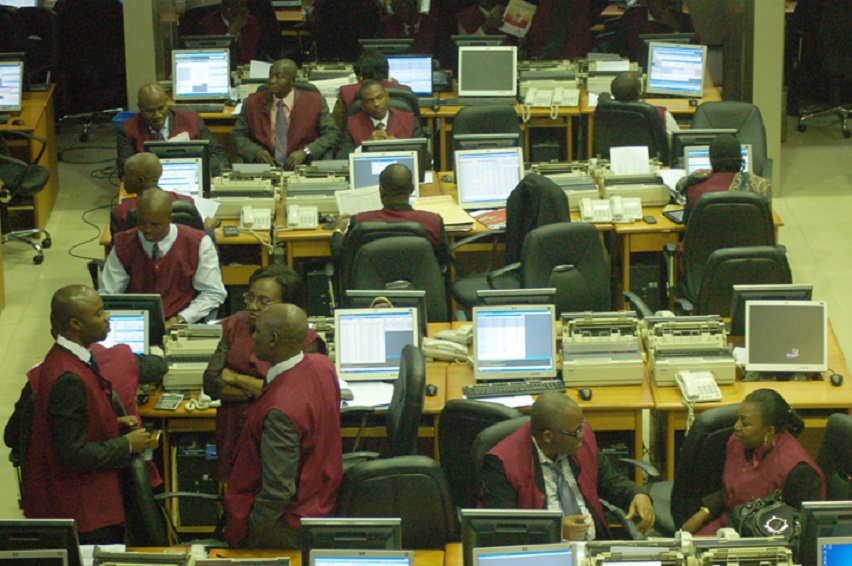
The Nigerian Exchange (NGX) Limited was down by 0.17 per cent on Tuesday after traders reactivated their selling button amid watch happenings in the global and domestic scenes.

It was observed that investors rebalanced their portfolios and repriced their risk levels, cutting down their exposure to Nigerian stocks.

Consequently, the All-Share Index (ASI) shrank by 116.71 points to 66,984.62 points from 67,101.33 points on Monday, as the market capitalisation declined by N65 billion to N36.801 trillion from N36.866 trillion.

Profit-taking was the order of the day as the banking, insurance and consumer goods sectors depreciated by 1.11 per cent, 0.71 per cent, and 0.11 per cent, respectively, while the energy and the industrial goods counters closed flat apiece.

Business Post reports that investor sentiment was weak yesterday after the bourse ended with 27 price losers and 13 price gainers, indicating a negative market breadth index.

John Holt closed on top of the losers’ chart after it dropped 10.00 per cent to N1.44, Presco declined by 9.54 per cent to N182.00, DAAR Communications fell by 8.70 per cent to 21 Kobo, DEAP Capital slipped by 7.41 per cent to 25 Kobo, and Jaiz Bank slumped by 6.25 per cent to N1.50.

On the flip side, McNichols led the gainers’ group after it improved its value by 10.00 per cent to 66 Kobo, Capital Hotels rose by 9.82 per cent to N3.02, Chams expanded by 9.38 per cent to trade at N1.40, ABC Transport gained 8.82 per cent to settle at 74 Kobo, and Oando appreciated by 7.61 per cent to quote at N9.90.

Fidelity Bank was the busiest stock of the trading session with 53.4 million units valued at N442.9 million, Access Holdings transacted 31.1 million units worth N490.5 million, UBA exchanged 26.8 million worth N459.7 million, Oando traded 13.6 million units for N133.4 million, and Zenith Bank sold 11.3 million units worth N359.0 million.

At the close of transactions, the value of transactions increased by 122.86 per cent to N7.8 billion from 3.5 million, while the volume of trades went down by 4.18 per cent to 257.4 million shares from 268.7 million, and the number of deals decreased by 6,498 deals from 6,911 deals.


Dipo Olowookere is a journalist based in Nigeria that has passion for reporting business news stories. At his leisure time, he watches football and supports 3SC of Ibadan. Mr Olowookere can be reached via [email protected]

Click to comment

Leave a Reply

Your email address will not be published. Required fields are marked *

Economy

Naira Crashes to N1,362.05/$1 at Official Window After N1.50 Loss

Published

on

deposit old Naira notes

By Adedapo Adesanya

The Naira fell against the United States Dollar by N1.50 or 0.11 per cent in the Nigerian Autonomous Foreign Exchange Market (NAFEX) to sell at N1,362.05/$1 on Wednesday, June 10, compared with the N1,360.55/$1 it traded on Tuesday.

Also, the local currency lost N4.33 against the Pound Sterling in the official window yesterday to trade at N1,827.33/£1 versus the preceding day’s N1,823.00/£1, and depreciated against the Euro by N1.74 to quote at N1,575.35/€1, in contrast to N1,573.61/€1 of the previous session.

However, at the GTBank forex desk, the Naira gained N3 against the US Dollar to sell at N1,370/$1 versus N1,373/$1, and at the parallel market, it remained unchanged at N1,380/$1.

Updated data from the Central Bank of Nigeria (CBN) showed that foreign reserves surged further due to additional inflows from various sources. Nigeria’s gross external reserves increased to $50.439 billion, its highest level since March 2026, reflecting sustained inflows from oil revenue and other FX sources.

Also, the International Monetary Fund (IMF) has said increased confidence in the Naira, supported by lower and more stable inflation, would encourage households, businesses and investors to hold more local currency assets and reduce reliance on foreign currencies.

The global lender, in a recent assessment, stressed the importance of strengthening the CBN’s operational framework and aligning liquidity management operations more closely with monetary policy objectives.

In the cryptocurrency market, there were recoveries from recent losses as US headline inflation rose an expected 0.5 per cent in May, but the beat on the core rate — which cuts out food and energy costs — pleased markets. The core rate, though, rose just 0.2 per cent in May against forecasts for 0.3 per cent.

The print reinforces the view that the US Federal Reserve will keep interest rates at 350-375 basis points at its June 17 meeting, but is likely to increase rates by 25 basis points by the end of the year.

Cardano (ADA) went up by 2.4 per cent to $0.1647, Bitcoin (BTC) rose by 2.3 per cent to $62,794.09, Binance Coin (BNB) jumped 1.8 per cent to $596.23, Ethereum (ETH) grew by 1.7 per cent to $1,658.12, and Solana (SOL) also soared by 1.7 per cent to $65.23.

Further, Dogecoin (DOGE) appreciated by 1.5 per cent to $0.0849, Ripple (XRP) expanded by 0.4 per cent to $1.11, and TRON (TRX) increased by 0.05 per cent to $0.3218, while the US Dollar Tether (USDT) lost 0.10 per cent to close at $0.9989, and the US Dollar Coin (USDC) declined by 0.01 per cent to $0.9997.

Continue Reading

Economy

Oil Prices Jump as Iran Shuts Down Strait of Hormuz

Published

on

oil prices driving up Trump

By Adedapo Adesanya

Oil prices jumped early on Thursday as Iran declared the critical energy chokepoint, the Strait of Hormuz, closed ‌after the US launched additional strikes against the Middle East oil producer.

Brent futures rose $1.48 or 1.59 per cent to $94.58 per barrel, and the US West Texas Intermediate (WTI) crude climbed $1.71 or 1.90 per cent to $91.74 a barrel.

Iran’s top joint military command announced the closure of the ​Strait of Hormuz on Thursday, including oil tankers and commercial ships, saying any vessel attempting ⁠passage will be shot at.

Market analysts noted that the renewed ​escalation in fighting prompted oil prices to rally in early morning trading.

On Wednesday, the US military said on X that commercial ships continue to transit in and out of the strait. It also said no US warships have been struck in the strait, after ​Iran’s state media reported US ships near the waterway were targeted by missiles and drones.

US forces began launching ​additional strikes against multiple targets in Iran on Wednesday, the latest in an escalating exchange of attacks that threaten ‌to ⁠reignite a full-scale war, which was paused in early April when the two sides agreed to a fragile ceasefire.

Defence Secretary Pete Hegseth held a press briefing announcing further attacks on Iran, saying, “If we need to negotiate with bombs, we’ll negotiate with bombs.” US Central Command later described those attacks as targeting “Iranian military surveillance capabilities, communication systems, and air defence sites across Iran.”

In response to the attacks, Iran’s top joint military command then announced that the Strait was closed to all shipping.

President Donald Trump said the strikes would stop shortly, but that they would continue if Iran’s leaders did not sign an agreement with the US immediately.

Iran’s months-long ​blockade of the strait, which ​normally carries a fifth ⁠of global oil and gas shipments, has kept oil prices elevated.

The latest exchange of strikes between the US and Iran marks the most significant escalation in the conflict since both countries agreed to a fragile ceasefire in April. Since then, oil inventories have drained dramatically, and no tangible breakthroughs have been announced.

Crude oil inventories in the US decreased by 7.2 million barrels during the week ending June 5, according to new data from the Energy Information Administration (EIA).  The EIA’s data release follows figures that were released by the American Petroleum Institute (API) a day earlier, which reported that crude oil inventories saw a draw of 9.119 million barrels in the period.

Continue Reading

Economy

Customs Street Rallies 0.06% Amid Weak Investor Sentiment

Published

on

Customs Street Nigerian Stock Exchange

By Dipo Olowookere

A marginal 0.06 per cent was recorded by Customs Street at the close of business on Wednesday, extending the dominance of the bulls for another trading session.

The uptick printed by the Nigerian Exchange (NGX) Limited was despite weak investor sentiment after reporting 30 price gainers and 36 price losers, representing a positive market breadth index.

Livestock Feeds gained 10.00 per cent to close at N9.35, Deap Capital expanded by 9.86 per cent to N5.35, Abbey Mortgage Bank appreciated by 9.78 per cent to N12.35, Vitafoam grew by 8.25 per cent to N210.00, and FTN Cocoa chalked up 6.54 per cent to finish at N9.45.

On the flip side, Neimeth lost 10.00 per cent to trade at N9.00, International Energy Insurance slipped by 9.92 per cent to N7.90, John Holt shrank by 9.73 per cent to N13.45, Union Homes REIT declined by 8.56 per cent to N70.00, and eTranzact went down by 8.06 per cent to N16.55.

Though activity level contracted yesterday, it remained on the high side, as market participants transacted 1.2 billion equities worth N38.8 billion in 54,193 deals compared with the 1.3 billion equities valued at N57.9 billion traded in 59,956 deals on Tuesday, indicating a shortfall in the trading volume, value, and number of deals by 7.69 per cent, 32.99 per cent, and 9.61 per cent, respectively.

Sterling Holdings sold 565.3 million shares valued at N4.5 billion to emerge as the busiest during the session. FCMB transacted 122.1 million equities for N1.5 billion, Access Holdings sold 49.5 million stocks worth N1.3 billion, Jaiz Bank exchanged 34.9 million shares valued at N313.8 million, and Universal Insurance traded 32.4 million stocks worth N35.6 million.

Business Post reports that the banking and industrial goods sectors respectively lost 0.79 per cent and 0.09 per cent yesterday as a result of profit-taking.

However, the consumer goods index rose 0.42 per cent, the energy counter increased by 0.14 per cent, and the insurance segment improved by 0.03 per cent due to bargain-hunting.

As a result, the All-Share Index (ASI) went up by 154.59 points to 244,852.21 points from 244,697.62 points, and the market capitalisation soared by N99 billion to N157.043 trillion from N156.944 trillion.

Continue Reading

Trending