Connect with us

Feature/OPED

Food Crisis And Nigeria’s Multi Dimensional Poverty

Published

on

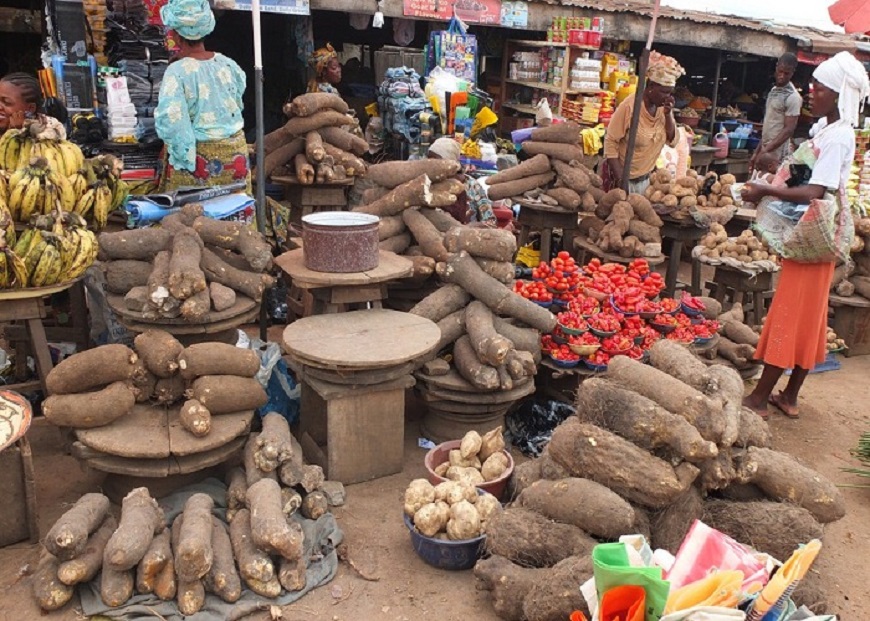
Food Crisis

By Jerome-Mario Utomi

If there is any fresh fact that supports the claim by the National Bureau of Statistics (NBS) in November 2022 that the Multidimensional Poverty Index (MPI) is higher in rural areas than in urban areas, it is my experience during a short visit to Agbor, a community which, according to Wikipedia, is the most populous among the Ika people, located in and functions as the headquarter of Ika South Local Government Area of Delta State in South-south geo-political zone of Nigeria.

Among many other observations, the referenced report puts the MPI in rural areas at 72% and that of urban areas at 42%, thereby confirming that a much higher proportion of people living in rural areas compared to those living in urban areas are multidimensionally poor.

The report further noted that 63% (about 133 million people), that is about 6 out of every 10 Nigerians, are multidimensionally poor, with 65% (86 million) and 35% (47 million) of the poor living in the North and South of Nigeria, respectively. The implication is that location matters with respect to poverty and unemployment.

Essentially, as a Nigerian resident in Lagos, I have come across many reports that underlined Nigeria as a nation confronted with both food insecurity and crisis. Again, aside from witnessing commentators argue at different times and places that when food continues to rise in price, everyone feels it, but those with less money, understandably, feel it far more, as they have to spend more of their money on the essentials: housing and food.

I have also, on the other hand, before embarking on that trip, seen parents go without food to ensure that children can eat. Particularly, as prices of staple foods in Lagos, such as rice have reportedly morphed from N35.000 to well over N50,000. Other items such as noodles have equally and appreciably added in prices as the smallest pack which used to sell for N100 now hovers between N130 and N150.

While these heightened price regimes were considered worrying by Lagosians, new facts derived from my latest visit show that if the ongoing food inflation in Lagos is a challenge, the experience in local communities/small towns like Agbor is a crisis.

I arrived at Agbor in the evening and was adequately taken care of by my host and, therefore, made it straight to my hotel room without having any contact with food vendors within and outside the guest house.

The following morning, I thought it wise to observe my breakfast before resuming the assignment that brought me to the town. I approached the reception to ascertain what their breakfast arrangement looks like but was told in plain language that they have no provision/arrangement for such.

With that response, I stepped out onto Old Lagos-Asaba road and just a few buildings away from the guest house was a ‘fast food’ vendor. As it was breakfast that I needed, I politely requested that he prepare two packs (the smallest size) of noodles and two eggs for me. And just immediately, she replied; it will cost you N1,200. How come? I asked. If this is sold at this price, how can jobless Nigerians, particularly the youths, afford such meals? I further queried. Then she replied; Oga, that is the amount; it is either you buy or leave me alone. The jobless Nigerians you are talking about are already aware of the price regime. The rest they say is history.

Scene 2: In the afternoon of the same day, while on my way back to the guest house, I saw a woman who sells roasted yam by the roadside. The pieces of yam displayed were ‘wickedly’ cut into tiny framed sizes and could conveniently be likened to the worth sold for N100 in Lagos. I greeted the woman and thereafter, pointed at two pieces. She replied saying; it was N400. Without pressing further or seeking further clarification, I requested that she prepare it for me.

Handing over the yam to me, which was garnished with three pieces of meat sold at N600 (N200 a piece), I innocently flashed one thousand naira note at her. Lo and behold, the woman told me that I had to give her an additional N200 as the total value of what I bought was N1200. How come? When? I asked at the same time. It was then that she explained to me that the two pieces of yam were actually sold for N800 at N400 per piece.

Also devastating and of course another reason for us to be alarmed is the awareness that this galloping inflation in Agbor, Delta State and its environs is not limited to food items alone but affects accommodation. In what is in some ways a more brazen move is that in Agbor, house rent is higher when juxtaposed with the experience in some parts of Lagos.

This is the challenge facing communities in our republic. The high cost of food and accommodation in Agbor may have existed in an overt manner, the experience in other towns and communities in the country may be worse but exists in covert forms.

Talking about food insecurity in Nigeria, many have argued that the food challenge in the country has been impacted especially by violent conflicts, including the insurgency in the North East; armed banditry in the Northwest; perennial farmer/herder conflicts in the North Central, South West, and increasingly across the country; and separatist agitation in the South East among others.

To others, the challenge is exacerbated by natural disasters; in particular, the rising incidence and frequency of floods in large parts is a consequence of climate change impact, which continues to affect food production and the availability and affordability of food.

A sterling example is the report by the National Emergencies Management Agency (NEMA), 2022 which among other remarks observed that floods led to the destruction and washing away of over 675,000 hectares of farmland.

“One can only imagine the extent of the impact of this scale of destruction of farmlands on agricultural activities and food production across the country. Farmers, the majority of whom are small-scale farmers, lost not only crops and harvests, but also farm animals, poultry, fishery, and farm implements to the raging floods.”

Whatever the true picture may be, there are in the opinion of this piece multiple reasons why the federal and of course state governments in Nigeria should undertake strategic efforts to solve the problem of food inflation not just in Agbor but across the country.

Aside from the fundamental relationship between the food crisis and inflation and its harmful effects on every economy, the human population in the country quadrupled and unemployment multiplied in the past decades and the average impact of this uncontrolled increase on the nation’s economy is tellingly obvious.

Undoubtedly, I believe and still believe that as a country desirous of achieving sustainable development, the recent decision by the Federal Government to launch the conditional cash transfer policy for 15 million households on October 17, 2023, will not resolve the present hunger challenge in the country.

Rather, there are both specific and specialized reasons for the government to throw its weight behind agriculture by creating an enabling environment that will encourage Nigerian youths to take to farming.

First, aside from the worrying awareness that by 2050, global consumption of food and energy is expected to double as the world’s population and incomes grow, climate change is expected to have an adverse effect on both crop yields and the number of arable acres, we are in dire need of solution to this problem because unemployment has diverse implications.

Security-wise, a large unemployed youth population is a threat to the security of the few that are employed. Any transformation that does not have job creation as its main objective will not take us anywhere and the agricultural sector has the capacity to absorb the teeming unemployed youth in the country.

The second reason is that globally, there are dramatic shifts from agriculture in preference for white-collar jobs, a trend that urgently needs to be reversed.

Separate from job creation, averting malnutrition which constitutes a serious setback to the socio-economic development of any nation is another reason why Nigeria must embrace agriculture, a vehicle for food security and a sustainable socio-economic sector.

In fact, it was noted recently that in Nigeria, governments over the years have come to realize that sustainable growth is achievable only under an environment in which the generality of the people is exposed to a balanced diet, not just food. This explains why agricultural production should receive heightened attention. In Nigeria, an estimated 2.5 million children under five suffer from severe acute malnutrition (sam) annually, exposing nearly 420,000 children within that age bracket to early death from common childhood illnesses such as diarrhoea, pneumonia and malaria.

This is the best time for President Bola Ahmed Tinubu-led federal government and state governors to serve and save Nigerians from malnutrition and multi-dimensional poverty.

God bless Nigeria!!!

Utomi Jerome-Mario is the Programme Coordinator (Media and Policy) at the Social and Economic Justice Advocacy (SEJA), Lagos. He could be reached via [email protected]/08032725374

Feature/OPED

Ledig at One: The Year We Turned Stablecoins Into Real Liquidity for the Real World

Published

on

Ledig

Ever tried sending a large amount of money into or out of certain markets and felt your stomach twist a bit? That was the feeling many companies carried long before Ledig existed. Delays. Guesswork. Phone calls that sounded unsure. People waiting on people, and no reliable derivatives hedging protocol to shield them from currency swings. It was messy.

That frustration is what pushed us to open Ledig to the world a year ago. We wanted a system built for big transfers. Not a few hundred dollars. Serious amounts. A hundred thousand. A million. Even more. And we wanted it to move in seconds, not a strange timeline that no one could explain.

So, we built a setup that lets companies bring in stablecoins and get local currency out quickly. We also kept the opposite direction just as clean. Local currency in, stablecoins out. Both ways needed to feel the same because business doesn’t move in only one direction. Some clients even switch between the two during the same week.

In the early days, people sent smaller amounts to test us. Fair enough. But once they saw a large payment settle almost instantly, confidence spread. This is how we crossed our first $100M. Most of that came from global companies working across Africa and other emerging markets. These firms care about stability, not buzzwords. They just want their money to land where it should.

A lot of the magic sits behind the scenes. Wallets. Local settlement tools. A solid FX engine that adjusts as needed. None of this appears on the surface. All a user sees is a simple dashboard or a set of API calls that get the job done. They don’t even need to think about crypto. The tech exists under the hood, doing the heavy lifting quietly.

But fast movement alone wasn’t enough.

Ledig derivatives hedging protocol

There was another problem staring companies in the face. Currency swings. And they hurt. Imagine finishing a project today and waiting ninety days to get paid in a currency that drops often. By the time the company receives the money, the value has fallen so much that the profit is almost gone. This is a real issue, and many firms have lived through that shock.

This is where our derivatives hedging protocol stepped in. It lets companies lock in their value early so they don’t get caught off guard later. The product ran off-chain at first and still passed $55M in activity. Now we’re taking the derivatives hedging protocol fully on-chain. We picked Base for this next step because it fits the type of stablecoins our settlement system relies on. It also gives companies a clean, transparent environment to execute derivatives hedging protocol strategies built for actual commercial needs rather than trading games.

It took time to get here. Our team is small, which surprised a lot of people, but that worked in our favour. We avoided noise. We focused on building pieces that work. Think of it like a set of tools. One tool converts stable to fiat. Another handles fiat to stable. Another manages FX. Another supports treasury. Another delivers hedging to protect value. Each tool works alone, but when a company puts them together, they get a full workbench that covers money movement and risk in one place.

We rarely talk about revenue publicly, but the business is in a good place. The real sign of health is that companies keep trusting us with large transactions. Not one-off tests. Proper flows. The kind that supports payrolls, suppliers, expansion, and daily operations. In markets where delays can break everything, this matters.

Looking ahead, our focus for 2026 is simple. Bring the derivatives hedging protocol on-chain at scale. Grow our liquidity pipeline so larger payments stay just as smooth as they are today. Strengthen our licensing and regulatory setup, so bigger institutions can work with us without extra steps. And continue tightening the entire system so companies entering emerging markets can do it with far less stress.

Ledig is one year old. The mission is still the same. Move large amounts of money fast. Protect companies from painful currency swings using a battle-tested derivatives hedging protocol. Build tools they can rely on without worrying about how the background tech works.

This is just the beginning.

Continue Reading

Feature/OPED

If You Understand Nigeria, You Fit Craze

Published

on

confusion nigeria

By Prince Charles Dickson PhD

There is a popular Nigerian lingo cum proverb that has graduated from street humour to philosophical thesis: “If dem explain Nigeria give you and you understand am, you fit craze.” It sounds funny. It is funny. But like most Nigerian jokes, it is also dangerously accurate.

Catherine’s story from Kubwa Road is the kind of thing that does not need embellishment. Nigeria already embellishes itself. Picture this: a pedestrian bridge built for pedestrians. A bridge whose sole job description in life is to allow human beings cross a deadly highway without dying. And yet, under this very bridge, pedestrians are crossing the road. Not illegally on their own this time, but with the active assistance of a uniformed Road Safety officer who stops traffic so that people can jaywalk under a bridge built to stop jaywalking.

At that point, sanity resigns.

You expect the officer to enforce the law: “Use the bridge.” Instead, he enforces survival: “Let nobody die today.” And therein lies the Nigerian paradox. The officer is not wicked. In fact, he is humane. He chooses immediate life over abstract order. But his humanity quietly murders the system. His kindness baptises lawlessness. His good intention tells the pedestrian: you are right; the bridge is optional.

Nigeria is full of such tragic kindness.

We build systems and then emotionally sabotage them. We complain about lack of infrastructure, but when infrastructure shows up, we treat it like an optional suggestion. Pedestrian bridges become decorative monuments. Traffic lights become Christmas decorations. Zebra crossings become modern art—beautiful, symbolic, and useless.

Ask the pedestrians why they won’t use the bridge and you’ll hear a sermon:

“It’s too stressful to climb.”

“It’s far from my bus stop.”

“My knee dey pain me.”

“I no get time.”

“Thieves dey up there.”

All valid explanations. None a justification. Because the same person that cannot climb a bridge will sprint across ten lanes of oncoming traffic with Olympic-level agility. Suddenly, arthritis respects urgency.

But Nigeria does not punish inconsistency; it rewards it.

So, the Road Safety officer becomes a moral hostage. Arrest the pedestrians and risk chaos, insults, possible mob action, and a viral video titled “FRSC wickedness.” Or stop cars, save lives, and quietly train people that rules are flexible when enough people ignore them.

Nigeria often chooses the short-term good that destroys the long-term future.

And that is why understanding Nigeria is a psychiatric risk.

This paradox does not stop at Kubwa Road. It is a national operating system.

We live in a country where a polite policeman shocks you. A truthful politician is treated like folklore—“what-God-cannot-do-does-exist.” A nurse or doctor going one year without strike becomes breaking news. Bandits negotiate peace deals with rifles slung over their shoulders, attend dialogue meetings fully armed, and sometimes do TikTok videos of ransoms like content creators.

Criminals have better PR than institutions.

In Nigeria, you bribe to get WAEC “special centre,” bribe to gain university admission, bribe to choose your state of origin for NYSC, and bribe to secure a job. Merit is shy. Connection is confident. Talent waits outside while mediocrity walks in through the back door shaking hands.

You even bribe to eat food at social events. Not metaphorically. Literally. You must “know somebody” to access rice and small chops at a wedding you were invited to. At burial grounds, you need connections to bury your dead with dignity. Even grief has gatekeepers.

We have normalised the absurd so thoroughly that questioning it feels rude.

And yet, the same Nigerians will shout political slogans with full lungs—“Tinubu! Tinubu!!”—without knowing the name of their councillor, councillor’s office, or councillor’s phone number. National politics is theatre; local governance is invisible. We debate presidency like Premier League fans but cannot locate the people controlling our drainage, primary schools, markets, and roads.

We scream about “bad leadership” in Abuja while ignoring the rot at the ward level where leadership is close enough to knock on your door.

Nigeria is a place where laws exist, but enforcement negotiates moods. Where rules are firm until they meet familiarity. Where morality is elastic and context-dependent. Where being honest is admirable but being foolish is unforgivable.

We admire sharpness more than integrity. We celebrate “sense” even when sense means cheating the system. If you obey the rules and suffer, you are naïve. If you break them and succeed, you are smart.

So, the Road Safety officer on Kubwa Road is not an anomaly. He is Nigeria distilled.

Nigeria teaches you to survive first and reform later—except later never comes.

We choose convenience over consistency. Emotion over institution. Today over tomorrow. Life over law, until life itself becomes cheap because law has been weakened.

This is how bridges become irrelevant. This is how systems decay. This is how exceptions swallow rules.

And then we wonder why nothing works.

The painful truth is this: Nigeria is not confusing because it lacks logic. It is confusing because it has too many competing logics. Survival logic. Moral logic. Emotional logic. Opportunistic logic. Religious logic. Tribal logic. Political logic. None fully dominant. All constantly clashing.

So, when someone says, “If dem explain Nigeria give you and you understand am, you fit craze,” what they really mean is this: Nigeria is not designed to be understood; it is designed to be endured.

To truly understand Nigeria is to accept contradictions without resolution. To watch bridges built and ignored. Laws written and suspended. Criminals empowered and victims lectured. To see good people make bad choices for good reasons that produce bad outcomes.

And maybe the real madness is not understanding Nigeria—but understanding it and still hoping it will magically fix itself without deliberate, painful, collective change.

Until then, pedestrians will continue crossing under bridges, officers will keep stopping traffic to save lives, systems will keep eroding gently, and we will keep laughing at our own tragedy—because sometimes, laughter is the only therapy left.

Nigeria no be joke.

But if you no laugh, you go cry—May Nigeria win.

Continue Reading

Feature/OPED

Post-Farouk Era: Will Dangote Refinery Maintain Its Momentum?

Published

on

dangote farouk ahmed

By Abba Dukawa

“For the marketers, I hope they lose even more. I’m not printing money; I’m also losing money. They want imports to continue, but I don’t think that is right. So I must have a strategy to survive because $20 billion of investment is too big to fail. We are in a situation where we will continue to play cat and mouse, and eventually, someone will give up—either we give up, or they will.” —Aliko Dangote

This statement reflects that while Dangote is incurring losses, he remains committed to his investment, determined to outlast competitors reliant on imports. He believes that persistence and strategy will eventually force them to concede before he does.

Aliko Dangote has faced unprecedented resistance in the petroleum sector, unlike in any of his other business ventures. His first attempt came on May 17, 2007, when the Obasanjo administration sold 51% of Port Harcourt Refinery to Bluestar Oil—a consortium including Dangote Oil, Zenon Oil, and Transcorp—for $561 million. NNPC staff strongly opposed the sale. The refinery was later reclaimed under President Yar’adua, a setback that provided Dangote a tough but invaluable lesson. Undeterred, he went on to build Africa’s largest refinery.

As a private investor, Dangote has delivered much-needed infrastructure to Nigeria’s oil-and-gas sector. Yet, his refinery faces regulatory hurdles from agency’s meant to promote efficiency and growth. Despite this monumental private investment in the nation’s downstream sector, powerful domestic and foreign oil interests may have influenced Farouk Ahmad, former NMDPRA Managing Director, to hinder the refinery’s operations.

The dispute dates back to July 2024, when the NMDPRA claimed that locally refined petroleum products including those from Dangote’s refinery were inferior to imported fuel.  Although the confrontation appeared to subside, the underlying rift persisted. Aliko Dangote is not one to speak often, but the pressure he is facing has compelled him to break his silence. He has begun to speak out about what he sees as a deliberate targeting of his investments, as his petroleum-refining venture continues to face repeated regulatory and institutional challenges.

The latest impasse began when Dangote accused the NMDPRA of issuing excessive import licenses for petroleum products, undermining local refining capacity and threatening national energy security. He alleged that the regulator allowed the importation of cheap fuel, including from Russia, which could cripple domestic refineries such as his 650,000‑barrel‑per‑day Lagos plant.

 The conflict intensified after Dangote publicly accused Farouk Ahmad, former head of NMDPRA, of living large on a civil servant’s salary. Dangote claimed Ahmad’s lifestyle was way too lavish, pointing out that four of his kids were in pricey Swiss schools. He took his grievance to the ICPC, alleging misconduct and abuse of office.

It’s striking how Nigerian office holders at every level have mastered the art of impunity. Even though Ahmad dismissed the accusations but the standoff prompting Ahmad’s resignation. But the bitter irony these “public servants” tasked with protecting citizens’ interests often face zero consequences for violating policies meant to safeguard the Nation and public interest.

The clash of titans lays bare deeper flaws in Nigeria’s petroleum governance. It shows how institutional weaknesses turn regulatory disputes into personal power plays. In a system with robust norms, such conflicts would be settled via clear rules, independent oversight, and transparent processes not media wars and public accusations.

Even before completion, the refinery’s operating license was denied. Farouk Ahmad claimed Dangote’s petrol was subpar, ordering tests that appeared aimed at public embarrassment. Dangote countered with independent public testing of his diesel, challenging the regulator’s claims.

He also invited Ahmad to verify the tests on-site, but the offer was declined. Moreover, NNPC initially refused to supply crude oil, forcing Dangote to source it from the United States a practice that continues.

President Tinubu later directed the NNPC to resume crude supplies and accept payment in naira, reportedly displeasing the state oil company. In addition to presidential directives, Farouk claimed Dangote was producing petrol beyond the approved quantity and insisted that crude oil be purchased exclusively in U.S. dollars a condition Dangote accepted.

From the public’s point of view, the Refinery is a game-changer for Nigeria, with the potential to end fuel imports and boost the economy. With a capacity of 650,000 barrels per day, it produces around 104 million liters of petroleum products daily, meeting 90% of Nigeria’s domestic demand and allowing exports to other West African countries.

The Dangote Refinery is poised to earn foreign exchange, stabilize fuel prices, and strengthen Nigeria’s energy security. However, the ongoing dispute surrounding the refinery underscores the challenges of aligning national interests with regulatory and institutional frameworks.

The Dangote Refinery’s growing dominance has sparked concerns among stakeholders like NUPENG and PENGASSAN, who fear it could lead to a private monopoly, stifling competition and harming smaller players. This concern stems from the refinery’s rejection of the traditional ₦5 million-per-truck levy on petroleum shipments.

However, Dangote has taken steps to address these concerns, reducing the minimum purchase requirement from 2 million liters to 250,000 liters, opening the market to smaller operators and strengthening distribution networks. The refinery has also purchased 2,000 CNG trucks to maintain operations, emphasizing its commitment to making energy affordable and accessible

Many are watching closely to see if Dangote’s actions are driven by a desire for transparency and fairness in Nigeria’s oil and gas sector or private business interests. Did Dangote genuinely want to fight the corruption going on in the sector?, Will Dangote refinery operate for the common good or seek market dominance? Did Farouk Ahmad act in the public interest or obstruct the refinery for hidden oil interests? Will the Dangote Refinery Maintain Its Momentum in the Post-Farouk Era?The dispute between Dangote and Farouk Ahmad remains shrouded in mystery, with the ICPC investigation likely to uncover the truth

To many, the government faces a delicate balancing act: protecting local refiners while ensuring fair competition. While some argue that Dangote’s success shouldn’t come at the expense of smaller players, others see it episodes like this reveal persistent contradictions: powerful interests, fragile institutions, and blurred lines between regulation and politics.The Petroleum Industry Act (PIA) promised a new era of clarity, efficiency, and accountability, but its implementation has been slow. The PIA’s success hinges on addressing these challenges.

What benefits one party can indeed threaten another. Despite entering the sector with good intentions, Dangote has faced relentless pushback, all eyes are on whether the refinery can sustain its momentum. Analysts and commentators are sharing their perspectives based on available data from relevant institutions. If anyone spreads false information, the truth will eventually come out

Dukawa is a journalist, public‑affairs analyst, and political commentator. He can be reached at [email protected]

Continue Reading

Trending