Connect with us

Economy

Dangote Refinery Expects Fifth Crude Cargo as Fourth Arrives

Published

on

Fifth Crude Cargo Dangote Refinery

By Modupe Gbadeyanka

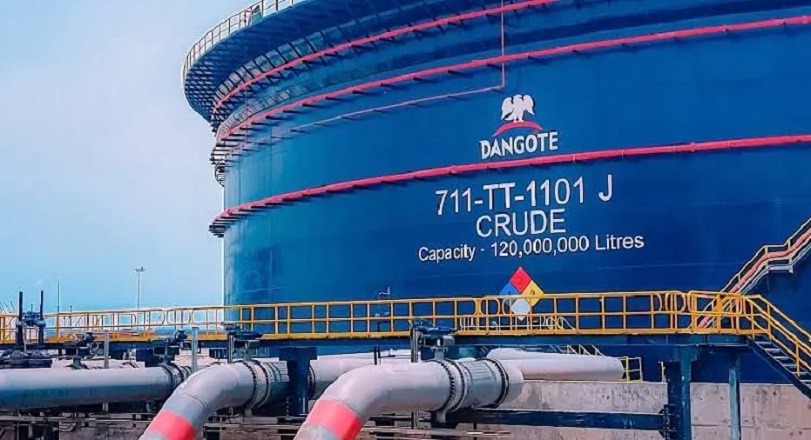
The fifth shipment of one million barrels of crude is expected by Dangote Refinery anytime from now after receiving the fourth cargo a moment ago.

Business Post gathered that the fourth shipment of bonny light crude was supplied by the Nigeria National Petroleum Corporation (NNPC) Limited to the company in Lagos.

The first shipment of the commodity was delivered to the 650,000-barrel-per-day oil facility worth about $20 billion in early December 2023.

Recall that after getting the first consignment, the President of Dangote Group, Mr Aliko Dangote, said, “We are delighted to have reached this significant milestone. This is an important achievement for our country as it demonstrates our ability to develop and deliver large capital projects.

“Our focus over the coming months is to ramp up the refinery to its full capacity. I look forward to the next significant milestone when we deliver the first batch of products to the Nigerian market.”

In a statement on Monday, Dangote Refinery said the delivery of the latest crude cargo would propel the facility to commence product very soon.

The world’s largest single-train refinery is expecting about six million barrels of crude.

It stated that once the six million barrels are fully delivered, it will facilitate the initial run of the refinery as well as kick-start the production of diesel, aviation fuel, and LPG before subsequently progressing to the production of Premium Motor Spirit (PMS).

Designed for 100 per cent Nigerian crude with the flexibility to process other crudes, the facility can process most African crude grades as well as Middle Eastern Arab Light and even US Light tight oil as well as crude from other countries.

Dangote Petroleum Refinery can meet 100 per cent of Nigeria’s requirement of all refined products, gasoline, diesel, kerosene, and aviation jet, and also has a surplus of each of these products for export.

The refinery was built to take crude through its two SPMs located 25 kilometres from the shore and to discharge petroleum products through three separate SPMs. In addition, the refinery can load 2,900 trucks a day at its truck-loading gantries.

Dangote Refinery has a self-sufficient marine facility with the ability to handle the largest vessel globally available. In addition, all products from the refinery will conform to Euro V specifications.

The refinery is designed to comply with US EPA, European emission norms, and Department of Petroleum Resources (DPR) emission/effluent norms as well as African Refiners and Distribution Association (ARDA) standards.


Modupe Gbadeyanka is a fast-rising journalist with Business Post Nigeria. Her passion for journalism is amazing. She is willing to learn more with a view to becoming one of the best pen-pushers in Nigeria. Her role models are the duo of CNN's Richard Quest and Christiane Amanpour.

Economy

Nigeria Now Consolidating Reforms for Economic Stability—Edun

Published

on

wale edun finance minister

By Adedapo Adesanya

The Minister of Finance and Coordinating Minister of the Economy, Mr Wale Edun, has stressed that Nigeria was now consolidating its macroeconomic reforms to sustain economic stability in an increasingly volatile global environment.

The Minister spoke at a high-level panel on Fiscal Policy in a Shock – Prone World at the ongoing Al Ula conference for Emerging Market Economies in Riyadh, Saudi Arabia.

“Nigeria’s macroeconomic and fiscal reforms are working. Momentum must be maintained, and the benefits channelled towards long-term growth and resilience,” he stated.

He said the government is also leveraging digital tools to improve revenue assurance, while deepening fiscal and monetary coordination and promoting realistic budgeting practices to ensure durable fiscal discipline.

He noted that despite accounting for a significant share of global growth, population and natural resources, emerging economies remain under-represented in global financial decision-making.

Mr Edun also highlighted the growing strategic importance of Gulf nations in the evolving global economic landscape.

He said countries in the Gulf are increasingly shaping global trade routes, investment flows and sources of capital, making them critical partners for emerging economies such as Nigeria.

The finance minister stressed Nigeria’s commitment to building stronger partnerships that promote a more inclusive and equitable global financial system.

He said Nigeria was positioning itself to engage constructively with global partners to support reforms that unlock growth, stability and shared prosperity.

Mr Edun’s call comes amid mounting global economic pressures. Many emerging economies are grappling with high debt levels, elevated inflation, volatile capital flows and tightening global financial conditions.

Rising interest rates in advanced economies have increased debt-servicing costs, while currency volatility has strained fiscal and external balances across Africa and other developing regions.

Global trade is also facing increased fragmentation due to geopolitical tensions, supply chain disruptions and protectionist tendencies.

These trends have disproportionately affected emerging markets that depend heavily on trade, foreign investment and access to international finance.

For Nigeria, the push for a global economic reset aligns with ongoing domestic reforms aimed at stabilising the macroeconomic environment.

The country has embarked on exchange rate reforms, fiscal consolidation and efforts to attract long-term investment to support growth and job creation.

Mr Edun has repeatedly argued that without reforms to the global financial system, domestic policy efforts in emerging economies risk being undermined by external shocks.

At the Al Ula conference, he reiterated that a more balanced global system would enhance resilience, improve access to finance and support sustainable development.

He said Nigeria would continue to engage in global policy conversations to ensure that emerging economies are not only rule-takers but active shapers of the new global economic order.

Continue Reading

Economy

Lagos Lists N230bn Series 4 10-Year Bond on Stock Exchange

Published

on

Lagos N230bn Series 4 10-Year Bond

By Aduragbemi Omiyale

The N230 billion 10-year bond issued to investors by the Lagos State government has been listed on the Nigerian Exchange (NGX) Limited.

It was the Series 4 of the state government’s N1 trillion Debt and Hybrid Instruments Issuance Programme, which was sold at a coupon rate of 16.25 per cent.

It was offered for sale to bondholders in November 2025, with Chapel Hill Denham Advisory Limited as the leading issuing house and bookrunner.

The joint issuing houses and bookrunners were Asset & Resources Management Limited, Capital Bancorp Plc, Cardinal Stone Partners Limited, Cedrus Capital Limited, Comercio Partners Capital Limited, Cordros Advisory Services Limited, Coronation Merchant Bank Limited, Dynamic Portfolio Limited, FCMB Capital Markets Limited, FCSL Asset Management Company Limited, FirstCap Limited, G.A. Capital Limited, LeadCapital Plc, Light House Capital Limited, Phoenix Global Capital Markets Limited, Quantum Zenith Capital and Investments Limited, Radix Capital Partners Limited, SFS Financial Services Limited, Stanbic IBTC Capital Limited, United Capital Plc, and, Vetiva Advisory Services Limited.

The debt instruments are callable at par after 60 months, on any coupon payment date, subject to the issuer having obtained prior regulatory approvals and upon issuance of the requisite notice to bondholders.

Business Post reports that the bond was sold at a unit price of N1,000, with the interest to be paid to investors on every May 20 and November 20 until maturity.

According to the Governor of Lagos State, Mr Babajide Sanwo-Olu, proceeds from the exercise would be used for critical infrastructure in transportation, housing, the environment, healthcare, education, urban renewal, and the provision of other sustainable infrastructure that would serve the future needs of the state.

The listing of the debt instrument on the stock exchange today, Monday, February 9, 2026, allows investors to trade the bond at the secondary market.

Continue Reading

Economy

CBN to Begin 304th MPC Meeting February 23

Published

on

CBN MPC meeting rate

By Adedapo Adesanya

The Central Bank of Nigeria (CBN) has announced plans to hold its 304th Monetary Policy Committee (MPC) meeting on Monday, February 23 and Tuesday, February 24, 2026.

This information was disclosed in a circular published on the apex bank’s official website on Monday. This will be the first meeting of 2026.

The gathering comes amid sustained efforts by the CBN to rein in inflation, stabilise the foreign exchange market, and strengthen macroeconomic conditions.

At its last MPC meeting in November 2025, the central bank retained the Monetary Policy Rate (MPR) at 27 per cent, maintaining its restrictive posture in a bid to curb inflationary pressures and stabilise the foreign exchange (FX) market.

The MPC is one of the bank’s highest policy-making bodies, responsible for formulating monetary and credit policies aimed at ensuring price stability.

Through key instruments such as the MPR, Cash Reserve Ratio (CRR), and Liquidity Ratio (LR), the committee guides interest rate conditions and overall monetary direction in the economy.

Comprising the CBN Governor, Deputy Governors, Board members, and appointed external members, the committee meets periodically to review critical economic indicators, including inflation, gross domestic product, and exchange rate developments, before taking policy decisions.

The apex bank outlined the timetable and venue in its official notice.

“The 304th meeting of the Monetary Policy Committee (MPC) is scheduled to hold as follows,” the CBN said.

“Day 1: Monday, February 23, 2026 – Time: 10.00 a.m.”

“Day 2: Tuesday, February 24, 2026 – Time: 8.00 a.m.”

According to the circular, the meeting will take place at the MPC Meeting Room on the 11th floor of the CBN Head Office in Abuja.

Continue Reading

Trending