Connect with us

Economy

Dangote Refinery Expects Fifth Crude Cargo as Fourth Arrives

Published

on

Fifth Crude Cargo Dangote Refinery

By Modupe Gbadeyanka

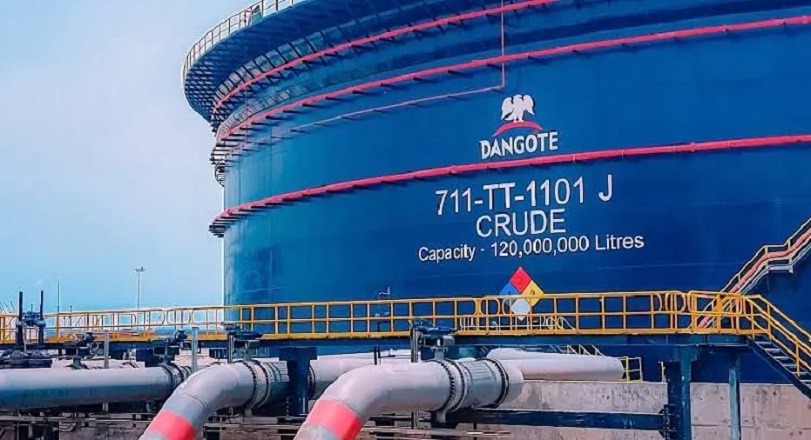
The fifth shipment of one million barrels of crude is expected by Dangote Refinery anytime from now after receiving the fourth cargo a moment ago.

Business Post gathered that the fourth shipment of bonny light crude was supplied by the Nigeria National Petroleum Corporation (NNPC) Limited to the company in Lagos.

The first shipment of the commodity was delivered to the 650,000-barrel-per-day oil facility worth about $20 billion in early December 2023.

Recall that after getting the first consignment, the President of Dangote Group, Mr Aliko Dangote, said, “We are delighted to have reached this significant milestone. This is an important achievement for our country as it demonstrates our ability to develop and deliver large capital projects.

“Our focus over the coming months is to ramp up the refinery to its full capacity. I look forward to the next significant milestone when we deliver the first batch of products to the Nigerian market.”

In a statement on Monday, Dangote Refinery said the delivery of the latest crude cargo would propel the facility to commence product very soon.

The world’s largest single-train refinery is expecting about six million barrels of crude.

It stated that once the six million barrels are fully delivered, it will facilitate the initial run of the refinery as well as kick-start the production of diesel, aviation fuel, and LPG before subsequently progressing to the production of Premium Motor Spirit (PMS).

Designed for 100 per cent Nigerian crude with the flexibility to process other crudes, the facility can process most African crude grades as well as Middle Eastern Arab Light and even US Light tight oil as well as crude from other countries.

Dangote Petroleum Refinery can meet 100 per cent of Nigeria’s requirement of all refined products, gasoline, diesel, kerosene, and aviation jet, and also has a surplus of each of these products for export.

The refinery was built to take crude through its two SPMs located 25 kilometres from the shore and to discharge petroleum products through three separate SPMs. In addition, the refinery can load 2,900 trucks a day at its truck-loading gantries.

Dangote Refinery has a self-sufficient marine facility with the ability to handle the largest vessel globally available. In addition, all products from the refinery will conform to Euro V specifications.

The refinery is designed to comply with US EPA, European emission norms, and Department of Petroleum Resources (DPR) emission/effluent norms as well as African Refiners and Distribution Association (ARDA) standards.


Modupe Gbadeyanka is a fast-rising journalist with Business Post Nigeria. Her passion for journalism is amazing. She is willing to learn more with a view to becoming one of the best pen-pushers in Nigeria. Her role models are the duo of CNN's Richard Quest and Christiane Amanpour.

Economy

Meristem Projects Nigeria’s March 2026 Inflation at 13.59%

Published

on

inflation in Nigeria

By Aduragbemi Omiyale

Analysts at Meristem Research have projected that the inflation rate in Nigeria for March 2026 should further moderate to 13.59 per cent on a year-on-year basis from the 15.06 per cent recorded in February 2026.

The company, in a note sighted by Business Post, explained that easing in the average prices of goods and services for last month would be impacted by a high base from the same period of 2025, but noted that on a month-on-month basis, the rate will spike.

Last month, energy prices soared after the price of crude oil on the global market soared as a result of the war in Iran, with prices of items growing in Nigeria.

“However, month-on-month pressures are likely to pick up, driven by the renewed increases in energy prices, which should nudge headline inflation higher.

“Core inflation is also likely to edge higher, reflecting second-round effects from higher transportation and production costs, although the relative stability of the Naira should help moderate the pace of increase.

“Food inflation is also expected to rise on a month-on-month basis, driven by higher logistics and distribution costs, as well as recent increases in staple food prices,” a part of the report noted.

The National Bureau of Statistics (NBS) is expected to release the inflation numbers later today.

Nigeria’s headline inflation rate moderated marginally by 0.04 per cent to 15.06 per cent in February 2026 from 15.10 per cent in January 2026, though on a month-on-month basis, inflationary pressures accelerated.

Continue Reading

Economy

Nigeria’s Public Debt Nears N160trn

Published

on

total debt stock

By Adedapo Adesanya

Nigeria’s total public debt rose from N153.29 trillion at the end of September 2025 to N159.28 trillion in December 2025, according to the latest data released by the Debt Management Office (DMO) on Tuesday.

The increase indicates a quarter-on-quarter increase of N5.98 trillion or 3.9 per cent.

The debt office noted that the December 2025 figures are provisional and were converted using the Central Bank of Nigeria’s official exchange rate of N1,435.25/$, while the September 2025 figures were converted using N1,474.85/$.

On a year-on-year basis, the debt profile marked an increase of N14.61 trillion or 10.1 per cent, from N144.67 trillion in December 2024 to N159.28 trillion in December 2025, representing a rise from $94.23 billion to $110.97 billion, an increase of $16.75 billion, in Dollar terms.

Domestic debt remained the largest, rising from N81.82 trillion in September 2025 to N84.85 trillion in December 2025.

This represents a quarter-on-quarter increase of N3.03 trillion or 3.7 per cent compared to December 2024, when domestic debt stood at N74.38 trillion – the figure increased by N10.47 trillion or 14.1 per cent year-on-year.

In Dollar terms, domestic debt rose from $55.47 billion in September 2025 to $59.12 billion in December 2025, and from $48.44 billion in December 2024. This highlights a sustained reliance on the domestic market for financing.

The federal government accounted for the bulk of domestic debt at N80.49 trillion, representing 50.53 per cent of total public debt, while states and the Federal Capital Territory (FCT) accounted for N4.36 trillion.

Nigeria’s external debt stood at N74.43 trillion as of December 2025, representing 46.73 per cent of total public debt.

This reflects a quarter-on-quarter increase of N2.95 trillion from N71.48 trillion in September 2025, and a year-on-year increase of N4.14 trillion from N70.29 trillion recorded in December 2024.

In Dollar terms, external debt rose from $48.46 billion in September 2025 to $51.86 billion in December 2025, and from $45.78 billion in December 2024.

The federal government continued to dominate external borrowing, accounting for N66.27 trillion of the total external debt, while states and the FCT accounted for N8.16 trillion.

However, the structure of Nigeria’s debt portfolio remained broadly stable despite the increase in overall debt.

While domestic debt accounted for 53.27 per cent of total debt in December 2025, compared to 53.37 per cent in September 2025 and 51.41 per cent in December 2024, external debt stood at 46.73 per cent in December 2025, compared to 46.63 per cent in September 2025 and 48.59 per cent a year earlier.

Continue Reading

Economy

Daily Petrol Consumption in Nigeria Slips to 47.3 million Litres Amid Price Hike

Published

on

daily petrol consumption

By Dipo Olowookere

The volume of premium motor spirit (PMS), commonly known as petrol, consumed daily in Nigeria stood at 47.3 million litres in March 2026 compared with the 56.9 million litres recorded in February 2026.

This information was revealed by the Nigerian Midstream and Downstream Petroleum Regulatory Authority (NMDPRA) in its latest factsheet.

The decline in daily petrol consumption in Nigeria coincided with a hike in the price of the product, triggered by a rise in global crude oil prices as a result of the Middle East crisis.

The United States and Israel launched airstrikes in Iran in late February, with crude oil rising above $100 per barrel and even above $110 per barrel at one point.

The price is currently below $100 per barrel on the global market after the President of the United States, Mr Donald Trump, signalled his intention to negotiate with Iran amid the blockage of the Strait of Hormuz.

Data by NMDPRA also showed that diesel consumption eased to 14.5 million litres per day from the previous month’s 20.3 million litres per day, while aviation fuel stood at 2.1 million litres per day versus 2.9 million litres per day in February 2026.

It was also disclosed that PMS daily supply for the month under review increased to 40.1 million litres per day from the preceding month’s 39.5 million litres per day.

From this, domestic supply came down by 6.30 per cent to 34.2 million litres per day from 36.5 million litres per day, while imported petrol stood at 5.9 million litres per day versus 3.0 million litres per day a month earlier.

Business Post observed that Dangote Refinery supplied about 34.2 million litres per day of PMS into the Nigerian market from the 48.2 million litres per day it produced. The private refiner produced 16.5 million litres of diesel per day in March 2026, supplying 2.2 million litres per day into the domestic market.

In the period, the Warri and Kaduna refineries were totally shut down, while the Port Harcourt refinery, according to the report, though it was shut down, witnessed the evacuation of about 0.048 million litres of diesel per day while it was operational.

Continue Reading

Trending