Connect with us

Education

The University Degree Saga: Changing The Nigeria Academic Narrative

Published

on

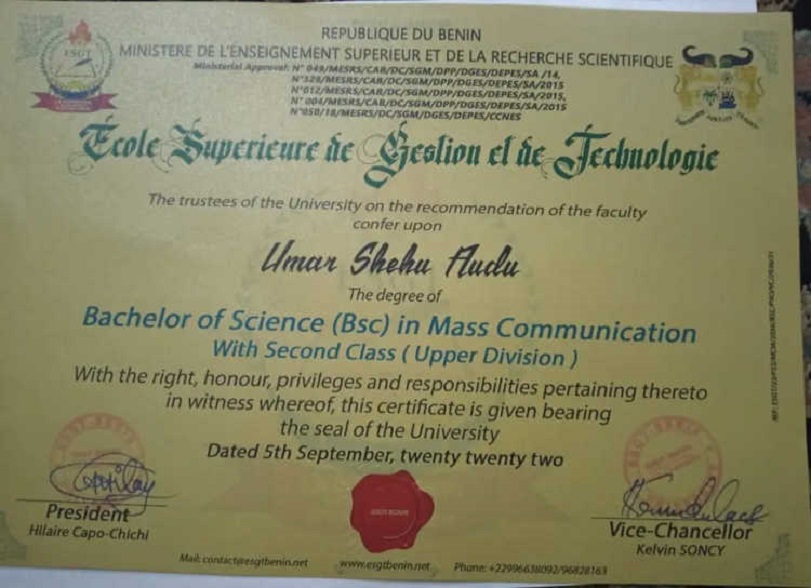
fake certificate benin republic

By Olutayo Irantiola

The unfolding University degree saga in Nigeria has brought to the fore the need for our country to look inward and strengthen our academic heritage. It is pretty unfortunate where we have found ourselves as a country. I am not a beneficiary of the heydays when university students each chicken on Sundays, but the system has continued to nosedive year in and year out.

It is getting to a point where the federal government needs to evaluate its students across the globe so that we can effectively understand our situation. What do people want from the Nigerian educational system to ascertain where we are getting it wrong? This brings to mind the number of students who are “exiled” so that they can get globally competitive certificates. In 2022 and 2023 respectively, Nigerian students experienced war in Sudan Russia and Ukraine.

One of the most disheartening things about our tertiary institution is that passing the West African Examination Council Nigeria (WASC), Joint Admission Matriculation Board Examinations, and Post-JAMB of the various institutions, you are not guaranteed admission into your course of choice and even the university of choice. You have to scramble for admission; seek a lecturer to help follow up on your admission. All these gave rise to people seeking admission in neighbouring countries.

With a burgeoning youthful population, there is a need for the government to enlarge the capacity of the various institutions, but we keep tightening the admission measures as typified above. We cannot continue to allow admission quotas to institutions every session and expect parents who do not know anyone to keep their children at home for years while waiting for admission.

Until recently, first-class degrees were rare in Federal and State Universities because many lecturers believed that God was the only one who owned first-class while the lecturer owned second-class upper degrees, and students could jostle second-class lower and third-class degrees. Whereas the labour market had labelled students with such degrees as “half-baked and unemployable”. All these made parents get loans to train their children in all these mushroom institutions in the neighbouring countries.

Aside from the deep-pocket Nigerians who can afford to send their children to Ivy League universities in Europe and America, people are looking for ways in which their wards will save years in the university due to the incessant strikes that last many months. Meanwhile, the government and the academic workforce have little or nothing to lose at the expense of the students’ lives. How long will Nigerian students have a timeline for completing a bachelor’s degree programme?

Another issue we have as a country is the conversion of all tertiary levels of education to Universities. No institution trains teachers again; it is now a University; no institution trains technicians again, and everyone wants to become an Engineer. People without a University education cannot go beyond certain levels in Civil Service, amongst other limitations we place on our nationals. Then, people can troop into another country to get a University degree of any type. This unrealistic demand of society has pushed students out of the country.

It might be a bitter pill to swallow, but people will want to go for any form of education, and the recent increase in fees paid in Nigerian tertiary institutions is not encouraging. Truly, the government is doing everything to reduce subsidies across the board, but Nigerians cannot see the additional value to the students. People will only go for a shortcut to beat the system as well.

There is a growing phenomenon now, Nigerians are gunning for honorary doctorate degrees, and all of these degrees are coming from the same institutions that the Ministry of Education is suspending the accreditation and evaluation of degree certificates from in Benin Republic, Togo, Uganda, Kenya and Niger Republic. Do we need to wait for a Crisis to break out before we take the appropriate steps?

I am not justifying wrongs, but it is a charge for the government and academic leaders to wake up from their age-long slumber; they need to find ways of redeeming the educational image of the country and overhauling the educational sector. A quote by the late sage, Chief Obafemi Awolowo, “To attain the goals of economic freedom and prosperity, Nigeria must do certain things as a matter of urgency and priority. It must provide free education at all levels and free health facilities for the masses of its citizens”. If it is not free now, we need to get it right if we will stop falling to the tricks being paid on Nigerians by other countries in our search for certificates.

Olutayo Irantiola, a Lagos-based PR Consultant, Playwright and Biographer, blogs on www.peodavies.com

Click to comment

Leave a Reply

Your email address will not be published. Required fields are marked *

Education

Orire School Abduction: Oyo Teachers Begin Indefinite Strike

Published

on

Orire School Abduction

By Modupe Gbadeyanka

Teachers in Oyo State on Monday, June 1, 2026, commenced an indefinite strike to protest the abduction of their colleagues and some pupils about two weeks ago.

The teachers withdraw their services from schools until further notice in compliance with the directive of the Nigeria Union of Teachers (NUT).

In a statement on Sunday, the group said the industrial action affects all public primary and secondary school teachers in Oyo State.

They are aggrieved over the continued captivity of abducted teachers and pupils, whose rescue and safe release remain uncertain.

According to the union, the prolonged detention of the victims has created fear and anxiety among teachers, discouraged parents from sending their children to school, and heightened tension across communities in the state.

The NUT said the industrial action is aimed at drawing the attention of government authorities to the urgent need to intensify efforts toward securing the safe release of the abductees without further delay.

It urged all teachers to comply fully with the directive, remain law-abiding, and stay safe in their respective homes throughout the period of the strike.

The association also reaffirmed its solidarity with the abducted teachers, pupils, and their families, stressing that lawful engagements with relevant government authorities would continue until the victims regain their freedom.

The NUT assured members that it remains committed to protecting the welfare and security of teachers and learners across the country.

A few weeks ago, some terrorists stormed the Orire Local Government Area of Oyo State and kidnapped dozens of children and teachers. They have remained in captivity, with the federal government only sending a delegation to the town on Sunday, May 31, 2026.

Continue Reading

Education

KolaDaisi University Hosts Career Fair June 10 in Ibadan

Published

on

KolaDaisi University Career Fair

By Modupe Gbadeyanka

On Wednesday, June 10, 2026, KolaDaisi University (KDU), in a bid to strengthen the talent-to-industry pipeline, will hold its inaugural Career Fair at its campus in Ibadan, Oyo State, with over 200 final-year students, alumni, and a diverse range of leading employers across multiple sectors expected to partake in the programme.

The one-day event, organised by the Directorate of Advancement and Alumni Relations, will feature participation from top-tier organisations spanning finance, consulting, technology, manufacturing, and other key industries.

Participating companies will engage directly with students, offering opportunities for graduate trainee programmes, National Youth Service Corps (NYSC) placements, internships, and entry-level employment.

In addition to recruitment opportunities, the Career Fair will include a series of industry-led sessions, panel discussions, and networking engagements designed to provide students with insights into workplace expectations, emerging career trends, and professional development pathways.

“At KolaDaisi University, we are deliberate about preparing our students for life beyond the classroom. This Career Fair represents a critical platform for fostering meaningful engagement between our students and industry leaders.

“It is not just an event, but a long-term investment in partnerships that will drive innovation, talent development, and economic growth,” the President of the Directorate of Advancement and Alumni Relations, Mrs Olasumbo Obaseki, stated.

The Career Fair underscores the university’s commitment to equipping its students with not only academic excellence but also the practical skills, professional exposure, and networks required for success in today’s competitive labour market.

It is put together in collaboration with key industry partners, including Chapel Hill Denham, Mobile Screens and Sound Limited, SKOT Communications, LEADWAY Assurance, HighlerLife Properties Consult Ltd, Idea Konsult, New Horizons Nigeria, alongside several other organisations committed to nurturing emerging talent.

These partnerships reflect a shared vision of developing a workforce that is both competent and responsive to evolving industry needs.

This impactful and timely initiative is an essential platform for aligning academic outcomes with industry expectations.

The initiative forms part of KDU’s broader institutional strategy to enhance graduate employability through sustained industry engagement, career readiness programmes, and alumni relations.

By creating structured opportunities for interaction between students and employers, the institution continues to position itself as a forward-thinking institution committed to producing globally competitive graduates.

Continue Reading

Education

Tinubu Appoints 39-Year-Old Prof Segun Aina as New JAMB Registrar

Published

on

prof segun aina JAMB

By Modupe Gbadeyanka

Professor Segun Aina has been appointed to replace Professor Is-haq Oloyede as the Registrar of the Joint Admissions and Matriculation Board (JAMB). The two-term tenure of his successor expires on July 31, 2026.

Mr Aina was chosen for the position by President Bola Tinubu, and he is expected to bring to bear his vast experience, knowledge and practical insight into the operations of the board, to take the critical educational organisation beyond the laudable heights achieved by his predecessor.

According to a statement on Thursday by the Special Adviser to the President on Information and Strategy, Mr Bayo Onanuga, Professor Aina, who will be 40 in July, is a distinguished academic and systems expert with extensive experience in national examination systems, digital infrastructure, and public-sector institutional reform.

He holds a Bachelor of Engineering in Computer Systems Engineering from the University of Kent, an MSc in Internet Computing and Network Security, and a PhD in Digital Signal Processing, both from Loughborough University, United Kingdom. He has also completed the Senior Management Programme at Lagos Business School.

A Professor of Computer Engineering at Obafemi Awolowo University, Ile-Ife, Mr Aina began his career with JAMB during his National Youth Service, gaining foundational experience in national admissions and data-driven institutional processes. These insights have shaped his ongoing contributions to examination reform and systems optimisation.

With over 15 years of post-graduation experience, Professor Aina operates at the intersection of technology, policy, and institutional transformation, advising federal and state governments on system design, digital transition, and operational reform. At 39, he became one of Nigeria’s youngest Computer Engineering professors and will now make history as JAMB’s youngest registrar.

He has served as a consultant to major examination bodies, including NECO, NABTEB, and various State Ministries of Education, providing expertise on ICT systems, examination integrity, and digital process optimisation.

Professor Aina is a member of several professional bodies, including the Council for the Regulation of Engineering in Nigeria (COREN), the Nigerian Society of Engineers (NSE), the Institute of Electrical and Electronics Engineers (IEEE), and the Institution of Engineering and Technology (IET).

Continue Reading

Trending