Connect with us

Economy

Naira Value Falls Across Forex Market Segments

Published

on

devalue naira

By Adedapo Adesanya

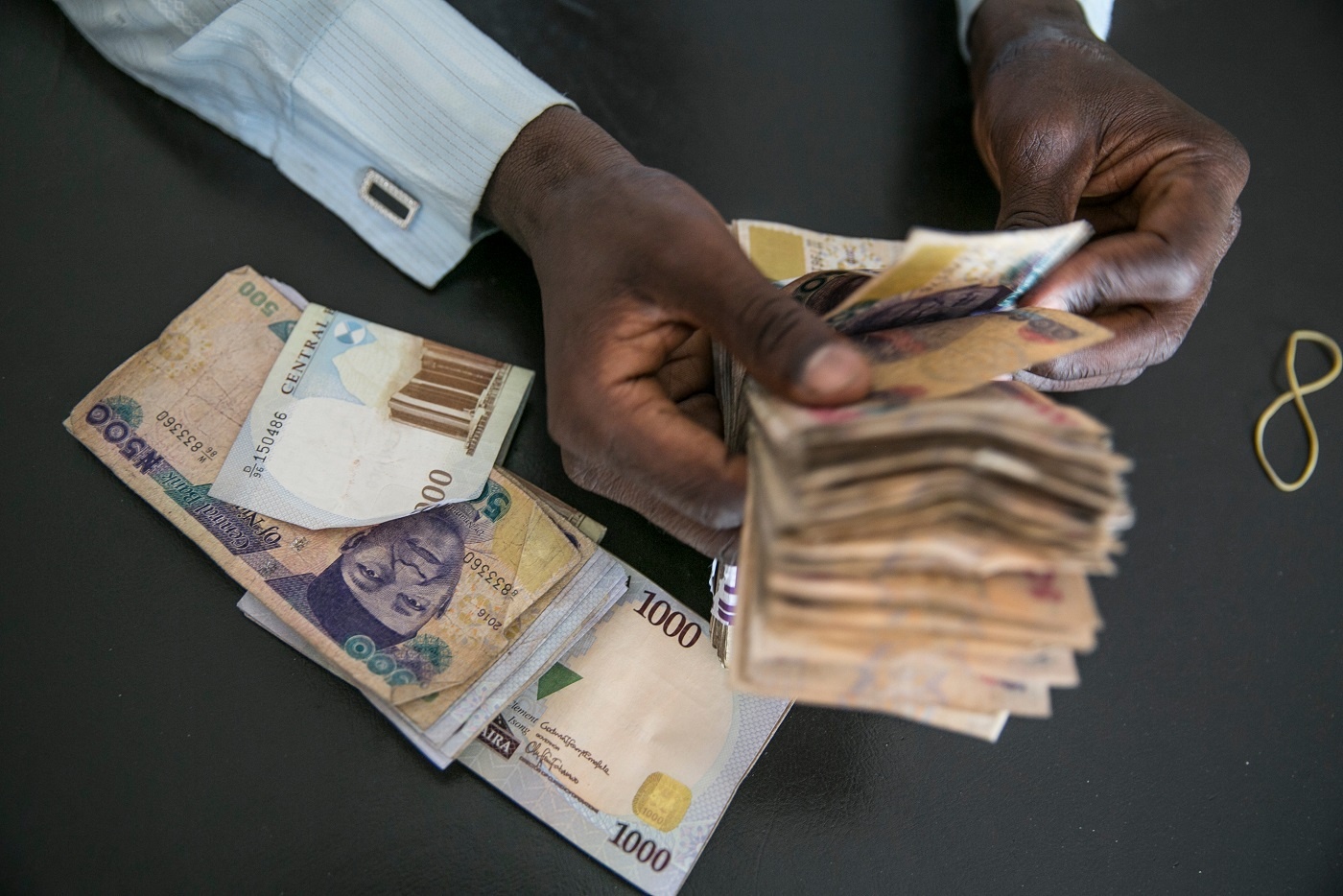
Continued disruption in the supply of foreign exchange (FX) into the currency market further weakened the value of the Naira against the US Dollar across the segments on Wednesday, January 24, despite reassurances by the Central Bank of Nigeria (CBN) to bring ease to the market.

In the Nigerian Autonomous Foreign Exchange Market (NAFEM) window yesterday, the local currency depreciated against the greenback by 0.4 per cent or N3.63 to sell at N882.24/$1 compared with the previous day’s N878.61/$1, according to data from the FMDQ Securities Exchange.

Also, the Naira witnessed a downward movement against the Pound Sterling during the session by N21.98 to sell at N1,141/£1 versus Tuesday’s closing price of N1,163.87/£1 and against the Euro, it depreciated by N18.46 to finish at N977.59/€1, in contrast to the preceding day’s N996.05/€1.

It was observed that the supply of forex to the spot market was depressed, with the turnover at $56.60 million in the midweek session, 3.2 per cent or $1.86 million lower than the $58.46 million achieved a day earlier.

In the Peer-to-Peer (P2P) segment, the value of the Nigerian currency depreciated by N8 to close at N1,378/$1 compared with the previous day’s value of N1,369/$1.

In the same vein, the domestic currency plunged against the Dollar on Wednesday by N15 to quote at N1,380/$1, in contrast to the N1,365/$1 it was exchanged on Tuesday.

The forex crisis in Nigeria has heightened recently after plans by the CBN to unify the rates have seen no progress since the underlying cause, supply remains yet to be settled.

At a summit on  Wednesday, the CBN Governor, Mr Olayemi Cardoso, said the Naira is undervalued, adding that priority must be given to transparency in the Nigerian foreign exchange rate system to attain stability and fair determination of rates.

“We are implementing a comprehensive strategy to improve liquidity in our FX markets in the short, medium, and long term. Our focus is on addressing fundamental issues that have hindered the effective operation of our markets over the years,” he added.

A look at the cryptocurrency market showed that Solana (SOL) continued to rise as it notched a 4.1 per cent as more products continued to be built on its network due to its accessibility and affordability.

Litecoin (LTC) climbed higher by 0.8 per cent to $65.59, Cardano (ADA) also recorded a 0.8 per cent increase to sell at $0.4701, Bitcoin (BTC) rose by 0.5 per cent to $39,923.02, Ripple (XRP) gained 0.12 per cent to trade at $0.5143, and the US Dollar Tether (USDT) grew by 0.02 per cent to $0.9997.

However, Binance Coin (BNB) slipped by 3.6 per cent to trade at $288.06, Ethereum (ETH) went down by 0.6 per cent to $2,208.74, and Dogecoin (DOGE) dipped by 0.12 per cent to $0.0781, while the US Dollar Coin (USDC) retained parity at $1.00.


Adedapo Adesanya is a journalist, polymath, and connoisseur of everything art. When he is not writing, he has his nose buried in one of the many books or articles he has bookmarked or simply listening to good music with a bottle of beer or wine. He supports the greatest club in the world, Manchester United F.C.

Advertisement
Click to comment

Leave a Reply

Your email address will not be published. Required fields are marked *

Economy

Grey to Cut Cross-Border Payment Costs with New USD Offering

Published

on

grey fintech

By Adedapo Adesanya

A cross-border payments solutions company, Grey has expanded its business banking platform to include US Dollar corporate accounts, bulk international payments, and USDC stablecoin support, all integrated into a single system.

The company is positioning itself as a low-cost, faster alternative to traditional international banking, particularly for businesses in emerging markets as it enables companies to open US Dollar accounts, receive global payments, and send payouts to 170+ countries, including bulk transfers, within minutes.

Grey aims to solve common cross-border payment challenges, particularly the high transfer costs that often range between 6 and 7 per cent of transaction value, prolonged settlement cycles that can stretch across several days, and the limited access many businesses face when trying to open and operate foreign currency accounts. In addition, companies frequently contend with hidden intermediary fees and poor foreign exchange transparency, both of which undermine cost predictability and effective cash flow management.

By integrating USD business accounts and USDC stablecoin functionality into its platform, Grey enhances its value proposition around faster settlement, clearer pricing structures, improved cost efficiency, and broader global accessibility. The expanded capabilities enable businesses to manage international transactions with greater speed, transparency, and operational control.

“Businesses may operate without borders today, but access to reliable global banking remains uneven, particularly for companies in high-growth markets,” said Mr Idorenyin Obong, Co-founder and Chief Executive Officer of Grey. “We’re closing that gap and enabling businesses to move money faster, with greater transparency and control, wherever their clients or partners are based.”

“When payments are delayed, or costs are unpredictable, growth stalls,” added Mr Joseph Femi Aghedo, Chief Operating Officer and Co-founder of Grey. “Grey eliminates those friction points, giving businesses a faster, simpler way to manage payroll, supplier payments, and partner payouts across borders. Adding USD and stablecoin capabilities makes these benefits accessible to even more customers.”

Established in Africa in 2020, Grey has a presence in key markets, including the United States, the United Kingdom, and Europe, and has recently expanded its services and operations into Latin America and Southeast Asia.

Since its inception, the company has consistently enhanced its services to empower digital nomads worldwide, regardless of location. Grey’s offerings include multi-currency accounts, low-cost international money transfers, a virtual USD card, expense management tools, and robust security measures.

Continue Reading

Economy

Quidax, Lisk to Unlock Stablecoins, On-chain Financial Opportunities

Published

on

Quidax

By Aduragbemi Omiyale

A partnership designed to expand access to stablecoins and on-chain financial opportunities for everyday users and businesses has been entered into between Quidax and Lisk.

The partnership provides a critical gateway for the developer community, as builders on the Lisk network can now leverage Quidax’s robust digital asset infrastructure to access stablecoins and local currencies at competitive rates.

This institutional-grade infrastructure is designed to power “future-forward” financial products, ranging from neobanks and cross-border payment platforms to regional exchanges and global fintech solutions. It will also allow Quidax customers to trade and move value seamlessly using USDT, USDC, LSK, and Ether (ETH) on the Lisk network.

The collaboration will also accelerate the adoption of Web3 solutions that solve real-world financial challenges for millions of customers across Africa by combining Quidax’s deep local liquidity and compliant framework with Lisk’s scalable L2 technology.

In 2024, Quidax became the first crypto exchange to receive a provisional operating license from Nigeria’s Securities and Exchange Commission (SEC).

“The partnership with Lisk enables us to extend our platform to serve more people and cater to the increasing demand from products and services that want to integrate our stablecoin and digital assets product to build products across Africa,” the Chief Infrastructure Officer at Quidax, Mr Morris Ebieroma, said.

Also commenting, the Ecosystem Lead for Africa at Lisk, Ms Chidubem Emelumadu, said, “Africa represents one of the most critical frontiers for blockchain innovation, where the demand for reliable and inclusive financial tools is urgent.

“Our partnership with Quidax expands access to stablecoins and on-chain financial opportunities for everyday users and businesses. At the same time, it gives founders building on Lisk the critical infrastructure they need to create solutions that can scale meaningfully across the continent,” she added.

Continue Reading

Economy

Customs Urges Freight Forwarders to Adopt Automated Licence, Permit System

Published

on

Nigeria Customs Service

By Adedapo Adesanya

The Nigeria Customs Service (NCS) has urged freight forwarders to adopt its automated Licence and Permits Processing system to reduce the cost of doing business.

This advice was given by the Assistant Comptroller-General of Customs, Mr Muhammed Babadede, during a stakeholders’ engagement on automation held in Lagos on Monday.

He noted that the reform responds to longstanding demands for faster, more transparent and simpler procedures for industry stakeholders, disclosing that Comptroller-General of Customs, Mr Bashir Adeniyi, has approved the full automation of the service’s licences and permits processes.

“For years, stakeholders dealt with paperwork, long queues and uncertainty from manual processing. Those days are coming to an end.

“This sensitisation is across all zones. The goal is to ensure stakeholders understand the automated system before implementation,” Mr Babadede said.

He said automation would enable applications and renewals from offices or mobile phones, eliminating visits to customs formations, assuring stakeholders of a fair and consistent process, and reducing errors associated with manual documentation.

He said automation would improve record-keeping, supervision and service delivery without increasing pressure on officers.

The Deputy Comptroller-General, Tariff and Trade, CK Naigwan, also represented by Mr Babadede, reiterated management’s commitment to seamless implementation.

Meanwhile, the Comptroller of Customs for Licence and Permit Unit, Mrs Ngozika Anozie, praised the Comptroller-General for driving innovation within the Service, saying the automation aligns Customs procedures with global best practice and strengthens institutional efficiency.

According to her, the reform reflects the three-point agenda of the Chairman of the World Customs Organisation, Mr Adeniyi, centred on consolidation, collaboration and innovation.

She said the system would enhance the ease of doing business in the maritime sector and boost national revenue generation.

“Automation will cut business costs and reduce travel risks for stakeholders

“They will no longer travel repeatedly to Abuja, paying for transport, hotels and feeding to process licences and permits,” she said, adding that the platform would automatically reject fake documents and accept genuine submissions, curbing fraudulent practices.

“The CGC is determined to sanitise the system, and we are committed to achieving that objective,” Mrs Anozie said.

On his part, the Assistant Superintendent of Customs, Mr Ibrahim Usman, said the Licence and Permit Unit operates under the Tariff and Trade Department.

He explained that the unit ensures proper issuance of licences and permits and compliance with import regulations.

Mr Usman said all licences and permits expire on December 31 of their issuance year.

He added that the portal would become fully operational after nationwide sensitisation, with stakeholders duly informed.

Customs Area Controller, Tincan Island Command, Mr Frank Onyeka, thanked stakeholders for their continued support.

He urged them to take the exercise seriously to achieve seamless processing across Customs operations.

Stakeholders raised concerns about online payment integration and potential technical disruptions.

Officials addressed the questions and pledged continued engagement to ensure smooth implementation nationwide.

Continue Reading

Trending