Connect with us

Economy

Customs Street Opens Week Bullish After 0.66% Surge

Published

on

Customs Street Nigerian Stock Exchange

By Dipo Olowookere

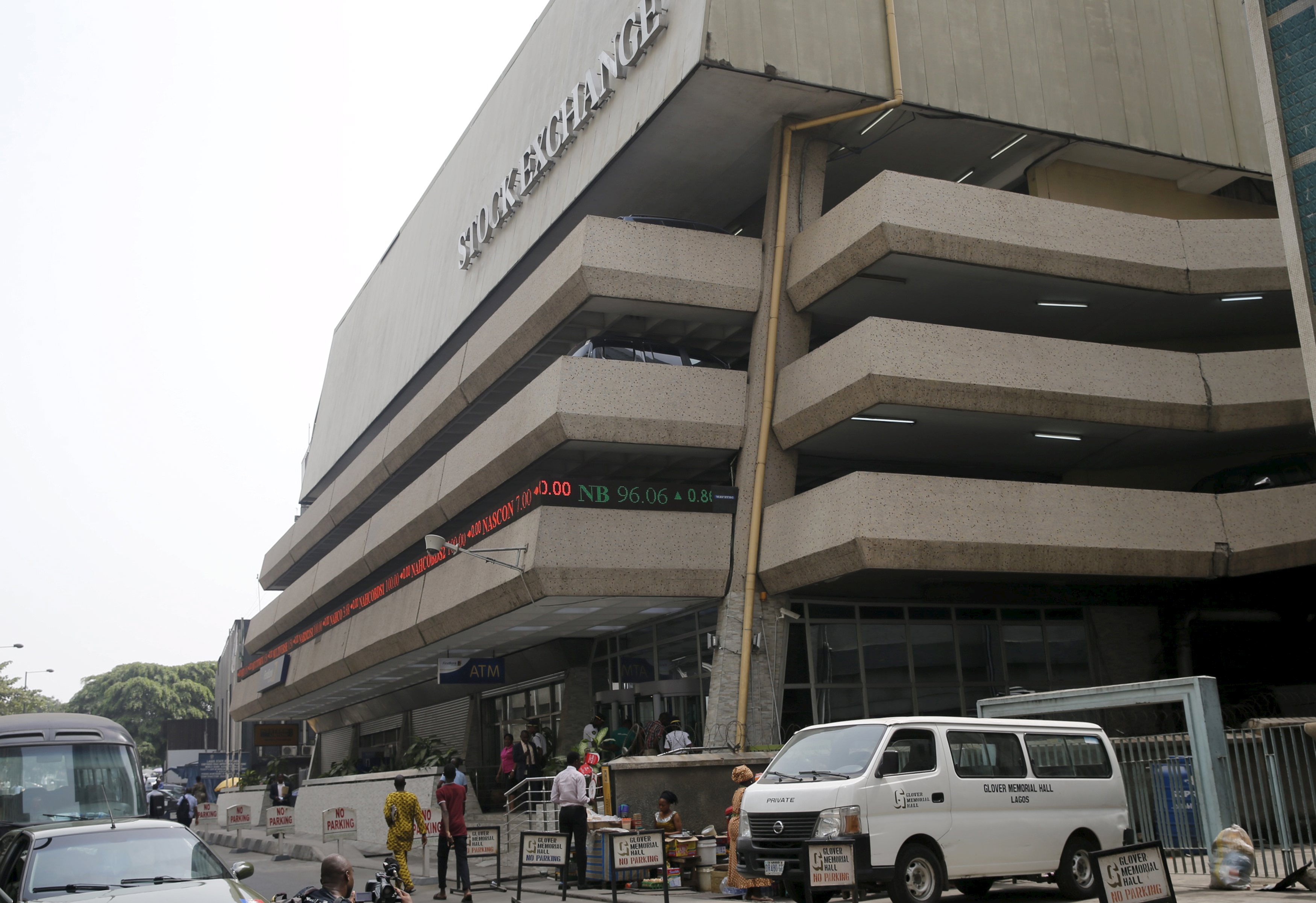
The Nigerian Exchange (NGX) Limited ended the first trading session of the week on a positive note after it chalked up 0.66 per cent on Monday.

The gains recorded yesterday were boosted by the 3.42 per cent rise by the insurance sector, the 1.44 per cent surge by the banking index, and the 1.30 per cent leap by the industrial goods counter. They offset the 0.20 per cent loss posted by the energy sector and a 0.11 per cent decline suffered by the consumer goods industry.

Consequently, the All-Share Index (ASI) closed higher by 1,273.78 points to 196,263.55 points from 194,989.77 points, and the market capitalisation appreciated by N805 billion to N125.969 trillion from N125.164 trillion.

Business Post observed that investor sentiment turned bearish during the session after Customs Street ended with 34 price losers and 33 price gainers, representing a negative market breadth index.

Fortis Global Insurance gained 10.00 per cent to trade at 66 Kobo, Okomu Oil expanded by 10.00 per cent to N1,605.60, Fidson rose by 9.90 per cent to N95.50, NPF Microfinance Bank rose by 9.89 per cent to N6.89, and Infinity Trust Mortgage Bank jumped 9.84 per cent to N17.30.

On the flip side, The Initiates weakened by 10.00 per cent to N17.55, Deap Capital deflated by 9.97 per cent to N6.86, LivingTrust Mortgage Bank went down by 9.92 per cent to N5.90, Multiverse lost 9.92 per cent to close at N22.70 per cent, and Ellah Lakes shrank by 9.77 per cent to N11.55.

Yesterday, market participants traded 1.3 billion shares worth N31.5 billion in 95,091 compared with the 820.5 million shares valued at N28.3 billion in 63,507 deals last Friday, indicating an increase in the trading volume, value, and number of deals by 58.44 per cent, 11.31 per cent, and 49.73 per cent apiece.

Japaul ended the session as the busiest stock after selling 474.0 million units worth N2.0 billion, Chams traded 51.5 million units for N221.3 million, Jaiz Bank exchanged 48.3 million units for N566.9 million, Secure Electronic Technology transacted 46.3 million units worth N68.8 million, and Mutual Benefits sold 42.5 million units valued at N242.5 million.


Dipo Olowookere is a journalist based in Nigeria that has passion for reporting business news stories. At his leisure time, he watches football and supports 3SC of Ibadan. Mr Olowookere can be reached via [email protected]

Advertisement
Click to comment

Leave a Reply

Your email address will not be published. Required fields are marked *

Economy

Nigeria Halts Petrol Import Licences for Second Month

Published

on

petrol subsidy

By Adedapo Adesanya

Nigeria has suspended the issuance of Premium Motor Spirit (PMS) or petrol import licenses for a second straight month in a move that signals a win for Dangote Refinery.

This development comes as regulators begin enforcing provisions of ​the Petroleum Industry Act (PIA) that allow imports only when domestic supply falls short.

Data from the Nigerian Midstream and Downstream Petroleum Regulatory Authority (NMDPRA) indicated that no import licenses were issued in February, while the Crude Oil Refineries Association of ​Nigeria (CORAN) confirmed to Reuters that none have been issued so far in March, signalling ​a shift towards prioritising local output.

According to Bloomberg, oil marketing firms, including a unit of TotalEnergies SE, Conoil Plc and MRS Nigeria Plc, which imported around one-quarter of the nation’s petroleum in January, had their licenses suspended.

The shift highlights a stronger ⁠intent by the federal government to protect domestic refining and marks a win ​for the Dangote Refinery and other local refineries, which last year sued the NMDPRA and the state ​oil company, the Nigerian National Petroleum Company (NNPC) Limited, to force a halt to imports.

Under the PIA, the regulator may grant import permits only when domestic production is not enough to meet national demand.

There have been previous arguments that issuing licenses was necessary to maintain competition and ​prevent market dominance.

Fuel pump prices have surged by more than 50 per cent since the United States and ‌Israel ⁠began strikes on Iran last week, pushing global oil markets higher.

NMDPRA Spokesperson, Mr George Ene‑Ita, blamed the sharp rise in prices on escalating conflict in the Middle East.

Nigeria’s average daily petrol consumption fell to 56.9 million litres per day ​in February 2026, ​down from 60.2 ⁠million litres in January.

In February, the Dangote Refinery supplied 36.5 million litres of petrol and 8 million litres of ​diesel to the local market, leaving a daily deficit of 20 million litres that was covered by previously imported stock.

According to NMDPRA, these volumes ​were sufficient, ⁠leading to its decision to withhold import licenses.

Mr Eche Idoko, spokesperson for the Crude Oil Refiners Association of Nigeria (CORAN), which has long urged the government to stop ⁠issuing import ​licenses that undermine local refiners’ margins, welcomed the ​regulator’s stance.

“For us, anything that protects local production is a good move. The challenge now is ​to sustain the momentum,” Mr Idoko said.

Continue Reading

Economy

Nigeria’s Economy Strong Enough to Absorb Oil Market Shocks—Edun

Published

on

wale edun

By Adedapo Adesanya

The federal government has begun assessing the potential economic implications of the escalating geopolitical tensions in the Middle East and adjusting policies to shield Nigeria from possible disruptions.

This was disclosed by the Minister of Finance, Mr Wale Edun, as the Economic Management Team (EMT) convened to evaluate the risks posed by the US-Israel-Iran standoff to global energy routes, such as the Strait of Hormuz.

He said Nigeria’s robust 4.07 per cent real GDP growth in Q4 2025 positions the country to weather looming oil market shocks from Iran tensions.

Mr Edun, who chairs the EMT, in a statement issued on Tuesday by the Assistant Director for Information and Public Relations in the ministry, Uloma Amadi, said the government was closely monitoring developments and remained committed to safeguarding Nigeria’s economic stability.

The EMT moved to review the potential impact of the unfolding crisis on the Nigerian economy.

Mr Edun also chaired a Naira-for-Crude policy coordination meeting to evaluate developments in the global energy market and their possible domestic implications.

The government noted that the situation remained fluid, with global markets already showing signs of uncertainty amid concerns about potential disruptions to critical energy supply routes, particularly the Strait of Hormuz.

Such disruptions, it said, could lead to volatility in crude oil prices and financial markets worldwide.

Given Nigeria’s integration into global commodity and financial markets, the government identified three major channels through which the crisis could affect the domestic economy.

These include crude oil and gas prices, capital flows and financial market conditions, as well as global logistics and supply costs.

The statement noted that volatility in global energy markets was already pushing up the prices of key commodities, with possible implications for domestic fuel, diesel, cooking gas, and fertiliser costs.

It added that heightened geopolitical risks could also lead to a shift by global investors toward safe-haven assets, potentially affecting capital inflows into emerging markets, including Nigeria.

In addition, disruptions to major shipping and energy supply routes could increase international freight and logistics costs, thereby exerting upward pressure on domestic prices.

The Minister of Finance noted that, beyond these immediate effects, sustained instability in the region could lead to higher prices for goods and services, further intensifying inflationary pressures and the cost of living.

During the EMT meeting, ministers provided sector-specific updates on the evolving situation, with discussions focusing on the likely scale of impact on Nigeria depending on the duration and intensity of the conflict.

Particular attention was placed on how developments in the global oil market could influence Nigeria’s fiscal outlook and external reserves.

The government said the Economic Management Team is closely monitoring key macroeconomic indicators, including global crude oil prices, exchange rate developments, and their potential impact on domestic prices.

It is also tracking capital flows, financial market conditions and broader implications for Nigeria’s fiscal position.

Despite global uncertainty, the Federal Government said Nigeria is entering the period from a position of strengthened economic fundamentals.

It cited recent economic data showing that the country recorded a real Gross Domestic Product growth of 4.07 per cent in the fourth quarter of 2025, one of the strongest quarterly performances in more than a decade.

According to the statement, the growth reflects the impact of ongoing economic reforms and improved macroeconomic coordination.

The government said it remains committed to protecting these gains and ensuring that recent progress in economic stabilisation and revenue mobilisation is not undermined by external shocks.

To achieve this, the Economic Management Team is maintaining close coordination across fiscal, monetary and energy policy institutions.

Policy options are also being kept under continuous review to mitigate potential volatility and protect households and businesses from the possible spillover effects of the global crisis.

Mr Edun emphasised that careful policy calibration would remain central to the government’s response to evolving global developments.

Continue Reading

Economy

NASD Investors Lose N16.25bn

Published

on

NASD Investors' Portfolios

By Adedapo Adesanya

The NASD Over-the-Counter (OTC) Securities Exchange faced south on Tuesday, March 10, by 0.64 per cent, with the market capitalisation dropping N16.25 billion to close at N2.540 trillion versus the preceding session’s N2.556 trillion, and the NASD Unlisted Security Index (NSI) shrinking by 27.15 points to 4,245.97 points from 4,273.12 points.

The red team had more members than the green team yesterday, with the former comprising four and the latter three.

Central Securities Clearing System (CSCS) Plc depreciated by N2.43 to sell at N80.00 per share versus N83.78 per share, Afriland Properties Plc lost N1.90 to trade at N17.60 per unit versus N19.50 per unit, Geo-Fluids Plc declined by 30 Kobo to N3.00 per share from N3.30 per share, and Acorn Petroleum Plc declined by 2 Kobo to N1.33 per unit from N1.35 per unit.

Conversely, FrieslandCampina Wamco Nigeria Plc appreciated by N2.85 to N136.70 per share from N133.85 per share, Lagos Building Investment Company (LBIC) Plc added 25 Kobo to sell at N4.00 per unit compared with Monday’s price of N3.75 per unit, and First Trust Mortgage Bank Plc gained 1 Kobo to settle at N1.91 per share versus N1.90 per share.

The volume of securities surged during the session by 1,253.2 per cent to 14.9 million units from 1.1 million units, the value of securities jumped 180.7 per cent to N132.7 million from N47.3 million, and the number of deals increased by 61.1 per cent to 58 deals from 36 deals.

The most active stock by value (year-to-date) was CSCS Plc with 38.1 million units exchanged for N2.4 billion, Okitipupa Plc occupied the second spot with 6.3 million units worth N1.1 billion, and the third place was taken by MRS Oil Plc with 3.4 million units valued at N507.8 million.

The most traded stock by volume (year-to-date) was Resourcery Plc with 1.05 billion units sold for N408.7 million, followed by Geo-Fluids Plc with 130.6 million units transacted for N503.8 million, and CSCS Plc with 38.1 million units worth N2.4 billion.

Continue Reading

Trending