

World
Practical Ideas of Russian-African Club for Strengthening Russia-Africa Relations

By Gouend Louis
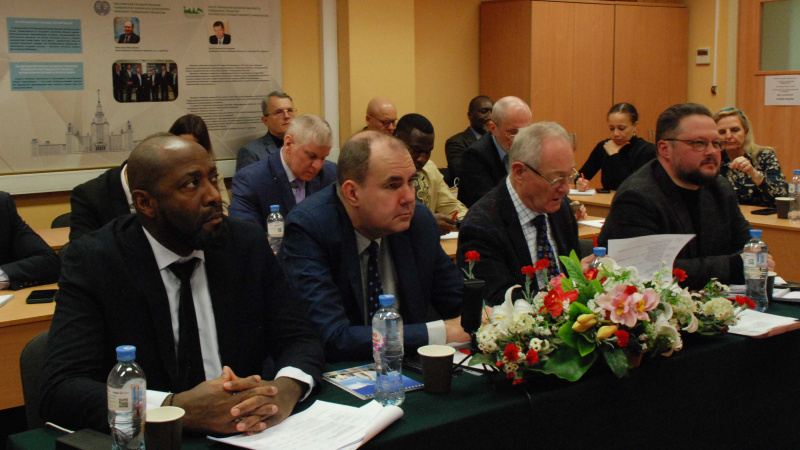
On February 8, the Russian-African Club of MSU named after M.V. Lomonosov held an International Conference: “Development of cultural and humanitarian cooperation between Russia and African countries.” The event took place at the Faculty of Global Processes of Moscow State University.
The conference was held as part of the implementation of the decisions of the Second Summit and the Russia-Africa Economic and Humanitarian Forum, which was held on July 27-28, 2023. in St. Petersburg. The event was supported by the Secretariat of the Russia-Africa Partnership Forum of the Ministry of Foreign Affairs of the Russian Federation.
The conference was attended by more than 100 people, representatives of 30 countries of the African continent and Russia. Its participants included Russian and African diplomats, government and public figures, leaders of African diasporas, activists of non-governmental and youth organizations, Africanists, representatives of the film industry, mass communications, sports, culture and education.
The conference was opened by Ilya Vyacheslavovich Ilyin, Dean of the Faculty of Global Processes at Moscow State University, Chairman of the Russian UNESCO Committee for the program “Management of Social Transformations (MOST)”, First Vice-President of the Russian-African Club of Moscow State University named after M.V. Lomonosov. He congratulated those gathered on the 300th anniversary of the Russian Academy of Sciences and conveyed greetings from the President of the Russian-African Club of Moscow State University named after M.V. Lomonosov, academician, rector of Moscow State University Viktor Antonovich Sadovnichy. Ilyin I.V. noted the successful work of the club and expressed confidence that during the conference practical proposals will be developed that will be sent to the Secretariat of the Russia-Africa Partnership Forum. The dean set the businesslike tone of the conference and was the first to put forward a practical proposal for the creation of an International Movement of University Ambassadors (UMA). In his opinion, the establishment of the MDUA would be especially relevant in light of the upcoming World Youth Festival in Sochi in March this year.
In the welcoming speech of the Chairman of the Council of the Russian-African Club of Moscow State University named after M.V. Lomonosov, Ambassador-at-Large of the Russian Ministry of Foreign Affairs, head of the secretariat of the Russia-Africa Partnership Forum, Oleg Borisovich Ozerov, notes the following. “In recent years, African countries have demonstrated a steadily growing interest in learning the Russian language and subsequently obtaining specialized, technical and higher education in Russian civilian and military educational institutions.”
The Executive Secretary of the Russian Federation Commission for UNESCO, Tatyana Evgenievna Dovgalenko, addressed the conference with greetings. She thanked the Russian-African Club of Lomonosov Moscow State University for its work on cooperation with African countries and spoke about key UNESCO projects carried out in African countries.
His Royal Highness, Member of the South African Parliament Zolani Mkiva, famous African poet, recognized artist, and cultural activist, noted the special importance of the conference theme. He recalled the historically friendly ties between Russia and African countries and also emphasized the need to build relations between peoples based on cultural programs.
Speaking on the topic of Russian-African cooperation in the field of science and education, Acting Vice-Chancellor of Copperbelt University in Zambia, Professor Paul Chisale noted that Russia is an advanced country with enormous technological, scientific, and educational potential. Africa can learn a lot from cooperation with Russia. These are joint scientific projects and exchanges between teachers and students.
Director of Public Relations of the Office of Presidential and National Scholarships of the President and Cabinet of Zimbabwe, Rachel Nyaray Chitate, expressed the hope that Russia and Africa will work together to forge the future. The expert noted that the strengths of our countries are complementary. As an example, she cited an area of science where the great scientific school of Russia could rely on young scientific personnel from the African continent.
Experts in the field of military education in Russia – head of the department of the Research Institute of Military History, Candidate of Historical Sciences, Associate Professor Andrey Evgenievich Shagov, as well as a corresponding member of the Russian Academy of Missile and Artillery Sciences, head of the department of the Research Institute of Military History, Military Academy of the General Staff of the Armed Forces of the Russian Federation Alexey Kuznetsov Andreevich, spoke about the importance of training scientific military personnel for African countries.
The conference also discussed the issue of practical activities in the field of preservation, restoration and protection of cultural property of Russia and Africa. An expert of the Council for the Security of Cultural Property of ICOM Russia, Sergei Antonovich Uzyanov, stated that during conflicts and disasters, thefts and illegal movement of cultural property occur. The most valuable artefacts of the national heritage are being auctioned on the Internet. The speaker spoke about the unique technology for the security marking of cultural property, developed based on the 18th Central Research Institute of the Ministry of Defense of the Russian Federation.
Vanyukova Daria Vladimirovna, a researcher at the State Museum of Oriental Art and Monastyreva Galli Germanovna, adviser on humanitarian issues of the Association for Economic Cooperation with African Countries, spoke about the experience of implementing museum, cultural and educational projects in Africa using the example of Mali. The speakers called for expanding the geography of humanitarian cooperation in Africa and expanding educational projects to all countries of the continent.
Pan-Africanist, sports commentator for the online media “Civic Network”, President of the Chadian Futsal Federation, Vice-President of the Central African Branch for Relations with the African Sports Organization Mahamat Issaha Sogar, as well as Secretary General of the Cameroon Students’ Association Kamdem Motcheyo Tedi and Mohamed Selim, Managing Director East Step Tourism companies in Egypt offered their humanitarian projects to expand cooperation in the field of sports, tourism, joint festivals and sports and recreational events.
The President of the ANO Center for Business and Cultural Cooperation with African Countries, Vladimir Anatolyevich Bagrov, spoke on the issue of cooperation in the field of cinema. He spoke about the film industry of African countries and noted the high prospects for cooperation in this area. Film director and producer Dr Nyengo Stevens from Cameroon suggested using cinema as a tool of cultural diplomacy, holding joint film festivals, and signing corporate agreements between film producers and companies to be able to create high-quality products for a global audience.
Head of the Department of Global Social Processes and Work with Youth of the Faculty of Global Processes of Moscow State University named after M.V. Lomonosov, Doctor of Sociological Sciences, Professor Natalya Leonovna Smakotina proposed conducting special educational programs on working with youth aimed at friendship and cooperation. Program director of the Russian-African Club, and associate professor of Moscow State University Ilya Leonidovich Shershnev supported the idea and proposed developing a curriculum and creating advanced training courses for the implementation of humanitarian projects and public diplomacy programs between Russia and African countries.
The founding president of the Black African Defense League, Eguchi Behanzin, is convinced that Africa’s education sector has been expropriated by the West, especially the United States. Through their educational projects, they influence the minds of African youth. According to the speaker, the traditions of Russian education are excellent, and African youth dream of having access to this knowledge. The speaker thanked Russia for scholarships for African students. He also expressed hope that Russia will help in training teaching staff for Africa.
The President of the Dogon Youth Movement “Jinna Dogon” in Mali, Bokari Guindo, proposed developing cooperation between museums in African and Russian countries. The speaker also noted that there is huge potential for the development of tourist flow between our countries.
Dean of the Faculty of Journalism of Moscow State University named after M.V. Lomonosova, professor, academician of the Russian Academy of Education Elena Leonidovna Vartanova, together with the deputy dean of the Faculty of Journalism for International Cooperation Anna Aleksandrovna Gladkova and the leading researcher of the Faculty of Journalism, associate professor of the Russian Academy of Education Dunas Denis Vladimirovich, presented a presentation on the topic “The image of Africa in the Russian media: conflictological aspect.” In the course of the study, scientists concluded that mentioning conflict issues does not prevent the Russian media from addressing Africa as a region that has enormous potential, strengthening relations with which contributes to Russia’s national interests.
Managing Director of the Analytical Center for Afrocentrism from Togo, Dr Amasso Yves Ekoué, noted the importance of developing video content as the most attractive to young people and that Russia’s chairmanship of BRICS should be used to promote joint initiatives and expand cooperation.
Director and founder of the pan-African magazine “Those Who Make Africa” Aldo Newman noted that for mutual penetration of the media spheres of Russia and Africa, it is necessary to launch channels broadcasting in the languages of the peoples of our countries and we need to rely more on local media that have authority among the population, to promote the Russian vision of current events and the values common to our countries.
Gouand Louis, President of the Diaspora of the Republic of Cameroon in the Russian Federation, Chairman of the Commission for Work with African Diasporas and Public Relations of the Russian-African Club of Moscow State University named after M.V. Lomonosov spoke about the media project of the Russian-African Club of Moscow State University, the information platform Rusafromedia (https://rusafromedia.ru/), uniting Russian and African journalists. He invited participants to register on this resource and more actively publish their materials there and exchange relevant information from the life of the Russian-African partnership.
In conclusion, the executive secretary of the club, Alexander Fedorovich Berdnikov, highlighted the main directions in which the work of the Club will continue. All proposals will be included in the final document of the conference and will be transferred to government agencies that are working on Russian-African cooperation


