Economy
Nigerian Stock Market Further Falls by 1.30% Amid Panic Selling
By Dipo Olowookere
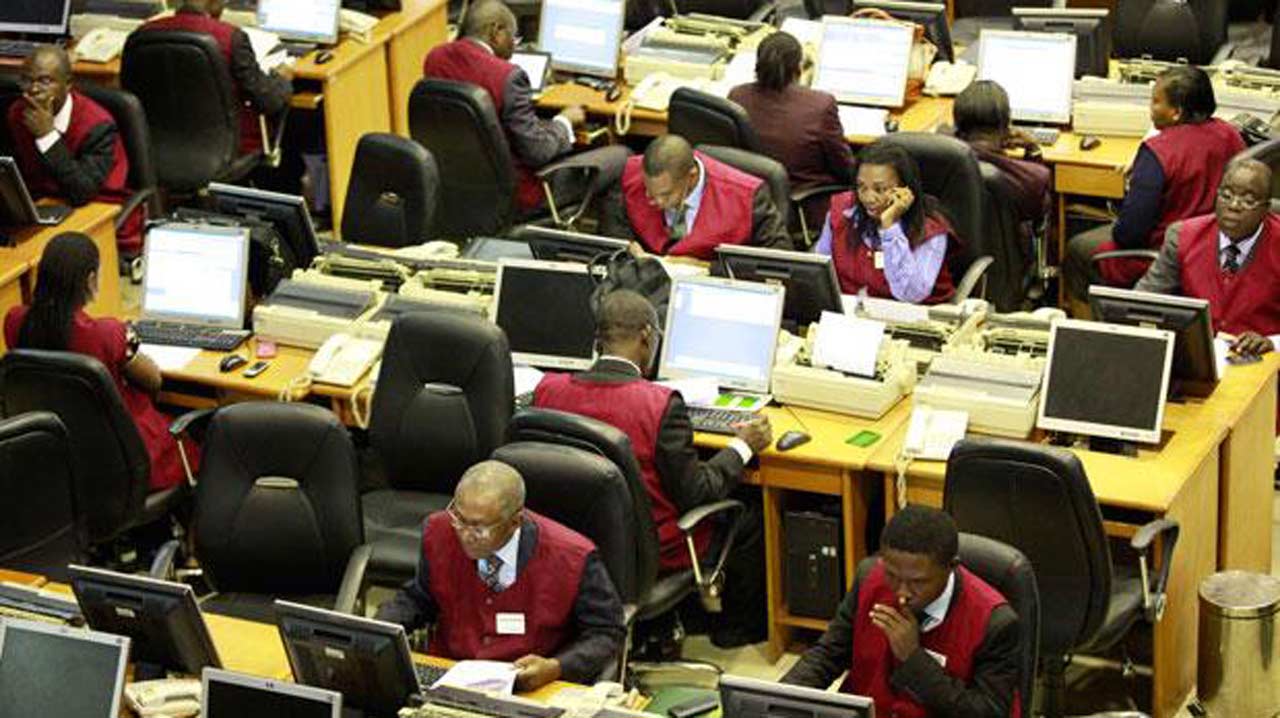
The Nigerian Exchange (NGX) Limited witnessed panic selling from investors on Tuesday as the foreign exchange (FX) market continued to dampen mood.
The free fall of the exchange rate of the Naira to the Dollar in the currency market is making Naira-denominated investments unattractive and yesterday, it further inflicted a 1.30 per cent loss to the equity market.
It was observed that traders sold off some of their blue-chip equities, particularly in the financial and industrial goods sectors.
Business Post reports that the insurance index went down by 3.89 per cent, the industrial goods counter lost 3.62 per cent, the banking space shed 2.37 per cent, and the consumer goods counter depreciated by 0.87 per cent, while the energy sector appreciated by 0.21 per cent.
When trading activities ended for the day by 2:30 pm, the All-Share Index (ASI) crumbled by 1,332.56 points to close at 101,060.67 points versus the previous day’s 102,393.23 points, and the market capitalisation retreated by N729 billion to settle at N55.299 trillion compared with Monday’s closing value of N56.028 trillion.
Investor sentiment remained weak, according to analysis of the market data, as the bourse finished with 43 price losers and eight price gainers, representing a negative market breadth index.
Honeywell Flour suffered a 10.00 per cent loss to sell for N3.60, BUA Cement shed 9.98 per cent to N142.95, PZ Cussons declined by 9.75 per cent to N27.30, UPDC REIT crashed by 9.32 per cent to N5.35, and NEM Insurance slumped by 8.63 per cent to N6.35.
On the flip side, Juli gained 9.94 per cent to quote at N1.77, Eterna rose by 6.17 per cent to N17.20, Veritas Kapital advanced by 5.97 per cent to 71 Kobo, Geregu Power improved by 3.68 per cent to N985.00, and Tantalizers expanded by 2.63 per cent to 39 Kobo.
A total of 256.2 million shares valued at N6.6 billion were transacted at the exchange yesterday in 8,783 deals compared with the 273.9 million shares worth N7.4 billion traded in 9,688 deals in the preceding session, indicating a decline in the trading volume, value, and the number of deals by 6.46 per cent, 10.81 per cent, and 9.34 per cent, respectively.
Transcorp closed the day as the most active equity with the sale of 39.8 million units for N528.5 million, as UBA traded 26.0 million units valued at N624.5 million. Fidelity Bank exchanged 25.5 million shares worth N270.5 million, Zenith Bank sold 21.0 million equities for N750.5 million, and GTCO transacted 13.8 million stocks valued at N535.5 million.
Economy
NGX Tumbles by 1.12% on Sell-Offs in BUA Foods, Others
By Dipo Olowookere
The Nigerian Exchange (NGX) Limited tumbled by 1.12 per cent on Wednesday as a result of selling pressure in three of the five key sectors of the bourse.
Yesterday, the insurance space rose by 0.71 per cent and the energy counter appreciated by 0.02 per cent. But these gains were erased by the three other sectors, with the consumer goods index down by 4.93 per cent, the industrial goods sector down by 0.42 per cent, and the banking segment down by 0.30 per cent.
Consequently, the All-Share Index (ASI) receded by 2,756.48 points to 243,967.09 points from 246,723.57 points, and the market capitalisation dropped by N1.762 trillion to close at N157.494 trillion compared with Tuesday’s N159.256 trillion.
The worst-performing stock for the day was BUA Foods, which lost 10.00 per cent to trade at N760.60. Unilever Nigeria shed 9.97 per cent to close at N131.40, John Holt depreciated by 9.90 per cent to N9.10, AVA Capital declined by 9.50 per cent to N8.10, and Austin Laz crashed by 8.81 per cent to N2.90.
The best-performing stock for the session was International Energy Insurance, which chalked up 10.00 per cent to quote at N4.40. Ecobank gained 9.93 per cent to settle at N71.40, Trans-Nationwide Express expanded by 9.77 per cent to N2.36, CWG grew by 9.74 per cent to N21.40, and Cornerstone Insurance improved by 6.80 per cent to N5.50.
Yesterday, 1.5 billion shares were sold for N20.9 billion in 39,085 deals compared with the 3.9 billion shares worth N32.4 billion exchanged in 45,608 deals a day earlier, representing a decline in the trading volume, value, and number of deals by 61.54 per cent, 35.49 per cent, and 14.30 per cent, respectively.
On top of the activity chart was Fortis Global Insurance, with a turnover of 853.2 million units sold for N2.6 billion. Universal Insurance exchanged 251.8 million units worth N214.1 million, Chams transacted 40.0 million units valued at N181.0 million, First Holdco traded 28.3 million units worth N3.9 billion, and Access Holdings sold 25.4 million units valued at N702.4 million.
Economy
SEC Fixes 5 pm T+1 Settlement Deadline for Equities, Commodities
By Aduragbemi Omiyale
As part of the implementation of the T+1 settlement cycle in the Nigerian capital market, the Securities and Exchange Commission (SEC) has fixed 5:00 pm on the first business day after a transaction (T+1) as the settlement deadline for equities and commodities traded and settled through the Central Securities Clearing System (CSCS).
In a circular on Wednesday to capital market operators and other market participants, the capital market regulator noted that all transactions in the affected securities must be fully paid by 5:00 pm T+1 to ensure compliance with the standard Delivery versus Payment (DvP) settlement procedure.
It warned that where a broker/dealer’s trading account is not adequately funded to meet its settlement obligation within the prescribed period, the default would be managed in line with the CSCS Default Management Procedure and the applicable transaction settlement guidelines of the relevant exchange.
The commission also clarified that foreign portfolio investors are not required to prefund their accounts for trades in the Nigerian capital market.
However, it said capital market operators facilitating transactions on behalf of foreign portfolio investors must establish and maintain appropriate controls and processes to ensure timely funding and completion of settlements within the prescribed timeframe.
The clarification follows earlier SEC circulars on the implementation of the T+2 settlement cycle for equities transactions, issued on June 3, 2025, and the transition to the T+1 settlement cycle, issued on May 15, 2026.
The T+1 cycle means that eligible securities transactions are settled one business day after the trade date, reducing the period between execution and final settlement.
The SEC said the transition represents a significant milestone in its efforts to build a more efficient, resilient and internationally aligned trading and post-trade environment, adding that the shorter settlement cycle would improve settlement efficiency, reduce counterparty risk, enhance liquidity and strengthen the competitiveness of the Nigerian capital market.
According to the agency, the reforms would ultimately improve the attractiveness of the Nigerian market to both domestic and international investors.
Economy
Oil Prices Rise as Hormuz, Bab el-Mandeb Attacks Fuel Supply Fears
By Adedapo Adesanya
Oil prices slightly rose on Wednesday as attacks on ships in the Middle East continued and talks to end the Iran war hit an impasse.
Brent futures gained 7 cents to trade at $88.98 a barrel, while the US West Texas Intermediate (WTI) crude increased by 7 cents to $83.27 per barrel.
The US and Yemen’s Iran-aligned Houthis reported separate attacks on shipping in the Strait of Hormuz and the Bab el-Mandeb Strait on Tuesday, two crucial export routes for Middle Eastern oil and gas in addition to the Suez Canal.
Reuters reported that there continued to be no discussions between Iran and the US to extend their ceasefire because, from Iran’s perspective, the deal had no start date and so there was nothing to extend.
Shipping data showed the number of vessels transiting the Strait of Hormuz fell to a one-week low of eight on Tuesday. Before the war, 125 to 140 vessels passed through the crucial waterway each day.
The US military, meanwhile, said an American Navy MH-60 helicopter fired two Hellfire missiles to disable the steering gear of a Panama-flagged cargo ship.
The ship ignored repeated warnings to stop violating a naval blockade on Iranian ports, the US Central Command said.
Forecasters including the Organisation of the Petroleum Exporting Countries (OPEC) and the International Energy Administration (IEA) revised down their oil demand outlooks as US-Iran talks stall.
OPEC lowered its world oil demand growth forecast for 2026 to 580,000 barrels per day, it said in its monthly oil market report.
The International Energy Agency cut its 2026 demand projections and now expects a 1.6 million barrels per day contraction this year. However, the Paris-based agency is also predicting a 4.3 million barrels per day drop in supply this year, and an overall 2026 deficit of around 1.27 million barrels per day.
According to the IEA, Middle East oil flows briefly returned to pre-war levels in early July, with loadings reaching 20 million bpd, before falling to 12 million bpd later in the month. Middle East production remained 8.3 million barrels per day below pre-war levels in July.
The IEA cited the Hormuz shutdown, the US blockade of Iranian exports, attacks in the Bab el-Mandeb Strait and reduced Kazakh CPC Blend exports among the forces keeping global supply below demand.