Economy
Climate Change: Agric Experts Advocate Smart Farming Practices
By Bon Peters
Agriculture experts have advocated “smart farming practices” to combat climate change, improve productivity and enhance food security in the country.
They noted that if climate change challenges were not nipped in the bud, more than 52 per cent of the country’s agricultural production would be threatened by 2050.
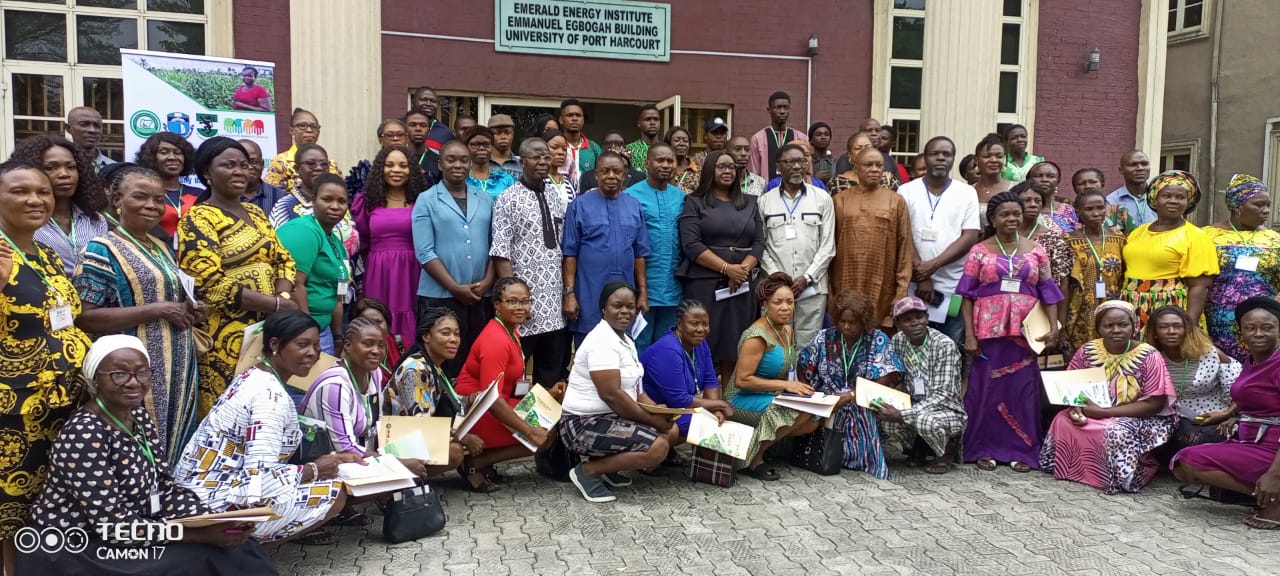
The experts under the aegis of the Society of Action in Nigeria (SCAN), in collaboration with the University of Port Harcourt, disclosed this during a workshop organized for women and youth leaders on Thursday in Port Harcourt the Rivers state capital.
A Senior Lecturer in the Department of Agricultural Extension and Development Studies at the University of Port Harcourt, Dr Clara Ifeanyiobi, who was the project lead of the programme, said the aim of the workshop was to equip farmers with adaptative skills on climate change.
She noted that the project was a micro grant from Adaptation Research Alliance to the Society for Climate Action in Nigeria (SCAN) in collaboration with the University of Port Harcourt and the University of Nigeria Nsuka.
According to Ms Ifeanyiobi, when these skills are incorporated in agri-business, huge losses usually associated with climate change would be averted while farmers’ livelihoods would also gain a positive turnaround.
In her words, “Today’s training is tailored to the identified areas of need which is majorly in the area of crop and soil management practices for cassava, maize and vegetable farming.
“We are excited that there will be a huge turnaround in this year’s harvest, we’ve been in the business of equipping farmers with climate smart agricultural practices for over 10 years and our results from our target farmers have been quite laudable.
“This one is a lot bigger, haven synergized with key agencies like the Nigeria Meteorological Agency (NIMET) and the International Institute of Tropical Agriculture (IIT).
“Beneficiaries are also expected to go to their various communities and establish the climate smart rural women and youth groups.
“We are also going to support the various trainings at the community level. So, we look forward to a bumper harvest across the 23 local councils of the state.”
The don also stated that improved crop varieties like cassava stems, maize (SC- 526) were also distributed to participants of the workshop (farmers) drawn from the 23 local government areas of the state.
Another resource person, Dr Doris Akachukwu, a Senior Lecturer at the Micheal Opara University of Agriculture, Umudike, Abia State, urged the federal government to utilise agricultural resources in the country to tackle current food crises.
“Here in Nigeria, we have the land and manpower; rather than desire things that are far-fetched, we should put in more commitment and funding for agriculture.
“Nigeria should begin to look inward, fund large scale production to ensure food sufficiency and employment for our teaming youths,” she said.
Ms Akachukwu expressed worry over poor commitment to Agriculture by farmers and youths in the country, adding that lack of basic techniques, seedlings and environmental pollution, effects of greenhouse gases were some of the impediments to Agricultural productivity in the Niger Delta area.
Similarly, Dr Bassey Udom, an Associate Professor, and soil scientist at the University of Port Harcourt, said that the training would help the farmers on innovative soil practices to help cushion climate change.
He also urged the Federal Government to tackle security which he highlighted as key to agricultural prosperity.
Our correspondent reports that various resource persons in the field of sciences especially soil scientists and crop scientists proffered solutions to some of the challenges and complaints by the participants.
Economy
Fed Rate Cut Signal, Stalling Ukraine Peace Talks Raise Oil Prices
By Adedapo Adesanya
Oil prices were up on Thursday amid investors’ expectations for the Federal Reserve to cut interest rates, while stalled Ukraine peace talks tempered expectations of a deal restoring Russian oil flows.
Brent crude gained 59 cents or 0.94 per cent to trade at $63.26 a barrel and the US West Texas Intermediate (WTI) crude appreciated by 72 cents or 1.22 per cent to $59.67 per barrel.
The market ticked up on expectations that a US rate cut will support the world’s largest economy and oil demand, after data showed employment is slowing.
Markets are pricing in an 89 per cent chance of a cut when the Federal Reserve meets on December 9-10, significantly higher than rate-cut bets just a couple of weeks ago, according to the CME FedWatch tool.
Support also came as the dollar edged lower for its 10th straight day of losses against a basket of major currencies, making crude cheaper for buyers using other currencies.
Analysts noted that escalating tensions between the US and Venezuela were also supporting prices on concerns of a drop in crude supplies from the South American country, which is a member of the Organisation of the Petroleum Exporting Countries (OPEC).
US President Donald Trump’s administration is ratcheting up pressure on Venezuelan President Nicolás Maduro, signalling the possibility of a US invasion.
The perception that progress on a peace plan for Ukraine was stalling also supported prices, after President Trump’s representatives emerged from peace talks with the Kremlin with no resolution in sight.
Expectations of an end to the war had pressured prices lower, as traders anticipated a deal would allow Russian oil back into an already oversupplied global market..
Meanwhile, Ukraine continued its assault on Russia’s energy infrastructure as it hit the Druzhba oil pipeline in Russia’s central Tambov region, the fifth attack on the pipeline that sends Russian oil to Hungary and Slovakia.
Kpler noted that Ukraine’s drone campaign against Russian refining infrastructure has affected production to down around 5 million barrels per day between September and November, a 335,000 barrels per day year-on-year decline, with gasoline (petrol) hit hardest and gasoil output also materially weaker.
US crude and fuel inventories rose last week as refining activity picked up, the Energy Information Administration (EIA) said on Wednesday.
Crude inventories rose by 574,000 barrels to 427.5 million barrels in the week ended November 28, the EIA said, compared with analysts’ expectations in a Reuters poll for an 821,000-barrel draw.
Fitch Ratings on Thursday cut its 2025-2027 oil price assumptions to reflect market oversupply and production growth that is expected to outstrip demand.
Economy
Nigeria Approves Fiscal Plan Proposing N54.5trn 2026 Budget
By Adedapo Adesanya
The Federal Executive Council (FEC) has signed off on a medium-term fiscal plan that projects spending of around N54.5 trillion in 2026, as it approved the 2026-2028 medium-term expenditure framework (MTEF), outlining Nigeria’s economic outlook, revenue targets, and spending priorities for the next three years.
The Minister of Budget and National Planning, Mr Atiku Bagudu, said oil price was pegged at $64 per barrel, while the exchange rate assumption for the budget year is N1,512/$1.
He said while the council set an oil production benchmark of 2.06 million barrels per day for 2026, the fiscal planning is based on a cautious 1.8 million barrels per day.
Mr Bagudu stated the exchange rate projection reflects the fact that 2026 precedes a general election year, adding that all the assumptions were drawn from detailed macroeconomic and fiscal analyses by the budget office and its partner agencies.
According to the minister, inflation is projected to average 18 per cent in 2026.
Mr Bagudu said based on the assumptions, the total revenue accruing to the federation in 2026 was estimated at N50.74 trillion, to be shared among the three tiers of government.
“From this projection, the federal government is expected to receive N22.6 trillion, states N16.3 trillion, and local governments N11.85 trillion,” he said.
“When revenues from all federal sources are consolidated, including N4.98 trillion from government-owned enterprises, total Federal Government revenue for 2026 is projected at N34.33 trillion —representing a N6.55 trillion or 16 per cent decline compared to the 2025 budget estimate.”
The minister said statutory transfers are expected to amount to roughly N3 trillion, while debt servicing was projected at N10.91 trillion.
He said non-debt recurrent spending — covering personnel costs and overheads — was put at N15.27 trillion, while the fiscal deficit for 2026 is estimated at N20.1 trillion, representing 3.61 per cent of gross domestic product (GDP).
The MTEF also projected that nominal GDP will reach over N690 trillion in 2026 and climb to N890.6 trillion by 2028, with the GDP growth rate projected at 4.6 per cent in 2026.
The non-oil GDP is also expected to grow from N550.7 trillion in 2026 to N871.3 trillion in 2028, while oil GDP is estimated to rise from N557.4 trillion to N893.5 trillion over the same period.
Economy
Operators Exploit Loopholes in PIA to Frustrate Domestic Crude Oil Supply—Dangote
By Aduragbemi Omiyale
There seems to be a deliberate effort to starve local crude oil refiners from getting supply, foremost African businessman, Mr Aliko Dangote, has said.
He said loopholes in the Petroleum Industry Act (PIA) are being exploited to ensure private refiners like the Dangote Petroleum Refinery import the commodity, making consumers pay more for petroleum products.
Mr Dangote insisted that Nigeria has no justification for importing crude or refined petroleum products if existing laws were properly enforced.
Speaking during a visit by the South South Development Commission (SSDC) to the Dangote Petroleum Refinery and Fertiliser Complex in Lagos, he noted that the PIA already establishes a framework that prioritises domestic crude supply.
According to him, several oil companies routinely divert Nigerian crude to their trading subsidiaries abroad, particularly in Switzerland, forcing domestic refineries to buy from these offshore entities at a premium of four to five dollars per barrel.
“The crude is available. It is not a matter of shortage. But the companies move everything to their trading arms, and we are forced to buy at a premium. Meanwhile, we do not receive any premium for our own products,” he said.
He disclosed that he has formally written to the Federal Government, urging it to charge royalties and taxes based on the actual price paid for crude, to prevent revenue losses and to discourage practices that disadvantage local refiners.
Mr Dangote said the Nigerian National Petroleum Company (NNPC) remains the primary supplier honouring domestic supply obligations, providing five to six cargoes monthly. However, the refinery requires as many as twenty cargoes per month from January to operate optimally.
Describing the situation as “unsustainable for a country intent on genuine industrial growth,” Mr Dangote argued that Africa’s economic future depends on value addition rather than perpetual raw material export.
“It is shameful that while we exported one point five million tonnes of gasoline in June and July, imported products were flooding the country. That is dumping,” he said.
On report by the Nigerian Midstream and Downstream Petroleum Regulatory Authority (NMDPRA), that the refinery supplied only 17.08 million litres of the 56.74 million litres consumed in October 2025, Mr Dangote said that the refinery exports its products if regulators continue to permit dumping by marketers.
Addressing Nigeria’s ambition to achieve a $1 trillion economy, Mr Dangote said the target is attainable through disciplined policy execution, improved power generation and a revival of the steel sector.
“You cannot build a great nation without power and steel. Every bolt and nut used here was imported. That should not be the case. Nigeria should be supplying steel to smaller African countries,” he said.
He also underscored opportunities for partnership with the SSDC in agriculture, particularly in soil testing and customised fertiliser formulation, noting that misuse of fertiliser remains a major reason Nigerian farmers experience limited productivity gains.
“We are setting up advanced soil testing laboratories. From next year, we want to work with the SSDC to empower farmers by providing accurate soil assessments and customised fertiliser blends,” Mr Dangote said.
-
Feature/OPED6 years agoDavos was Different this year
-
Travel/Tourism9 years ago
Lagos Seals Western Lodge Hotel In Ikorodu
-
Showbiz3 years agoEstranged Lover Releases Videos of Empress Njamah Bathing
-
Banking7 years agoSort Codes of GTBank Branches in Nigeria
-
Economy2 years agoSubsidy Removal: CNG at N130 Per Litre Cheaper Than Petrol—IPMAN
-
Banking3 years agoFirst Bank Announces Planned Downtime
-
Banking3 years agoSort Codes of UBA Branches in Nigeria
-
Sports3 years agoHighest Paid Nigerian Footballer – How Much Do Nigerian Footballers Earn