Connect with us

Economy

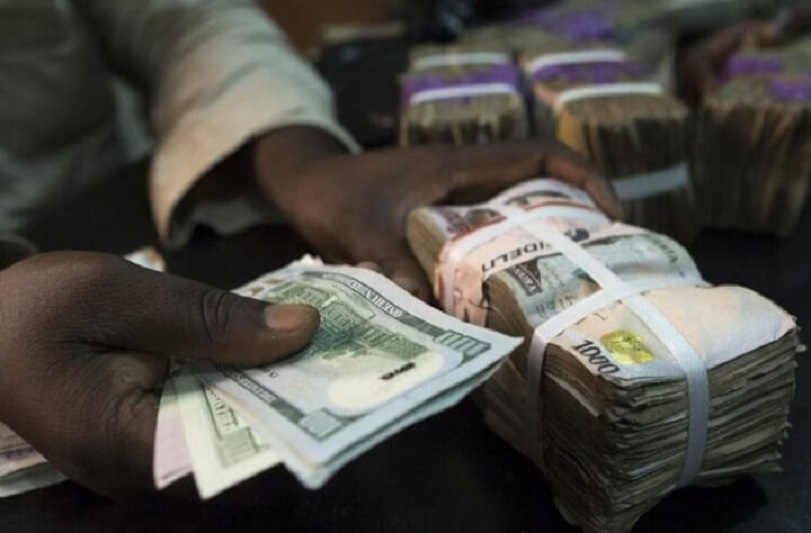
Dollar Crashes to N1,520/$1 at Parallel Market

Published

on

Naira 4 Dollar

By Dipo Olowookere

The value of the Naira to the US Dollar significantly strengthened in the parallel market on Monday, trading at N1,520/$1 compared with the N1,700/$1 it was traded on Sunday.

This development followed steps taken by the Central Bank of Nigeria (CBN) last week to stabilise the currency market and take control of the ecosystem.

Recall that over the weekend, the central bank announced plans to increase the minimum capital base of Bureaux De Change (BDC) operators to N2 billion for national operations and N500 million for regional.

It was also speculated that the bank may resume the weekly sale of foreign exchange (FX) to BDCs in a bid to boost liquidity and give the Naira more weight.

In 2021, the central bank under the former Governor, Mr Godwin Emefiele, stopped the sale of forex to BDCs, claiming they were aiding financial terrorism.

He transferred this function to the banks, and since then, the local currency has been battered because customers are unable to get access to FX when needed.

There are indications that the BDC operators may begin to sell FX to customers, though at the retail end, especially for transactions not more than $1,000.

Since last week, the Economic and Financial Crimes Commission (EFCC) and other security agencies have been going after BDCs across the country.

This has affected the market, though the Naira has gradually gained against the Dollar, which was almost hitting N2,000.

At the Olugbede Model Market in Egbeda under Alimosho Local Government Area of Lagos State, the American currency was exchanged with the Naira at N1,520/$1 on Monday afternoon.

In the same vein, at the Alade Market in Ikeja, where trading activities have slowed because of the actions of security operatives, the Dollar was exchanged with the Naira between N1,515/$1 and N1,550/$1.

Also, in the peer-to-peer (P2P) segment of the forex market, the Naira appreciated against the greenback today by N108 to trade at N1,597/$1 at the time of filing this report compared with N1,705/$1 it was transacted over the weekend. At midday on Monday, it traded at about N1,638/$1.


Dipo Olowookere is a journalist based in Nigeria that has passion for reporting business news stories. At his leisure time, he watches football and supports 3SC of Ibadan. Mr Olowookere can be reached via [email protected]

Economy

FrieslandCampina, Two Others Erase N26bn from NASD OTC Bourse

Published

on

FrieslandCampina

By Adedapo Adesanya

Three stocks stretched the bearish run of the NASD Over-the-Counter (OTC) Securities Exchange by 1.21 per cent on Friday, December 19, with the market capitalisation giving up N26.01 billion to close at N2.121 billion compared with the N2.147 trillion it ended a day earlier, and the NASD Unlisted Security Index (NSI) dropping 43.47 points to 3,546.41 points from 3,589.88 points.

The trio of FrieslandCampina Wamco Nigeria Plc, Central Securities Clearing System (CSCS) Plc, and NASD Plc overpowered the gains printed by four other securities.

FrieslandCampina Wamco Nigeria Plc lost N6.00 to sell at N54.00 per unit versus N60.00 per unit, NASD Plc shrank by N3.50 to N58.50 per share from N55.00 per share, and CSCS Plc depleted by N2.91 to N33.87 per unit from N36.78 per unit.

On the flip side, Air Liquide Plc gained N1.01 to close at N13.00 per share versus N11.99 per share, Golden Capital Plc appreciated by 70 Kobo to N7.68 per unit from N6.98 per unit, Geo-Fluids Plc added 39 Kobo to sell at N5.50 per share versus N5.11 per share, and IPWA Plc rose by 8 Kobo to 85 Kobo per unit from 77 Kobo per unit.

During the trading day, market participants traded 1.9 million securities versus the previous day’s 30.5 million securities showing a decline of 49.3 per cent. The value of trades went down by 64.3 per cent to N80.3 million from N225.1 million, but the number of deals jumped by 32.1 per cent to 37 deals from 28 deals.

Infrastructure Credit Guarantee Company (InfraCredit) Plc finished the session as the most active stock by value on a year-to-date basis with 5.8 billion units valued at N16.4 billion, followed by Okitipupa Plc with 178.9 million units transacted for N9.5 billion, and MRS Oil Plc with 36.1 million units traded for N4.9 billion.

The most active stock by volume on a year-to-date basis was still InfraCredit Plc with 5.8 billion units worth N16.4 billion, trailed by Industrial and General Insurance (IGI) Plc with 1.2 billion units sold for N420.7 million, and Impresit Bakolori Plc with 536.9 million units traded for N524.9 million.

Continue Reading

Economy

Naira Crashes to N1,464/$1 at Official Market, N1,485/$1 at Black Market

Published

on

Official FX Market

By Adedapo Adesanya

It was not a good day for the Nigerian Naira at the two major foreign exchange (FX) market on Friday as it suffered a heavy loss against the United States Dollar at the close of transactions.

In the black market segment, the Naira weakened against its American counterpart yesterday by N10 to quote at N1,485/$1, in contrast to the N1,475/$1 it was traded a day earlier, and at the GTBank forex counter, it depreciated by N2 to settle at N1,467/$1 versus Thursday’s closing price of N1,465/$1.

In the Nigerian Autonomous Foreign Exchange Market (NAFEX) window, which is also the official market, the nation’s legal tender crashed against the greenback by N6.65 or 0.46 per cent to close at N1,464.49/$1 compared with the preceding session’s rate of N1,457.84/$1.

In the same vein, the local currency tumbled against the Euro in the spot market by N2.25 to sell for N1,714.63/€1 compared with the previous day’s N1,712.38/€1, but appreciated against the Pound Sterling by 73 Kobo to finish at N1,957.30/£1 compared with the N1,958.03/£1 it was traded in the preceding session.

The market continues to face seasonal pressure even as the Central Bank of Nigeria (CBN) is still conducting FX intervention sales, which have significantly reduced but not remove pressure from the Naira. Also, there seems to be reduced supply from exporters, foreign portfolio investors and non-bank corporate inflows.

President Bola Tinubu on Friday presented the government’s N58.47 trillion budget plan aimed at consolidating economic reforms and boosting growth.

The budget is based on a projected crude oil price of $64.85 a barrel and includes a target oil output of 1.84 million barrels a day. It also projects an exchange rate of N1,400 to the Dollar.

President Tinubu said inflation had plunged to an annual rate of 14.45 per cent in November from 24.23 per cent in March, while foreign reserves had surged to a seven-year high of $47 billion.

Meanwhile, the cryptocurrency market was dominated by the bulls but it continues to face increased pressure after million in liquidations in previous session over accelerating declines, with Dogecoin (DOGE) recovering 4.2 per cent to trade at $0.1309.

Further, Ripple (XRP) appreciated by 3.9 per cent to $1.90, Cardano (ADA) rose by 3.5 per cent to $0.3728, Solana (SOL) jumped by 3.4 per cent to $126.23, Ethereum (ETH) climbed by 2.9 per cent to $2,982.42, Binance Coin (BNB) gained 2.0 per cent to sell for $853.06, Bitcoin (BTC) improved by 1.7 per cent to $88,281.21, and Litecoin (LTC) soared by 1.2 per cent to $76.50, while the US Dollar Tether (USDT) and the US Dollar Coin (USDC) traded flat at $1.00 each.

Continue Reading

Economy

Crude Oil Prices Climb as US Blocks Venezuelan Tankers

Published

on

crude oil prices

By Adedapo Adesanya

Crude oil prices edged up on possible disruptions from a US blockade of Venezuelan tankers as the market waits for news about a possible Russia-Ukraine peace deal.

Brent futures rose 65 cents or 1.1 per cent to $60.47 per barrel while the US West Texas Intermediate (WTI) futures expanded by 51 cents or 0.9 per cent to $56.66 per barrel. Both Brent and WTI were down about 1 per cent this week after both crude benchmarks fell about 4 per cent last week.

US President Donald Trump said he was leaving the possibility of war with Venezuela on the table, noting that there would be additional seizures of oil tankers near Venezuelan waters after the US seized a sanctioned oil tanker off the coast of Venezuela last week.

The American President this week ordered a “blockade” of all sanctioned oil tankers entering and leaving Venezuela, in the US’ latest move to increase pressure on Nicolas Maduro’s government, targeting its main source of income. The pressure campaign on President Maduro has included a ramped-up military presence in the region and more than two dozen military strikes on vessels in the Pacific Ocean and Caribbean Sea near Venezuela, which have killed at least 90 people.

President Trump has also previously said that US land strikes on the South American country will soon start.

Meanwhile, US Secretary of State Marco Rubio on Friday said that the US is not concerned about an escalation with Russia when it comes to Venezuela, as the Trump administration builds up military forces in the Caribbean.

This development comes as President Trump seeks an end to the unending war between Ukraine and Russia that is heading towards its fourth year.

European Union leaders decided on Friday to borrow cash to loan 90 billion Euros to Ukraine to fund its defense against Russia for the next two years as Russian President Vladimir Putin offered no compromise on Friday on his terms for ending the war in Ukraine and accused the European Union of attempting “daylight robbery” of Russian assets.

Ukraine, meanwhile, struck a Russian “shadow fleet” oil tanker in the Mediterranean Sea with aerial drones for the first time.

Earlier this week, the US and Ukraine both signaled progress in negotiations about a peace agreement during talks in German capital city of Berlin. The US is now reportedly offering Ukraine security guarantees modeled on NATO’s Article 5 mutual defense pledge.

Continue Reading

Trending