Connect with us

Economy

Peter Obi Laments Nigeria’s Dependence on War-Torn Ukraine for Food

Published

on

Peter Obi

By Adedapo Adesanya

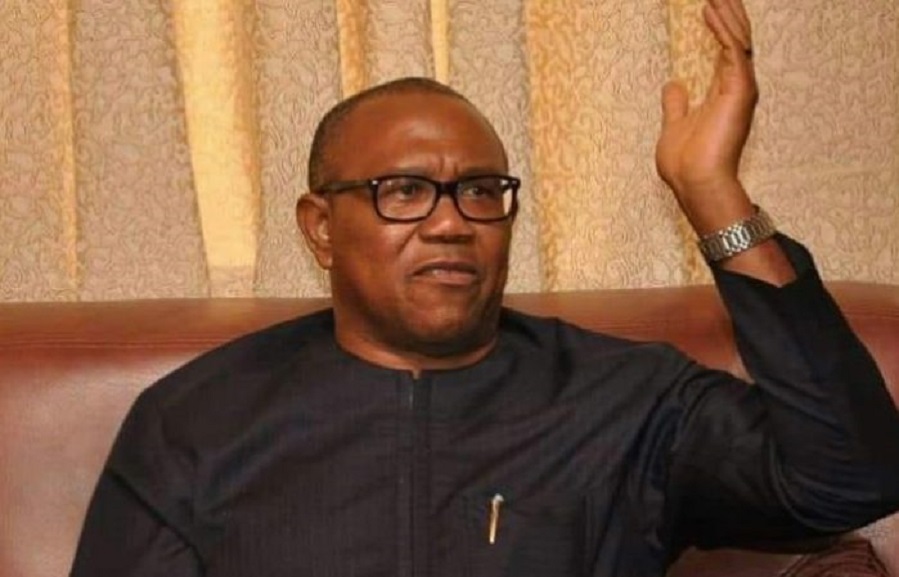
The presidential candidate of the Labour Party in the 2023 polls, Mr Peter Obi, has lamented Nigeria’s dependence on Ukraine, a country ravaged by war, for food aid.

Mr Obi, in a statement on Monday, expressed dissatisfaction at the current economic realities and recounted times when the Nigerian economy was faring better than that of Ukraine in 2015.

“Ukraine cultivates over 60 per cent of its arable land, whereas Nigeria has over 60 per cent uncultivated arable land.

“Despite the conflict, Ukraine feeds itself, and exports agricultural products worth over $25 billion which is about the same value as our crude oil export earnings, and it serves as a strategic global food supplier, even providing aid to a peaceful yet unproductive Nigeria,” Mr Obi said.

Ukraine has been attacked by Russia since February 24, 2022, after President Vladimir Putin claimed that the neighbouring country was a territory under it.

Mr Obi, in his statement today, said Ukraine’s GDP per capita was $2,125 in 2015 while that of Nigeria was $2,680.

But lamented that as of 2022, the reverse had taken place, with Ukraine’s GDP per capita exceeding $4,000, while Nigeria’s declined to $2,184.

He lamented that the regression in economic growth is attributed to a failure in leadership over the years, adding that Nigeria has remained unproductive since 2015.

“It is disheartening that our once economically confident nation, blessed with vast arable land and abundant natural resources, now relies on a war-torn Ukraine for food assistance.

“This national disgrace stems from years of leadership failure, necessitating urgent reflection and a reordering of our national priorities and resource management and allocation.

“Instructively, Ukraine, with a population of 43 million on 603,728 km², outshines Northern Nigeria, covering 744,249 km² with a young, energetic population exceeding 100 million.

“In 2015, Ukraine’s GDP per capita was $2125, compared to Nigeria’s $2680. By 2022, despite being at war, Ukraine’s GDP per capita exceeded $4000, while Nigeria’s regressed to $2184,” he said.

Ukraine had recently donated 25,000 tons of wheat to Nigeria, in a move it says will help tackle the emergency food crisis affecting over 1.3 million people in Northeast Nigeria.

The development is part of the United Nations World Food Programme’s (WFP) response in northeast Nigeria amidst inflation and food price spikes.

The contribution is also part of Ukraine’s humanitarian Grain from Ukraine initiative launched by President Volodymyr Zelenskyy.

The shipment was made possible through the collaborative effort from the United Kingdom, Canada, Denmark, Finland, France, Luxembourg, Norway, the Republic of Korea and Sweden, which has helped cover the costs of transporting the wheat from Ukraine to Nigeria and its distribution to the families who need it.

Deadly conflicts in Nigeria have displaced millions of households from their homes and farmlands which negatively affected food production and supply.


Adedapo Adesanya is a journalist, polymath, and connoisseur of everything art. When he is not writing, he has his nose buried in one of the many books or articles he has bookmarked or simply listening to good music with a bottle of beer or wine. He supports the greatest club in the world, Manchester United F.C.

Economy

NGX Seeks Suspension of New Capital Gains Tax

Published

on

capital gains tax

By Adedapo Adesanya

The Nigerian Exchange (NGX) Limited is seeking review of the controversial Capital Gains Tax increase, fearing it will chase away foreign investors from the country’s capital market.

Nigeria’s new tax regime, which takes effect from January 1, 2026, represents one of the most significant changes to Nigeria’s tax system in recent years.

Under the new rules, the flat 10 per cent Capital Gains Tax rate has been replaced by progressive income tax rates ranging from zero to 30 per cent, depending on an investor’s overall income or profit level while large corporate investors will see the top rate reduced to 25 per cent as part of a wider corporate tax reform.

The chief executive of NGX, Mr Jude Chiemeka, said in a Bloomberg interview in Kigali, Rwanda that there should be a “removal of the capital gains tax completely, or perhaps deferring it for five years.”

According to him, Nigeria, having a higher Capital Gains Tax, will make investors redirect asset allocation to frontier markets and “countries that have less tax.”

“From a capital flow perspective, we should be concerned because all these international portfolio managers that invest across frontier markets will certainly go to where the cost of investing is not so burdensome,” the CEO said, as per Bloomberg. “That is really the angle one will look at it from.”

Meanwhile, the policy has been defended by the chairman of the Presidential Fiscal Policy and Tax Reforms Committee, Mr Taiwo Oyedele, who noted that the new tax will make investing in the capital market more attractive by reducing risks, promoting fairness, and simplifying compliance.

He noted that the framework allows investors to deduct legitimate costs such as brokerage fees, regulatory charges, realised capital losses, margin interest, and foreign exchange losses directly tied to investments, thereby ensuring that they are not taxed when operating at a loss.

Mr Oyedele  also said the reforms introduced a more inclusive approach to taxation by exempting several categories of investors and transactions.

Continue Reading

Economy

Food Concepts Return NASD OTC Exchange to Danger Zone

Published

on

NASD OTC exchange

By Adedapo Adesanya

Food Concepts Plc neutralized the gains recorded by three securities, returning the NASD Over-the-Counter (OTC) Securities Exchange into the negative territory with a 0.27 per cent loss on Thursday, December 4.

Yesterday, the share price of the parent company of Chicken Republic and PieXpress declined by 34 Kobo to sell at N3.15 per unit compared with the previous day’s N3.49 per unit.

This shrank the market capitalisation of the OTC bourse by N5.72 billion to N2.136 billion from N2.142 trillion and weakened the NASD Unlisted Security Index (NSI) by 9.57 points to 3,571.53 points from 3,581.10 points.

Business Post reports that Central Securities Clearing System (CSCS) Plc went down by 50 Kobo to N38.50 per share from N38.00 per share, FrieslandCampina Wamco Nigeria Plc gained 29 Kobo to sell at N55.79 per unit versus N55.50 per unit, and Geo-Fluids Plc added 5 Kobo to close at N4.60 per share compared with Wednesday’s closing price of N4.55 per share.

Trading data indicated that the volume of securities recorded at the session surged by 6,885.3 per cent to 4.3 million units from the 61,570 units posted a day earlier, the value of securities increased by 10,301.7 per cent to N947.2 million from N3.3 million, and the number of deals went up by 146.7 per cent to 37 deals from the 15 deals achieved in the previous trading session.

At the close of business, Infrastructure Credit Guarantee Company (InfraCredit) Plc was the most traded stock by value on a year-to-date basis with the sale of 5.8 billion units for N16.4 billion, trailed by Okitipupa Plc with 170.4 million units worth N8.0 billion, and Air Liquide Plc with 507.5 million units valued at N4.2 billion.

InfraCredit Plc also finished the session as the most traded stock by volume on a year-to-date basis with 5.8 billion units transacted for N16.4 billion, followed by Industrial and General Insurance (IGI) Plc with 1.2 billion units sold for N420.2 million, and Impresit Bakolori Plc with 536.9 million units traded for N524.9 million.

Continue Reading

Economy

Investors Gain N97bn from Local Equity Market

Published

on

Nigerian equity market

By Dipo Olowookere

The upward trend witnessed at the Nigerian Exchange (NGX) Limited in recent sessions continued on Thursday as it further improved by 0.10 per cent.

This was despite investor sentiment turning bearish after the local equity market ended with 23 price gainers and 28 price gainers, indicating a negative market breadth index.

UAC Nigeria gained 10.00 per cent to finish at N88.00, Morison Industries appreciated by 9.94 per cent to N3.54, Ecobank rose by 8.53 per cent to N36.90, and Coronation Insurance grew by 8.47 per cent to N2.56.

On the flip side, Ellah Lakes depreciated by 10.00 per cent to N13.14, Eunisell Nigeria also shed 10.00 per cent to finish at N72.90, Transcorp Hotels slipped by 9.95 per cent to N157.50, Omatek shrank by 9.23 per cent to N1.18, and Guinea Insurance dipped by 8.46 per cent to N1.19.

Yesterday, the All-Share Index (ASI) went up by 152.28 points to 145,476.15 points from 145,323.87 points and the market capitalisation chalked up N97 billion to finish at N92.726 trillion compared with the previous day’s N92.629 trillion.

Customs Street was bubbling with activities on Thursday, though the trading volume and value slightly went down, according to data.

A total of 1.9 billion stocks worth N19.2 billion exchanged hands in 23,369 deals during the session versus the N2.3 billion valued at N21.0 billion traded in 21,513 deals a day earlier.

This showed that the number of deals increased by 8.63 per cent, the volume of transactions depleted by 17.39 per cent, and the value of trades decreased by 8.57 per cent.

For another trading day, eTranzact led the activity chart with 1.6 billion units sold for N6.4 billion, Fidelity Bank traded 31.0 million units worth N589.3 million, GTCO exchanged 28.3 million units valued at N2.5 billion, Zenith Bank transacted 27.1 million units for N1.6 billion, and Ecobank traded 21.9 million units worth N744.3 million.

Continue Reading

Trending