Banking
Union Bank Reaffirms Commitment to Gender Inclusivity
By Modupe Gbadeyanka
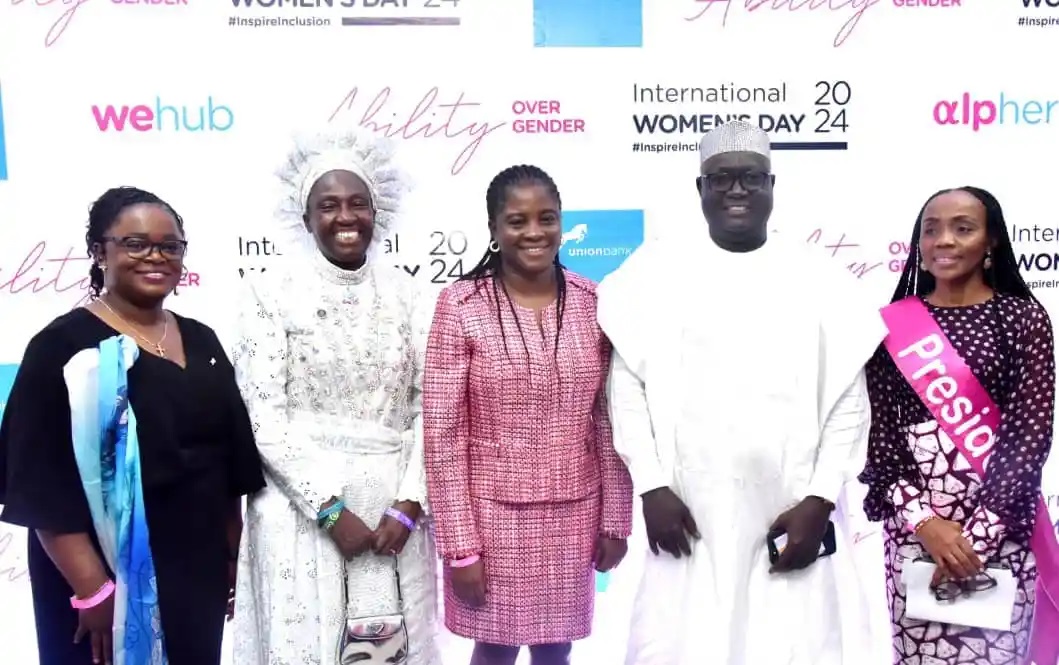
Union Bank of Nigeria has reaffirmed its commitment to gender inclusivity and the promotion of female excellence and competence across different fields of endeavour.
At an event to commemorate 2024 International Women’s Day, the financial institution re-emphasised its advocacy for an equitable and inclusive society devoid of biases, stereotypes, and discrimination.
At the programme tagged Ability Over Gender, the bank’s new chief executive, Ms Yetunde Oni, reiterated the company’s commitment to continually champion the cause of women’s advancement and other underrepresented communities while pushing for their inclusion and recognition in otherwise closed-off spaces.
Also, at a special panel session moderated by the Head of Retail Segments and αlpher, Ms Chioma Nwokike, the discussants lent their voices on how to change the narrative around inclusion and truly create an environment that enables women to truly thrive and excel Because She Can.
The panellists included the Advocacy and Communications Lead at EFInA (Enhancing Financial Innovation and Access), Ms Chinasa Collins-Ogbuo; the Managing Partner for Débbo Africa, Dr Zahra Modibbo; the Specialist Advisory Services Africa at Women’s World Banking, Ms Olajumoke Daramola; and the Learning Solutions Manager at Shell Nigeria, Ms Esohe Adetola.
Speaking on the sidelines of the event, the Chief Brand and Marketing Officer at Union Bank, Ms Olufunmilola Aluko, said, “Union Bank, at its core, stands for equal representation and acknowledgement of the incredible skills and ability women bring to the table notwithstanding the industry or enterprise they engage in.”
“The message behind this year’s theme is a call for everyone to strive for a fair, equitable world where individuals are judged and assessed on the depth of their capability rather than their biological makeup,” she added.
Banking
Funding Delays African Energy Bank H1 2026 Launch, Now September
By Adedapo Adesanya
The African Energy Bank (AEB) will now officially launch in September in Abuja after failing to meet its targeted first-half 2026 commencement date, marking a fresh timeline for the continent’s energy financing institution.
The Secretary General of the African Petroleum Producers’ Organisation (APPO), Mr Farid Ghezali, as per Argus Media, acknowledged “several postponements” but said the new deadline is “to make the bank operational in September 2026 in view of the incompressible deadlines from an administrative point of view”.
A planned April start was pushed back to June before APPO members were again mobilised around a third-quarter deadline. At a recent meeting, the Nigerian government reiterated the country’s commitment to the African Energy Bank’s formal commencement of operations.
The bank was established by the APPO and the African Export-Import Bank (Afreximbank) to address the critical financing needs of Africa’s oil, gas and broader energy sectors and mitigate the global funding pressure against hydrocarbon investments in Africa.
The APPO scribe said funding has remained a major challenge even when the Nigerian government said the headquarters of the bank was ready since 2025.
Mr Ghezali called on APPO members to redeem their pledges towards the $500 million start-up capital before the end of June.
Argus quoted sources as saying that 91 per cent of the capital had been raised and that the Nigerian National Petroleum Company (NNPC) Limited and the Nigerian Content Development and Monitoring Board (NCDMB) would make up the balance.
Mr Ghezali said AEB aims to reverse the situation that sees Africa importing more than 60 per cent of its oil products consumption and producing only 12 per cent of global upstream liquids while being home to many of the world’s largest national oil and gas reserves.
He stated that the bank will target the financing of 20–30 LNG, petroleum products pipeline, terminals and refining projects by 2030. Projects that monetise natural gas as a transition fuel will take up 40 per cent of AEB’s loan book, and priority will be given to projects that contribute towards the creation of “500,000 to 1 million direct and indirect jobs in the energy value chain”.
Speaking at a Nigerian energy summit in February, Mr Ghezali said the bank plans to raise $15 billion in its first three years of operations to fund strategic energy projects.
He also unveiled the three-phase road map for the AEB, including “Phase one, which, as I said in the first half of 2026, launches the African Energy Bank platform with 10-pillar projects involving countries such as Nigeria, Angola, and Libya. APPO certification and integration of IOCs such as Shell or ENI.”
“Phase two, in 2027, we plan to start a regional gas-oil trade, integrating the principles of the Bassari Declaration for 15 per cent local content.”
Phase three, reaching 2030, the African Energy Bank will be a true African financial hub, with $200 billion mobilised.”
Banking
Zenith Bank Marks 2026 World Environment Day With Lagos Clean-up Drive
By Modupe Gbadeyanka
Zenith Bank Plc has joined other global corporations to commemorate the 2026 World Environment Day with a two-phase environmental clean-up initiative in Lagos State.
The financial institution participated in the commemoration under the global theme Inspired by Nature. For Climate. For Our Future through a two-day event.
In the first phase, which was a morning clean-up conducted by staff of the Bank on Wednesday, 3 June 2026, along Ajose Adeogun Street, Victoria Island, Lagos, employees of the lender cleared waste, sensitised residents on proper disposal practices, and reinforced the bank’s culture of community service and environmental stewardship.
The second day, participants engaged in a waterways clean-up at the Falomo Waterways, Ikoyi, Lagos. This was in collaboration with the Lagos Waste Management Authority (LAWMA) and the Lagos State Waterways Authority (LASWA). The joint effort focused on removing marine debris, promoting cleaner waterways, and supporting the state’s broader climate-resilience agenda.
“At Zenith Bank, sustainability is integral to how we operate. Clearing our streets and our waterways is a practical reminder that protecting the environment is a shared responsibility – and one we are proud to take up alongside LAWMA and LASWA.
“Through these exercises, we are taking deliberate action to preserve our communities, support climate action, and inspire others to act. Our operations will continue to align with global environmental standards as we build a more sustainable future for Nigeria and Africa,” the chief executive of Zenith Bank, Ms Adaora Umeoji, stated.
Zenith Bank says it remains committed to embedding Environmental, Social and Governance (ESG) principles across its operations, investing in green initiatives, energy efficiency, and community-focused programmes, in line with its commitment to environmental sustainability and responsible business practices.
These efforts advance the United Nations Sustainable Development Goals – particularly SDG 7 (Affordable and Clean Energy), SDG 11 (Sustainable Cities and Communities) and SDG 13 (Climate Action). Sustainability remains an operational imperative across the Bank’s Nigerian base and its broader African, UK and European footprints.
Banking
Moniepoint CEO Advocates Using Transaction Data to Unlock Financing for SMEs
By Modupe Gbadeyanka
The need to consider the usage of transaction data to design credit products for millions of small businesses in Nigeria has been emphasised by the chief executive of Moniepoint Incorporated, Mr Tosin Eniolorunda.
Speaking at a panel session at the launch of the Nigeria Payments System Vision 2028 (PSV 2028) by the Central Bank of Nigeria (CBN) recently, the Moniepoint chief said transactions from the payments ecosystem could be tracked to unlock economic survival for millions of underserved businesses that have been historically shut out of formal credit markets.
PSV 2028 is a framework aimed at setting priorities and direction for the country’s payments infrastructure over the coming years, with financial inclusion, resilience, and innovation among its core pillars.
According to the CBN governor, Mr Yemi Cardoso, the new framework builds on Nigeria’s progress in digital payments and seeks to accelerate the country’s transition towards a more inclusive, technology-driven ecosystem as it continues to lead Africa’s digital payments ecosystem.
At the panel, Eniolorunda noted that “I believe the next phase of growth will come from layering services like credit onto existing payment flows, using the visibility and trust already built through financial transactions.”
Speaking on the power of payment infrastructure as a foundation for broader financial services, he argued that the data generated by payment systems, when used responsibly, holds the key to making credit faster and more accessible for underserved businesses.
“One of the most powerful things about payment infrastructure is the data it creates. When used responsibly, it can help unlock quicker and more accessible credit for businesses that have historically been underserved. For many small businesses, access has always been the real barrier,” he said.
“Achieving the ambitions of PSV 2028 will require regulators, banks, fintechs, and ecosystem players working together with a shared long-term vision,” Mr Eniolorunda added, echoing Governor Cardoso’s warning against the country’s historic “start-stop” policy cycles.
“Over the past two decades, Nigeria’s payments ecosystem has evolved into one of the most dynamic and innovative in the world. From instant payments and digital adoption to fintech-led innovation, our progress has often set the pace on the continent. While this progress has not always been fully reflected in global narratives, its impact on economic activities, financial inclusion, and system resilience is evident across our economy,” he said.
Business Post learned that the panel was moderated by the chief executive of Sterling Bank, Mr Abubakar Suleiman, and also featured the chief executive of the Nigeria Inter-Bank Settlement System (NIBSS) Plc, Mr Premier Oiwoh; his counterparts at Remita Payment Services Limited (RPSL), Mr Deremi Atanda; and Shared Agent Network Expansion Facilities (SANEF) Limited, Mrs Uche Uzoebo, among others.
-
Feature/OPED6 years agoDavos was Different this year
-
Travel/Tourism10 years ago
Lagos Seals Western Lodge Hotel In Ikorodu
-
Showbiz3 years agoEstranged Lover Releases Videos of Empress Njamah Bathing
-
Banking8 years agoSort Codes of GTBank Branches in Nigeria
-
Economy3 years agoSubsidy Removal: CNG at N130 Per Litre Cheaper Than Petrol—IPMAN
-
Banking3 years agoSort Codes of UBA Branches in Nigeria
-
Banking3 years agoFirst Bank Announces Planned Downtime
-
Sports3 years agoHighest Paid Nigerian Footballer – How Much Do Nigerian Footballers Earn