General
Minister Blames Ebola Infestation for Tomato Scarcity
By Adedapo Adesanya
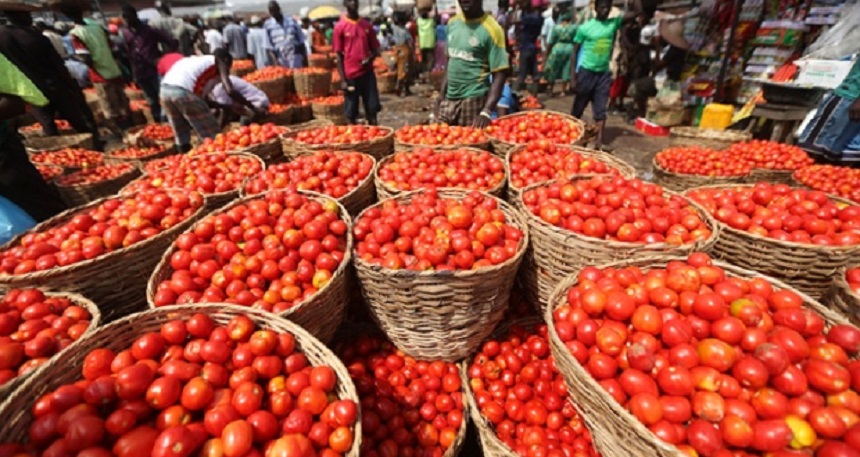
The scarcity of tomatoes experienced in parts of Nigeria is caused by a “severe infestation known as Tomato Ebola or Tomato Leaf Miner,” says the Minister of Agriculture and Food Security, Mr Abubakar Kyari.
According to developments verified by this newspaper, there is a fruit shortage in the market, which has pushed households to alternatives like tomato pastes and other vegetables.
Speaking on the issue in a post on X (formerly Twitter), the minister said the Federal Government has taken action to combat the issue.
“A significant number of our tomato farms have been affected by a severe infestation known as Tomato Ebola or Tomato Leaf Miner. This has drastically reduced the availability of tomatoes and contributed to rising costs.
“Our ministry is taking immediate action to combat this issue. We are deploying agricultural experts to affected areas to contain and eliminate the infestation.
“Additionally, we are supporting our farmers with the necessary resources and guidance to recover their crops as quickly as possible, just as we instituted the Ginger Blight Control Taskforce.
“We understand the impact this has on your daily lives and are working tirelessly to resolve the situation and restore the supply of affordable tomatoes. Thank you for your patience and understanding during this challenging time,” he said.
Earlier this month, Business Post reported that threats by the Tomato Crates Dealers Association of Nigeria and the Amalgamated Union of Food Stuff and Cattle Dealers of Nigeria could see tomatoes scarce in the markets.
Particularly, the National Chairman of the tomato sellers, Mr Ahmed Alaramma, said supply to Lagos may be cut because of the destruction of products of the group’s members in the metropolis during a clash among hoodlums at the popular Ile-Epo Market.
This is happening amid a high food inflation which reached 40.53 per cent on a year-on-year basis in April, marking a substantial increase of 15.92 percentage points from the 24.61 per cent recorded in 2023.
General
2027: Peter Obi Promises Lower Interest Rates if Elected President
By Adedapo Adesanya
The presidential candidate of the Nigeria Democratic Congress (NDC), Mr Peter Obi, has pledged to reduce interest rates if elected.
Mr Obi made the remarks during an appearance on Sunday Politics on Channels Television late on Sunday, where he outlined plans to revive the economy through cheaper credit for businesses and increased investment in agriculture and manufacturing.
He said Nigeria’s current borrowing costs are crippling small businesses, and this could be tied to the current interest rate level.
Last week, the Monetary Policy Committee (MPC) of the Central Bank of Nigeria (CBN) retained the Monetary Policy Rate (MPR), the country’s benchmark interest rate, at 26.5 per cent.
Mr Obi argued that government should focus on creating an enabling environment for entrepreneurs rather than directly engaging in production, stressing that small businesses remain the largest employers of labour in successful economies.
Drawing comparisons with countries such as Indonesia, he said governments that prioritise small businesses provide affordable financing, training and other forms of support that enable enterprises to thrive.
“The government supports them with training and loans at less than 10 per cent, actually about 5 per cent. How can you do small business in Nigeria with no support, no training, and interest rates at 35 per cent? It is impossible.”
According to Mr Obi, supporting manufacturers and visiting factories to understand their challenges is central to building a productive economy rather than one driven by consumption.
“I know the biggest problem for manufacturers today in Nigeria is interest rate,” he said.
The show’s host, Mr Seun Okinbaloye, then asked whether he would reduce interest rates if elected president.
“Of course, yes,” he answered, adding that his background in building businesses and in the corporate world qualifies him to know exactly what to do to drive the interest rate down.
Although the Nigerian president does not directly determine the MPR, presidential economic policies and appointments to the CBN leadership can influence the broader environment in which those decisions are made.
Following the conclusion of the 306th Monetary Policy Committee meeting held in Abuja on July 20 and 21, 2026, the Governor of the CBN, Mr Yemi Cardoso, who heads the MPC, said the decision to hold rates steady is intended to sustain the moderation in inflation, preserve stability in the foreign exchange market and consolidate recent macroeconomic gains.
Headline inflation eased marginally to 15.91 per cent in June 2026, from 15.93 per cent in May, although food inflation accelerated on a monthly basis to 3.75 per cent from 2.98 per cent.
General
SERAP, NNPC in Court Over N211tn Sundry Receivables, Accrued Expenses
By Adedapo Adesanya
The Socio-Economic Rights and Accountability Project (SERAP) has dragged the Nigerian National Petroleum Company (NNPC) Limited before a Federal High Court in Abuja over what it described as the company’s failure to adequately explain and account for more than ₦211 trillion recorded in its 2023 audited financial statements.
According to SERAP, the sum of N211.015 trillion was listed under “Sundry Receivables” and “Accrued Expenses” in NNPC’s audited accounts without sufficient details to enable public scrutiny of the transactions.
In the suit marked FHC/ABJ/CS/1427/2026 and filed last week, the advocacy group is seeking an order compelling the state oil company to account for the funds and disclose all documents relating to the entries contained in its 2023 financial statements.
SERAP is asking the court to direct the oil company to provide a detailed explanation and reconciliation of the N107.6 trillion recorded as “Sundry Receivables,” including the identities of the debtors, amounts owed, legal basis for the receivables and the status of efforts to recover the funds.
The organisation is also requesting the disclosure of documents relating to the N103.4 trillion listed as “Accrued Expenses,” including the identities of creditors and beneficiaries, the nature of the liabilities, their legal basis and supporting records establishing their legitimacy.
In addition, SERAP wants the court to compel NNPC to release all records used in preparing and approving the N211 trillion entries in the audited accounts.
The group argued that there is an overriding public interest in making the information available, maintaining that NNPC Limited has a legal obligation to explain the transactions and demonstrate that the figures are accurate, lawful and backed by credible documentation.
SERAP further contended that the Freedom of Information Act and the African Charter on Human and Peoples’ Rights guarantee citizens access to information held by public institutions, including NNPC Limited, to facilitate oversight of public resources.
According to the organisation, disclosure of the information would promote transparency, strengthen fiscal accountability, prevent corruption and enable Nigerians to assess how the country’s oil wealth is being managed.
The suit stated that Nigerians have a right to know who owes the N107.6 trillion, who is entitled to the N103.4 trillion in accrued expenses, the legal basis for the transactions and whether the entries comply with relevant laws and accountability standards.
Filed by SERAP’s legal team comprising Miss Oluwakemi Agunbiade, Miss Kehinde Oyewumi, Mr Andrew Nwankwo and Miss Maryam Mumuni, the suit explained that “Sundry Receivables” represent funds NNPCL claims are owed to it by individuals, companies or government entities but have not yet been received.
It also described “Accrued Expenses” as liabilities NNPCL says it owes for goods, services or other obligations already incurred but not yet paid.
SERAP argued that together, the two entries account for more than N211 trillion in NNPC’s 2023 audited financial statements, yet the accounts do not sufficiently identify the parties involved, explain the legal basis of the transactions or provide supporting documentation for independent verification.
The organisation maintained that NNPCL remains subject to the Freedom of Information Act because it is wholly owned by the Federal Government and manages petroleum resources and oil revenues on behalf of the federation.
According to SERAP, the Petroleum Industry Act does not exempt the company from its obligations to operate transparently and accountably.
The organisation added that secrecy surrounding oil revenue management undermines public trust, weakens the rule of law and runs contrary to Nigeria’s constitutional provisions, financial regulations and international anti-corruption commitments.
No date has been fixed for hearing the suit.
General
Movement Not Restricted During Monthly Environmental Sanitation—Wahab
By Modupe Gbadeyanka
The Lagos State Commissioner for the Environment and Water Resources, Mr Tokunbo Wahab, has disclosed that the state government has not restricted the movement of people during the re-introduced monthly environmental sanitation exercise.
Responding to an enquiry by an X user, Faveo Autos, on Saturday, he said the exercise was not brought back to restrict the movement of residents, noting that arresting anyone during the sanitation was unlawful and not backed by law.
However, he encouraged Lagosians to use the period to keep their surroundings clean.
“What is the fine for movement during environmental [sanitation]?” Mr Wahab was asked by Faveo Autos today.
In his response, the Commissioner said, “For clarity, there is no restriction on movement during the monthly environmental sanitation exercise. Consequently, arresting anyone on the basis of movement during the exercise is unlawful and does not represent the position or policy of the Lagos State Government.
“The monthly environmental sanitation exercise was reintroduced primarily to restore and strengthen the culture of environmental cleanliness across the state.
“The initiative is backed by the Lagos State Environmental Management and Protection Law, 2017. However, the law does not provide for any restriction on movement during the exercise.
“Our focus is on encouraging Lagosians to embrace environmental sanitation as a civic responsibility and a shared commitment to maintaining a cleaner, healthier, and more sustainable Lagos, rather than relying on enforcement measures.”