Connect with us

Economy

Tomato Scarcity Looms in Lagos as Sellers Threaten to Cut Supply

Published

on

Tomatoes

By Modupe Gbadeyanka

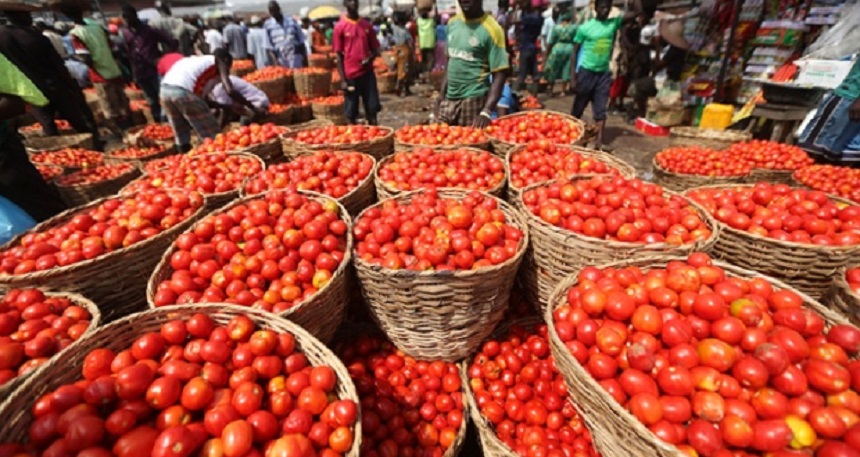
The price of tomatoes and other food products may spike very soon if the threats by the Tomato Crates Dealers Association of Nigeria and the Amalgamated Union of Food Stuff and Cattle Dealers of Nigeria are carried out.

At a press briefing on Sunday, the National Chairman of the tomato sellers, Mr Ahmed Alaramma, said supply to Lagos may be cut because of the destruction of products of the group’s members in the metropolis last week during a clash among hoodlums at the popular Ile-Epo Market.

Recall that last week, some thugs at the market destroyed food products over a disagreement.

Addressing newsmen in Zaria, Kaduna State, Mr Alaramma, who doubles as the National Secretary of the Amalgamated Union of Food Stuff and Cattle Dealers of Nigeria, commended the destruction of over 60,000 empty tomato crates by the hoodlums.

According to him, his members began to use the crates to convey tomatoes to the markets because of convenience as the raffia basket caused more damage.

He noted that each empty crate cost N6,000, and with over 60,000 empty tomato crates burnt during the mayhem, his members have lost over N360 million in investments.

“Over 70 members of the association rent out the crates to tomato dealers across the country; we have over 60,000 crates which were about to be returned to the north at the market during the turmoil.

“These crates were burnt by the area boys during the clash and they (area boys) prevented our people from quenching the fire. We have video evidence and other proof supporting our claims,” he stated.

Mr Alaramma declared that if nothing is done to compensate his members, “We will have no option than to cut the supply of tomatoes to Lagos over this incident.”

He charged the federal government, Lagos State government and other relevant stakeholders to look into the matter, as the association was already in touch with its legal team over available legal remedies in the event of an unfavourable response from the governments.


Modupe Gbadeyanka is a fast-rising journalist with Business Post Nigeria. Her passion for journalism is amazing. She is willing to learn more with a view to becoming one of the best pen-pushers in Nigeria. Her role models are the duo of CNN's Richard Quest and Christiane Amanpour.

Click to comment

Leave a Reply

Your email address will not be published. Required fields are marked *

Economy

FG Gives Committee Six Weeks to Draft New VAT Modification Order

Published

on

VAT Modification Order

By Adedapo Adesanya

The federal government has given a newly inaugurated Inter-Ministerial Committee six weeks to draft a new Value Added Tax (VAT) Modification Order 2026, as part of efforts to support the implementation of the Tax Reform Acts that took effect on January 1, 2026.

Speaking at the inauguration of the committee at the Federal Ministry of Finance headquarters in Abuja recently, the Minister of Finance and Coordinating Minister of the Economy, Mr Taiwo Oyedele, said the tight timeline was meant to ensure the country quickly gets a modern VAT framework aligned with the new tax regime and Nigeria’s broader economic transformation agenda.

Mr Oyedele said the assignment was aimed at providing a modern framework that aligns with Nigeria’s new tax regime and supports the country’s economic transformation.

Describing the Tax Reform Acts as the most comprehensive overhaul of Nigeria’s tax system in decades, the minister said the reforms were designed to simplify tax laws, improve certainty, enhance competitiveness, protect vulnerable Nigerians and drive sustainable economic growth.

“The Tax Reform Acts represent the most comprehensive reform of Nigeria’s tax system in decades. They simplify our tax laws, improve certainty, enhance competitiveness, protect vulnerable Nigerians, and position our economy for sustainable growth,” the minister said.

He explained that although the previous VAT Modification Order had been superseded by the new legislation, the committee was not expected to reproduce the old framework but to develop “a modern, coherent, and forward-looking VAT Modification Order that complements the new law and supports Nigeria’s economic transformation.”

According to the minister, the committee will review Nigeria’s existing VAT administration framework to identify areas requiring clarification, engage public and private sector stakeholders to validate classifications and ensure alignment with economic and social objectives, develop comprehensive lists of VAT-exempt and zero-rated supplies while considering revenue implications and international obligations, draft a clear and implementable VAT Modification Order, and recommend legislative amendments where necessary.

He further outlined five guiding principles for the committee’s work, including fidelity to the law, growth-oriented design, clarity and certainty, broad stakeholder engagement and international benchmarking.

“This Order should promote industrialisation, investment, exports, innovation, food security, and energy transition, without undermining the integrity of the VAT system,” the minister stated.

The committee has been given a maximum of six weeks to complete its assignment and submit a Draft VAT Modification Order 2026 alongside schedules of VAT-exempt and zero-rated supplies with corresponding Harmonised System (HS) Codes, implementation notes and a stakeholder consultation report.

Its membership comprises representatives of the Federal Ministry of Finance, Nigeria Revenue Service (NRS), Nigeria Customs Service (NCS), Federal Ministry of Industry, Trade and Investment, Joint Revenue Board (JRB), Manufacturers Association of Nigeria (MAN), Tax Advisory Committee and the Tax Justice and Governance Platform.

“The membership of this Committee brings together deep knowledge, expertise, and experience from across government and the private sector,” the minister added.

The Tax Reform Acts, which took effect on January 1, 2026, are expected to improve the ease of doing business, strengthen investor confidence and provide a more efficient tax framework to support Nigeria’s long-term economic growth.

Continue Reading

Economy

Heavy Sell-Offs Weaken NASD Index by 0.64%, Erase N16.5bn from Market

Published

on

NASD Unlisted Securities Index

By Adedapo Adesanya

NASD Over-the-Counter (OTC) Securities Exchange remained in the negative territory after it further depreciated by 0.64 per cent on Friday, July 24, despite recording four price gainers.

The NASD Security Index (NSI) dropped 27.4 points at the close of business to settle at 4,294.75 points versus the previous day’s 4,383.48 points, while the market capitalisation gave up N16.49 billion to end at N2.577 trillion, in contrast to the N2.594 trillion it ended a day earlier.

The bourse was down during the session amid heavy sell-offs, with the volume of transactions skyrocketing by 693.9 per cent to 2.99 million units from Thursday’s 377,635 units.

Equally, the value of trades went up by 71.6 per cent to N69.4 million from N40.4 million, and the number of deals increased by 41.0 per cent to 55 deals from the preceding day’s 39 deals.

Great Nigeria Insurance (GNI) Plc remained the most active stock by value on a year-to-date basis, with 3.4 billion units worth N8.4 billion, trailed by Infrastructure Credit Guarantee (Infracredit) Plc with 2.3 billion units sold for N6.5 billion, and Central Securities Clearing System (CSCS) Plc with 75.6 million units traded for N5.4 billion.

GNI Plc was also the most active stock by volume on a year-to-date basis, with 3.4 billion units exchanged for N8.4 billion, trailed by Infracredit Plc with 2.3 billion units transacted for N6.5 billion, and Resourcery Plc with 1.1 billion units valued at N415.7 million.

The market ended the session with four price gainers and two price losers, led by FrieslandCampina Wamco Nigeria Plc, which lost N7.44 to trade at N136.19 per share compared with the previous day’s N143.63 per share, and CSCS Plc, which declined by N1.64 to N93.63 per unit from N95.27 per unit.

But MRS Oil gained N13.50 to sell at N148.50 per share versus N135.00 per share, Afriland Properties Plc advanced by 56 Kobo to N17.41 per unit from N16.85 per unit, UBN Property Plc surged by 18 Kobo to N1.93 per share from N1.75 per share, and Food Concepts Plc climbed by 1 Kobo to N2.50 per unit from N2.49 per unit.

Continue Reading

Economy

Profit-taking Crashes Nigeria’s Stock Exchange by 0.19%

Published

on

Nigeria's stock exchange

By Dipo Olowookere

Nigeria’s stock exchange succumbed to profit-taking on Friday, losing 0.19 per cent when the closing gong was hit at 4 pm.

Shares in the banking and energy sectors influenced the decline suffered by the Nigerian Exchange (NGX) Limited during the session, as they respectively closed lower by 0.40 per cent and 0.04 per cent.

The industrial goods index was flat yesterday, while the insurance counter gained 0.68 per cent and the consumer goods space chalked up 0.25 per cent. The gains by these two segments could not keep Customs Street in the green territory at the close of business.

As a result, the All-Share Index (ASI) retreated by 474.00 points to 247,357.40 points from 247,831.40 points, and the market capitalisation decreased by N306 billion to N159.588 trillion from N159.894 trillion.

Presco dropped 10.00 per cent during the trading day to close at N2,070.00, Thomas Wyatt crumbled by 9.93 per cent to N3.63, Trans-Nationwide Express plunged by 8.44 per cent to N2.82, Royal Exchange slipped by 7.86 per cent to N1.29, and LivingTrust Mortgage Bank shrank by 7.32 per cent to N3.80.

On the flip side, C&I Leasing improved by 9.48 per cent to N6.35, Cornerstone Insurance rose by 9.09 per cent to N6.00, RT Briscoe jumped by 8.61 per cent to N13.25, Honeywell Flour expanded by 7.38 per cent to N17.45, and Africa Prudential increased by 6.98 per cent to N13.80.

Despite the poor performance, the local bourse recorded a positive market breadth index after finishing with 35 price gainers and 25 price losers, representing strong investor sentiment.

It was a relatively quiet market on Friday, as the activity level dropped, with the trading volume down by 27.72 per cent to 565.5 million units from 782.4 million units, and the trading value contracted by 46.89 per cent to N29.9 billion from N56.3 billion, while the number of deals executed by investors soared by 16.03 per cent to 53,688 deals from 46,273 deals.

Access Holdings was the busiest stock for the session, with a turnover of 128.0 million units sold for N3.8 billion, First Holdco transacted 35.4 million units worth N4.3 billion, Chams exchanged 34.8 million units valued at N154.3 million, Zenith Bank traded 30.4 million units for N3.9 billion, and UBA sold 30.4 million units worth N1.5 billion.

Continue Reading