Connect with us

Health

Nigeria Can Make Billions of Naira through Medical Tourism—Cancer Expert

Published

on

cancer expert Elikee Ekenna

By Bon Peters

A cancer expert and pharmacist, Dr Elikee Ekenna, says Nigeria can make billions of Naira annually through medical tourism.

Mr Ekenna made this disclosure while fielding questions recently in Emene Enugu state.

He wondered why Nigerians prefer going abroad for treatment of cancers and other life-threatening ailments like kidney diseases, heart diseases, and diabetes among others, while the cures through natural remedies are readily available even as he said that Nigeria stands to make billions of naira as people from other parts of the world will come for treatment.

Speaking on the synthetic drugs to treat such diseases he said “Some of these chronic and intractable diseases do not respond well to synthetic drugs that informed my quest for something that would do a lot for us.”

He went further to posit that his organization, Ekenna Natures Limited, was committed to understanding and finding cures for different diseases ravaging the world today through natural remedies and has been able to achieve incredible results in providing cures for globally acclaimed intractable diseases.

Mr Ekenna, a University of Nigeria Nsukka trained pharmacist insisted that he approached diseases through natural means, employing the use of plants, which according to him, have been able to produce natural drugs in the forms of capsules and pills that combat ailments like cancer, kidney failure and heart diseases.

He disclosed that those plants were thoroughly studied and based on their phytochemical constituents, were used for the drug formulations.

According to Ekenna, “These are diseases when people have them, they look at them as a death sentence, but by God’s grace I have reversed that notion in this centre.”

The pharmacist, who has garnered so many awards and recommendations from both local and foreign Universities and organizations explained that his researches were based on scientific information, not university research works.

“It is a personal work which had taken me up to 10 years to compile the phytochemical studies and properties of plants,” he said.

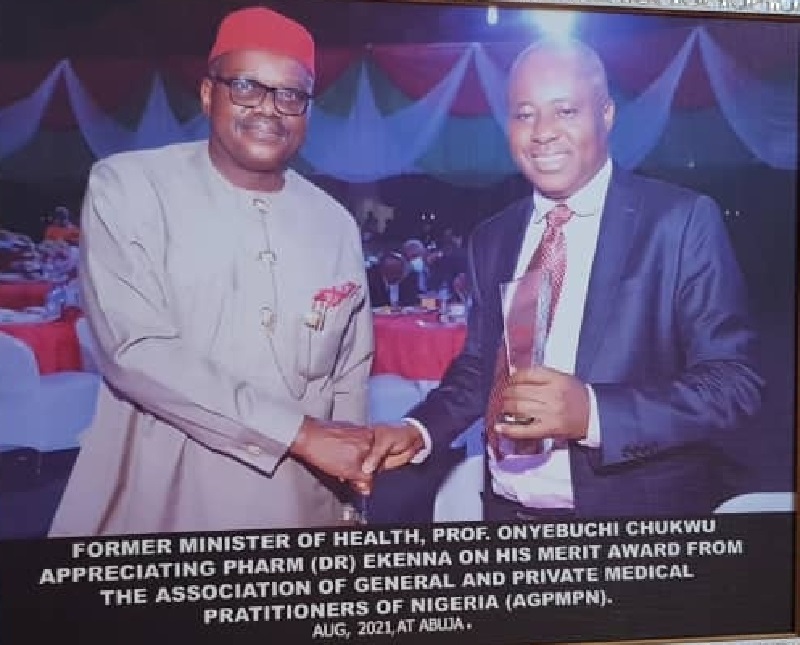
Talking about his awards, Mr Ekenna disclosed that the last award he got was from an event hosted by the Association of Private Doctors in Nigeria at a conference centre in Abuja, adding that at that conference, he met the former Minister of Health Prof. Onyebuchi Chukwu, who then was a co-awardee.

His words, “I reminded him how I struggled to present my case to him when he was the incumbent Minister of Health but was referred to National Institute for Pharmaceutical Research and Development (NIPRD) Abuja, which invited me for a presentation. I had expected to get more from the minister who showed a lot of interest in natural drugs.”

Speaking on the Federal government’s insouciant attitude towards natural drugs, Mr Ekenna explained that the federal government has  shown interest  “but what they have done is not very commendable.”  ‘I have gotten a patent Right certificate from the Federal Government. But in terms of involvement, nothing much has been done on the side of the government.” Patent right means that the federal government has to be fully involved having certified the efficacy in whatever we are doing here.”

“It takes one man to have an idea or innovation and a whole nation to develop it. If you leave it for one man, he will crumble,” he insisted.

The federal government had helped when they assisted my first line drug by paying half of the cost needed, he said.

Noting that his assistance came as a result of the validation of research work conducted by the Nigeria Natural Medicine Development Agency (NNMDA) in conjunction with LUTH, “I had expected more from a nation that should be delving more into the developing areas of medical tourism“ he said.

He went further to urge the government to reverse the trend and look into the plants with a high level of biodiversity and bioavailability even as he stated that over-dependency on Oil is not too good for the country, saying, “We are not only rich in Oil but also in active plants.”

Mr Ekenna revealed that he has reservations towards foreign partnerships, “I have not been so quick to run into the hands of foreign agencies, being a drug expert I know the implications. It is easy to sell yourself for a pot of porridge. I have tried to assess myself to see if I can make it as indigenous as possible”.

Taking a walk down memory lane, Mr Ekenna, looking back at how he started acknowledged God for restoring his health when he was diagnosed with a deadly disease during his years at the university. After this, he got inspired and resorted to using plants around him to make drugs.

“I will say that God has been and will continue to be the foundation of this world. I had my problems when I was in the university and how God delivered me made me think otherwise,” he said.

He added, “Having suffered from a disease which pharmacy I was studying at that time could not help me, I was thinking about what next to do but God healed me. God helped me establish a formula that can cure diseases.”

Still giving Glory to God, Mr Ekenna said that his growth was beyond what he had expected it to be, attributing it to hard work, consistency, discipline and a special Grace from God.

In a bid to clear the stereotypical notion of natural drugs always seen as diabolical, Mr Ekenna pointed out the difference between herbal and natural drugs.

According to him, “We have herbal and natural drugs. Natural medicine is more encompassing while herbal medicine is just herbs, ours is a scientific natural medicine which is scientifically derived with the plants studied and packaged in capsules, pills and extracts with the signs of posology; basic systems applied. So that makes a huge difference between what we do here and what we know about herbal medicine”.

He advised that the use of basic systems, where the appropriate dosage is given should be employed in the creation of herbal drugs.

Cancers and diseases being ailments that are not particular to only a set of demography, Mr Ekenna assures that his drugs are suitable for anyone suffering from those diseases except leukaemia which they are yet to establish a protocol to boast of.

“We are here for you if you have kidney disease, kidney stone, liver disease, heart diseases, cancer of all sorts except leukaemia which we have not established a protocol we can boast of at the moment”, he said pointing out some instances of cancers which had been cured completely by those drugs.

Mr Ekenna targets to establish Nigeria as a medical tourist centre for all nations of the world.

“We can do that, we use 100% natural drugs from the soil of this country, we just need to apply our science to these plants”, he said.

Mr Ekenna who made known his stance at a public hearing on the passing of the bill on natural medicine, where he said he defended the bill, stated that the Bill if passed into Law would benefit every sector and the nation’s foreign reserve would increase.

“We are not only rich in oil but also bio-active plants,” he added.

He, therefore, called on the Federal government to invest in natural medicine as it would not only benefit the nation’s health but create possible employment for the youths. He went on to encourage universities to adopt and add to their curriculum the practical aspect of courses, reiterating that once schools are practically inclined innovation and creative ideas would sprout.


Advertisement
Click to comment

Leave a Reply

Your email address will not be published. Required fields are marked *

Health

Nigeria Launches First National Antimicrobial Resistance Survey

Published

on

Antimicrobial Resistance Survey

By Adedapo Adesanya

Nigeria has launched its first nationally representative survey on antimicrobial resistance to generate critical data to guide evidence-based policies, improve patient outcomes, and strengthen health system resilience.

Antimicrobial resistance occurs when bacteria, viruses, fungi, and parasites evolve to resist treatment, making infections harder to cure.

As a result, surveillance is essential to track resistance patterns, identify priority pathogens, and guide targeted interventions and with support from the World Health Organization (WHO) and other partners, the initiative marks a milestone in the country’s public health response.

Nigeria becomes the third country globally to partner with WHO on a national antimicrobial resistance survey. having been selected based on the country’s strong commitment to AMR surveillance, its updated WHO Nigeria NAP 2.0, and readiness to expand laboratory and data systems.

Africa’s most populous country ranks 20th globally for age-standardized mortality due to antimicrobial resistance . In 2019, an estimated 263,400 deaths in Nigeria were linked to  it—more than the combined deaths from enteric infections, tuberculosis, respiratory infections, maternal and neonatal disorders, neglected tropical diseases, malaria, and cardiovascular diseases.

Globally, resistant infections in tertiary care settings cost between $2,371 and $29,289 per patient episode, extend hospital stays by an average of 7.4 days, and increase mortality risk by 84 per cent.

The survey will see the establishment of a national baseline on antimicrobial resistance prevalence to monitor interventions, assess the distribution, burden (morbidity, mortality, DALYs, cost), and diversity of AMR across regions and populations, as well as contribute to the global target of reducing AMR deaths by 10 per cent by 2030, in line with the political declaration endorsed at the 79th United Nations General Assembly in 2024.

It also seeks to strengthen routine antimicrobial resistance surveillance, including diagnostics, sample referral systems, and laboratory capacity.

Using WHO’s standardized methodology, the survey will run for 12–15 months and cover 40–45 randomly selected health facilities nationwide. Patients with suspected bloodstream infections (BSIs) will be identified using standard case definitions, and blood samples will be analysed in quality-assured laboratories.

Data will be collected across all age groups, covering clinical, demographic, laboratory, financial, and outcome indicators. Follow-up will occur at discharge, 28 days, and three months post-infection. The survey will sample approximately 35,000 patients suspected of BSIs to obtain around 800 isolates of the most common pathogens.

Dr Tochi Okwor, Acting Head, Disease Prevention and Health Promotion, Nigeria Centre for Disease Control and Prevention (NCDC) said, “With WHO’s support, we are confident the survey will generate the evidence needed to protect public health.”

WHO Representative in Nigeria, Dr Pavel Ursu, reaffirmed WHO’s commitment stating that ,“Nigeria is taking a decisive step toward combating AMR with an approach grounded in data, science, and measurable impact. This survey will provide the clarity needed to drive smarter policies, stronger surveillance, and better patient outcomes. Nigeria is laying the foundations for a resilient health system, one that protects lives, strengthens trust, and ensures that essential medicines remain effective for future generations.”

Adding her input, Dr Laetitia Gahimbare, Technical Officer at WHO Regional Office for Africa, added:“Strengthening surveillance enhances Nigeria’s capacity to detect and respond to AMR threats, supporting better patient outcomes, reinforcing health security, and building a resilient system.”

Professor Babatunde Ogunbosi, Paediatric Infectious Diseases Specialist at University College Hospital, Ibadan, highlighted the broader impact:, “This survey is about more than data. It’s about building national capacity for research, diagnostics, and policy. It integrates science into public health decision-making.”

Continue Reading

Health

Our Vision Extends Beyond Offering Health Insurance Packages—SUNU Health

Published

on

SUNU Health walk

By Modupe Gbadeyanka

One of the leading Health Maintenance Organisations (HMOs) in Nigeria, SUNU Health, has said its philosophy is proactive wellness, noting that this was why it recently partnered with The Divine Physician and St. Luke Catholic Chaplaincy Centre for a community health initiative.

The chief executive of the company, Dr Patrick Korie, said, “SUNU Health’s vision extends far beyond merely offering health packages and insurance.”

“We are fundamentally interested in proactive wellness—preventing illness rather than just treating it. This annual exercise is a crucial part of that commitment, and we will continue to champion it for as long as we exist,” he stressed.

The medical practitioner led the company’s annual Health Walk in Lagos on Saturday, November 8, 2025. The event drew hundreds of health enthusiasts, including the Chaplain of the centre, Rev Fr. John Okoria SJ.

His active participation reinforced the spiritual and moral commitment to holistic well-being, proving crucial in mobilizing staff and community members, thereby ensuring the vital wellness message reached a broad and deeply engaged audience.

The health walk covered several major streets in Lagos, starting from Ishaga Road and navigating through Itire Road, Randle Avenue, Akerele, Ogunlana Drive, and Workers Street before concluding back at the starting point. Following the vigorous walk, participants engaged in a session of high-energy aerobics and other outdoor exercises, reinforcing the day’s focus on fitness.

“We are delighted to champion this vital health initiative alongside the Catholic Chaplaincy Centre LUTH/CMUL. The turnout was truly delightful, reflecting the community’s deep desire to embrace wellness.

“Collaborations like this amplify our message and commitment to the Nigerian community,” the Brand and Corporate Communications Lead at SUNU Health, Mr Samuel Olayemi, stated.

Continue Reading

Health

80 Coronation Registrars Staff Donate Blood in Lagos CSR Initiative

Published

on

blood donation

By Adedapo Adesanya

Coronation Registrars Limited, a subsidiary of Coronation Group, in partnership with the Lagos State Blood Transfusion Committee (LSBTC), recently hosted a Blood Drive Initiative at the 5th floor of Coronation Group Plaza. The event saw over 80 staff donate blood to support critical healthcare needs in Lagos State.

The Blood Drive Initiative forms part of Coronation’s commitment to meaningful, human-centred corporate social responsibility, a direct, measurable, and life-saving effort that reflects the Group’s health and sustainability values.

As Prosperity Partners dedicated to creating sustainable wealth for clients and the African continent, Coronation recognises that true prosperity extends beyond financial returns to encompass the well-being of communities we serve.

The company noted that this initiative enabled it to deliver immediate social impact by supporting national blood supply shortfalls through employee-driven action, demonstrate leadership in health-focused CSR aligned with ESG goals and SDG 3 (Good Health & Well-being), strengthen internal culture by fostering employee engagement, empathy, and purpose in a safe, structured environment, and reinforce corporate reputation through public-facing acts of service, stakeholder trust, and media visibility.

Blood donation remains a critical need in Nigeria, where regular blood supply is essential for emergency care, surgeries, and treatment of various medical conditions. Each donation can save up to three lives, and the collective effort of Coronation employees will significantly impact patients in need across Lagos State healthcare facilities.

“This aligns seamlessly with Coronation’s broader sustainability agenda, which views healthcare access as fundamental to building prosperous communities across Africa,” the company said in a statement on Tuesday.

Partnering with a certified medical institution, the drive was professionally managed, medically compliant, and logistically efficient. Participants underwent necessary medical screening procedures to ensure donor fitness and safety. Following their donations, donors received refreshments and appreciation for their life-saving contribution.

“At Coronation, we believe in making a meaningful difference in the communities we serve,” said Mr Oluseyi Owoturo, Chief Executive Officer of Coronation Registrars Limited. “This Blood donation Initiative reflects our values in action, saving lives, building community, and positioning the company as a purpose-driven brand. We’re proud of our employees who stepped forward to donate blood and save lives. This is what sustainable impact looks like: tangible solutions that address real challenges facing our continent.”

The partnership with the Lagos State Blood Transfusion Committee ensured professional handling of the donation process, meeting all safety and quality standards for blood collection and storage.

Coronation Registrars Limited says it continues to demonstrate that corporate success goes hand-in-hand with social responsibility.

“This initiative reinforces the company’s purpose to create a prosperous future for clients and the African continent through transformational solutions,” it added.

Continue Reading

Trending