

Connect with us

Technology

Experts Discuss Ways to Navigate Fintech Regulatory Compliance Complexities

Published

on

Fintech Regulatory Compliance Complexities
By Modupe Gbadeyanka

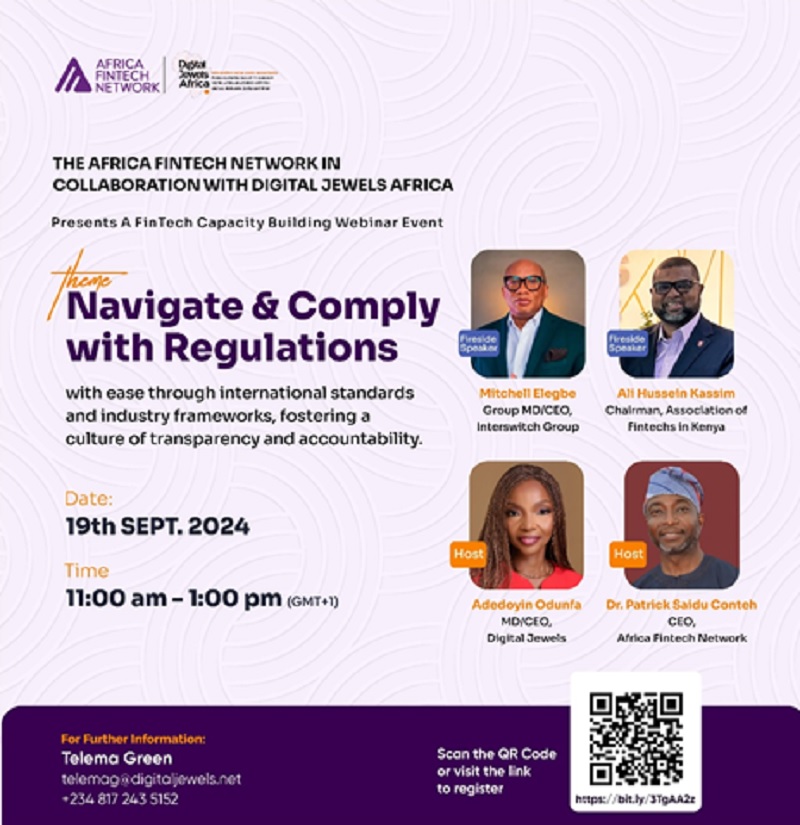
Some experts in the financial technology (fintech) industry in Africa recently provided valuable insights into the complexities of regulatory compliance at a webinar put together by Digital Jewels in collaboration with the Africa Fintech Network.

At the event themed Navigate and Comply with Regulations with Ease through International Standards and Industry Frameworks: Fostering a Culture of Transparency and Accountability, the speakers, including the chief executive of Interswitch Group, Mr Mitchell Elegbe, advised companies to endeavour to always be ahead of the regulator to avoid sanctions.

“Back in 2002, we faced significant challenges in gaining trust as a payment company in Nigeria. It was critical for us to be ahead of the curve with compliance and governance to build trust with both customers and regulators. That decision ultimately saved us and allowed us to grow into what we are today,” Mr Elegbe remarked.

He also appreciated Digital Jewels for helping Interswitch adopt global best practice standards, which significantly improved their operational efficiency and security.

On his part, the chairman of the Association of Fintechs in Kenya, Mr Ali Hussein Kassim, noted that Kenya and East Africa still lag behind in adopting global best practices despite being pioneers in mobile money and financial inclusion.

“The most interesting tech engagement and evolution will be the meshing of regtech and subtech so that we don’t have these humongous reporting structures every month to policymakers and regulators. It can be real-time.” He said, adding that this could allow for more agile compliance processes, benefiting both fintech companies and regulators.

The CTO of Digital Jewels, Mr Tokunbo Taiwo, outlined the operational challenges that fintech organizations face and stressed the importance of regulatory compliance as a key driver for growth.

“Fintech in Africa is growing at an unprecedented rate, ranking in the top 10 globally and third in Nigeria. A young, urbanizing population fuels this growth, increased digital penetration, and the post-COVID acceleration of digital services,” he stated, emphasising the importance of frameworks like ISO 27001 and PCI-DSS, which allow companies to create a unified compliance system that satisfies both local and international regulatory requirements.

On her part, the chief executive of Digital Jewels, Ms Adedoyin Odunfa, stated that, “International standards can help fintechs comply with ease,” pointing out that, “Ignorance is not an excuse under the law, so, fintechs must stay informed and ahead of the regulations they need to comply with.

“Don’t wait for the regulator to catch up with you. Being ahead of regulation is not just about compliance—it is about positioning yourself competitively in the market.”


Modupe Gbadeyanka is a fast-rising journalist with Business Post Nigeria. Her passion for journalism is amazing. She is willing to learn more with a view to becoming one of the best pen-pushers in Nigeria. Her role models are the duo of CNN's Richard Quest and Christiane Amanpour.

1 Comment

1 Comment

  1. Pingback: Experts Discuss Ways to Navigate Fintech Regulatory Compliance Complexities – Herald Today

Leave a Reply

Your email address will not be published. Required fields are marked *

Technology

The Difference Between VPS and Dedicated Server Explained

Published

on

vps dedicated server

Choosing between a VPS and a dedicated server can be complex. They run apps and webpages. But they operate differently. Understanding the difference between VPS and dedicated server solutions will help you prevent complications and save money later on. In this text we will explain everything in detail with examples from actual life.

VPS vs Dedicated Server: What Actually Sets Them Apart

One physical machine is divided into multiple virtual servers by a VPS. Through virtualization software, each user receives a portion of resources that are separate from those of other users.

A dedicated server operates in a different manner. One user owns a single physical machine. No neighbors, no sharing, simply complete hardware access.

This is the core of the vps vs dedicated server debate. Shared hardware means lower costs, while full ownership means more raw power. Finding the best vps hosting service often comes down to how well a provider balances performance with fair pricing on shared resources.

Factor VPS Dedicated Server
Resource allocation Shared pool, virtualized 100% dedicated hardware
Performance consistency Possible noisy neighbor effect Guaranteed, stable capacity
Scalability Instant resize Requires hardware upgrade or migration
Cost Lower entry price Higher fixed cost

Performance, Cost and Control: Where Each One Wins

In terms of raw performance, dedicated servers are superior. Each gigabyte of RAM and each CPU cycle are part of a single project. There is no competition for resources.

Flexibility is where VPS excels. It takes minutes, not days, to scale up. Pricing stays lower too, since costs get split across multiple users on the same hardware.

Shared hardware limitations rarely cause problems for smaller projects. Providers like Antihost allocate resources fairly, so performance stays steady even during traffic spikes. The gap only really matters once traffic gets heavy and consistent.

The contrast of vps vs virtual machine is also confusing people often. A VPS is a virtual computer in a technical sense, but it’s rented from a hosting company, rather than running on your own hardware.

vps dedicated server difference

Matching the Server to the Project: Real Scenarios

A dedicated server is rarely required for a small business website. A VPS can easily manage moderate traffic while maintaining low expenses.

A growing SaaS product usually starts on a VPS and expands as the user base grows. This adaptability is more crucial in the early stages than brute strength.

A database-heavy application benefits from dedicated hardware once query volume reaches a certain level. In this case, the lack of resource sharing and a constant disk speed are essential.

A game server depends on low latency and steady performance. Many game servers run fine on VPS today, especially with modern hardware. As David Heinemeier Hansson put it: “Personal servers have gotten really scarily quick, inefficient, and personal internet connections rival what we connected data centers with just a decade or two ago.” That shift makes VPS a stronger option than it used to be.

Here is a quick breakdown of what typically fits best:

  • Small business website: VPS, for cost and simplicity
  • Growing SaaS product: VPS, then scale to dedicated later
  • Database-heavy app: Dedicated server, for consistent speed
  • Game server: VPS, unless player counts get very large

Summary

In every situation, neither choice is superior to the other. Everything impacts the optimal selection, including the scale of the project, traffic patterns, and all growth plans. Scale from what works now when the numbers really demand it.

Continue Reading

Technology

Damage to Fibre Networks Carries Significant Economic Consequences—NCC

Published

on

ATCON FTTH fibre networks

By Modupe Gbadeyanka

The Executive Vice Chairman of the Nigerian Communications Commission (NCC), Mr Aminu Maida, has reemphasised the need to protect the nation’s telecommunications infrastructure, especially fibre networks, noting that damage to fibre networks carries significant economic consequences.

Speaking virtually at the Association of Telecommunications Companies of Nigeria (ATCON) Critical Conversation Forum on Fibre-to-the-Home (FTTH) in Lagos recently, he described FTTH as a critical enabler of Nigeria’s digital future.

“FTTH is uniquely positioned to meet Nigerians' next phase of data demand. The quality of our broadband will increasingly shape the competitiveness of our businesses, the growth of our digital industry and the opportunities available to our citizens,” the NCC chief stated.

“We must uphold deployment standards. Nigeria needs fibre that is properly installed, properly documented, and properly protected,” Mr Maida further said at the event themed Fibre to the Home in Nigeria: Addressing Challenges, Strengthening Standards and Ensuring Sustainable Deployment.

During a panel discussion titled Policy, Governance and Regulatory Alignment, the Deputy Director of Strategic Business Initiatives at ipNX, Mr Segun Okuneye, highlighted the need for stronger collaboration across the telecommunications ecosystem to unlock the full potential of fibre broadband in Nigeria.

According to him, sustainable fibre deployment extends beyond technology and investment to include policy consistency, stakeholder alignment, infrastructure protection, and shared responsibility.

“Achieving universal fibre connectivity requires more than deploying infrastructure; it requires sustained collaboration between operators, regulators, government agencies and host communities.

“When policies are aligned, deployment standards are consistently enforced, and critical infrastructure is protected, we create an environment where investment thrives and more Nigerians can enjoy reliable, high-speed broadband.

“At ipNX, we remain committed to working with all stakeholders to build resilient digital infrastructure that will support Nigeria’s economic growth for generations to come.”

Earlier in his welcome address, ATCON President, Mr Tony Emoekpere, underscored the strategic importance of FTTH in achieving the country’s broadband penetration targets while calling for greater public awareness around protecting communications infrastructure.

“This forum is critical because Fibre-to-the-Home is the technology that will enable the country to achieve full broadband penetration. We all depend on communication infrastructure, and it must be protected,” he declared.

Drawing a comparison with power infrastructure in the country, he added, “If somebody comes to your neighbourhood to tamper with your transformer or power cables, everybody will come out. The same thing needs to apply for communications infrastructure. When we see people damaging fibre cables, we should raise an alarm.”

Continue Reading

Technology

Financial Services Professionals Discuss Meeting Rising Customer Expectations

Published

on

Core by Interswitch

By Modupe Gbadeyanka

Thursday, July 23, 2026, provided an opportunity for financial services professionals to converge on Landmark Event Centre, Lagos, to brainstorm on ways to meet the rising customers’ expectations.

The platform used for this purpose was Core by Interswitch. It is part of the company’s broader commitment to strengthening Africa’s digital payments ecosystem by fostering collaboration, knowledge sharing and operational excellence across the financial services value chain.

At the event, participants, numbering over 400, also highlighted the growing importance of operational excellence in sustaining resilient payment infrastructure.

As digital financial services continue to expand across Africa, closer collaboration among financial institutions, fintechs and payment service providers will be essential to improving responsiveness, resolving operational challenges more effectively and delivering consistently reliable customer experiences.

The Executive Vice President for Operations and Technology at Interswitch, Mr Babafemi Ogungbamila, said the forum reflects the company’s belief that exceptional customer experiences are built not only on innovative technology but also on the expertise, collaboration and commitment of the professionals who keep payment systems running every day.

“Every successful digital transaction is powered by professionals whose work often goes unseen but is fundamental to building trust in digital payments. Core by Interswitch was created to recognise their contribution, strengthen collaboration across the industry and create opportunities for shared learning that ultimately benefit financial institutions and the customers they serve.

“As digital payments continue to evolve, investing in the people and processes that power the technology is just as important as investing in the technology itself,” Mr Ogungbamila said.

Beyond recognising the professionals whose work often goes unnoticed, the programme underscored the value of creating stronger connections across the payments ecosystem.

By creating a dedicated platform for knowledge sharing, collaboration and professional development, Core by Interswitch aims to build a more connected community of payments operations professionals equipped to respond to the evolving demands of the digital economy.

Continue Reading
