General
AATF Advocates Self-Sufficiency With Adoption of Water-Efficient Maize
By Adedapo Adesanya
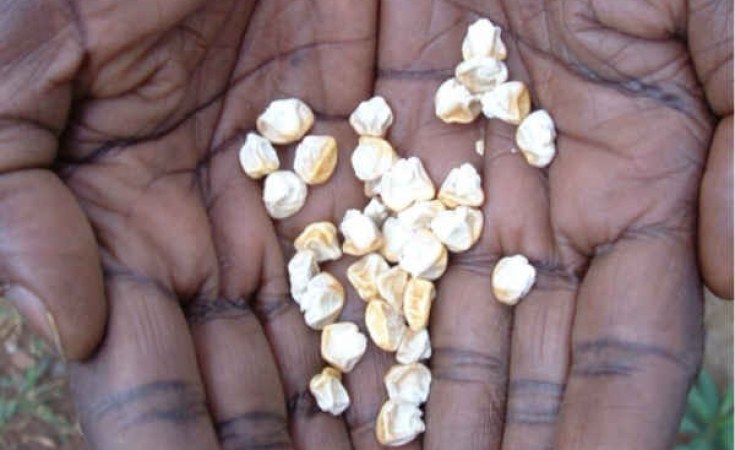
The African Agricultural Technology Foundation (AATF) says Nigeria will be self-sufficient in maize production by 2028 by adopting Water-Efficient Maize for Africa (WEMA) TELA maize by farmers across the country.
WEMA TELA Maize Project Manager for AATF, Mr Sylvester Oikeh, said this on the sidelines of an inspection tour of the TELA maize demo farm of the National Agricultural Biotechnology Research Development Agency (NABRDA) in Abuja, carried out by the TELA Maize Governing Council.
He urged Nigerians to embrace TELA maize technology as it was drought and insect-resistant as well as safe for humans and livestock.
Mr Oikeh said that the variety of the product had triple protection against drought, stemborer and fall army-worm.
According to him, by embracing the product, farmers will not need to spray.
The project manager said the technology had come to stay, adding that what was needed was to develop a seed system that would allow more farmers to have access to the seed.
He, however, identified inadequate seed as the biggest challenge currently facing the country.
Mr Oikeh said the organisation, at the moment, had opened 150 hectares to produce seed against 2025.
He said that despite the gesture, the seed would not be sufficient due to high demand.
Oikeh said that in the next three to four years, farmers should be able to have enough food produced locally to meet the seed demand for the product in the country.
“We brought in 51 tonnes of TELA maize this year which farmers are growing mostly for promotion; next year we are hoping to have 400 tonnes.
“In two years, we are planning to have up to 1,200 tons; so, by 2028 we should have 11,000 tons of TELA maize produce in Nigeria
“This is a new technology that requires training of the people; and gradually, as their production is increasing, you decrease importation until we meet local demand.
“Any government that embraces this technology must have the good political will to use the genetically modified technology to address the food security problem.’’
Mr Oikeh commended the government for embracing the product and called for the support of all and sundry to enable more farmers to adopt the technology to address the problem of drought and insects.
He said the TELA maize farm visitation was purposely to evaluate the project on the field with the seed system team.
“The evaluation is to allow them to see the performance of the varieties on farmers’ fields and their concerns so that when they go back to the breeding programme, they can improve on the breed based on the feedback they received.
“It also allows the team to know what the farmers feel and the amount of seeds required so that the team can start preparing the seeds it will bring to the farmers next year,” he added.
General
Datti Baba-Ahmed Dumps Labour Party, Joins PRP
By Modupe Gbadeyanka
The vice-presidential candidate of the Labour Party (LP) in the 2023 general elections, Mr Datti Baba-Ahmed, has left the party to join the Peoples Redemption Party (PRP).
Speaking on Channels Television’s Politics Today, the politician said he’s no longer interested in the way the Labour Party was being run.
He disclosed that there is no more peace in the political party he flew its flag in the last general elections because of greed.
He accused the ruling All Progressives Congress (APC) of destabilising opposition political parties to ensure President Bola Tinubu does not have a credible opponent in the 2027 presidential poll.
“What the Labour Party stood for is not the same now. We have a government of today which is interested in destroying other political parties,” he said.
“I am leaving the Labour Party tomorrow (today) by 12 midnight,” Mr Baba-Ahmed said when asked about his plans for next year.
I am leaving the Labour Party [at] midnight, and I am joining PRP. PRP is the new destination. PRP is the one with a history. It’s about 75 years old,” he further stated.
He further said, “When there was real peace in the Labour Party, someone was redeployed to the Labour Party and because of the antecedents of the person, [I don’t see things getting better].
PRP, a progressive Nigerian political party, was established in 1978 by Mallam Aminu Kano. It is rooted in social democratic principles and populist ideology, often focusing on the empowerment of the talakawa (common people).
Its current National Chairman, according to data obtained from the website of the Independent National Electoral Commission (INEC), is Mr Falalu Bello, while the National Secretary is Mr Babatunde F. Alli.

General
We Prioritised Personal Pension Plan, Others for Robust Pension System— PenCom
By Modupe Gbadeyanka
The Director General of the National Pension Commission (PenCom), Ms Omolola Oloworaran, has highlighted strategies deployed by her organisation to ensure pension coverage is deepened in Nigeria.
Speaking at the ISSA Technical Seminar in Abuja recently, she said the steps taken were to build a more inclusive, transparent, and responsive pension system, where communication serves not just as information, but as a bridge to trust, accessibility, and sustained industry growth.
According to her, the Contributory Pension Scheme (CPS) has, over more than two decades, built a strong institutional foundation, but true inclusion goes beyond coverage to require trust and clear communication.
For this reason, PenCom has prioritised the Personal Pension Plan, strengthened stakeholder engagement, and invested in digital channels that reach contributors in accessible and relatable ways, she stated.
Ms Oloworaran further stressed that, “Effective communication is not a soft complement to regulation; it is a core instrument of coverage expansion, compliance, and public confidence.
“Every circular we issue, every benefit we pay, and every reform we introduce ultimately succeeds or fails on whether our members can understand it and act on it.”
The ISSA Technical Seminar, themed Improving Inclusivity and Accessibility of Social Security Services Through Effective Communication, was organised in collaboration with the International Social Security Association (ISSA).
It brought together key stakeholders across West Africa to advance dialogue on strengthening social security systems through clearer, more inclusive engagement.
General
Nnaji Expresses Worry Over Lack of Power Plant Financing
By Adedapo Adesanya
Former Minister of Power, Mr Barth Nnaji, has run to the rooftop to declare that Nigeria has not secured financing for any major power plant in more than a decade, blaming policy reversals and weak government commitment for the prolonged investment drought.
Speaking at the Nigerian Association for Energy Economics conference in Lagos, Mr Nnaji said the country’s power sector lost momentum after a promising financing framework introduced under his watch was abandoned following a change in administration.
According to him, the partial risk guarantee instrument developed jointly with former Finance Minister, Mrs Ngozi Okonjo-Iweala, had begun attracting international investors by reducing the risks associated with power projects in Nigeria.
“The world was galloping to us to finance power plants because we were getting a service guarantee,” he said, noting that the framework helped secure funding for the Azura-Edo Power Station, one of Nigeria’s most significant independent power projects.
However, he said the policy was scrapped after the administration changed, abruptly halting investor interest.
“Till today, we have not financed any new major power plant in Nigeria. That’s about 11 years ago,” he said.
Mr Nnaji argued that policy inconsistency remains one of the biggest obstacles to power sector growth, without clear, stable and bankable policies.
He said Nigeria will continue to struggle to attract the long-term capital required for large-scale electricity projects.
He also urged Nigeria to adopt a pragmatic approach to energy transition, stressing that natural gas should remain the backbone of the country’s power strategy. With more than 210 trillion cubic feet of proven gas reserves, he said Nigeria is well-positioned to use gas as a bridge fuel for industrialisation and economic growth over the next two decades.
Yet, despite these vast reserves, inadequate infrastructure continues to constrain supply.
Mr Nnaji noted that the Nigeria LNG Limited is operating at only about 60 per cent of capacity due to insufficient gas availability, highlighting the urgent need for greater investment in gas production, processing and transportation.
He also cited the long-delayed Mambilla Hydroelectric Power Station as a symbol of Nigeria’s execution failures. Although technically viable, the project has remained on the drawing board for more than 40 years because of weak political will and inconsistent implementation.
He noted that Nigeria’s power challenge is not a lack of resources but a failure of execution. With an installed generation capacity of about 13,000 megawatts, the country still produces only 4,000 to 5,000 megawatts on average. Until policy becomes consistent and infrastructure investment accelerates, reliable electricity will remain frustratingly out of reach for millions of Nigerians.
-
Feature/OPED6 years agoDavos was Different this year
-
Travel/Tourism10 years ago
Lagos Seals Western Lodge Hotel In Ikorodu
-
Showbiz3 years agoEstranged Lover Releases Videos of Empress Njamah Bathing
-
Banking8 years agoSort Codes of GTBank Branches in Nigeria
-
Economy3 years agoSubsidy Removal: CNG at N130 Per Litre Cheaper Than Petrol—IPMAN
-
Banking3 years agoSort Codes of UBA Branches in Nigeria
-
Banking3 years agoFirst Bank Announces Planned Downtime
-
Sports3 years agoHighest Paid Nigerian Footballer – How Much Do Nigerian Footballers Earn

Pingback: AATF Champions Self-sufficiency With Water-efficient Maize. | (एएटीएफ जल-कुशल मक्का को अपनाने के साथ आत्मनिर्भरता की वकालत करता है ) - Latestagri