

Connect with us

Economy

Molex Envisions the Future of Robotics in New Industry Report that Considers the Rising Potential of Human-Machine Collaborations

Published

on

  • Advances in artificial intelligence, machine learning and sensor fusion drive robotics functionality across factory, home, classroom, healthcare and military applications
  • Ongoing innovations in high-speed connectivity, edge computing, network redundancy and fail-safe procedures crucial to optimizing robotics opportunities
  • Emergence of natural language processing and emotional AI functionality poised to propel more intuitive, responsive and adaptive human-machine interaction


LISLE, IL – Media OutReach Newswire – 3 December 2024 – Molex, a global electronics leader and connectivity innovator, has issued a thought leadership report that looks at the future potential of robotics, resulting in more intuitive, intelligent and interconnected human-machine communications and collaborations. “The Molex 2024 Robotics Report: How Robotics will Empower Human Potential” contemplates a future where highly advanced robotics systems and multipurpose robots transform fundamental aspects of everyday life — from improving how factories function and students learn to making smart homes more efficient, elevating patient care and increasing support for military operations.
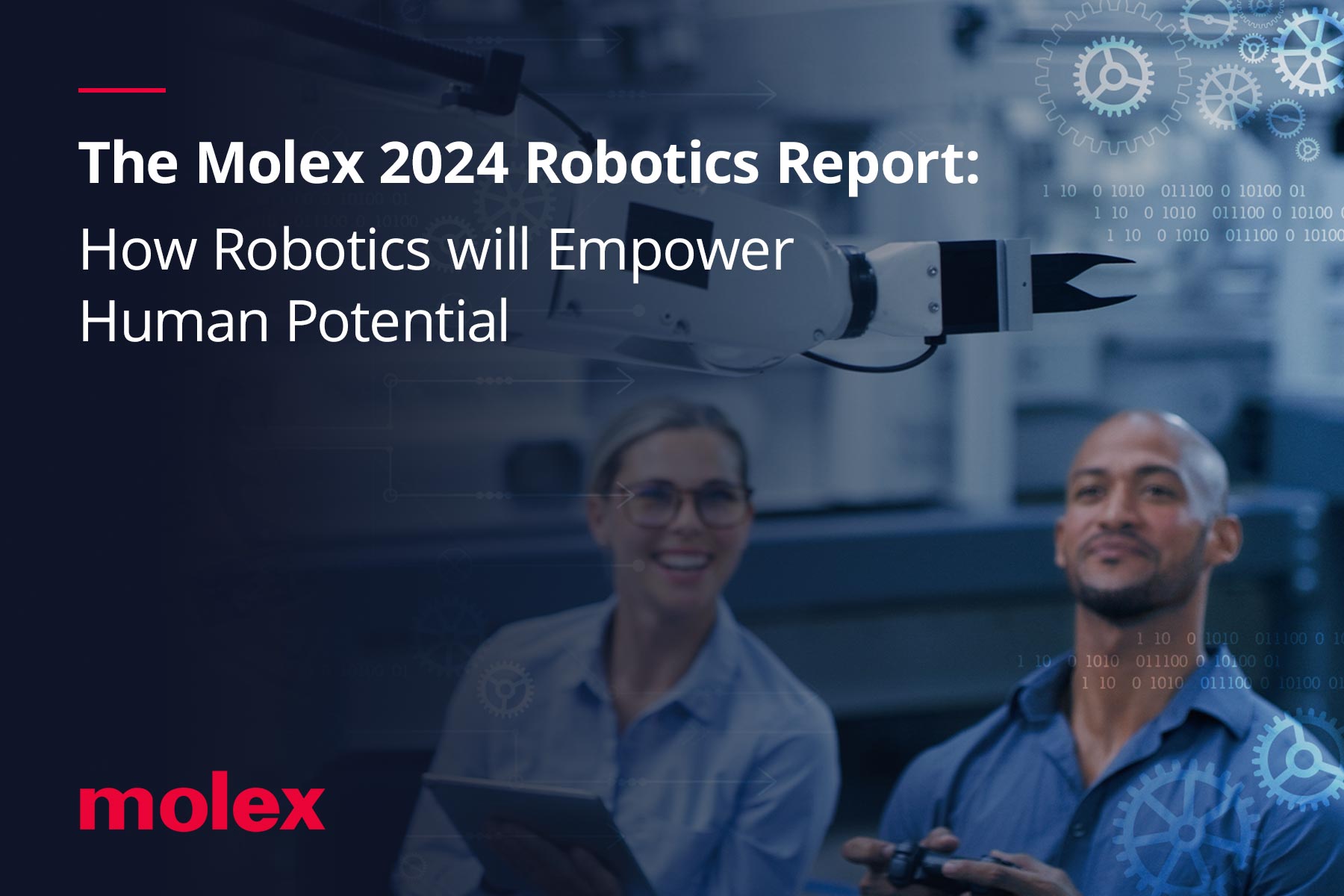
Molex Envisions the Future of Robotics in New Industry Report that Considers the Rising Potential of Human-Machine Collaborations

“As we explore the role of robotics across various industries, it is becoming increasingly apparent that the future will be shaped by the evolving relationship between humans and machines,” said Brian Hauge, SVP and president, Consumer and Commercial Solutions, Molex. “This latest industry report sheds light on a promising future of unprecedented human-machine interactions while underscoring the critical need for enabling technologies and seamless connections between robotics systems and their human counterparts to empower faster, more effective and extremely precise decision making.”

Foundational Technologies Driving Robotics Advancements
The future of robotics depends in larger part on the continued evolution of core communications and computing technologies that enable autonomous operation in dynamic environments. Topping the list is high-speed connectivity, as robotics systems require low-latency communications and near-instantaneous data transfers to respond with speed and precision. While 5G/6G networks will deliver high bandwidth, low latency communications, it is important to design robotics solutions with multiple connectivity options, including the ability to switch between 5G and Wi-Fi or satellite networks that provide multi-channel redundancy.

Equally important, processing data locally on nearby edge devices ensures uninterrupted, independent operation of robotics systems and robots. With edge computing, for example, these automated solutions can process data instantaneously, which is essential for applications requiring split-second decisions. In most industrial automation or manufacturing environments, robots are always programmed with fail-safe protocols that throttle back power and functionality to a safe operational state if connectivity is disrupted or compromised.

Benefitting from AI/ML and Sensor Fusion Innovations
As the biggest engines behind robotic adaptability, advancements in AI and ML are crucial. AI algorithms let robots make informed decisions based on real-time data while adapting quickly to new circumstances, and even predicting future conditions based on past interactions. Through ML, robots can analyze patterns to optimize behavior while increasing efficiency and accuracy by continually learning, adapting and improving performance. Sensor fusion combines data from different sources, such as LiDAR, cameras, along with depth and force sensors, to help multipurpose robots better perceive depth, movement and obstacles in different settings.

Important Factors in Greater Human-Robot Interactions
According to Molex’s robotics report, robots that can understand, respond to, and even anticipate human emotional and contextual needs are on the horizon. With Natural Language Processing (NLP), for instance, robots can follow spoken commands, engage in dialogue and adjust actions based on contextual understanding. Additionally, emotional AI enables robots to recognize and respond to emotional cues by analyzing a human’s tone of voice or facial expressions. Molex expects this rise in human-centered interactions to foster a deeper sense of engagement, enabling future robotics systems and autonomous robots to adapt more readily to complex home environments, and take on new roles as personalized educational tutors, indispensable surgery assistants and continuous patient monitors.

With the arrival of Industry 4.0, collaborative robots, or cobots, are gaining traction in handling increasingly complicated duties in industrial settings. Not only can robotics systems and an entire fleet of robots keep production lines running smoothly, but they can also anticipate and fix potential manufacturing bottlenecks while helping engineers design better products. In the future, cobots will redefine precision and personalization in every environment, including operating rooms, classrooms and battlefields.

Critical Enabler of Robotic Transformations
Major advances in robotic technologies and greater interaction opportunities will require innovations in connectivity, power management and data processing. Molex’s robust portfolio of resilient and reliable connectors will enable ever-increasing collaboration between humans and machines to support the most demanding applications across diverse industry sectors.
Hashtag: #Molex

The issuer is solely responsible for the content of this announcement.

About Molex

Molex is a global electronics leader committed to making the world a better, more connected place. With presence in more than 40 countries, Molex enables transformative technology innovation in the automotive, data center, industrial automation, healthcare, 5G, cloud and consumer device industries. Through trusted customer and industry relationships, unrivaled engineering expertise, and product quality and reliability, Molex realizes the infinite potential of Creating Connections for Life. For more information, visit .

Adedapo Adesanya is a journalist, polymath, and connoisseur of everything art. When he is not writing, he has his nose buried in one of the many books or articles he has bookmarked or simply listening to good music with a bottle of beer or wine. He supports the greatest club in the world, Manchester United F.C.

Advertisement

Economy

UK Backs Nigeria With Two Flagship Economic Reform Programmes

Published

on

UK Nigeria

By Adedapo Adesanya

The United Kingdom via the British High Commission in Abuja has launched two flagship economic reform programmes – the Nigeria Economic Stability & Transformation (NEST) programme and the Nigeria Public Finance Facility (NPFF) -as part of efforts to support Nigeria’s economic reform and growth agenda.

Backed by a £12.4 million UK investment, NEST and NPFF sit at the centre of the UK-Nigeria mutual growth partnership and support Nigeria’s efforts to strengthen macroeconomic stability, improve fiscal resilience, and create a more competitive environment for investment and private-sector growth.

Speaking at the launch, Cynthia Rowe, Head of Development Cooperation at the British High Commission in Abuja, said, “These two programmes sit at the heart of our economic development cooperation with Nigeria. They reflect a shared commitment to strengthening the fundamentals that matter most for our stability, confidence, and long-term growth.”

The launch followed the inaugural meeting of the Joint UK-Nigeria Steering Committee, which endorsed the approach of both programmes and confirmed strong alignment between the UK and Nigeria on priority areas for delivery.

Representing the Government of Nigeria, Special Adviser to the President of Nigeria on Finance and the Economy, Mrs Sanyade Okoli, welcomed the collaboration, touting it as crucial to current, critical reforms.

“We welcome the United Kingdom’s support through these new programmes as a strong demonstration of our shared commitment to Nigeria’s economic stability and long-term prosperity. At a time when we are implementing critical reforms to strengthen fiscal resilience, improve macroeconomic stability, and unlock inclusive growth, this partnership will provide valuable technical support. Together, we are laying the foundation for a more resilient economy that delivers sustainable development and improved livelihoods for all Nigerians.”

On his part, Mr Jonny Baxter, British Deputy High Commissioner in Lagos, highlighted the significance of the programmes within the wider UK-Nigeria mutual growth partnership.

“NEST and NPFF are central to our shared approach to strengthening the foundations that underpin long-term economic prosperity. They sit firmly within the UK-Nigeria mutual growth partnership.”

Continue Reading

Economy

MTN Nigeria, SMEDAN to Boost SME Digital Growth

Published

on

MTN Nigeria SMEDAN

By Aduragbemi Omiyale

A strategic partnership aimed at accelerating the growth, digital capacity, and sustainability of Nigeria’s 40 million Micro, Small and Medium Enterprises (MSMEs) has been signed by MTN Nigeria and the Small and Medium Enterprises Development Agency of Nigeria (SMEDAN).

The collaboration will feature joint initiatives focused on digital inclusion, financial access, capacity building, and providing verified information for MSMEs.

With millions of small businesses depending on accurate guidance and easy-to-access support, MTN and SMEDAN say their shared platform will address gaps in communication, misinformation, and access to opportunities.

At the formal signing of the Memorandum of Understanding (MoU) on Thursday, November 27, 2025, in Lagos, the stage was set for the immediate roll-out of tools, content, and resources that will support MSMEs nationwide.

The chief operating officer of MTN Nigeria, Mr Ayham Moussa, reiterated the company’s commitment to supporting Nigeria’s economic development, stating that MSMEs are the lifeline of Nigeria’s economy.

“SMEs are the backbone of the economy and the backbone of employment in Nigeria. We are delighted to power SMEDAN’s platform and provide tools that help MSMEs reach customers, obtain funding, and access wider markets. This collaboration serves both our business and social development objectives,” he stated.

Also, the Chief Enterprise Business Officer of MTN Nigeria, Ms Lynda Saint-Nwafor, described the MoU as a tool to “meet SMEs at the point of their needs,” noting that nano, micro, small, and medium businesses each require different resources to scale.

“Some SMEs need guidance, some need resources; others need opportunities or workforce support. This platform allows them to access whatever they need. We are committed to identifying opportunities across financial inclusion, digital inclusion, and capacity building that help SMEs to scale,” she noted.

Also commenting, the Director General of SMEDAN, Mr Charles Odii, emphasised the significance of the collaboration, noting that the agency cannot meet its mandate without leveraging technology and private-sector expertise.

“We have approximately 40 million MSMEs in Nigeria, and only about 400 SMEDAN staff. We cannot fulfil our mandate without technology, data, and strong partners.

“MTN already has the infrastructure and tools to support MSMEs from payments to identity, hosting, learning, and more. With this partnership, we are confident we can achieve in a short time what would have taken years,” he disclosed.

Mr Odii highlighted that the SMEDAN-MTN collaboration would support businesses across their growth needs, guided by their four-point GROW model – Guidance, Resources, Opportunities, and Workforce Development.

He added that SMEDAN has already created over 100,000 jobs within its two-year administration and expects the partnership to significantly boost job creation, business expansion, and nationwide enterprise modernisation.

Continue Reading

Economy

NGX Seeks Suspension of New Capital Gains Tax

Published

on

capital gains tax

By Adedapo Adesanya

The Nigerian Exchange (NGX) Limited is seeking review of the controversial Capital Gains Tax increase, fearing it will chase away foreign investors from the country’s capital market.

Nigeria’s new tax regime, which takes effect from January 1, 2026, represents one of the most significant changes to Nigeria’s tax system in recent years.

Under the new rules, the flat 10 per cent Capital Gains Tax rate has been replaced by progressive income tax rates ranging from zero to 30 per cent, depending on an investor’s overall income or profit level while large corporate investors will see the top rate reduced to 25 per cent as part of a wider corporate tax reform.

The chief executive of NGX, Mr Jude Chiemeka, said in a Bloomberg interview in Kigali, Rwanda that there should be a “removal of the capital gains tax completely, or perhaps deferring it for five years.”

According to him, Nigeria, having a higher Capital Gains Tax, will make investors redirect asset allocation to frontier markets and “countries that have less tax.”

“From a capital flow perspective, we should be concerned because all these international portfolio managers that invest across frontier markets will certainly go to where the cost of investing is not so burdensome,” the CEO said, as per Bloomberg. “That is really the angle one will look at it from.”

Meanwhile, the policy has been defended by the chairman of the Presidential Fiscal Policy and Tax Reforms Committee, Mr Taiwo Oyedele, who noted that the new tax will make investing in the capital market more attractive by reducing risks, promoting fairness, and simplifying compliance.

He noted that the framework allows investors to deduct legitimate costs such as brokerage fees, regulatory charges, realised capital losses, margin interest, and foreign exchange losses directly tied to investments, thereby ensuring that they are not taxed when operating at a loss.

Mr Oyedele  also said the reforms introduced a more inclusive approach to taxation by exempting several categories of investors and transactions.

Continue Reading

Trending

