Connect with us

Economy

Elumelu Charges Ghanaian Youth on Africapitalism

Published

on

By Dipo Olowookere

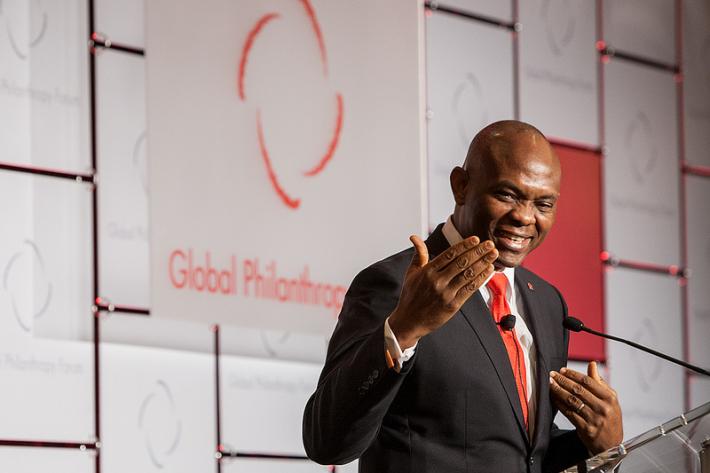
Chairman of United Bank for Africa (UBA) Plc, Mr Tony Elumelu, recently visited Ghana as the first stop of his UBA tour of Africa, propagating the ideal of Africapitalism.

In continuation of his strategic vision of engineering a robust economic and business relationship across the continent through Africapitalism as a necessary tool for the socio economic development of Africa, the Founder of Tony Elumelu Foundation (TEF) spoke at the prestigious University of Ghana, Legon, before hundreds of Ghanaian youths, academics and entrepreneurs.

The serial entrepreneur, who at the young age of 34, became the Managing Director of one of Nigeria’s top banks (Standard Trust Bank), reiterated the usefulness of preparedness.

He expanded on the qualities that make a successful entrepreneur.

‘The first is dedication, then vision, focus, ambition, and our ability to do things when we want to do them. We must always remain laser focused and aim to execute to perfection’ Mr Elumelu said.

These are some of the qualities that enabled Mr Elumelu lead one of the biggest mergers in Nigeria’s history to date.

Today, UBA is amongst the top 3 banks in the country and rapidly growing in Africa.

According to Mr Elumelu, ‘I saw us grow a bank from 5 branches to 1000 branches with presence in 19 African countries and in Paris, London and New York. The lesson here is start small, have a purpose, be disciplined, think long term’

He went on further to stress that entrepreneurship and not Aid, is key to achieving poverty reduction and empowering Africans to solve our challenges without dependence on aid from western countries.

In his words, “Knowledge has no currency or value. It is priceless, and there is no greater gift than the gift of knowledge” Speaking further, he said “Africans must come up with innovative, home grown solutions for challenges we continue to face.” He added that UBA embraces this innovation: “UBA was the 1st bank to encourage customers to come and bank with zero account balance.”

Earlier during the working visit, on Monday, Mr Elumelu met with the President of Ghana, Mr Nana Akufo-Addo where they held fruitful discussions on matters of mutual benefit as well as deliberated on issues geared towards the growth and development of Finance and entrepreneurship in Ghana.

Of the meeting, Mr Elumelu stated “I am delighted to be on this historic visit to Ghana which has been a shining light of UBA’s business across Africa. It was a great opportunity to meet with and congratulate the newly elected president of Ghana, Mr Nana Akufo-Addo and to extend our readiness to partner with his administration in the rapid development of Ghana and Africa at large. It was also an honour to meet with young and vibrant Students and share my Vision of Africapitalism”.


Dipo Olowookere is a journalist based in Nigeria that has passion for reporting business news stories. At his leisure time, he watches football and supports 3SC of Ibadan. Mr Olowookere can be reached via [email protected]

Click to comment

Leave a Reply

Your email address will not be published. Required fields are marked *

Economy

Oil Market Sheds $4 as US-Iran Deal Eases Supply Fears

Published

on

crude oil market

By Adedapo Adesanya

The oil market went down by $4 a barrel to a three-month low on Monday after President Donald Trump said the United States and Iran have signed a memorandum ​of understanding aiming to end the Iran war and reopen the Strait of Hormuz.

Brent crude futures declined by $4.16 or 4.76 per cent to $83.17 a barrel, and ‌the US West Texas Intermediate (WTI) crude futures shed $4.13 or 4.87 per cent to sell for $80.75 a barrel.

The US and Iran reached a deal to reopen the Strait of Hormuz, though analysts voiced caution over the agreement’s prospects. According to reports, the MoU has been signed by President Donald Trump, Vice President JD Vance and Iranian Parliament Speaker, Mr Mohammad Bagher Qalibaf.

Pakistan and Qatar, the two lead mediators in the deal, also confirmed the agreement, while an official ​signing ceremony for the agreement is due to be held on Friday in Geneva.

Reuters reported that the draft deal called for reopening ​the Strait of Hormuz within 30 days under Iranian arrangements, while President Trump said ships could traverse the waterway within days and would not be charged a toll.

Market analysts noted that the deal and the potentially imminent reopening of the Strait of Hormuz do not mean that the oil and gas trade will quickly return to its previous levels. The announcement of the deal is just the first step, and it could take months for oil and gas shipments in the region to return to pre-war levels.

The world has lost millions of barrels of oil and gas supply since the war closed the Strait of Hormuz, a chokepoint for a fifth of the world’s oil and liquefied natural gas supplies, ​for more than three months.

According to the International Energy Agency (IEA), more than 14 million barrels per day of oil output is shut, equivalent to about 14 per cent of world demand. It is unclear how quickly those barrels will return to market once the waterway is opened.

E4 nations, which include the United Kingdom, France, Germany and Italy, said on Sunday that the countries were prepared to lift sanctions on Iran in response to steps on its nuclear programme.

Continue Reading

Economy

United Capital Acquires 5% Stake in Nigerian Exchange Group

Published

on

United Capital revenue

By Adedapo Adesanya

United Capital Plc has acquired a 5 per cent equity stake in the Nigerian Exchange (NGX) Group Plc for an undisclosed fee, deepening its involvement in Nigeria’s capital market.

The pan-African investment banking and financial services group announced this in a statement on Monday, noting that the transaction had been successfully completed and describing the investment as a key milestone in its long-term growth strategy.

NGX Plc, which serves as the holding company for Nigeria’s premier securities exchange and related market infrastructure businesses, plays a central role in Nigeria’s capital formation, market development, and economic growth.

United Capital said the acquisition reflects its confidence in the future of Nigeria’s capital markets and positions the Group to contribute more actively to the development of the nation’s financial system.

Commenting on the development, the chief executive of United Capital, Mr Peter Ashade, said the investment aligns with the company’s vision of creating sustainable value while supporting institutions critical to economic development.

“This acquisition reflects our confidence in Nigeria’s capital markets and our responsibility to contribute to their growth actively,” Mr Ashade said.

“We have always said that United Capital is not just a participant in Nigeria’s capital markets; we are also builders. This strategic investment in NGX Plc is exactly that: we are building for impact. It is our vote of confidence in the leadership and strategic direction of the NGX and where the capital market is headed,” he added.

According to him, the acquisition underscores the firm’s commitment to supporting the continued evolution of Nigeria’s capital market infrastructure while delivering long-term value to shareholders.

United Capital, which operates across 12 countries in West, East and Central Africa, provides a range of services spanning investment banking, asset management, securities trading and wealth management.

The company said the stake in NGX Plc would enable it to leverage its regional footprint and market expertise to support the Exchange’s next phase of growth and transformation.

The acquisition comes amid a series of strategic milestones for the financial services group, including the successful recapitalisation of all its subsidiaries ahead of regulatory deadlines and the recent acquisition of operational licences in Ethiopia and Rwanda.

Continue Reading

Economy

Nigerians Resist IMF Proposal for Higher VAT, Telecom Tax

Published

on

excise tax on telecom

By Adedapo Adesanya

Nigerians have kicked against suggestions by the International Monetary Fund (IMF) to the federal government to consider increasing the Value Added Tax (VAT) rate and introducing excise duties on telecommunications services as part of efforts to boost revenue generation and create fiscal space for development spending.

IMF, in its 2026 Article IV Consultation Report on Nigeria, warned that despite recent tax reforms, additional revenue measures would likely be required over the medium term to support critical social and infrastructure spending.

According to the IMF, Nigeria’s revenue mobilisation efforts must go beyond administrative improvements to address the country’s persistently low revenue-to-GDP ratio and rising expenditure pressures.

The Fund stated that, “Further tax policy changes will likely be needed, such as increasing the VAT rate, extending VAT to fuel products, rationalising tax expenditures in particular VAT exemptions on extractive industries and some customs duties, and introducing telecom excises, to complement administrative gains.”

It noted that while the recently enacted tax reforms are expected to improve revenue collection over time, some of the measures are revenue-reducing in the short term and may take time to yield significant gains.

On X (formerly Twitter), user @RealCeecee wrote – “You want to impose more suffering on people living on empty pockets. Where exactly does all this revenue go to? IMF would never give this kind of advice to any country that has good leaders, when the masses are already going through extreme suffering.”

“To be honest Nigerian need to stand its feet against the IMF, no be anything them go detect for us. The revenue they are talking about has anyone seen where it goes, let alone imposing another way to generate that will actually cause discomfort for Nigerians,” another handle, @KingMasy, wrote.

The IMF had stressed that continued revenue mobilisation is essential if the government is to sustain higher capital spending and expand social intervention programmes aimed at cushioning the impact of economic reforms on vulnerable Nigerians.

“Over the medium term, continued revenue mobilisation is essential to creating fiscal space for development and social spending,” the Fund said, adding that there was limited room to maintain the projected increase in capital expenditure without additional revenue sources.

The Bretton Woods institution, however, cautioned that the timing of any new tax measures should take into account the worsening poverty and food insecurity situation in the country.

It emphasised that any tax increases should be accompanied by a fully funded and effective cash transfer programme to shield vulnerable households from additional economic hardship.

“The timing of reforms must consider the poverty and food insecurity situation and ensure that the cash transfer system is in place and funded,” the report stated.

The IMF’s recommendation comes as Nigeria continues to grapple with weak revenue generation despite recent reforms, including the removal of fuel subsidies and efforts to improve tax administration.

The Fund projected that poverty and food insecurity could worsen amid higher global fuel and food prices, noting that poverty had already reached 63 per cent of the population while about 27 million Nigerians faced food insecurity in 2025.

It also reiterated its call for a neutral fiscal stance in 2026, warning that spending pressures linked to poverty, food insecurity and preparations for the 2027 general elections could widen fiscal deficits and increase financing needs if not carefully managed.

Continue Reading

Trending