Economy
Dangote Refinery Makes First PMS Exports to Cameroon
By Aduragbemi Omiyale
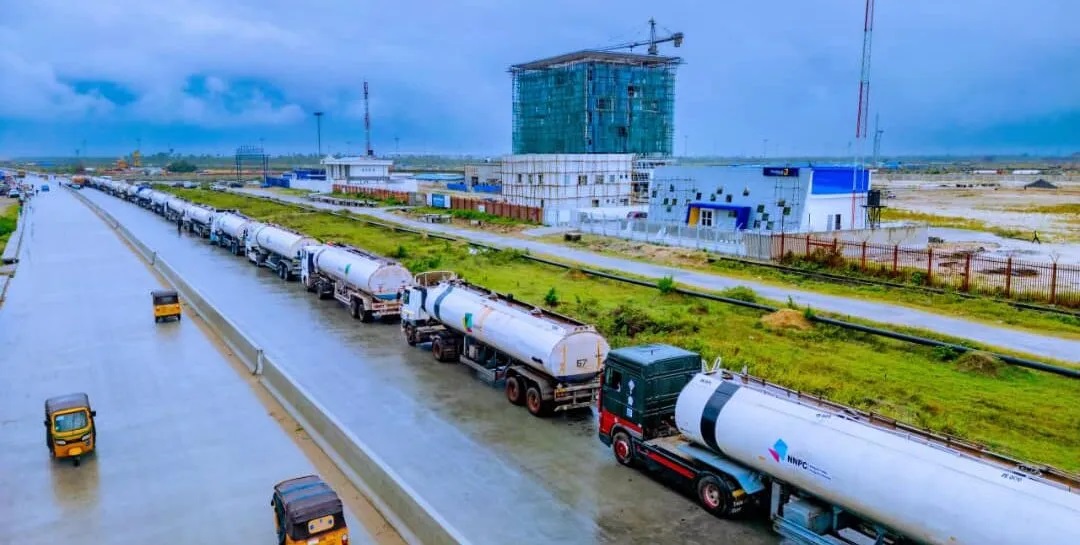
The Dangote Refinery located in the Lekki area of Lagos State has made its first export of premium motor spirit (PMS) just three months after it commenced the production of petrol.
In September 2024, the refinery produced its first petrol and began loading to the Nigerian National Petroleum Company (NNPC) on September 15.
However, due to some issues, the facility has not been able to flood the local market with its product, forcing it to look elsewhere.
In a landmark move for regional energy integration, Dangote Refinery has partnered with Neptune Oil to take its petrol to neighbouring Cameroon.
Neptune Oil is a leading energy company in Cameroon which provides reliable and sustainable energy solutions.
Dangote Refinery said this development showcases its ability to meet domestic needs and position itself as a key player in the regional energy market, adding that it represents a significant step forward in accessing high-quality and locally sourced petroleum products for Cameroon.
“This first export of PMS to Cameroon is a tangible demonstration of our vision for a united and energy-independent Africa.
“With this development, we are laying the foundation for a future where African resources are refined and exchanged within the continent for the benefit of our people,” the owner of Dangote Refinery, Mr Aliko Dangote, said.
His counterpart at Neptune Oil, Mr Antoine Ndzengue, said, “This partnership with Dangote Refinery marks a turning point for Cameroon.
“By becoming the first importer of petroleum products from this world-class refinery, we are bolstering our country’s energy security and supporting local economic development.
“This initial supply, executed without international intermediaries, reflects our commitment to serving our markets independently and efficiently.”
Economy
Oil Prices Rise as Hormuz, Bab el-Mandeb Attacks Fuel Supply Fears
By Adedapo Adesanya
Oil prices slightly rose on Wednesday as attacks on ships in the Middle East continued and talks to end the Iran war hit an impasse.
Brent futures gained 7 cents to trade at $88.98 a barrel, while the US West Texas Intermediate (WTI) crude increased by 7 cents to $83.27 per barrel.
The US and Yemen’s Iran-aligned Houthis reported separate attacks on shipping in the Strait of Hormuz and the Bab el-Mandeb Strait on Tuesday, two crucial export routes for Middle Eastern oil and gas in addition to the Suez Canal.
Reuters reported that there continued to be no discussions between Iran and the US to extend their ceasefire because, from Iran’s perspective, the deal had no start date and so there was nothing to extend.
Shipping data showed the number of vessels transiting the Strait of Hormuz fell to a one-week low of eight on Tuesday. Before the war, 125 to 140 vessels passed through the crucial waterway each day.
The US military, meanwhile, said an American Navy MH-60 helicopter fired two Hellfire missiles to disable the steering gear of a Panama-flagged cargo ship.
The ship ignored repeated warnings to stop violating a naval blockade on Iranian ports, the US Central Command said.
Forecasters including the Organisation of the Petroleum Exporting Countries (OPEC) and the International Energy Administration (IEA) revised down their oil demand outlooks as US-Iran talks stall.
OPEC lowered its world oil demand growth forecast for 2026 to 580,000 barrels per day, it said in its monthly oil market report.
The International Energy Agency cut its 2026 demand projections and now expects a 1.6 million barrels per day contraction this year. However, the Paris-based agency is also predicting a 4.3 million barrels per day drop in supply this year, and an overall 2026 deficit of around 1.27 million barrels per day.
According to the IEA, Middle East oil flows briefly returned to pre-war levels in early July, with loadings reaching 20 million bpd, before falling to 12 million bpd later in the month. Middle East production remained 8.3 million barrels per day below pre-war levels in July.
The IEA cited the Hormuz shutdown, the US blockade of Iranian exports, attacks in the Bab el-Mandeb Strait and reduced Kazakh CPC Blend exports among the forces keeping global supply below demand.
Economy
For Third Straight Month, Nigeria Meets OPEC Quota in July
By Aduragbemi Omiyale
Nigeria slightly surpassed its quota set by the Organisation of the Petroleum Exporting Countries (OPEC) in July 2026.
In the month under review, the country produced about 1.57 million barrels of crude oil per day.
It was the third consecutive month Africa’s largest oil-producing nation was meeting its monthly quota, set to stabilise the price of the commodity on the global market by the oil cartel.
Data released by the Nigerian Upstream Petroleum Regulatory Commission (NUPRC) on Wednesday showed that the 1.5 million barrels per day ceiling for Nigeria was surpassed last month.
The agency disclosed in a statement today that the country produced 1.505mbpd of crude oil and 0.17mbpd of condensate, bringing the combined daily production to 1.67mbpd.
In the month under review, the daily peak production of crude oil and condensate was 1.78mbpd, while the lowest daily production was 1.57mbpd.
Although Nigeria met its OPEC quota in the month of July, the statistics show that on a month-on-month basis, production fell by 4 per cent.
This was attributed to the decline in production due to operational challenges experienced at the Erha and Akpo fields, which impacted crude oil output during the period under review.
These disruptions constrained production volumes and contributed significantly to the overall reduction in national crude oil output.
Despite the challenges, production operations across most other producing assets remained relatively stable, with operators implementing measures aimed at maintaining production efficiency and minimising the impact of operational constraints, NUPRC stated.
Economy
Lasaco Assurance Lists N18.5bn Shares from Rights Issue on Stock Exchange
By Aduragbemi Omiyale
The over 9 billion shares of Lasaco Assurance Plc issued to shareholders of the company via a rights issue have been listed on the Nigerian Exchange (NGX) Limited.
The equities were brought to Customs Street on Wednesday by the organisation, increasing its total issued and fully paid-up share capital.
Lasaco Assurance, which scaled the recapitalisation hurdle of the National Insurance Commission (NAICOM) in July 2026, raised fresh capital from the capital market to shore up its capital base.
The underwriting firm got about N18.5 billion from the rights issue, which involved the issuance of 9,236,321,546 ordinary shares at a unit price of N2.00.
The exercise was on the basis of five new ordinary shares for every existing six ordinary shares held as of the close of business on Friday, February 20, 2026.
Confirming the listing of the additional stocks of Lasaco Assurance today, the Head of Issuer Regulation Department of NGX RegCo, Mr Godstime Iwenekhai, announced in a circular that, “Trading licence holders are hereby notified that an additional 9,236,321,546 ordinary shares of 50 Kobo each of Lasaco Assurance Plc were today, Wednesday, August 12, 2026, listed on the daily official list of Nigerian Exchange Limited.
“The additional shares arose from the company’s rights issue of 9,236,321,546 ordinary shares of 50 Kobo each at N2.00 per share on the basis of five new ordinary shares for every existing six ordinary shares held as of the close of business on Friday, February 20, 2026.
“With the listing of the additional 9,236,321,546 ordinary shares, the total issued and fully paid-up share capital of Lasaco Assurance Plc has now increased from 11,083,585,855 to 20,319,907,401 ordinary shares of 50 Kobo each.”