Connect with us

General

Over N600bn Petrol, Others in Our Tanks to Meet Local Demands—Dangote

Published

on

N600bn Petrol Dangote

By Modupe Gbadeyanka

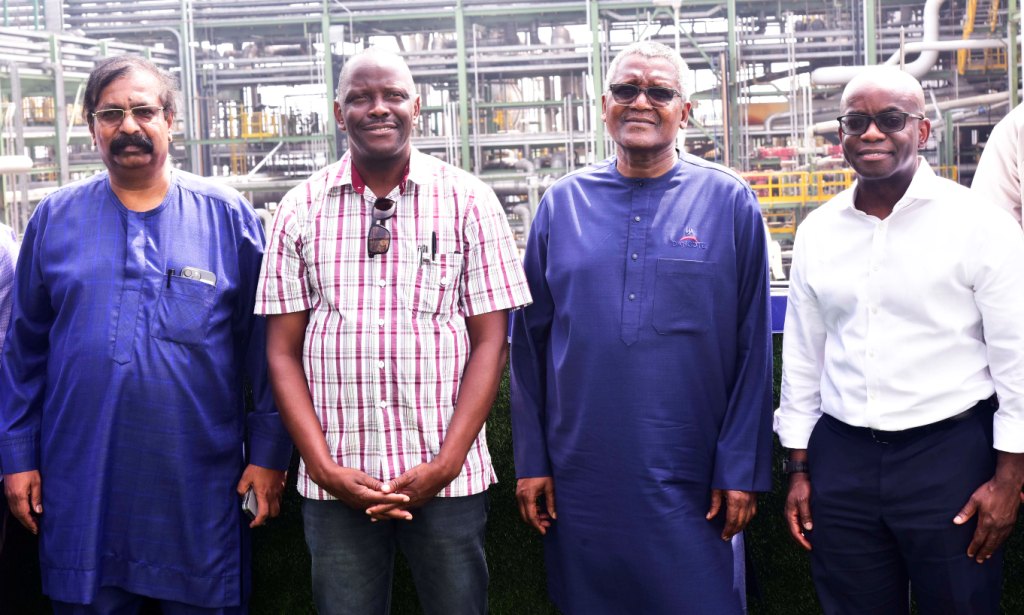
The president of Dangote Industries Limited (DIL), Mr Aliko Dangote, has disclosed that his refinery has over N600 billion worth of Premium Motor Spirit (PMS), otherwise known as petrol, in tanks.

Mr Dangote built the Dangote Petroleum Refinery believed to be worth about $20 billion in Lagos to serve the local and international markets.

Speaking when he welcomed a Zambian government delegation to the facility over the weekend, the businessman said the oil refinery has “more than half a billion litres of petroleum and over N600 billion worth of products like gasoline, diesel, and kerosene, to meet 100 per cent of Nigeria’s requirements.”

According to him, “This refinery is not only for Nigeria; it is for Africa. We must sustain the African Continental Free Trade Area (AfCFTA) deal. We are trying to see how we trade with other African countries.”

Also commenting, the Vice President of DIL, Mr Edwin Devakumar, said the refinery produces the best quality products as its core business strategy.

“The project concept was to process the crude from Nigeria and add value. But we also wanted to provide some flexibility to process most of the African crudes and some of the Middle Eastern crudes,” Mr Edwin stated.

“In another concept, what we did was maximum value extraction. That is a process where every barrel of crude which goes in, the value addition should be the best.

“The refinery can meet all our requirements. 44 per cent can meet the entire requirements of Nigeria, and 56 per cent of the production would be exported.

“Every day, we produce lighter products of 104 million litres; 57 million litres of petrol every day; 20 million litres of jet fuel; and 27 million litres of diesel production.

“The local consumption is just around 46 million litres, and the remaining 58 million litres will be exported daily,” he added.

On his part, the leader of the delegation, Mr Makozo Chikote, who is the Minister of Energy, said his country was ready to partner with Mr Dangote to make its energy and other sectors more competitive.

“In Zambia, we created an environment for the private sector to participate in the growth and development of our country. Currently, 100 per cent of our petroleum is done by the private sector.

“We are targeting increased productivity in mining, agriculture, and other sectors. Your presentation is an immediate solution to our energy needs. We are trying to promote competition among our private players

“We are looking at Dangote coming on board, which would lead to efficient, reliable, quality, and competitive products, and we want these done like yesterday.

“Coming to the Dangote Petroleum Refinery, we have learned so many advantages of bringing many players for competition, which has improved the lives of the citizens.

“From what we have seen, we need to promote trade within Africa to promote each other. We need these countries together to make Africa efficient, and a reliable trade hub.

“We have seen here that we can learn from what Dangote has done, and this would lead Africa and Africans to stand on their feet and not depend on overseas support in terms of trade. I believe going forward that people have learned a few lessons. The one lesson I have learned from this visit is that Dangote looks at the bigger picture for Africa,” the Minister noted.

Another member of the Zambia delegation, Mr Samuel Maimbo, who is the Vice President of Budget, Performance Review, and Strategic Planning at the World Bank Group, presently campaigning for the presidency of the African Development Bank (AfDB), explained that there is not enough development aid to develop Africa.

“There is also not enough government funding to develop Africa. The only way we can finance Africa’s growth at a pace and scale that solves our problem is by working through the private sector, which is why we are here today, to learn and to see what an ambitious programme looks like,” he stated.


Modupe Gbadeyanka is a fast-rising journalist with Business Post Nigeria. Her passion for journalism is amazing. She is willing to learn more with a view to becoming one of the best pen-pushers in Nigeria. Her role models are the duo of CNN's Richard Quest and Christiane Amanpour.

General

Petrol Prices in Nigeria Rise 22.55% in March 2026 on Hormuz Closure

Published

on

petrol consumption nigeria

By Adedapo Adesanya

The National Bureau of Statistics (NBS) has said that the average retail price of a litre of Premium Motor Spirit (PMS), otherwise known as petrol, rose by 22.55 per cent or N237.07 per litre to N1,288.54 in March 2026 from N1,051.47 in February.

In the Premium Motor Spirit (Petrol) Price Watch for March released on Tuesday, the NBS said on a year-on-year basis, the average retail price of fuel also increased by 2.13 per cent from N1,261.65 recorded in March 2025.

This surge in fuel prices could be linked to global disruptions brought on by the US-Israel war on Iran, which triggered the closure of the Strait of Hormuz and sent prices of crude oil above $100 per barrel.

While the country was not heavily hit by the impact, it felt the ripple effect of crude prices increasing, particularly as Dangote Refinery imported crude from other markets to cover for local feedstock shortfalls.

The data noted that by state, Anambra recorded the highest average retail price of N1,441.22 per litre, followed by Sokoto at N1,377.55 and Borno at N1,375.16.

However, the price was cheapest in Lagos at N1,162.71, followed by Ogun at N1,169.78 and Kaduna state at N1,193.40.

By zone, it was most expensive in the North East at N1,336.50 last month, while the South-West recorded the lowest at N1,232.46.

A look at the Diesel Price Watch Report for March showed that the average retail price paid by users rose by 16.05 per cent on a month-on-month basis to N1,648.08 per litre from N1,420.17 per litre a month earlier.

“On state profiles analysis, the highest average price of diesel in March was recorded in Ebonyi at N2,262.29 per litre, followed by Akwa Ibom at N1,895.72 and Osun at N1,872.15.

“On the other hand, the lowest price was recorded in Kogi at N1,383.40 per litre, followed by Katsina State at N1,438.25 and Enugu at N1,480.06,” parts of the report said.

Continue Reading

General

Datti Baba-Ahmed Dumps Labour Party, Joins PRP

Published

on

datti baba-ahmed

By Modupe Gbadeyanka

The vice-presidential candidate of the Labour Party (LP) in the 2023 general elections, Mr Datti Baba-Ahmed, has left the party to join the Peoples Redemption Party (PRP).

Speaking on Channels Television’s Politics Today, the politician said he’s no longer interested in the way the Labour Party was being run.

He disclosed that there is no more peace in the political party he flew its flag in the last general elections because of greed.

He accused the ruling All Progressives Congress (APC) of destabilising opposition political parties to ensure President Bola Tinubu does not have a credible opponent in the 2027 presidential poll.

“What the Labour Party stood for is not the same now. We have a government of today which is interested in destroying other political parties,” he said.

“I am leaving the Labour Party tomorrow (today) by 12 midnight,” Mr Baba-Ahmed said when asked about his plans for next year.

I am leaving the Labour Party [at] midnight, and I am joining PRP. PRP is the new destination. PRP is the one with a history. It’s about 75 years old,” he further stated.

He further said, “When there was real peace in the Labour Party, someone was redeployed to the Labour Party and because of the antecedents of the person, [I don’t see things getting better].

PRP, a progressive Nigerian political party, was established in 1978 by Mallam Aminu Kano. It is rooted in social democratic principles and populist ideology, often focusing on the empowerment of the talakawa (common people).

Its current National Chairman, according to data obtained from the website of the Independent National Electoral Commission (INEC), is Mr Falalu Bello, while the National Secretary is Mr Babatunde F. Alli.

PRP Data INEC

Continue Reading

General

We Prioritised Personal Pension Plan, Others for Robust Pension System— PenCom

Published

on

Personal Pension Plan PenCom DG

By Modupe Gbadeyanka

The Director General of the National Pension Commission (PenCom), Ms Omolola Oloworaran, has highlighted strategies deployed by her organisation to ensure pension coverage is deepened in Nigeria.

Speaking at the ISSA Technical Seminar in Abuja recently, she said the steps taken were to build a more inclusive, transparent, and responsive pension system, where communication serves not just as information, but as a bridge to trust, accessibility, and sustained industry growth.

According to her, the Contributory Pension Scheme (CPS) has, over more than two decades, built a strong institutional foundation, but true inclusion goes beyond coverage to require trust and clear communication.

For this reason, PenCom has prioritised the Personal Pension Plan, strengthened stakeholder engagement, and invested in digital channels that reach contributors in accessible and relatable ways, she stated.

Ms Oloworaran further stressed that, “Effective communication is not a soft complement to regulation; it is a core instrument of coverage expansion, compliance, and public confidence.

“Every circular we issue, every benefit we pay, and every reform we introduce ultimately succeeds or fails on whether our members can understand it and act on it.”

The ISSA Technical Seminar, themed Improving Inclusivity and Accessibility of Social Security Services Through Effective Communication, was organised in collaboration with the International Social Security Association (ISSA).

It brought together key stakeholders across West Africa to advance dialogue on strengthening social security systems through clearer, more inclusive engagement.

Continue Reading

Trending