

World
Geopolitical Implications of South Africa’s G20 Presidency Without United States

By Kestér Kenn Klomegâh
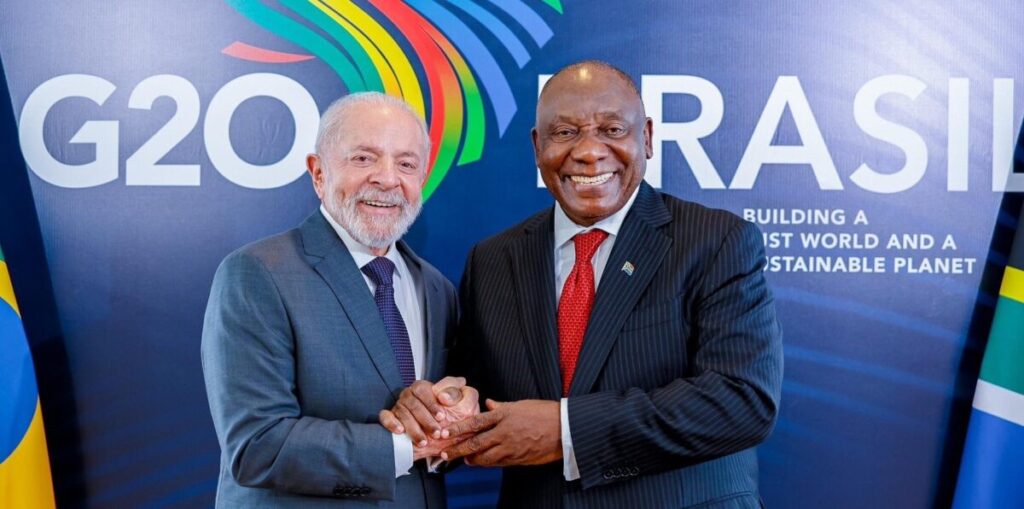
South Africa, for the first time, heads the G20, a multilateral organization, and it is taking pecuniary measures to balance the heightening complexities around the world. With President Donald Trump in the helm of power in the United States, the most different pragmatic approach in being adopted towards a number of issues ranging from politics through the global economy to social and humanitarian parameters. Geographical regions, including Africa, are also affected to a distinctive extent.
Below is an insightful interview conducted by Kestér Kenn Klomegâh with Mr Tariq Khan, a Senior Research Associate at the Institute for Global Dialogue (IGD) associated with the University of South Africa. Tariq focuses on economic, security and diplomatic issues in areas such as Pakistan-Africa Relations, Africn Relations, and Major Powers’ relations with Africa, Asia-Africa Relations and South-South Cooperation, Maritime Affairs. In this interview, Tariq Khan discussed Global Powers, G20 and Africa relations in the emerging new world. Here are the significant excerpts.
What are the practical implications of the United States, a major contributor among G20 members, skipping South Africa’s February summit?
The absence of the United States at the South Africa G20 summit poses diplomatic and strategic connotations of some importance. As a key global economic player, the U.S. influences major policy decisions within the G20, and its non-attendance could signal a de-prioritization of Africa within its foreign policy agenda.
First, it seems that there is no real commitment to the critical issues which the African continent is facing including debt relief, fair trade and development funding. South Africa, as the only African G20 member, has been a strong advocate for the continent’s economic priorities. If the Washington give unimportance or sideline this engagement, it risks reinforcing the perception that Washington is more focused on geopolitical tensions in Europe and Asia while offering only rhetorical support to Africa.
In adding up, such a move will give BRICS a boost, of which South Africa is a component and plays a prominent role. With BRICS growing and positioning itself as an alternative to Western-led institutions, the U.S. absence might encourage African nations to deepen their economic and political cooperation within BRICS which will lead to reduce reliance on Western-dominated frameworks.
Finally, absence of US could deteriorate or weaken the trustworthiness or credibility of the G20 as an inclusive global forum. South Africa has effectively championed the inclusion of the African Union (AU) as a permanent G20 member. If the U.S. disengages from the summit, it could slow momentum for integrating African priorities into global decision-making, reinforcing existing frustrations about Western dominance in multilateral institutions.
Can South Africa’s presidency change perceptions of the G20’s role in global politics and its contributions to Africa’s development?
South Africa’s G20 presidency presents a significant opportunity to reshape Africa’s role in global governance. Traditionally, the G20 has been dominated by the economic priorities of Western and Asian powers, often sidelining the challenges of the Global South. As the only African G20 member, South Africa can drive a more inclusive agenda through three key areas:
- Reinforcing Africa’s Economic Potential: South Africa can emphasize Africa’s role as a strategic investment destination rather than just an aid recipient, advocating for reforms in global financial institutions to support Africa’s economic growth.
- Advocating for Structural Reform: Building on its success in securing AU membership in the G20, South Africa can push for concrete actions such as debt restructuring, fair trade terms, and increased voting rights for Africa in institutions like the IMF and World Bank.
- Shaping Global South Solidarity: By aligning G20 priorities with those of BRICS and the broader Global South, South Africa can challenge the perception that the G20 merely upholds Western economic dominance and instead position it as a balanced institution where emerging economies wield real influence. On the other hand, South Africa must navigate its complex diplomatic positioning. At the same time as maintaining strong Western ties, its BRICS membership and increasing alignment with China and Russia could generate tensions. Achievement will depend on its capability to bridge these divides and promote an Africa-first agenda.
In the context of a rapidly changing global landscape, do we see G20 competing or collaborating with BRICS?
The relationship between G20 and BRICS is distinguished and characterized by both competition and selective collaboration. BRICS as an organization has turned out to be more and more self-confident to challenge Western domination in global governance, mainly following its expansion to Saudi Arabia, the UAE, Egypt, Iran, and Ethiopia and other states.
This reflects a broader shift toward a multipolar world where such organizations similar to the G20 face substitute governance frameworks. Though, collaboration between G20 and BRICS remains indispensable. Several BRICS members such as South Africa, China, India, and Brazil are also in the G20 which means they have an interest in shaping both platforms rather than abandoning one for the other.
Cooperation on issues such as debt relief, climate change and development financing is promising, but ideological and strategic differences may persist. If the G20 remains inflexible in its Western-centric approach, then BRICS could become a direct competitor, attracting more nations disappointed with Western-led economic policies.
The challenge of South Africa is to balance its engagement with both which ensures that interests of Africa are advanced across multiple platforms and could not be compromised its broader economic and diplomatic objectives.
What is the future of the G20, particularly in relation to Africa, given BRICS’ growing influence?
The G20’s significance to Africa will depend on whether it can transition from symbolic commitments to tangible actions. Traditionally, African engagement with the G20 has been marked by unfulfilled promises. To remain a meaningful partner for Africa, the G20 must focus on:
- Debt Relief and Fair Financing: Many African nations struggle with unsustainable debt burdens. The G20 must push for genuine restructuring mechanisms rather than perpetuating cycles of dependency.
- Infrastructure Investment: Africa’s development hinges on infrastructure, yet financing remains a challenge. The G20 should support merged financing models that combine public and private investment in sustainable projects.
- Technology and Industrialization Support: Africa’s long-term prosperity depends on industrialization and technological advancement. The G20 must facilitate technology transfer and capacity-building initiatives that give power to African economies. If the G20 fails to deliver meaningful reforms, African nations may increasingly turn to BRICS, which is enthusiastically positioning itself as a more responsive and approachable alternative.
Should African leaders first reform the African Union (AU) and regional blocs like ECOWAS before expecting changes in global institutions?
Of course yes, African leaders must first strengthen internal institutions before expecting global institutions to treat the continent as a unified force. Weak regional organizations undermine Africa’s bargaining power in global negotiations.
Key areas for reform include:
- Financial Independence: Reducing reliance on external donors would allow the AU and regional blocs to act with greater autonomy in decision-making.
- Stronger Enforcement Mechanisms: Regional organizations need better mechanisms to uphold democratic norms and economic agreements to prevent instability from weakening Africa’s global influence.
- Policy Coordination: A fragmented Africa cannot effectively engage with global institutions. Greater intra-African coordination is needed to present a unified front in international forums. If Africa wants to negotiate from a position of strength, its institutions must be stable, credible, and self-sufficient. Strengthening the AU and regional organizations will enhance Africa’s ability to engage effectively with both G20 and BRICS.
Final Thoughts: The Vision of ‘Africa We Want’
The realization of the “Africa We Want,” as outlined in the AU’s Agenda 2063, requires strategic engagement with external partners. However, Africa must ensure that these partnerships are mutually beneficial rather than reinforcing external dependencies. South Africa’s role is fundamental in this vision. As a bridge between the West, BRICS, and the African continent, it must advocate and promote policies that advance Africa’s long-term interests and objectives. Africa’s engagement with the G20, BRICS, and other international platforms must be strategic to ensure that these institutions contribute to Africa’s broader development agenda rather than perpetuating historical imbalances. In the end, Africa’s success in the global arena will depend on its ability to take advantage from both external partnerships and internal reforms.


