Economy
Dangote Acquires Permits, Land for Sugar Refinery in Ghana
By Aduragbemi Omiyale
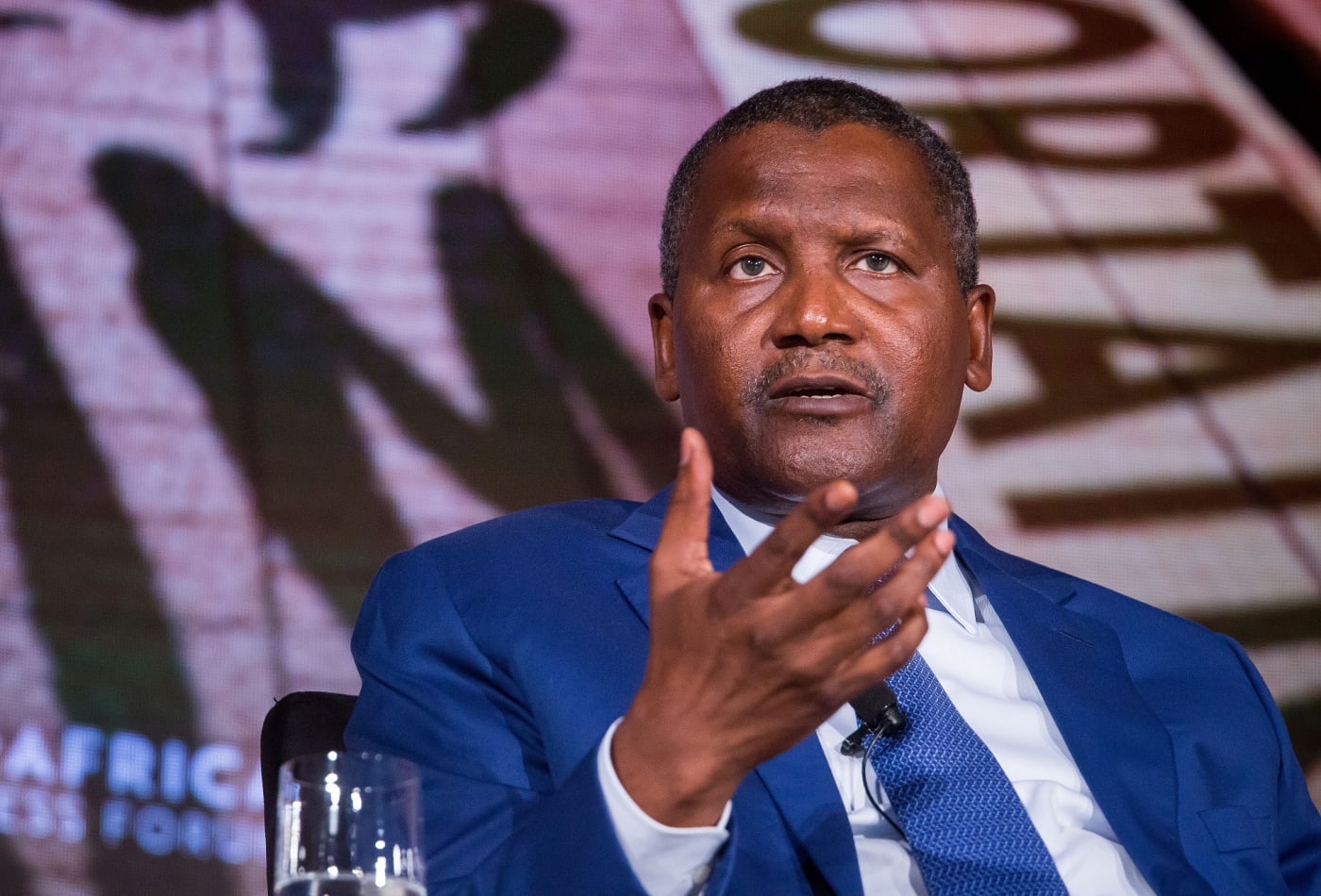
Africa’s richest man, Mr Aliko Dangote, has taken a significant step to reduce the annual sugar import bill of Ghana by $162 million with the establishment of a sugar refinery in the country.
The sugar milling project is to be sited in Kwame-Danso, Bono Region under the West African nation’s ambitious One District, One Factory (1D1F) initiative.
All the required permits as well as land for the massive project have been secured and the next step should be the commencement of the factory, according to Mr Dangote in a post on a LinkedIn.
Business Post reports that the Dangote Sugar Refinery Ghana will have the capacity to crush 12,000 tonnes of sugarcane daily, and an irrigation infrastructure spanning 25,000 hectares of farmland, with production lines for sugar, molasses, and ethanol.
“We’re thrilled to announce the launch of a major agro-industrial project in Kwame-Danso, Bono Region: Dangote Sugar Refinery,” the Nigerian businessman said, describing the venture as “a new chapter” in Ghana’s economic journey.
“With land secured and necessary permits obtained, we’re moving forward with the support of Ghana’s ‘One District, One Factory’ initiative.
“This project tackles Ghana’s $162 million sugar import bill while fostering a sustainable, homegrown solution.
“At Dangote, we envision more than just a factory. We see a catalyst for economic independence, job creation, and transformative impact across Africa. Join us in shaping the continent’s future,” he stated.
When completed, the project is expected to boost the revenue of Dangote Sugar Refinery Plc, an entity listed on the Nigerian Exchange (NGX) Limited.
Recall that in the 2024 financial year, the sugar refiner grew its turnover by 51 per cent to N665.6 billion from N441.5 billion a year earlier, with the earnings per share (EPS) rising to N15.80 from N6.00 in 2023.
Mr Dangote has consistently assured the company would build a sustainable business, target the production of 1.5 million metric tonnes of refined sugar annually and at the same time generate over 75,000 employment opportunities in its value chain.
Also, the chief executive of Dangote Sugar, Ravindra Singh Singhvi, reiterated the company’s goal of achieving self-sufficiency in sugar production for Nigeria, with a target of producing 700,000 tonnes of sugar locally within the next five years.
Economy
Energy Stocks Sink NGX Index by 0.36% to 240,750.47 points
By Dipo Olowookere
The Nigerian Exchange (NGX) Limited extended its losing streak to seven consecutive sessions on Wednesday after it closed lower by 0.36 per cent.
The loss suffered yesterday was inflicted by the energy space, which significantly shed 4.63 per cent at the close of business. This was because of profit-taking in Aradel Holdings.
Further, the insurance segment went down by 0.88 per cent due to sell-offs, especially after news of the revocation of the operating licence of Universal Insurance Plc by the National Insurance Commission (NAICOM) after it missed the new recapitalisation requirements.
The consumer goods index depreciated at midweek by 0.31 per cent, while the banking space recovered 0.54 per cent, with the industrial goods segment closing flat.
When market activities ended for the session, the All-Share Index (ASI) was down by 860.76 points to 240,750.47 points from 241,611.23 points, and the market capitalisation gave up N556 billion to settle at N155.417 trillion compared with the previous day’s N155.973 trillion.
International Energy Insurance shed 10.00 per cent to quote at N4.77, Aradel lost 9.99 per cent to trade at N1,374.20, Universal Insurance slumped by 9.41 per cent to 77 Kobo, Red Star Express depreciated by 9.26 per cent to N14.70, and Royal Express crashed by 8.62 per cent to N1.06.
On the flip side, Haldane McCall gained 10.00 per cent to end at N3.52, Coronation Insurance improved by 8.44 per cent to N2.44, UAC Nigeria jumped by 6.56 per cent to N177.85, AVA Capital grew by 6.29 per cent to N7.60, and Caverton rose by 5.32 per cent to N4.95.
The most active equity during the session was Fortis Global Insurance, with a turnover of 610.7 million units worth N1.2 billion. FCMB traded 60.9 million units worth N722.9 million, Fidelity Bank transacted 57.0 million units valued at N1.2 billion, Consolidated Hallmark sold 46.3 million units worth N312.7 million, and Royal Exchange exchanged 43.5 million units valued at N45.8 million.
In all, a total of 1.2 billion shares valued at N37.8 billion exchanged hands in 34,546 deals on Wednesday compared with the 429.8 million shares worth N27.5 billion traded in 35,683 deals on Tuesday. This indicated a spike in the trading volume and value by 179.20 per cent and 37.46 per cent, respectively, while the number of deals declined by 3.19 per cent.
Economy
NAICOM Withdraws Universal Insurance Operating Licence
By Aduragbemi Omiyale
The operating licence of Universal Insurance Plc has been withdrawn by the National Insurance Commission (NAICOM).
This action was taken by the regulator over the failure of the underwriting firm, which is listed on the Nigerian Exchange (NGX) Limited, to meet the new recapitalisation requirements on or before July 31, 2026.
NAICOM said it revoked the company’s licence based on its powers stipulated in the Nigerian Insurance Industry Reform Act (NIIRA) 2025.
The regulator has appointed a Receiver/Provisional Liquidator for the insurance company, and he is Mr Ogbonna Chukwumerije, a partner at Pinheiro LP.
He will immediately trace, recover, secure and take possession of Universal Insurance’s assets, collate its liabilities and facilitate their settlement in accordance with the provisions of NIIRA 2025.
He is also required to liaise with NAICOM and submit periodic reports on the progress of the receivership and liquidation process.
Already, Mr Chukwumerije has informed banks, financial institutions, policyholders, creditors, debtors, customers and members of the public that Universal Insurance had entered receivership, advising parties dealing with the company’s funds, assets, records, policies, claims and liabilities to verify the authority of anyone claiming to act on its behalf.
Banks and other financial institutions were specifically warned against honouring withdrawals, transfers, payment mandates or other instructions issued on behalf of Universal Insurance unless authorised by the receiver.
However, Universal Insurance has taken steps to appeal NAICOM’s decision. The organisation was among six insurers that failed to meet the recapitalisation deadline.
Economy
Oil Market Soars as UAE Suspends Economic Ties With Iran
By Adedapo Adesanya
The oil market was elevated on Wednesday as investors worried about escalating tensions in the Middle East, with the United Arab Emirates suspending all financial and economic transactions with Iran.
Brent crude futures settled at $91.62 a barrel after soaring by 60 cents or 0.7 per cent, while the US West Texas Intermediate (WTI) crude futures rose by 89 cents or 1.1 per cent to $85.83 a barrel.
The UAE has halted all trade, financial, and commercial ties with Iran until further notice, after saying Tehran had fired ballistic missiles targeting its territory.
Late on Tuesday, the UAE’s Defence Ministry said that “assessments revealed the two ballistic missiles detected, originating from Iran, were targeting maritime navigation and fell into the sea.” One of the missiles fell outside the Emirates’s territorial waters, while the second fell within its territorial waters, the ministry added.
In light of these missiles fired from Iran, the UAE halted all economic ties with Iran.
This development comes after US President Donald Trump said no talks were taking place with Iran and that the Strait of Hormuz was open. Iran, however, said the waterway remained shut.
The oil market remains focused on the Strait of Hormuz, through which about one-fifth of global oil and liquefied natural gas supplies passed before the US-Israeli war on Iran began at the end of February.
Available data from Kpler showed that only six commodity vessels crossed the strait on Tuesday, down from nine a day earlier and below the 10-day daily average of 11.
Meanwhile, oil shipments from Russia’s western ports have fallen to about 2.3 million barrels per day in the first half of August, 15 per cent below the initial loading plan, because of disruptions at the Black Sea port of Novorossiysk.
Crude oil inventories in the US saw a massive increase of 4.4 million barrels during the week ending August 14, according to new data from the US Energy Information Administration (EIA) released on Wednesday.
The EIA’s data release follows figures from the American Petroleum Institute (API) that were released a day earlier, which reported that crude oil inventories had fallen by 328,000 barrels in the period.