

World
Victory Day in Moscow, Russia-Africa Relations

By Kestér Kenn Klomegâh
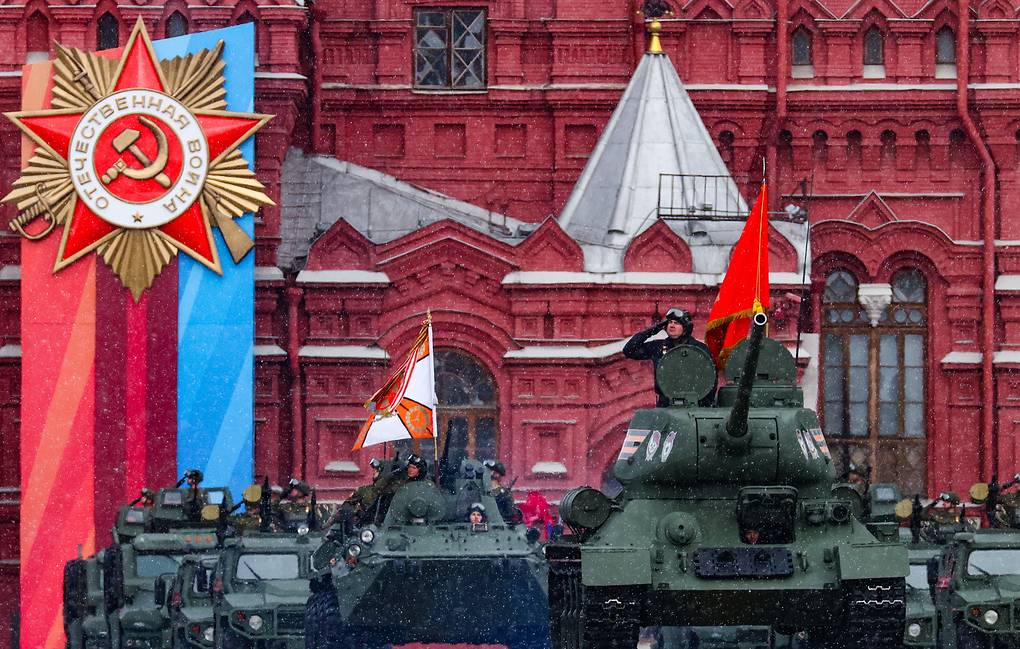
Russian President Vladimir Putin invited 29 world leaders to witness the main military parade at Moscow’s Red Square, and used the high-level occasion to review Russia’s diplomatic priorities with African leaders. The African leaders came from Burkina Faso, Congo, Egypt, Equatorial Guinea, Ethiopia, Guinea Bissau and Zimbabwe.
By taking part in the Victory Parade in Moscow, the African leaders had the unique chance to review their bilateral relations with the Kremlin, and at least, as part of a broader effort to celebrate their bilateral relations built down these years. Their presence in Moscow showcased the irreversible dynamism, political symbolism and rapidly evolving character of contemporary multifaceted ties, especially during this heightening and deepening of the current world’s geopolitical situation.
Burkina Faso, Mali and Niger are undergoing economic resuscitation, transforming their system of state management and governance, projects financing and production. Burkina Faso has nationalized its natural resources by expelling the France and other western corporate miners. Mali instead have bartered its resources in exchanged for Russia’s military-technical cooperation within an agreement signed in 2023.
Burkina Faso, Mali and Niger, currently run by military governments that have taken power in coups between 2021 and 2022, have a set of common goals to achieve after removal of their elected governments, accusing them of deep-seated corruption and further the exploitative character of western powers through manipulation.
Concretely the main objectives include reaffirming and securing their regional peace, with narratives pointed at the Economic Community of West African States (ECOWAS) under-performance in this sphere of maintaining security.
In the context of shifting global powers, this regional bloc has to undergo serious restructuring and reforms. The French-speaking members – Burkina Faso, Mali and Niger – and now with Chad, Senegal and Togo threatening to withdraw and join the Alliance of Sahel States (AES). The region is still engulfed with widespread terrorism and violent extremism.That however, the Sahelian States seek to protect their individual political sovereignty and territorial integrity.
Nevertheless, Russia’s growing relations with Alliance of Sahelian States (AES), consisting Burkina Faso, Mali and Niger also provides boundless potential opportunity to recalibrate their foreign policy away from western colonizers. These French-speaking States are strategically collaborating with Russia, and opting for military support within military-technical agreement. The bilateral agreements, a kind of bartering natural resources in exchange for military equipment and modern weaponry to help in enduring the capacity for fighting frequent Islamic attacks and countering terrorism in the region.
The Sahelian leaders appreciated the transformation change and the groundbreaking reality, as Russia is tremendously supporting to raise awareness of the political and economic status, offered them humanitarian packages. Several bilateral agreements have been signed to engage in accelerating economic and trade initiatives, and beyond. On their part, African leaders have also been identifying, monitoring, analyzing strategic threats that may hinder Russian initiatives in Africa. It is in recognition of Russia as a trusted and reliable partner.
Burkina Faso signed a Memorandum of Understanding on nuclear energy with the State Atomic Energy Corporation (Rosatom) during the Russia-Africa summit held in St. Petersburg in July 2023. Russia is teaming up with Mali and Niger to exploit their natural resources for undertaking development projects in their respective countries. Quite essentially, the bilateral agreements signed between Mali and Niger are directed at engaging in development their infrastructure which Russia has expressed strong interest to support, and has also despatched military troops to ensure peace and stability.
Central African Republic (CAR) leader, Faustin-Archange Touadéra, has enjoy tremendous support from the Kremlin. There are estimated 2,500 Russian instructors working there, according to local Russian media reports. Russia is constructing the city’s highways, rehabilitating educational building and exploiting the country’s mineral resources to improve living standards of the estimated 5.6 million.
Despite its significant mineral deposits and other resources, such as uranium reserves, crude oil, gold, diamonds, cobalt, lumber, and hydropower, as well as significant quantities of arable land, the Central African Republic is among the ten poorest countries in the world.
Over the years, Russia and the Republic of Congo have had good bilateral relations and, undoubtedly, there are still prospects for strengthening these relations. At this point, highlighting Russia-Congo partnerships have its own perspectives. Vladimir Putin during a meeting with Sassou-Nguesso, in Novo-Ogaryovo near Moscow, assertively referred to good potential in several industries, such as energy, the processing industry and agriculture.
Leading Russian companies, including LUKOIL and Yandex, operate effectively in the Congo. Rosatom plans to launch a number of large projects, especially those necessary for attaining the Sustainable Development Goals (SDGs). Congo has become the fourth largest oil producer in the Gulf of Guinea, and in 2018, the Republic of the Congo joined the Organization of Petroleum Exporting Countries.
As significant part of the geopolitics and first-class display of diplomatic symbolism for Russia-Africa relations, President of Equatorial Guinea, Teodoro Obiang Nguema Mbasogo, was invited as one of the African guests celebrating the Victory Day. Teodoro Obiang Nguema also been visiting Moscow.
He was at the Russian Energy Week 2024 and invited Russian investors to take interest in Africa’s natural resource extraction. Such partnerships should not be limited to the production of resources but should include knowledge transfer, technological training, and the promotion of modern energy infrastructure development. Equatorial Guinean leader, however, explained that Africa exists in an era of major changes and challenges.
Equatorial Guinea, believes that energy cooperation should be guided by a fundamental principle: to ensure the stability of energy markets, protecting the most vulnerable segments of the population from market volatility. Energy should not be a weapon, but as a means to achieve common prosperity. The collective responsibility is to ensure that the least developed countries are safely protected from fluctuations in energy prices and are not excluded from the benefits of energy and advanced technology.
Russia’s bilateral relations with Egypt and Ethiopia, has now transcended into a broader partnership in BRICS, the alliance of major developing countries. BRICS, as a multilateral economic and development-oriented cooperation platform, is at the forefront transforming world politics.
Therefore, Egypt and Ethiopia’s presence in Moscow during the May Day celebrations portrayed, in principle, an inevitable victory over western hegemony. Egypt and Ethiopia, and together with Russia, the position of the three resonates as a key collective player in shaping the emerging the world order. It could not have to be understated – Russia, Egypt and Ethiopia have shared strategic ambitions in this contemporary world.
Russia and Guinea-Bissau has had an excellent evolving relations now. President of the Republic of Guinea-Bissau, Umaro Sissoco Embalo, has visited four times, the lastest was on on February 26, 2025. Embalo participated in the first (2019) and second (2023) Russia-Africa Summits, respectively in southern city of Sochi and cultural capital, St. Petersburg.
On 9th May 2024, Guinea Bissau leader Embalo was one of the special guests to the May Day celebrations at the Red Square and earlier as part of the team to discuss peace initiatives with the Kremlin. That May Day celebrations, Putin stressed that “Africa is now building up capacity and aspires to emerging as an effective powerhouse in a multipolar world with its unique identity by making confident strides in nurturing a genuine sense of political and economic sovereignty.”
It is necessary to remind here that Russia and Guinea-Bissau have previously signed various agreements to bolster trade, economic cooperation and military-technical sphere, and beyond that created working groups on developing and subsequent implementation of programmes and projects particularly in Guinea-Bissau. “There is strong potential and promising opportunities in these areas, as many Russian companies are showing increasing interest in working in the Guinea-Bissauan market,” according to Putin.
Reports indicate that over 70 percent of Guinea-Bissau’s servicemen and civilian officials were trained in the Soviet Union and continued under Russia. Moreover, Russia has increased the quota for Guinea-Bissauan friends for the current year, 2025/26. With population approximately 1.8 million people, Guinea-Bissau faces challenges of ensuring security and more than two-thirds lives below the poverty line. Sharing borders with Guinea (to southeast), Gambia and Senegal (to the north), Guinea-Bissau attained its independence in September 1973.
In terms of Zimbabwe, much has been done. The greatest is Russia involvement in the US$3 billion Darwendale platinum mining project in the sun-scorched location, about 50 km northwest of Harare, the Zimbabwean capital. On 6th March 2025, Zimbabwean Minister of Foreign Affairs and International Trade, Amon Murwira, signed comprehensive bilateral agreements, including strengthening trade and economic cooperation.
Additional steps that were agreed upon to identify promising areas for joint engagement, particularly in geological exploration, mineral resource development, nuclear energy, agriculture, space technology, and information and communications technologies. In addition, Russia allocated 125 scholarships for Zimbabwean citizens to study at Russian universities.
The Speaker of the Federation Council of the Russian Federation, Valentina Matviyenko, headed a group of Russian senators went on a reciprocal inter-parliamentary visit to Harare. The delegation delivered a wonderful humanitarian aid to the Angels of Hope Foundation ran by the First Lady, Auxilia Mnangagwa in Harare.
In 2023, President Vladimir Putin despatched tonnes of grains (wheat) under ‘supply at no-cost’ to the people of Zimbabwe. Besides Zimbabwe, other African countries – Burkina Faso, Central African Republic, Eritrea, Mali, Somalia and Kenya benefited from this humanitarian aid to these African countries. (For further detailed information on this, read the transcript on the Kremlin’s website).
In a quick review, President Emmerson Mnangagwa expressed invariable commitment to deepening partnership based on agreements reached during his meetings with President Vladimir Putin, including on the sidelines of the St Petersburg International Economic Forum in June 2024. Zimbabwe plans to ascend into BRICS (Brazil, Russia, India, China and South Africa), an informal association which guarantees building an inclusive, a more fairer world especially for developing countries. Egypt, Ethiopia and South Africa are members, while Uganda and Nigeria are ‘partner states category’ with BRICS. Notwithstanding that, Algeria last year opted to become a share-holder in BRICS Bank, which was established in 2015.
Down the years, African leaders have emphasized the critical importance of delivering factual historical information about the tremendous role of the USSR and Russia in defeating fascism to the younger generation of Africans. During those years, the Soviet Union never colonized Africa, but instead supported Africa in their fight against colonialism and for the liberation of the continent and exploitation by western powers. In the era of shifting geopolitical powers, Africa is also struggling against existing forms of neo-colonialism, and this presents the basis for building and strengthening comprehensive interaction between Russia and Africa.
Worth reiterating that Burkina Faso, Congo, Egypt, Equatorial Guinea, Ethiopia, Guinea Bissau and Zimbabwe were given, based on the principles of equality and mutual respect, the authoritative opportunity in the Honor of the 80th Anniversary of the Great Victory and the Defenders of the Fatherland. Russia has indicated, several times, its task is to help African peoples rebuild their economies and strengthen their states to prevent future wars. African leaders are reminded of Russia’s assistance in reducing multitude of conflicts in African societies, and weighing in the readiness towards developing a pan-African identity. Without doubts, Russia and Africa share a strong mutual need for speeding up with the creation of a multipolar world.
In conclusion, the significance of their intended interaction, an explicit chance to review the potential opportunities to collaborate in broader economic diversification goals, and possibly forging collaboration through public-private partnerships. Burkina Faso, Congo, Egypt, Equatorial Guinea, Ethiopia, Guinea Bissau and Zimbabwe therefore had unique representation here, in the context of 80th anniversary celebrating Victory Day. For now, at least, this exemplifies noticeable ‘friendship and solidarity’ with Africa. In totality, Russia is consistently renewing its thunderous commitment to enhance relations with Africa.



Pingback: Victory Day in Moscow: Russia, Africa, and the Rebirth of Anti-Imperialist Sovereignty – Weaponized Information
Pingback: Weaponized Information