Connect with us

Economy

Dangote Flour Mills Bounces Back, Declares N10.6b Profit for 2016

Published

on

dangote flour court ordered meeting

By Modupe Gbadeyanka

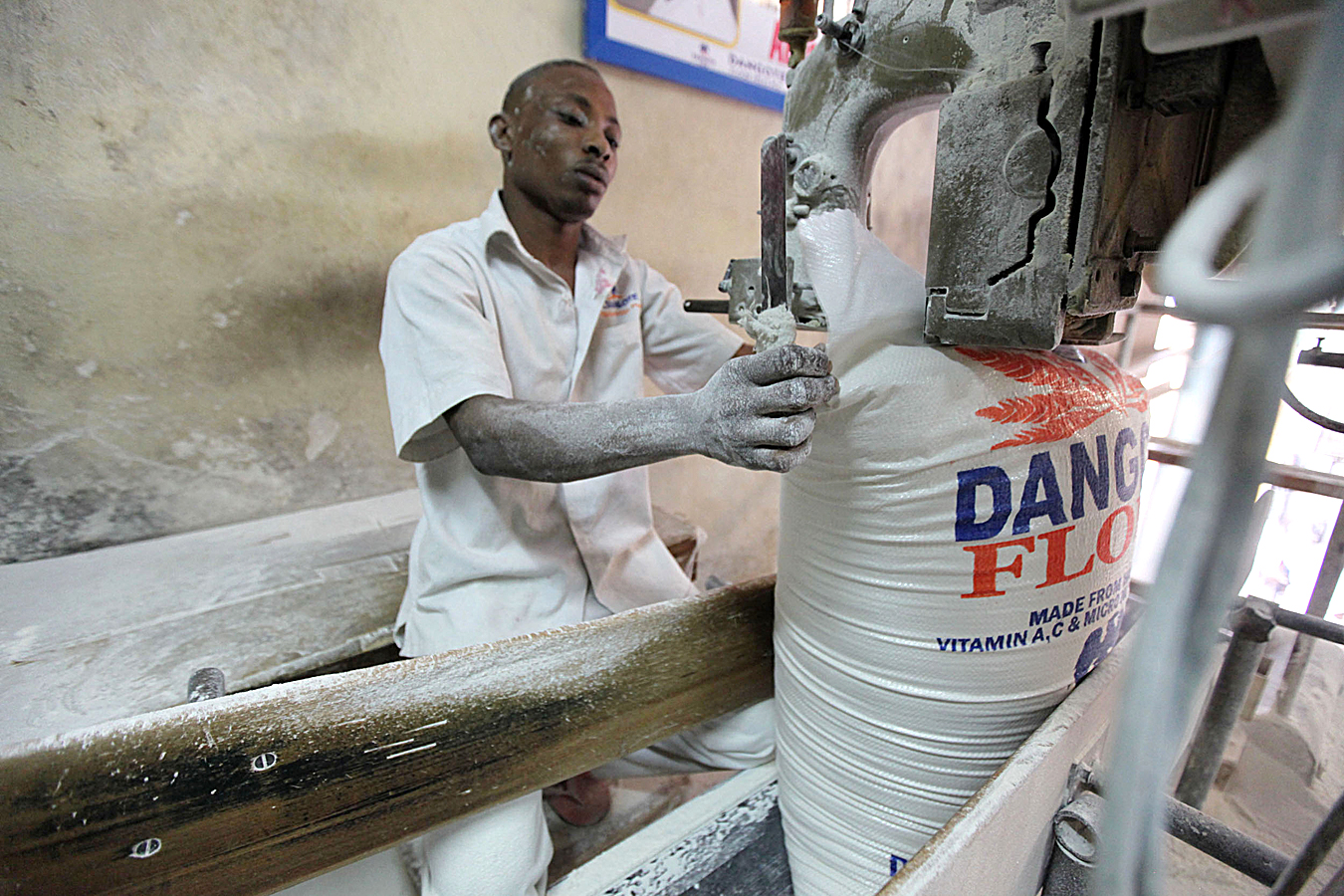
Dangote Flour Mills Plc has returned to profitability after four years of losses, declaring a profit before tax of N11.82 billion for its financial year ended December 31, 2016 in contrast to the N12.5 billion it lost in the corresponding year of 2015.

A review of the results released on the floor of the Nigerian Stock Exchange (NSE) showed that the firm’s operating profit went up to N16 billion compared to a loss of N8.6 billion posted at the preceding year.

In the same vein, profit after tax went up to N10.6 billion in contrast to N12.5 billion loss it declared in 2015.

Similarly, revenue went up by 120 percent from N48 billion to N105.8 billion, while gross profit increased by 556.8 percent to N29 billion compared to N4 billion in 2016. Capital market analysts described the company’s performance as heart-warming given that the company had recorded losses in the past.

Dangote Flour Mills consist of Dangote Flour, Dangote Pasta, and Dangote Noodles. It was sold to Tiger Branded Consumer Goods, but later reacquired and re-positioned for good results.

Having reacquired the flour mills, the new board of directors and management started a restructuring process.

Speaking on the repositioning, the chairman, Dangote Flour Mills, Mr Ighodalo Asue, stated that, “We bought back Dangote Flour Mill from Tiger Branded Consumer Goods and by this move, it means we have a stronger, better, sophisticated and more focused Dangote Flour Mills.

“Since the takeover, we have taken a lot of steps to reposition the company through expansion to drive growth.

“We are also using this medium to restate our commitment to increasing our shareholders.”

The group chief executive officer, Dangote Flour Mills, Mr Thabo Mabe, attributed the return to profitability to several strategies adopted by the company to increase market share and create value for shareholders.

He noted that the Dangote Flour Mills was driven by the vision of putting its products on the table of every Nigerian.


Modupe Gbadeyanka is a fast-rising journalist with Business Post Nigeria. Her passion for journalism is amazing. She is willing to learn more with a view to becoming one of the best pen-pushers in Nigeria. Her role models are the duo of CNN's Richard Quest and Christiane Amanpour.

Click to comment

Leave a Reply

Your email address will not be published. Required fields are marked *

Economy

NGX RegCo Fines Stockbroker for Unauthorised Sale of Clients’ Securities

Published

on

stockbroker nigeria

**Revokes Trading Licences of LMB, Platinum Stockbrokers

By Aduragbemi Omiyale

A stockbroking company, Premium Capital and Stockbrokers Limited, has been fined N5 million for engaging in “unauthorised sale of its clients’ securities.”

A circular issued by the Nigerian Exchange (NGX) Regulation Limited disclosed that the trading licence of the organisation has also been revoked.

In the notice signed by the Head of Market Regulation for NGX RegCo, Chinedu Akamaka, Premium Capital violated Rule 11.9 of the Rulebook of The Exchange, 2015 (Dealing Members’ Rules), which focuses on the Prohibition of Unauthorised Sale of Securities.

Business Post reports that Premium Capital was not the only stockbroker that had its trading licence withdrawn, as it also affected others.

The licence of LMB Stockbrokers Limited was revoked by NGX RegCo for prolonged inactivity, which falls contrary to Rule 6.4: Revocation of Inactive Dealing Members’ Licences, Rulebook of The Exchange, 2015 (Dealing Members’ Rules), as amended.

The same also affected Platinum Stockbrokers Limited, which has not witnessed activity on the floor of the NGX Limited for a while.

Similarly, the authorised dealing clerkship of Mr Bernard Oluwole Ilori, was taken back with immediate effect in alignment with an earlier determination by the Securities and Exchange Commission’s (SEC) Administrative Proceedings Committee (APC), which arose from his involvement in regulatory infractions connected to Mutual Alliance Investment and Securities Limited and resulted in his 10-year ban from the Nigerian capital market since March 25, 2021.

Investors have been “strongly advised not to engage in any activity with the firms” whose trading licenses have been revoked.

Continue Reading

Economy

NGX RegCo Delists Shares of DN Tyre, Greif Nigeria

Published

on

Greif Nigeria

By Aduragbemi Omiyale

The securities of DN Tyre and Rubber Plc, and Greif Nigeria Plc have been delisted by the regulatory arm of the Nigerian Exchange (NGX) Group Plc, NGX Regulation Limited.

A statement signed by the Head of the Issuer Regulation Department of NGX RegCo, Mr Godstime Iwenekhai, said the delisting became effective on Thursday, April 9, 2026.

In the notice issued yesterday, it was further disclosed that the action complied with the provisions of Clause 14 of the Amended Form of General Undertaking, for Listing on Nigerian Exchange Limited General Undertaking.

According to this clause, “The exchange reserves the right to, at its sole and absolute discretion, suspend trading in any listed securities of the Issuer, delist such securities, or remove the name of the issuer (listed company) from the daily official list of the exchange with or without prior notice to the issuer, upon failure of the issuer to comply with any one or more of the provisions of this General Undertaking, or when in its sole discretion, the exchange determines that such suspension of trading or delisting is in the public interest, or otherwise warranted.”

It was explained that the shares of the two firms were delisted because they fell below the listing standards.

“The securities of DN Tyre and Rubber Plc and Greif Nigeria have been delisted from the facilities of Nigerian Exchange Limited (NGX) effective Thursday, April 9, 2026, on the grounds that the companies are operating below the listing standards of NGX and their securities are no longer considered suitable for continued listing and trading in the market,” the disclosure noted.

Continue Reading

Economy

OTC Securities Exchange Down 0.95%

Published

on

Nigerian OTC securities exchange

By Adedapo Adesanya

The NASD Over-the-Counter (OTC) Securities Exchange declined by 0.95 per cent on Thursday, April 9, plunging the Unlisted Security Index (NSI) by 37.41 points to 3,893.50 points from 3,930.91 points.

In the same vein, the market capitalisation lost N22.38 billion during the session to N2.329 trillion from the N2.351 trillion it ended at midweek.

The OTC securities exchange was under selling pressure yesterday, resulting in a negative market breadth index after three securities lost weight and one gained weight.

Central Securities Clearing System (CSCS) Plc led the losers’ table after it shed N3.74 to sell at N64.21 per unit versus N67.95 per unit. Food Concepts Plc went down by 19 Kobo to N2.68 per share from N2.87 per share, and Free Range Farms Plc dropped 10 Kobo to settle at 90 Kobo per unit versus N1.00 per unit.

On the flip side, MRS Oil gained N5 to close at N165.00 per share compared with the preceding day’s N160.00 per share.

At the trading session, there was a 23.5 per cent jump in the value of securities to N40.4 million from N32.7 million, but the volume of securities fell by 81.9 per cent to 1.04 million units from 5.7 million units, and the number of deals went down by 29.7 per cent to 26 deals from the preceding session’s 37 deals.

At the close of transactions, Great Nigeria Insurance (GNI) Plc remained the most active stock by value on a year-to-date basis with 3.4 billion units valued at N8.4 billion, followed by CSCS Plc with 57.5 million units exchanged for N3.9 billion, and Okitipupa Plc with 27.5 million units traded for N1.8 billion.

Also, GNI Plc ended the trading day as the most traded stock by volume on a year-to-date basis with the sale of 3.4 billion units worth N8.4 billion, trailed by Resourcery Plc with 1.1 billion units worth N415.7 million, and Infrastructure Guarantee Credit Plc with 400 million units sold for N1.2 billion.

Continue Reading

Trending