Connect with us

Economy

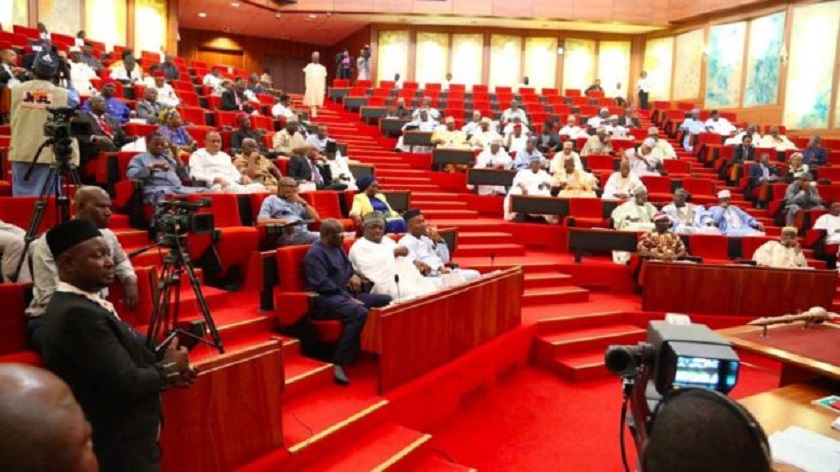
Senate Passes N1.81trn FCT Budget for 2025

Published

on

Senate confirms Umar Yahaya

By Adedapo Adesanya

The Senate on Wednesday passed the 2025 FCT Statutory Appropriation Bill, authorising a total expenditure of about N1.81 trillion for the Federal Capital Territory (FCT) for the 2025 fiscal year after a third reading.

The passage followed the presentation of the joint committee report by Mr Mohammed Ibrahim, which reviewed and harmonised input from both chambers in accordance with sections 62, 80, 88, 89, and 299 of the 1999 Constitution (as amended).

According to the report, the total statutory budget will be sourced from projected revenues for the year.

The budget structure comprises personnel costs of N150.35 billion (8.29 per cent), overhead costs of N352.03 billion (19.41 per cent), and capital expenditure of N1.31 trillion (72.31 per cent).

The total recurrent expenditure, comprising personnel and overhead stands at N502.38 billion, while capital projects will take the largest share of the budget.

The committees explained that the budget was formulated after extensive consultations with the Minister of the FCT, Mr Nyesom Wike, and key officials of the Federal Capital Territory Administration (FCTA).

The spending plan is expected to drive infrastructural development, improve service delivery, and address the growing needs of residents of Abuja and its satellite towns.

Mr Wike had during the budget defence at the Senate last Wednesday expressed concern over worsening security and healthcare challenges in the FCT, calling for urgent and coordinated national intervention.

He also stressed the critical role of Abuja as the seat of power and a diplomatic hub—one that requires a unique and strategic security framework.

In the healthcare sector, Mr Wike announced the recent acquisition of modern diagnostic equipment aimed at enhancing public health services throughout the FCT.

The FCT minister said the equipment represents a significant step forward in the FCT Administration’s broader plan to improve access to quality medical care.

Business Post reports that unlike other states with a House Assembly, since Abuja is without its own state government, its budget has to be passed by the Senate and House of Representatives, which acts as both the legislative and oversight authority of the FCT.


Adedapo Adesanya is a journalist, polymath, and connoisseur of everything art. When he is not writing, he has his nose buried in one of the many books or articles he has bookmarked or simply listening to good music with a bottle of beer or wine. He supports the greatest club in the world, Manchester United F.C.

Advertisement
Click to comment

Leave a Reply

Your email address will not be published. Required fields are marked *

Economy

Customs Street Opens Week Bullish After 0.66% Surge

Published

on

Customs Street Nigerian Stock Exchange

By Dipo Olowookere

The Nigerian Exchange (NGX) Limited ended the first trading session of the week on a positive note after it chalked up 0.66 per cent on Monday.

The gains recorded yesterday were boosted by the 3.42 per cent rise by the insurance sector, the 1.44 per cent surge by the banking index, and the 1.30 per cent leap by the industrial goods counter. They offset the 0.20 per cent loss posted by the energy sector and a 0.11 per cent decline suffered by the consumer goods industry.

Consequently, the All-Share Index (ASI) closed higher by 1,273.78 points to 196,263.55 points from 194,989.77 points, and the market capitalisation appreciated by N805 billion to N125.969 trillion from N125.164 trillion.

Business Post observed that investor sentiment turned bearish during the session after Customs Street ended with 34 price losers and 33 price gainers, representing a negative market breadth index.

Fortis Global Insurance gained 10.00 per cent to trade at 66 Kobo, Okomu Oil expanded by 10.00 per cent to N1,605.60, Fidson rose by 9.90 per cent to N95.50, NPF Microfinance Bank rose by 9.89 per cent to N6.89, and Infinity Trust Mortgage Bank jumped 9.84 per cent to N17.30.

On the flip side, The Initiates weakened by 10.00 per cent to N17.55, Deap Capital deflated by 9.97 per cent to N6.86, LivingTrust Mortgage Bank went down by 9.92 per cent to N5.90, Multiverse lost 9.92 per cent to close at N22.70 per cent, and Ellah Lakes shrank by 9.77 per cent to N11.55.

Yesterday, market participants traded 1.3 billion shares worth N31.5 billion in 95,091 compared with the 820.5 million shares valued at N28.3 billion in 63,507 deals last Friday, indicating an increase in the trading volume, value, and number of deals by 58.44 per cent, 11.31 per cent, and 49.73 per cent apiece.

Japaul ended the session as the busiest stock after selling 474.0 million units worth N2.0 billion, Chams traded 51.5 million units for N221.3 million, Jaiz Bank exchanged 48.3 million units for N566.9 million, Secure Electronic Technology transacted 46.3 million units worth N68.8 million, and Mutual Benefits sold 42.5 million units valued at N242.5 million.

Continue Reading

Economy

Naira Further Crashes to N1,349/$1 at Official Market

Published

on

Official FX Market

By Adedapo Adesanya

The first trading day in the currency market in Nigeria ended bearish for the Naira as its value further weakened against the US Dollar in the Nigerian Autonomous Foreign Exchange Market (NAFEX) on Monday by N2.92 or 0.22 per cent to N1,349.24/$1 from the N1,346.32/$1 it was traded last Friday.

Also in the spot market, the Nigerian currency depreciated against the Pound Sterling by N6.62 during the trading day to close at N1,821.87/£1 versus the preceding session’s N1,815.25/£1, and lost N6.80 on the Euro to settle at N1,591.42/€1, in contrast to the previous rate of N1,584.62/€1.

At the GTBank forex desk, the Nigerian Naira crashed against the greenback yesterday by N1 to quote at N1,357/$1 versus the preceding session’s closing value of N1,356/$1, but in the black market, the Naira appreciated by N5 to close at N1,365/$1 compared with the preceding trading day’s N1,370/$1.

The Naira slide came amid renewed pressure as weekly inflows declined, as Bureaux De Change (BDC) operators were unable to purchase Dollars from banks two weeks after the Central Bank of Nigeria (CBN) reopened the official FX Market window to them.

It had been expected that BDCs would help to further deflate the parallel market premium, but according to reports, BDC operators had yet to commence FX purchases from commercial banks, two weeks after the apex bank said legitimate agents can access up to $150,000 from the banks.

There were no FX inflows from the CBN during the past week, according to a report by the research department of Coronation Merchant Bank.

Meanwhile, Nigeria’s external reserves, which provide the CBN with firepower to support the naira, rose to $48.77 billion as of February 19, 2026.

Meanwhile, the cryptocurrency market was in the red as a broader risk-off shift tied to an emerging “AI scare trade” in equities is weighing on crypto markets.

This is leading traders to sell, while the sharp liquidation events that typically attract dip buyers have seen no such move recently, with Bitcoin (BTC) down by 3.2 per cent to $62,901.86.

Further, Ethereum (ETH) depreciated by 2.5 per cent to $1,821.13, Cardano (ADA) slid 1.9 per cent to $0.2571, Litecoin (LTC) went down by 1.9 per cent to $50.45, Solana (SOL) shrank 1.8 per cent to $76.54, Dogecoin (DOGE) declined by 1.7 per cent to $0.0912, Ripple (XRP) slumped 1.2 per cent to $1.32, and Binance Coin (BNB) lost 0.6 per cent to sell for $589.88, while the US Dollar Tether (USDT) and the US Dollar Coin (USDC) closed flat at $1.00 each.

Continue Reading

Economy

Crude Oil Slips Ahead Third Round of US–Iran Nuclear Talks

Published

on

Utapate crude oil blend

By Adedapo Adesanya

Crude oil eased on Monday ahead of a third round of nuclear talks between the US and Iran, and amid increased economic uncertainty after the latest US tariff upheaval.

According to data, Brent crude futures lost 27 cents or 0.38 per cent to close at $71.49 a barrel, while US West Texas Intermediate (WTI) crude futures fell 17 cents or 0.26 per cent to per barrel $66.31.

Iran has indicated its preparedness to make concessions on its nuclear programme in return for sanctions lifting and recognition of its right to enrich uranium.

The Iranian government, facing pressure at home with a growing opposition and globally with threats of a US military strike, appears ready for a third round of Omani-mediated talks with American negotiators this week.

According to reports, the Foreign Minister of Oman, Mr Badr Albusaidi, on Sunday said talks would resume on Thursday, February 26, in Geneva “with a positive push to go the extra mile toward finalising the deal” over Iran’s nuclear program.

In separate remarks, the Iranian government suggested talks in the Swiss city on that date. However, there has been no confirmation from the US officials.

The US administration has been pressuring Iran to agree to curtail its nuclear program, which Iran insists is intended for peaceful, civilian purposes, such as electricity generation. The US, along with Israel and others in the West, has accused Iran of intending to build atomic weapons.

US President Donald Trump has dispatched two aircraft carrier strike groups, with dozens of fighter jets and bombers to the region, and other military planes and supporting forces have been spotted flying into air bases in the Middle East.

President Trump said on Saturday that he would raise a temporary tariff from 10 per cent to 15 per cent on US imports from all countries, the maximum allowed under the law.

This came after a US Supreme Court ruling last week struck down key parts of President Trump’s tariff plans, rekindling uncertainty among investors and businesses.

Goldman Sachs lifted its Q4 2026 Brent forecast to $60 and WTI to $56 per barrel, citing lower-than-expected OECD stock levels.

The bank still projects a 2.3 million barrels per day surplus in 2026, assuming no major supply disruptions.

Meanwhile, the Organisation of the Petroleum Exporting Countries and its allies (OPEC+) may resume production increases in 2026 amid limited inventory builds and shifting market dynamics.

Continue Reading

Trending