Media OutReach
Gold market: May 2025 overview and June 2025 outlook. A monthly digest by the global broker Octa
Overall, the past month presented a rather bumpy ride for traders as it was fueled by a series of notable market-moving events (outlined below). Gold investors contended with persistent trade-related news, shifting geopolitical dynamics in the Middle East and Eastern Europe, rapidly changing monetary policy expectations and U.S. recession probabilities as well as escalating concerns regarding global debt and weakening U.S. dollar. Demonstrating its traditional role, gold once again highlighted its inherent value as a safe-haven asset, potentially indicating continued positive performance in the near future.
- 5-6 May. XAUUSD rallied by more than 6% in just two days as buying from China increased after its markets reopened following a long Labour Day holiday, which ran from 1 May to 5 May. In addition, President Trump’s announcement of a 100% tariff on foreign films renewed trade war fears, weakened the U.S. dollar, and made gold more appealing to holders of other currencies.
- 7-8 May and 12 May. Gold started to pull back from the $3,430 level as the market began to price in the potential easing of trade tensions ahead of the scheduled meeting between the U.S. Treasury Secretary Scott Bessent and Vice Premier of China He Lifeng in Geneva, Switzerland. Furthermore, the U.S. announced a ‘breakthrough’ trade agreement with Britain, which had an additional bullish impact on the greenback (and a bearish impact on the bullion). Improving risk sentiment and rising hopes for the normalisation of global trade relations culminated on 12 May when the U.S. and China announced that they managed to reach a temporary trade deal. As a result, gold prices plunged by as much as 3% on 12 May and continued to fall for another three trading sessions.
- 15 May. Gold began to erase earlier losses after touching critical support in the 3,150 area, which triggered a flow of pending buy-limit orders, helping pull XAUUSD up by almost 2%. In addition, soft U.S. Producer Price Index (PPI) data prompted investors to expect more rate cuts by the Federal Reserve (Fed), further supporting gold prices.
- 20 May. As investors were still digesting the long-term implications of Moody’s downgrade of the U.S. debt, U.S. President Donald Trump was attempting to convince his fellow Republicans in the U.S. Congress to unite behind a sweeping tax-cut bill, which is widely expected to worsen the federal budget deficit outlook. As a result, the U.S. dollar continued to fall, while gold’s price rose towards $3,300 per oz.
- 23 May. Gold prices rose by almost 2%, achieving their best week in six. This was largely due to investors seeking a safe haven as U.S. President Donald Trump renewed tariff threats, recommending a 50% tariff on European Union (EU) imports from 1 June and stating that Apple would face a 25% tariff on iPhones made outside the U.S.
- 29 May. After declining for the previous three trading sessions, XAUUSD rose again after a U.S. appeals court reinstated President Donald Trump’s sweeping tariffs, just a day after most of the tariffs were blocked by a trade court.
‘May was a wild ride for the gold market thanks to America’s erratic trade policies,‘ says Kar Yong Ang, a financial market analyst at Octa broker. ‘Ever since Trump announced his reciprocal tariffs in April, they have been repeatedly delayed, adjusted, challenged, blocked and reinstated, sowing chaos, breeding uncertainty and leaving traders with no clear direction‘.
Indeed, as mentioned previously, the XAUUSD monthly chart shows a significant doji candlestick for May, indicating trader indecision and a potential mid-term reversal. In fact, the short-term trend from 22 April can generally be described as ‘sideways’, as traders are unsure about the bullion’s next big move..However, the broader, long-term trend is still decidedly bullish, as gold’s price remains comfortably above key trendlines and MAs. Overall, chaotic U.S. trade policy, rising fears about the sustainability of the U.S. twin deficits (fiscal and trade), endless geopolitical tensions and political instability, and solid structural demand on the part of central banks helped keep the bullion’s price near all-time highs. In addition, the big technical picture has been positive, resulting in trend buying by investors.
Physical demand for bullion has been a key driver behind the rising price of gold in recent months. Just recently, a Hong Kong Census and Statistics Department (C&SD) report showed that China’s total gold imports via Hong Kong nearly tripled in April, hitting their highest level in more than a year. A total of 58.61 metric tons (mt) of gold was imported via Hong Kong in April, up 178.17% from 21.07 tons in March. And these figures may not even provide a complete picture of Chinese purchases, as gold is also imported via Shanghai and Beijing. Indeed, the People’s Bank of China (PBoC) has been actively adding gold to its reserves for six straight months. According to the World Gold Council, PBoC added 2.2 mt to its gold holdings in April, which now stand at 2,295 mt, 6.8% of total reserve assets. Other countries, notably India and Russia, also continued to stockpile gold. Overall, according to global broker Octa’s estimates, global central banks have added more than 240 tons of gold to their reserves in Q1 2025.
Interestingly, U.S. trade policy also affected physical flows among Western nations. According to Swiss customs data, gold imports to Switzerland from the U.S. jumped to the highest monthly level since at least April 2012 after excluding precious metals from U.S. import tariffs. Reuters reported that Switzerland, the world’s biggest bullion refining and transit hub, and Britain, home to the world’s largest over-the-counter gold trading hub, registered massive outflows to the U.S. over December-March as traders sought to hedge against the possibility of broad U.S. tariffs hitting bullion imports.
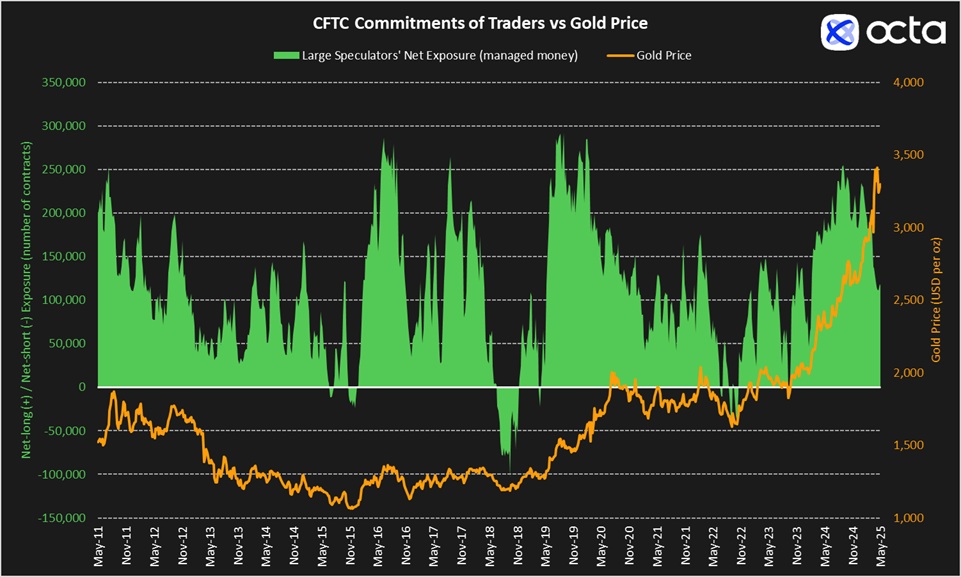
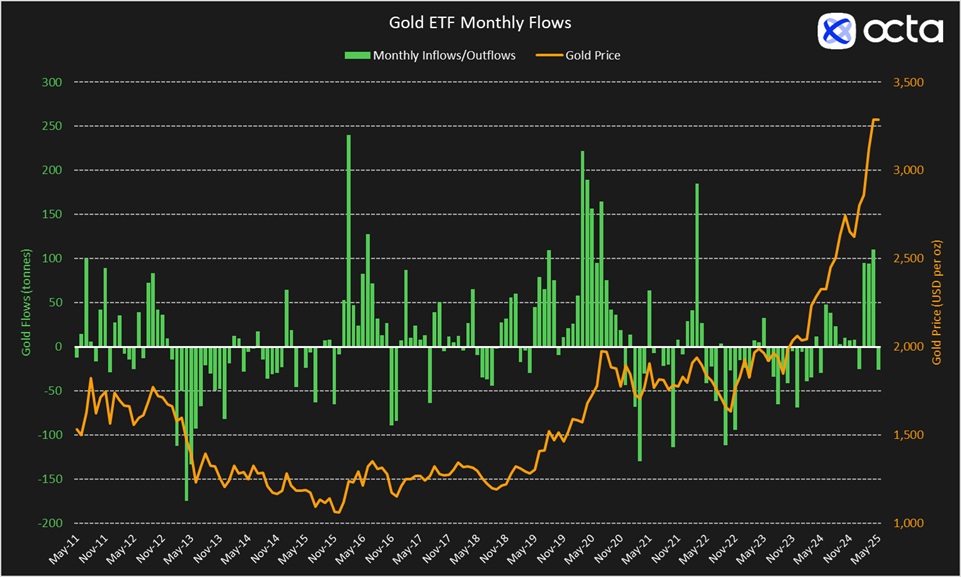
Apart from central banks, global investors have also remained quite bullish on gold. According to the Commodity Futures Trading Commission (CFTC), large speculators (leveraged funds and money managers) were still net-long COMEX gold futures and options as of 27 May, 2025. Long positions totalled 152,034 contracts vs only 34,797 short contracts. Meanwhile, according to LSEG, a financial firm, flows into physically-backed gold exchange-traded funds (ETFs) reached almost 50 mt year-to-date. Most recently, however, speculative bullish interest in gold and ETFs flows have been subsiding.
‘Although large speculators remain net-long, the size of their exposure is substantially smaller compared to what it was back in September 2024, when the uncertainty around the U.S. Presidential elections fuelled bullish bets‘, says Kar Yong Ang, adding that ETFs actually recorded a minor outflow in the first half of May.
Outlook
Fundamentally, the outlook for gold looks bright, but there are important caveats. We have singled out three important factors that will continue to play out in June and the rest of 2025.
Geopolitical uncertainty
Lingering global economic and geopolitical risks continue to play out, with the ongoing trade negotiations between the United States and the rest of the world, particularly China, being the most critical factor affecting the gold market and the global financial system.
The conflicts in the Middle East, such as the Israel-Hamas hostilities, a brief spat between India and Pakistan, and the ongoing conflict between Russia and Ukraine, have destabilised world politics and raised many fears ranging from oil and food supply disruptions to the prospect of a worldwide conflict. Gold, considered a ‘safe-haven’ asset, typically sees increased demand during political uncertainty and instability. While it is extremely difficult to project the resolution of geopolitical conflicts, let alone to forecast the emergence of new ones, peace negotiations in the hottest regions have already commenced. ‘Conflicting parties seem to have at least started to talk. A cease-fire in the Middle East and Eastern Europe is now more likely than it was only a month ago, but a lasting peace may take years to achieve. Either way, any progress in negotiations or even a temporary cessation of hostilities will improve risk sentiment and have a bearish impact on gold,‘ says Kar Yong Ang, global broker Octa analyst.
The looming 8 July tariff deadline imposed by U.S. President Trump further complicates the global political landscape, adding another reason for gold prices to remain elevated. As of today, the United Kingdom is the only country that has signed a new trade deal with the U.S., while trade talks with dozens of other countries have progressed too slowly. Negotiations remain unwieldy, while China and the U.S., the world’s two largest economies, continue to accuse one another of breaching the Geneva trade deal. As long as trade tensions persist, investors will be reluctant to sell gold.
Global monetary policy
Gold is priced in U.S. dollars and is therefore highly sensitive to changes in U.S. interest rates, inflation, and the greenback’s value. As already mentioned, the market is positioned for a dovish Fed. In fact, the latest interest rates swap market data implies roughly 75 basis points (bps) worth of rate cuts by the Fed by the end of December 2025. It is widely expected that other central banks will not fall far behind. For example, after the latest Eurozone inflation figures came out lower than expected, investors now expect the European Central Bank (ECB) to deliver two quarter-point rate cuts by the end of December 2025. Likewise, the Bank of England (BoE) is anticipated to announce at least two rate cuts of 25 bps each before the end of the year. Fundamentally, a less tight (or looser) monetary policy worldwide is a major bullish factor for gold. Because gold has no passive income and does not pay any interest, the opportunity cost of holding it becomes lower when central banks reduce their policy rates. The main risk, of course, is inflation. Should it remain above central banks’ targets or, even worse, start to increase, the Fed and its counterparts will be forced to hold the rates higher for longer.
‘Inflation is a major concern. Tariff-related price increases are yet to be felt, and although U.S. consumer 1-year and 5-year inflation expectations have eased, they remain very high by historical standards. I think some central banks, and maybe even the Fed, will prefer to wait until trade tensions are resolved before committing fully to rate cuts,‘ says Kar Yong Ang.
Physical demand
Physical demand for gold may continue to increase primarily because China, a significant gold consumer, remains an active buyer, but also because global central banks in general are increasingly turning to gold to diversify their reserves away from the U.S. dollar. Specifically, China has seen its national currency, the renminbi (RMB), appreciate more than 2% over the past month. This is not a welcoming development for a country whose economy heavily depends on exports. Thus, Chinese authorities may relax gold import quotas to stop the yuan from appreciating too much. As a result, the physical and investment demand for gold in China may rise in the months ahead. As for India, the demand for gold may temporarily slow due to seasonal factors, but is unlikely to reverse. Indian jewellers may delay making new stock acquisitions as monsoon rains are arriving, while the wedding season is concluding, but that will only have a temporary impact.
Technical picture
Kar Yong Ang, global broker Octa analyst, said: ‘From a technical perspective, XAUUSD looks bullish no matter how you look at it. 3,397, 3,438, and 3,463-3,471 levels are still real targets for bulls. Only a drop below 3,125 will invalidate the underlying bullish trend, and even then XAUUSD is more likely to trend sideways than to go deep down.’
Conclusion
Overall, we continue to see a generally bullish picture for gold, but it may be changing soon. Fundamentally, gold is still a ‘buy’ but no longer a ‘screaming buy’, as we labelled it in our August 2024 Digest. Wall Street analysts predict higher prices. Goldman Sachs recently hiked its 2025 gold forecast to $3,700 per oz, particularly due to strong central bank demand, implying a 10% upside potential from the current levels. At the same time, large speculators have already started to reduce their net-long exposure, while the outlook for the global monetary policy remains uncertain due to tariffs. Investors, in general, may be a bit too optimistic when it comes to rate cuts.
‘As things currently stand, it is still very hard to draw a bearish case for gold, but I do think that the bullish trend is showing first signs of exhaustion and some consolidation is likely to follow‘, said Kar Yong Ang, global broker Octa analyst. Next month will be critical for the gold market as it features seven key rate decisions and will likely be packed with news related to trade negotiations. Traders should be cautious as June news may essentially determine the XAUUSD trend for the next six months.
| 4 June | Bank of Canada meeting |
| 5 June | European Central Bank meeting |
| 6 June | U.S. Nonfarm Payroll |
| 11 June | U.S. Consumer Price Index |
| 15-16 June | Group-7 Summit |
| 17 June | Bank of Japan meeting |
| 18 June | Federal Reserve meeting |
| 19 June | Swiss National Bank meeting |
| 19 June | Bank of England meeting |
| 20 June | People’s Bank of China meeting |
| 23 June | S&P Global Purchasing Managers Indices |
| 24-25 June | North Atlantic Treaty Organization Summit |
| 26-27 June | European Council Summit |
| 27 June | U.S. Personal Consumption Expenditure Price Index |
| 30 June | German Consumer Price Index |
___
Hashtag: #Octa
The issuer is solely responsible for the content of this announcement.
Octa
Octa is an international CFD broker that has been providing online trading services worldwide since 2011. It offers commission-free access to financial markets and various services used by clients from 180 countries who have opened more than 52 million trading accounts. To help its clients reach their investment goals, Octa offers free educational webinars, articles, and analytical tools.
The company is involved in a comprehensive network of charitable and humanitarian initiatives, including improving educational infrastructure and funding short-notice relief projects to support local communities.
In Southeast Asia, Octa received the ‘Best Trading Platform Malaysia 2024’ and the ‘Most Reliable Broker Asia 2023’ awards from Brands and Business Magazine and International Global Forex Awards, respectively.
Media OutReach
MSIG Hong Kong’s 2025 Claims Report Reveals Growth in Claims Settlement Ratio for Fifth Consecutive Year and Spotlights Award-Winning Travel Insurance Offerings
Launched market-first Door-to-Door Luggage Repair Service for Travel Insurance customers
HONG KONG SAR – Media OutReach Newswire – 28 July 2026 – MSIG Insurance (Hong Kong) Limited (“MSIG”) today published its 2025 Claims Report, highlighting a fifth consecutive annual rise in its claims settlement ratio since 2020, strong performance across key classes, and new customer-focused travel innovations.
In 2025, MSIG honoured HK$359 million in claims in Hong Kong and Macau and achieved a 94.7% claims settlement ratio, up from 91.1% in 2020, reflecting the insurer’s sustained commitment to extraordinary claims service and role as a trusted partner. Employees’ Compensation Hong Kong recorded a 99.87% settlement ratio, followed closely by Helper (97.57%) and Travel (96.27%).
This year’s report shows significant progress in its customer-first approach – with an over 11% year-on-year increase in compliments received from customers, as well as 100% of the insurer’s 2025 Google reviews being 5-star rated.
Philip Kent, Chief Executive Officer of MSIG Hong Kong, said: “In a year of rapid change, our teams have stayed close to our customers and continued to put forward products and services that have truly helped when it mattered most. That’s what a customer-first mindset is all about and the results are clear from this year’s claims report. From innovative travel protection to extraordinary claims servicing, we continue to invest in bringing unique-to-market product features to our customers as their trusted partner, and are fully committed to further enhancing our service experience to deliver the assurance they need at every stage of their life journey.”
MSIG’s innovations in Travel Insurance also earned notable industry recognition in 2025 and 2026, reinforcing the strength of the offerings and the value they are delivering to customers:
- Won the Travel Insurance category at the 10Life 5-Star Insurance Awards 2026
- Top 3 Finalists in “Most Innovative Product/Service Award (General Insurance)” at the Hong Kong Insurance Awards 2025
New Travel Insurance services
In April 2025, MSIG launched two travel services designed to make support faster and more seamless. The market-first Door-to-Door Luggage Repair Service completed 135 luggage repair requests from April to December 2025, equal to 16% of all luggage damage claims, while Overseas Medical Teleconsultation simplifies access to care while travelling abroad. These new services reflect innovation in an area where customers value convenience, speed and reassurance.
MSIG built on that momentum in October 2025 with upgraded Travel Insurance products that added new benefits, including Cancellation of Journey for Any Reason. The enhancement gives travellers greater flexibility and strengthens MSIG’s position in a critical category where expectations are rising around responsive, real-world protection.
Beyond travel, the report highlights a wide range of cases of MSIG’s broader focus on customer-centred claims service across personal and commercial lines – demonstrating a commitment not only to efficient claims handling, but also to helping customers navigate disruption and move forward.
Hashtag: #MSIG
The issuer is solely responsible for the content of this announcement.
About MSIG Insurance (Hong Kong) Limited (“MSIG”)
MSIG is a wholly owned subsidiary of Mitsui Sumitomo Insurance Co Ltd and a member of the MS&AD Insurance Group, Asia’s leading general insurance brand with presence in 50 countries and regions globally. The Group is amongst the world’s top 10 insurance groups based on gross revenue and one of Japan’s leading insurers with A+ Stable credit rating. With over 40,000 employees world-wide, MSIG is represented in all ASEAN markets as well as in Australia, New Zealand, Hong Kong, Mainland China, Korea, India and Taiwan.
MSIG has been providing general insurance solutions to customers in Hong Kong for more than 170 years, dating as far back as 1855. We offer a wide range of solutions and services through an extensive distribution network including agents, brokers, and strategic partnerships with leading banks as well as growing collaborations with digital and consumer platforms.
Media OutReach
Swiss-Belhotel International Expands Bali Portfolio with the Soft Opening of The 5-Star Ashva Swiss-Belresort Ubud Bali
The launch reflects the group’s unwavering confidence in Bali’s resilient luxury tourism segment. Designed to meet the evolving preferences of modern travelers, Ashva Swiss-Belresort Ubud Bali brings sophisticated international hospitality standards to a sanctuary engineered for multi-generational family bonding, couples’ retreats, and immersive, experience-focused stays.
Sudharman Shetty, President Director of PT Ratna Forever Hospitality, stated:
“The development of Ashva Swiss-Belresort Ubud Bali represents a strategic step in expanding our hospitality business while supporting the growth of quality tourism in Ubud. We believe that Ubud’s natural beauty, cultural heritage, and unique attractions can be combined with international service standards to create a destination with strong value and long-term sustainability. Through the presence of the Swiss-Belresort brand, we hope Ashva will grow into a preferred resort choice for both domestic and international travellers, while also making a positive contribution to the local community and economy,” said Sudharman Shetty, Founder & Owner of Ratna Forever Hospitality.”
Gavin M. Faull, Chairman and President of Swiss-Belhotel International, added: “Indonesia continues to be a cornerstone of our global expansion vision. This development not only reflects the deep trust of our partners at PT Ratna Forever Hospitality in our balanced approach to guest comfort and operational excellence, but it also underscores our strong confidence in the market—particularly within the high-growth segment of travelers seeking spacious, lifestyle-oriented resort experiences.”
Developed with a contemporary yet culturally rooted resort concept, Ashva Swiss-Belresort Ubud Bali features 90 beautifully appointed guestrooms and suites, alongside 4 exclusive wooden pavilions. Accommodations range from a generous 40 to 106 square meters, perfectly catering to families and groups. Select premium room and suite tiers elevate the stay experience with private heated plunge pools and smart in-room technology.
The culinary landscape introduces diverse dining destinations, including Giwangkara All Day Dining and the renowned Udupi Multi-Cuisine Restaurant, which boasts a strictly separated, dedicated kitchen section for pure vegetarian preparation.
The resort’s striking architectural centerpiece is a terraced swimming pool concept, designed with cascading water elements and a Petanu Pool Bar overlooking Ubud’s layered natural landscape. To accommodate business and celebratory milestones, the property features a grand ballroom, versatile meeting spaces, and scenic outdoor areas beautifully tailored for weddings and social events.
Ilkin Ilyaszade, Senior Vice President – Operations and Development, Indonesia at Swiss-Belhotel International, commented: “As we actively strengthen our footprint across key hubs in Indonesia, Bali remains an essential, highly resilient destination with exceptional growth potential. The soft opening of Ashva Swiss-Belresort Ubud Bali directly supports this trajectory. Beyond creating vibrant leisure experiences, our comprehensive facilities and scenic setting are strategically positioned to capture the rising demand for premium corporate meetings, weddings, and high-profile social events.”
During the soft opening phase in July and August 2026, guests can take advantage of exclusive introductory rates before the resort transitions to its grand launch in September. To discover a new expression of refined living or to secure reservations, please visit ashvaswiss-belresort.com.
SBEC Loyalty Programme: Enjoy 10%–35% OFF on Rooms, Dining, and other services at 165+ hotels globally by becoming an SBEC loyalty member. Sign up for FREE and enjoy instant benefits through the Swiss-Belhotel International App—available in the App Store and Google Play Store.
Hashtag: #SwissBelhotelInternational #UbudResort #5StarResort #IndiaMarket #WellnessResort
https://www.swiss-belhotel.com/
https://www.linkedin.com/company/swiss-belhotel-international
https://www.facebook.com/swissbelhotel
https://www.instagram.com/swissbelhotel/
The issuer is solely responsible for the content of this announcement.
About Swiss-Belhotel International
Swiss-Belhotel International operates in 20 countries, managing 165+* hotels, resorts, and projects across New Zealand, Australia, Indonesia, Asia, the Middle East, Africa, and Europe, with regional offices in Hong Kong, New Zealand, Australia, China, Indonesia, UAE, the Philippines, Vietnam, Malaysia, and Thailand. Committed to delivering world-class hospitality, the group also offers the Swiss-Belexecutive Card (SBEC), a loyalty program providing many benefits, discounts from 10% to 35% on rooms, dining, and other services, plus priority check-in, complimentary upgrades, and late check-out. No collecting points, no waiting for redemption, with the free-to-join Green Global tier, members can enjoy instant discounts from their first stay! Book stays and access special offers tailored for SBI guests and SBEC members through the Swiss-Belhotel International App – available in
App Store and
Google Play Store. Stay connected with us on
Facebook,
Linkedin,
Instagram, and
TikTok for the latest updates and exclusive benefits. Visit
swiss-belhotel.com for more information.
*Numbers may fluctuate
Media OutReach
Nota Sign Integrates with Hong Kong’s iAM Smart, Enabling One-Stop Account Opening, Employee Onboarding and Contract Signing for Businesses and Residents
As Hong Kong continues to advance its digital government infrastructure, iAM Smart has become an important gateway connecting public services with digital commercial services. By the first quarter of 2026, the iAM Smart mobile application had recorded more than 10 million cumulative downloads and connected users to over 1,400 online services and electronic forms provided by government departments, public organisations and private institutions.
Through its integration with this digital identity ecosystem, Nota Sign has further strengthened its local digital signing capabilities in Hong Kong.
Designed to support electronic signature and data privacy requirements in more than 100 countries and regions, Nota Sign complies with major international regulatory frameworks, including the EU eIDAS Regulation, the US ESIGN Act, Hong Kong’s Electronic Transactions Ordinance and the GDPR.
The platform has completed ISO/IEC 27001 and ISO/IEC 27701 certifications, as well as SOC 2 Type I and Type II audits. It supports local digital identity systems in markets including Hong Kong and Singapore and operates data centres in key regions worldwide to meet data localisation requirements, fulfilling its commitment to “Sign with Global Trust.”
Through its deep integration with iAM Smart, Nota Sign enables both corporate and individual users to complete trusted identity verification and legally valid digital signatures using their iAM Smart accounts.
The integration connects Nota Sign directly with Hong Kong’s official digital identity infrastructure and further embeds the platform into the city’s digital government ecosystem. It provides government organisations, businesses and individuals in the Greater Bay Area, particularly those in Hong Kong, with a safer, more efficient and standardised one-stop digital signing solution.
Developed by the Government of the Hong Kong Special Administrative Region, iAM Smart is a one-stop digital identity authentication platform. Its compliant digital signing framework is established in accordance with Hong Kong’s Electronic Transactions Ordinance.
The platform serves as a key gateway through which Hong Kong residents and businesses access digital government and commercial services. It provides trusted identity verification, encrypted security and fully traceable records and is widely used across public service applications, commercial transactions and identity verification scenarios.
The integration brings together the core capabilities of iAM Smart and Nota Sign. Hong Kong users can authorise access to Nota Sign with one click using their iAM Smart accounts, eliminating repeated registration and data entry and significantly simplifying identity verification during cross-border signing processes.
Users can also verify their identities through iAM Smart and use Nota Sign to sign contracts, commercial documents and official records online. Data is encrypted throughout the process, all actions are recorded and signing activities remain fully traceable, helping ensure that the resulting signatures meet applicable legal and regulatory requirements.
For users, the integration between Nota Sign and iAM Smart creates a more convenient and trusted digital signing experience for both businesses and individuals.
Whether handling local transactions in Hong Kong, collaborating across the Guangdong-Hong Kong-Macao Greater Bay Area or conducting cross-border commercial activities, users can reduce repeated identity checks, paper document circulation and in-person procedures, improving both operational efficiency and the overall digital service experience.
Nota Sign supports a wide range of high-frequency signing scenarios, including business operations, financial services, human resources, commercial collaboration and personal affairs. Typical applications include the following:
Nota Sign can be used for local Hong Kong business activities and cross-border collaboration across the Greater Bay Area, including supply chain coordination, procurement transactions and service partnerships.
Businesses can initiate cooperation agreements, procurement contracts, service agreements, supply chain reconciliation confirmations and other commercial documents through Nota Sign.
Signatories can then use iAM Smart to complete identity authentication and digital signing, improving business collaboration efficiency and delivering a smoother signing experience.
For cross-regional employment, businesses can initiate online signing processes for offer letters, employment contracts, confidentiality agreements, non-compete agreements and overseas or cross-border assignment documents.
Employees can authenticate their identities and sign digitally through iAM Smart, allowing onboarding documentation to be completed entirely online. This reduces the costs associated with manual identity verification and paper document circulation while improving the efficiency of human resources management.
Nota Sign can support digital processes involving account opening, insurance applications, wealth management and corporate services.
Businesses can embed iAM Smart’s identity authentication capabilities into Nota Sign signing workflows. Once customers have completed identity verification, they can immediately sign account-opening agreements, authorisation documents, service agreements and other materials.
This reduces repeated authentication and duplicate data entry, providing customers with a smoother and more efficient online service experience.
Hong Kong residents can use iAM Smart to verify their identities and sign digitally when entering into tenancy agreements, granting personal authorisations or handling cross-border mandates.
Users no longer need to repeatedly enter their identity details or attend multiple in-person verification appointments. This improves the efficiency of a wide range of digital processes and makes signing more convenient and intuitive.
Huang Xiang, Founder and CEO of Fadada, said that the integration with iAM Smart represents an important strategic step in Nota Sign’s continued development in the Guangdong-Hong Kong-Macao Greater Bay Area. It also strengthens the platform’s local compliance service ecosystem and regional service capabilities.
Nota Sign previously established a partnership with Digi-Sign, the first commercial recognised certification authority under Hong Kong’s Tradelink.
Overseas users who do not have an iAM Smart account can use Tradelink iD-One, together with passport-based electronic Know Your Customer verification, to complete identity verification and apply for a digital certificate.
Following the integration with iAM Smart, Hong Kong residents can now complete identity authentication and digital signing directly through their iAM Smart accounts.
These two identity verification channels serve different user groups and further strengthen Nota Sign’s identity authentication network in Hong Kong.
Looking ahead, Nota Sign will continue to leverage its mature cross-border signing technology and compliance framework to provide reliable digital signing infrastructure for Chinese enterprises expanding overseas, Hong Kong and Macao businesses entering the Chinese mainland, and cross-border industrial collaboration across the Greater Bay Area.
Through these capabilities, Nota Sign aims to establish a leading cross-border electronic signing platform rooted in the Greater Bay Area and serving organisations worldwide.
Nota Sign is Fadada’s global electronic signature platform. It is designed to support electronic signature and data privacy requirements in more than 100 countries and regions and complies with regulatory frameworks including the EU eIDAS Regulation, the US ESIGN Act, Hong Kong’s Electronic Transactions Ordinance and the GDPR.
The platform integrates with dozens of recognised overseas certification authorities and provides electronic signature solutions at multiple assurance levels.
Nota Sign has completed ISO/IEC 27001 and ISO/IEC 27701 certifications, as well as a SOC 2 Type I audit. It operates data centres in key regions worldwide to meet data localisation requirements and supports localised signing services such as Singapore’s Singpass.
The platform has also introduced a GxP-compliant electronic signature solution designed to meet international regulatory requirements, including FDA 21 CFR Part 11 and EU Annex 11.
Powered by a legal-specific large language model, Nota Sign provides artificial intelligence capabilities such as intelligent contract review and multilingual document comparison.
It also supports integration with mainstream enterprise systems, including Salesforce and SAP, significantly shortening cross-border signing cycles and helping businesses “Sign with Global Trust.”
Fadada
www.notasign.com
ze****@****da.com
Hashtag: #FaDaDa #NotaSign
The issuer is solely responsible for the content of this announcement.