Economy
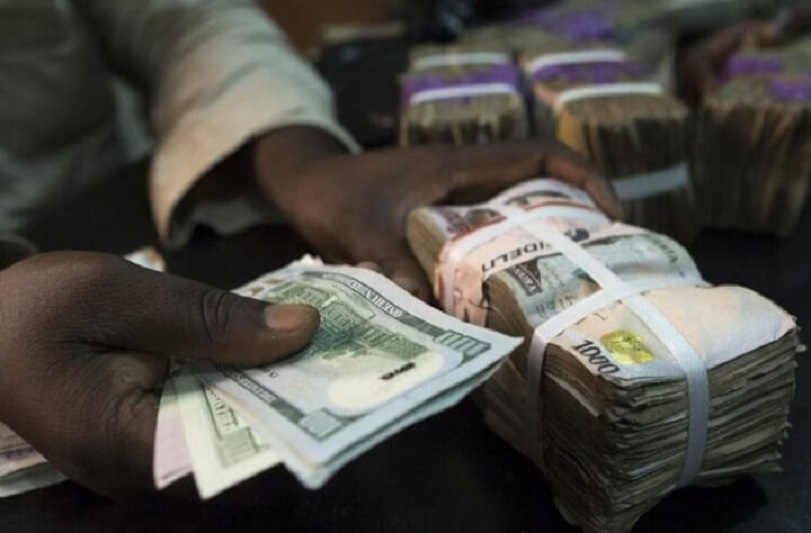
Naira Crumbles to N1,554.57/$1 at Official FX Market
By Adedapo Adesanya
It was a bad day for the Naira in the Nigerian Autonomous Foreign Exchange Market (NAFEM) on Monday, June 16 as its value shrank against the United States Dollar at the close of transactions.
The Nigerian currency lost 0.18 per cent or N2.72 on the greenback during the trading session to close at N1,554.57/$1 compared with the N1,551.85/$1 it was traded last Friday.
The local currency also weakened against the Pound Sterling in the official market yesterday by N1.16 to sell for N2,101.46/£1 compared with the preceding day’s N2,100.30/£1 and lost N3.66 to finish at N1,791.92/€1, in contrast to the preceding session’s N1,788.26/€1.
However, the domestic currency appreciated against the Dollar in the black market segment yesterday by N20 to trade at N1,590/$1 compared with the preceding session’s rate of N1,610/$1.
The Naira, over the recent weeks, had been stable due to sustained investor confidence and market optimism boosted by offshore FX inflows as well as boosting local production, easing forex pressure, and strengthening non-oil exports.
However, recent global jitters particularly the Israel-Iran attacks have spooked investors even as oil prices have seen over 7 per cent boost in the last week.
Support is expected to come as Nigeria’s headline inflation rate eased further to 22.97 per cent in May 2025, according to the National Bureau of Statistics (NBS), showing a decline from April’s 23.71 per cent, marking a 0.74 per cent reduction.
In the cryptocurrency market, the bears took control due to profit-taking, though Ripple (XRP) moved in a different direction, rising by 2.6 per cent to close at $2.23.
Daily active addresses has jumped nearly 700 per cent in just one week. According to data from Santiment, the number of daily interacting XRP addresses has soared to 295,000, up from a three-month average of around 40,000.
Together with this surge, the number of whale wallets containing 1 million or more XRP has also reached an all-time high as there are now 2,700 wallets with at least 1 million XRP in it- worth approximately $2.25 million per wallet.
It is the largest figure in the 12-year history of XRP, which demonstrates the increasing level of confidence among big investors.
In addition, Binance Coin (BNB) increased by 0.7 per cent to $658.84, and Bitcoin (BTC) went up by 0.3 per cent to $106,973.78.
On the flip side, Dogecoin (DOGE) slumped by 1.9 per cent to $0.1738, Solana (SOL) fell by 1.9 per cent to $153.58, Cardano (ADA) slid by 1.6 per cent to $0.6334, Ethereum (ETH) declined by 1.4 per cent to $2,580.71, and Litecoin (LTC) crashed by 1.0 per cent to $86.42, while the US Dollar Tether (USDT) and the US Dollar Coin (USDC) closed flat at $1.00 each.
Economy
OTC Securities Market Returns to Green Territory With N30bn Gain
By Adedapo Adesanya
The NASD Over-the-Counter (OTC) Securities Exchange returned to positive territory after it chalked up 1.18 per cent on Wednesday, June 24.
The NASD Security Index (NSI) was up during the session by 50.02 points to 4,289.36 points from the previous session’s 4,239.34 points, and the market capitalisation got a N30.03 billion boost to settle at N2.574 trillion compared with Tuesday’s closing value of N2.544 trillion.
The growth witnessed yesterday was influenced by two securities, led by Central Securities Clearing System (CSCS) Plc, which improved its value by N4.68 to N79.68 per share from N75.00 per share. Food Concepts Plc grew by 25 Kobo to sell at N2.75 per unit versus the preceding day’s N2.51 per unit.
At the close of trading activities, the value of securities bought and sold by market participants went up by 1,387.1 per cent to N82.9 million from the preceding session’s N5.6 million, and the volume of securities soared by 1,162.2 per cent to 2.7 million units from the previous 211,671 units, while the number of deals was halved by 50 per cent to 19 deals from 38 deals.
Great Nigeria Insurance (GNI) Plc remained the most active stock by value on a year-to-date basis, with 3.4 billion units valued at N8.4 billion, followed by Infrastructure Credit Guarantee (Infracredit) Plc with 2.3 billion units sold for N6.5 billion, and CSCS Plc with 68.3 million units transacted for N4.7 billion.
GNI Plc also closed the session as the most traded stock by volume on a year-to-date basis, with 3.4 billion units worth N8.4 billion, followed by Infracredit Plc with 2.3 billion units exchanged for N6.5 billion, and Resourcery Plc with 1.1 billion units traded for N415.7 million.
Economy
Naira Depreciates to N1,380/$ in Official Market
By Adedapo Adesanya
The value of the Naira further depreciated by 0.72 per cent or N9.90 against the United States Dollar to N1,380.54/$1 in the Nigerian Autonomous Foreign Exchange Market (NAFEX) on Wednesday, June 24, in contrast to Tuesday’s exchange rate of N1,370.64/$1.
Equally, the local currency weakened against the Pound Sterling in the same official market yesterday by N4.88 to close at N1,815.63/£1 versus the previous session’s N1,810.75/£1, and lost N2.61 on the Euro to sell at N1,563.63/€1 compared with the preceding day’s N1,561.02/€1.
However, at the GTBank forex counter, the domestic currency maintained stability against the US Dollar during the session at N1,380/$1, and at the parallel market, it closed flat at N1,395/$1.
Rising FX payments and a strong US Dollar have generally put significant pressure on emerging-market currencies, like the Naira.
According to the data from the Central Bank of Nigeria (CBN), NFEM interbank FX turnover was relatively steady at $125.588 million across 126 deals, from $125.314 million the previous day.
Interbank FX activity among financial institutions has fluctuated amid a sharp slowdown in forex market interventions by the apex bank, with more than six weeks of no support for the local currency.
Meanwhile, Nigeria’s foreign reserves increased further to $51.142 billion, while global oil prices entered the lower $70s.
Meanwhile, in the cryptocurrency market, nearly $1 billion worth of futures positions were liquidated across crypto majors to tokenised versions of stocks such as Micron Technology Inc (MU) and Sandisk (SNDK).
The dip triggered roughly $430 million in long liquidations on Bitcoin-tracked futures, or bets on higher prices that were automatically closed as the price fell.
Thursday’s PCE inflation print, the Fed’s preferred price gauge, is the next data point that could move the market in either direction, with Dogecoin (DOGE) down by 2.4 per cent to $0.0771.
Further, Bitcoin (BTC) fell by 1.9 per cent to $61,584.02, Ethereum (ETH) shed 1.6 per cent to trade at $1,645.50, Ripple (XRP) depreciated by 1.6 per cent to $1.08, Binance Coin (BNB) slumped by 1.5 per cent to $570.95, Cardano (ADA) crashed by 1.1 per cent to $0.1495, and Solana (SOL) slipped by 1.0 per cent to $69.19.
But TRON (TRX) gained 0.1 per cent to finish at $0.3288, while the US Dollar Tether (USDT) and the US Dollar Coin (USDC) remained unchanged at $1.00 each.
Economy
Brent Crude Slides Below $74 as Hormuz Supply Fears Ease
By Adedapo Adesanya
The price of Brent crude futures, the global oil benchmark, declined by $3.34 or 4.3 per cent on Wednesday to settle at $73.74 per barrel, its lowest level before the start of the Iran war on February 28, 2026.
Also, the US West Texas Intermediate (WTI) crude futures lost $2.87 or 3.9 per cent during the session to sell for $70.34 a barrel.
The development came as supply concerns eased with more stranded oil tankers exiting the Strait of Hormuz, which had been blocked since late February.
Market analysts noted that crude oil flows through the Strait of Hormuz are similar to what they were before the start of the Iran war, as tankers exit the key waterway with the help of military escorts. Around 20 million barrels of crude oil have exited the Strait of Hormuz in the last 24 hours.
Before the war began in late February, roughly 125 ships passed through the chokepoint each day, but current traffic remains a fraction of that.
Reuters reported that three stranded tankers carrying 5 million barrels of crude oil exited the strait on Wednesday, with two heading to Asia, shipping data showed, as the interim deal between Iran and the US began to unlock more supply stuck in the Gulf.
As Middle Eastern producers scramble to move crude that has spent months stranded in the Persian Gulf, tanker rates have exploded higher. The cost of hiring a tanker in the Gulf has nearly doubled in just a week, jumping from around $106,000 per day to more than $190,000 per day. For some very large crude carriers (VLCCs) hauling cargoes through Hormuz, daily earnings have surged to nearly $470,000.
The US also authorised Iranian oil sales this week, easing decades-old sanctions as it pushes toward a final peace deal with Iran in return for commitments on nuclear inspections and free transit through the Strait of Hormuz.
Oman said it would keep the strait open to shipping without imposing tolls and had designated two temporary routes north and south of the existing shipping lane to facilitate the safe passage of vessels leaving the region.
Crude inventories in the US remained tight on strong refining demand and amid a release of oil from the government’s emergency stash. The Energy Information Administration (EIA) said crude stocks, including commercial and those in the Strategic Petroleum Reserve, fell by 15.1 million barrels to 743.3 million barrels in the week ended June 19, which was the lowest level since 1984.
-
Feature/OPED6 years agoDavos was Different this year
-
Travel/Tourism10 years ago
Lagos Seals Western Lodge Hotel In Ikorodu
-
Showbiz3 years agoEstranged Lover Releases Videos of Empress Njamah Bathing
-
Banking8 years agoSort Codes of GTBank Branches in Nigeria
-
Economy3 years agoSubsidy Removal: CNG at N130 Per Litre Cheaper Than Petrol—IPMAN
-
Banking3 years agoSort Codes of UBA Branches in Nigeria
-
Banking3 years agoFirst Bank Announces Planned Downtime
-
Sports3 years agoHighest Paid Nigerian Footballer – How Much Do Nigerian Footballers Earn