Media OutReach
Mind the B-Gap: Telcos see a compelling case for digital inclusion powered by cloud technology
New research from CloudMosa shows digital inclusion is shifting from CSR to a core business strategy – and telcos stand to gain if they move quickly
- Majority (97%) of telco leaders say digital inclusion is now central to their business strategy, driven primarily by the need to bridge the digital divide (71%)
- With 92% of respondents seeing a strong alignment with government affordability initiatives as a key benefit of prioritizing digital inclusion
- Despite 2G network phaseouts progressing – with 62% of telcos completing the transition – 40% of Indian consumers still rely on 2G, exposing a critical gap in access
- 93% express confidence in cloud-powered solutions to help close the digital inclusion gap across high-growth markets
HONG KONG SAR – Media OutReach Newswire – 18 June 2025 – Millions of would-be customers remain offline across Asia’s fastest-growing digital economies. This is not a lifestyle choice; it’s because telcos are overlooking them — and a big growth opportunity in the process. In India, Vietnam, and the Philippines alone, over 600 million people still lack affordable access to the internet. CloudMosa, a leading cloud and mobile technology company, today released its inaugural B-Gap Barometer report, exploring the barriers keeping people offline in markets with network access as well as attitudes to potential solutions.
Based on insights from senior telecommunication leaders across the digitally ascending markets of India, Vietnam, and the Philippines, the report maps telcos’ 2G-to-4G migration, identifies persistent barriers to digital inclusion, and outlines how decision-makers are rethinking innovation and business strategies amid network transitions. The research also reveals the shift we’re seeing in digital inclusion becoming a strategic business priority, underscoring affordable access as the next frontier for growth.
“Telcos are racing to the future with 5G, but growth won’t come from the top alone,” said Shioupyn Shen, CEO of CloudMosa. “The real opportunity lies in those being left behind in the migration to 4G and beyond. This report is a call to action for industry leaders: those who move first to bridge the affordability gap will shape the next decade of the industry.”
Rising demands for affordable connectivity
Telcos are now at a crossroads. According to the B-Gap Barometer, 62% of operators across India, Vietnam, and the Philippines have already completed their 2G shutdowns, and another 26% are prepared for migration. Yet, despite the rapid progress in network infrastructure to support 4G, large populations still rely heavily on 2G networks. This is particularly evident in India, where 40% reported that up to half their company’s user base is still on 2G networks.
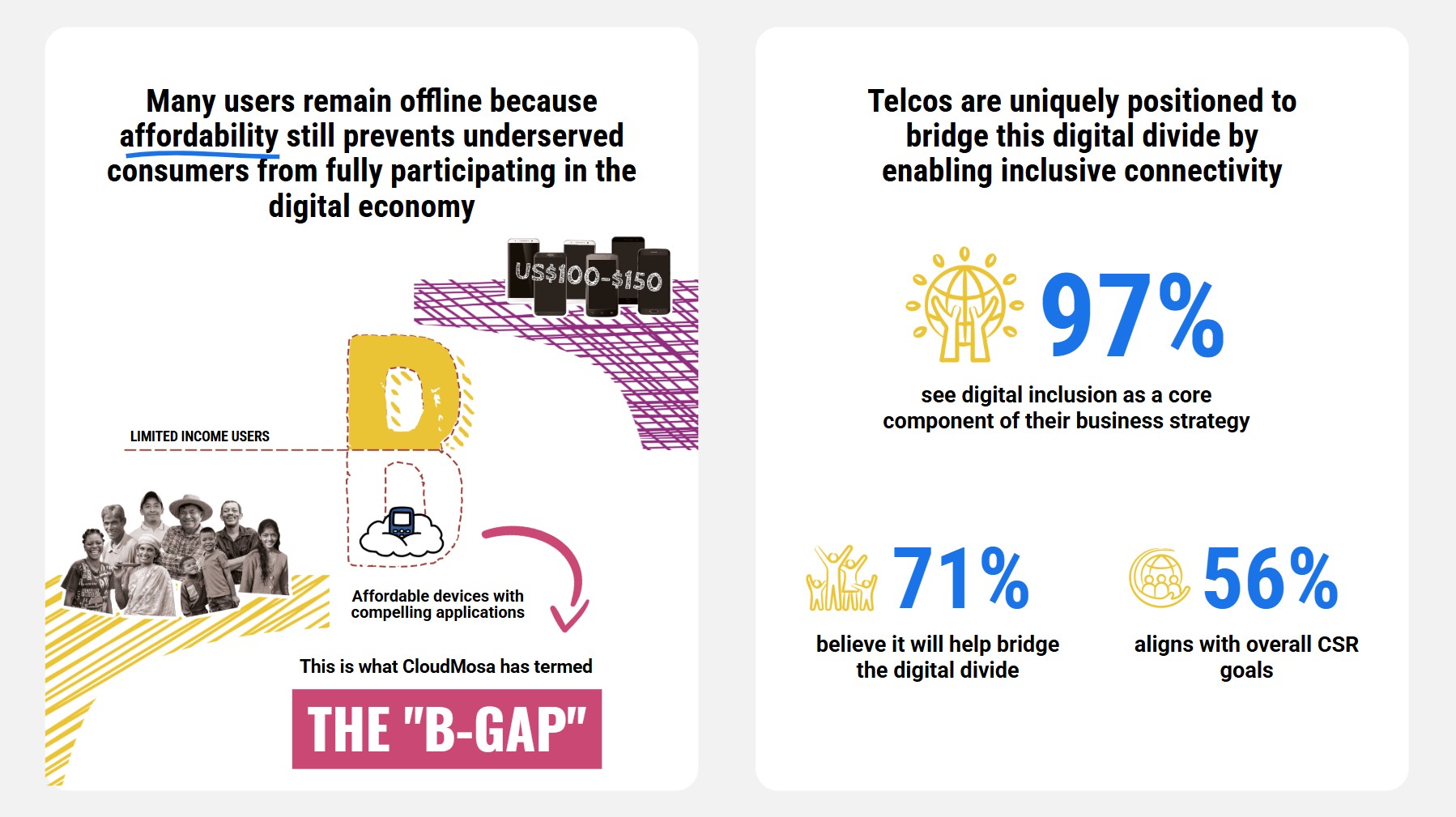
Despite existing network coverage, many users remain offline because affordability still prevents underserved consumers from fully participating in the digital economy – a challenge CloudMosa has termed the “B-Gap”.
In the Philippines, 66% of telco leaders cite costly data plans as consumers’ top barriers in transitioning to 4G and beyond. Vietnam and India follow closely, with 57% and 51% reflecting a similar sentiment. While more users are aiming to upgrade to smartphones – 73% in Vietnam and 62% in the Philippines – many still lean on feature phones given cost limitations. Seventy-five percent of Indian users still prefer traditional feature phones, driven by cost, simplicity, and reliability.
While the rest of the world is rushing towards 5G, these users present the region’s most overlooked commercial opportunity and telcos are uniquely positioned to move them up the value chain to ultimately close this gap. Doing so will unlock revenue, drive education, employment, economic mobility, and social inclusion.
Why inclusion is now a business imperative
As telcos continue to grapple with legacy network costs, stagnant average rate per user, or how to expand to underserved markets, digital inclusion is no longer a CSR initiative. It is becoming a critical commercial strategy to reach more users across digitally ascending markets.
A staggering 97% of industry players across three markets pointed to digital inclusion as a central component of their business strategy, with the biggest driver being bridging the digital divide (71%), followed by aligning with CSR goals (56%). More than half (53%) see inclusion helping with market expansion, customer retention and loyalty. The benefits are multifaceted, but the bottom line is clear: digital inclusion is a business growth engine that telcos can’t afford to ignore.
Driving the future of inclusive connectivity
While tech affordability has long been a challenge, key players are now presented with a solution in the form of cloud-based mobile devices to reach wider communities. Developed by CloudMosa, Cloud Phone is a breakthrough solution that transforms low-cost feature phones into modern, internet-capable devices. By shifting computing and data processing to the cloud, Cloud Phone delivers seamless online experiences that were previously out of reach for users on basic handsets.
In fact, telco leaders feel positively about this technology in helping to bridge the gap for billions of people worldwide that still lack crucial access. Ninety-one percent believe this solution can help close the B-Gap, with another 90% interested in its potential to dramatically improve UX for low-income users. Eighty-five percent have even cited running premium applications on low-cost devices as an attractive feature.
“We’re not just bringing the internet to feature phones — we’re unlocking opportunity for billions,” Shen added. “What we’ve built with Cloud Phone introduces a new growth model for telecom carriers, phone manufacturers and content providers. We want to show the mobile ecosystem how doing good doesn’t need to come at the expense of profitability. Telcos can still achieve commercial success while providing solutions that meet people where they are.”
What’s next: The business playbook for telcos
Traditionally viewed as low revenue customers, 2G feature phone users now represent a significant untapped opportunity. With cloud-based solutions reducing device and data costs, telcos can serve this segment profitably, offering app-based services on feature phones that operate like smartphones.
Solutions such as Cloud Phone offer a high-margin innovation platform to tackle the challenges telcos are facing by unlocking new growth while enabling digital transformation and wider business goals. Along with the right partnerships and business models, telcos can transform inclusion into real impact.
Download the B-Gap Barometer here: https://www.cloudphone.tech/b-gap-barometer.
For more information on CloudMosa, click here for the full press kit.
Hashtag: #CloudMosa
https://www.cloudphone.tech/
https://www.linkedin.com/company/cloudmosa
The issuer is solely responsible for the content of this announcement.
About the B-Gap Barometer Report
About CloudMosa
CloudMosa is a pioneer in providing cloud computing and remote browser solutions for both the consumer and enterprise sectors. For over a decade, CloudMosa has developed products with unparalleled security, speed, and efficiency for its clients. With a suite of offerings powered by its flagship product, Puffin Cloud Avatar Technology, CloudMosa is committed to reshaping the digital landscape and empowering users for a faster, more secure mobile experience. To learn more about CloudMosa’s cloud-powered solutions, visit
https://www.cloudphone.tech/
Media OutReach
SEAX Global Acquires Major Stake in Interlink Telecom to Accelerate ASEAN Expansion
Acquisition creates a fully integrated regional connectivity platform, enabling seamless, low-latency connectivity that supports ASEAN’s expanding digital economy
SINGAPORE/KUALA LUMPUR, MALAYSIA – Media OutReach Newswire – 13 December 2025 – SEAX Global (“SEAX”), a leading wholesale connectivity provider in Southeast Asia, today announced it has acquired a major stake in Interlink Telecom Public Company Limited (“ITEL”), a prominent Thai fixed network telecommunications provider.
This acquisition consolidates SEAX’s presence across Malaysia, Singapore, Indonesia, and now Thailand, integrating ITEL’s nationwide fiber network infrastructure and telecommunications licences with SEAX’s regional subsea and terrestrial networks. By leveraging ITEL’s on-ground operational capabilities alongside SEAX’s cross-border reach, customers can expect faster deployment timelines, greater service flexibility, and more seamless regional connectivity.
ITEL Global, a new subsidiary formed to serve international requirements from both local and major global clientele, will continue managing operations within Thailand, preserving its local expertise and market familiarity while aligning with SEAX’s broader regional strategy to deliver a network footprint with unparalleled coverage, improved reliability, and a customer-centric approach throughout Southeast Asia.
Louis Teng, Group CEO of SEAX Global, said, “By bringing together our regional networks with ITEL’s deep local expertise in Thailand, we’re creating a powerful, customer-focused platform that can keep pace with the rapid digital transformation underway in ASEAN. This partnership enables us to deliver robust, low-latency connectivity solutions that meet the evolving needs of enterprises and digital ecosystems seeking seamless cross-border service.”
Dr. Nuttanai Anuntarumporn, Group CEO of Interlink Telecom, added, “Thailand’s digital infrastructure is evolving swiftly, and through collaboration with SEAX, we have the opportunity to become a regional seamless connectivity provider, developing and operating high-performance cross-border infrastructure connecting Thailand, Singapore, Malaysia, Indonesia, Vietnam, and Hong Kong. Together, we will jointly build and operate this infrastructure, integrate our networks, and deliver seamless regional connectivity across ASEAN.”
McKinsey highlights that Southeast Asia’s digital economy is projected to grow at a compound annual growth rate of nearly 20%, fuelled by rising digital adoption across businesses and consumers, and expanding digital services including cloud computing and online payments. This surge is driving robust demand for reliable fibre connectivity and cross-border data solutions critical for digital platforms, OTT providers, and multinational enterprises.
This strategic expansion creates an integrated end-to-end regional connectivity platform, improving network coverage, reliability, and service flexibility. SEAX’s SIJORI hub, covering Singapore, Johor Bahru, and Batam, complements Interlink’s Thailand network, critical as digital economy growth accelerates, especially via data centre and AI-related services.
Hashtag: #SEAXGlobal
The issuer is solely responsible for the content of this announcement.
SEAX Global
SEAX Global is a privately funded, geopolitically neutral leader in Southeast Asia’s wholesale connectivity solutions. Established in 2013, SEAX specializes in submarine and terrestrial cable systems, cable landing stations, and data center colocation, providing seamless, high-performance connectivity across the region.
SEAX is owned by Forbes Asia Billionaire Dato’ Dr. Low Tuck Kwong’s family, the Singapore-born Indonesian entrepreneur best known as the founder of Bayan Resources and one of Southeast Asia’s wealthiest businessmen.
The company holds full operational licenses in Malaysia, Singapore, and Indonesia. These licenses uniquely allow SEAX to build and operate private fixed networks for dedicated or enterprise use. Leveraging its regulatory compliance, extensive network portfolio, and regional expertise, SEAX empowers businesses with reliable, scalable, and secure data transmission, supporting cross-border connectivity and exceptional customer service across Southeast Asia while positioning itself for continued growth and regional expansion.
Interlink Telecom
Interlink Telecom Public Company Limited (ITEL) is Thailand Telecommunications Network Service Provider, with a type 3 Telecommunications License from The National Broadcasting and Telecommunications Commission (NBTC). ITEL provides telecommunication services through a fiber optic network nationwide in Thailand. The company offers various services, such as MPLS IP-VPN, dark fiber, wavelength, IPLC, as well as telecommunication network installation and broadcast services. ITEL also provides data center space services, including co-location, cloud computing, and disaster recovery services. ITEL was established in 2007 and headquartered in Bangkok, Thailand. In 2024–2025, ITEL expanded into its fourth business segment in medical equipment distribution and service. Through Interlink Health Technology (IHT), the company provides medical equipment rental services, supported by skilled technicians and mobile service units for hospitals nationwide.
Media OutReach
M7 World Championship unveils first Opening Ceremony, tournament draw, and M7 Pass—elevates Indonesia on global stage
The Swiss Stage sets up early mouthwatering clashes between tournament favourites—Team Liquid face Aurora Gaming PH in a Filipino showdown, while Selangor Red Giants face CG Esports in a Malaysian rivalry.
|
Region
|
Channels
|
|
MLBB Women’s Esports
|
|
|
Global
|
|
Hashtag: #MOONTONGames, #M7, #Esports, #Gaming
The issuer is solely responsible for the content of this announcement.
About MOONTON Games
Media OutReach
A First in the Asia-Pacific – Taiwan Leads the Launch of the Early Kidney Disease Annual Report, Opening a New Era in Advancing Kidney Care
- Yung-Ho Hsu, Secretary General of the Taiwan Society of Nephrology
- Shang-Jyh Hwang, Honorary President of the Taiwan Society of Nephrology
- Masaomi Nangaku, Immediate Past-President of the International Society of Nephrology
- Marcello Tonelli, President of the International Society of Nephrology
- Mai-Szu Wu, President of the Taiwan Society of Nephrology
- Chung-Liang Shih, Minister of the Ministry of Health and Welfare
- Ching-Fen Shen, Director General of the Health Promotion Administration, Ministry of Health and Welfare
- Chih-Cheng Hsu, Professor at the National Health Research Institutes
- Hyeong-Cheon Park, President Elect of the Asia Pacific Society of Nephrology
- Rajnish Mehrotra, President of the International Society of Peritoneal Dialysis
The complete and immediate analysis aids in reversing the past trend where most patients were diagnosed at late stages and required dialysis, ushering in a new era of early detection and treatment. Minister of Health and Welfare, Chung-Liang Shih, stated at a press conference that this annual report serves as a new engine for promoting precise care, integrating complete data and risk classification indicators for Early CKD P4P(Pay for Performance) and Pre-ESRD P4P. This fills the gap in early kidney disease data and strengthens the quantitative basis for policy and clinical decision-making, facilitating early intervention and delaying disease progression. The goal is to achieve the Healthy Taiwan Policy target of reducing the standardized mortality rate for chronic diseases by one-third by 2030, and for Taiwan’s care model to become an example in the Asia-Pacific, establishing a sustainable and precise new framework for kidney care.
The early kidney disease annual report reveals several key trends. According to KDIGO risk classification, the proportion of high-risk and very high-risk patients in the P4P program has gradually decreased in recent years, reflecting a shift in treatment strategies toward early intervention and prevention. This trend not only highlights the medical team’s emphasis on the care of early-stage chronic kidney disease patients but also helps delay disease progression and reduce the incidence of later-stage complications. In terms of controlling the “three highs” (hyperglycemia, hypertension, and hyperlipidemia), data shows that approximately 80% of patients meet lipid targets and nearly 60% maintain stable blood sugar levels. However, only about 30% meet the target for blood pressure below 130/80 mmHg, indicating significant challenges remain in blood pressure control. The “three highs” are important risk factors for the progression and deterioration of chronic kidney disease, making it crucial to further improve control rates. The implementation of the P4P program has already shown preliminary results, and there are expectations for more immediate, comprehensive, and rigorous data collection and tracking, which will more fully demonstrate the long-term benefits of this care model.
Data-Driven: Taiwan’s First Early Kidney Disease Annual Report Fills Care Gaps
Professor Chih-Cheng Hsu from the National Health Research Institutes pointed out that past domestic kidney disease care has primarily focused on dialysis and end-stage disease, with limited understanding of early stages and delayed updates on data. This annual report breaks through traditional reporting frameworks and represents the first integration of complete data and risk classification indicators for Early CKD P4P and Pre-ESRD P4P. Utilizing big data for in-depth analysis, it outlines the disease progression and comorbidity trends of patients at different risk levels, successfully filling the long-term gap in early kidney disease care. He noted that grasping information on early stages of disease helps clinicians intervene earlier and delay deterioration while providing quantitative evidence for health policies to promote proactive and timely kidney care strategies, enhancing Taiwan’s international competitiveness in precise health governance.
Early CKD P4P and Pre-ESRD P4P are two phased quality-based reimbursement programs promoted by the National Health Insurance Administration, addressing key care needs for early chronic kidney disease and pre-dialysis patients, respectively. Early CKD P4P primarily targets patients in CKD stages 1-3a, aiding healthcare institutions in early identification of kidney deterioration risks through disease tracking and integrated care models, providing personalized management. Pre-ESRD P4P focuses on patients in CKD stages 3b, 4-5, enhancing control of complications, medication, and nutritional management while utilizing data feedback to support treatment decisions, aiming to delay dialysis and improve care efficiency. Both programs link the complete processes from early prevention to pre-dialysis intervention, contributing to improved overall CKD care quality and patient long-term prognosis.
Precise Kidney Care: Holistic and Continuous CKD Care as a Model for Chronic Disease
Taiwan centers its approach on “precise care,” continuously optimizing the integrated chronic kidney disease care system to implement policy blueprints in clinical practice. Director General of National Health Insurance Administration, Lian-Yu Chen, mentioned that Taiwan has progressively refined various measures, from educational programs for pre-end-stage renal disease patients to integrated care plans for early chronic kidney disease. The medical team can adjust personalized treatment strategies based on patient risk classification and clinical data, strengthening disease management and follow-up effectiveness for early-stage patients. She indicated that by integrating and providing feedback across units, care gaps could be minimized to ensure that patients receive consistent medical services across different levels of care. Director General of Health Promotion Administration, Ching-Fen Shen, remarked that grassroots health education and community health advocacy go hand in hand to enhance public awareness of kidney health. Years of efforts have significantly slowed the deterioration of early kidney disease progression, with patients participating in integrated care exhibiting a lower future risk of dialysis compared to those who do not participate, showing tangible effectiveness of the Taiwan model.
Policy Linkage and Sustainable Vision: Achieving the Healthy Taiwan Goals and Leading the New Landscape of Asia-Pacific
In response to the government’s “Healthy Taiwan” policy, Taiwan is implementing a preventive kidney care model based on the Early CKD P4P and Pre-ESRD P4P systems and the Early Kidney Disease Annual Report. President of the Taiwan Society of Nephrology, Mai-Szu Wu, stated that investing in early chronic kidney disease management not only contributes to health sustainability but also reduces waste of medical resources, achieving dual benefits of health outcomes and environmental sustainability, assisting the government in its goal to reduce chronic disease mortality by one-third by 2030.
During the Asia-Pacific Nephrology Conference (APCN) held in Taipei this year, the Asia-Pacific’s first Early Kidney Disease Annual Report was officially unveiled. President of the International Society of Nephrology, Marcello Tonelli, and Immediate Past-President , Masaomi Nangaku, along with the President Elect of the Asia Pacific Society of Nephrology Hyeong-Cheon Park and Honorary Secretary Sunita Bavanandan attended as witnesses, attracting experts from South Korea, Japan, Thailand, Malaysia, Australia, New Zealand, Singapore, Hong Kong, Mongolia, Indonesia, and the Philippines. Additionally, various important domestic academic societies, including the Taiwan Academy of Family Medicine, Taiwan Society of Cardiology, the Diabetes Association of the Republic of China (Taiwan), the Taiwan Association of Clinical Diabetes, and the Taiwan Medical Clinics Association also participated and supported the event. Minister Chung-Liang Shih expressed gratitude for the collective efforts and emphasized that this kidney annual report showcases Taiwan’s leading position in medical data integration and clinical evidence, hoping that real-time and comprehensive data analysis will once again showcase Taiwan’s precision care model to the international community, working together with other countries to create a new global framework for chronic kidney disease prevention and treatment.
Hashtag: #TaiwanSocietyofNephrology
The issuer is solely responsible for the content of this announcement.
-
Feature/OPED6 years agoDavos was Different this year
-
Travel/Tourism9 years ago
Lagos Seals Western Lodge Hotel In Ikorodu
-
Showbiz3 years agoEstranged Lover Releases Videos of Empress Njamah Bathing
-
Banking7 years agoSort Codes of GTBank Branches in Nigeria
-
Economy3 years agoSubsidy Removal: CNG at N130 Per Litre Cheaper Than Petrol—IPMAN
-
Banking3 years agoFirst Bank Announces Planned Downtime
-
Banking3 years agoSort Codes of UBA Branches in Nigeria
-
Sports3 years agoHighest Paid Nigerian Footballer – How Much Do Nigerian Footballers Earn