Connect with us

World

BRICS at Rio de Janeiro: And What Next?

Published

on

BRICS at Rio de Janeiro

By Kestér Kenn Klomegâh

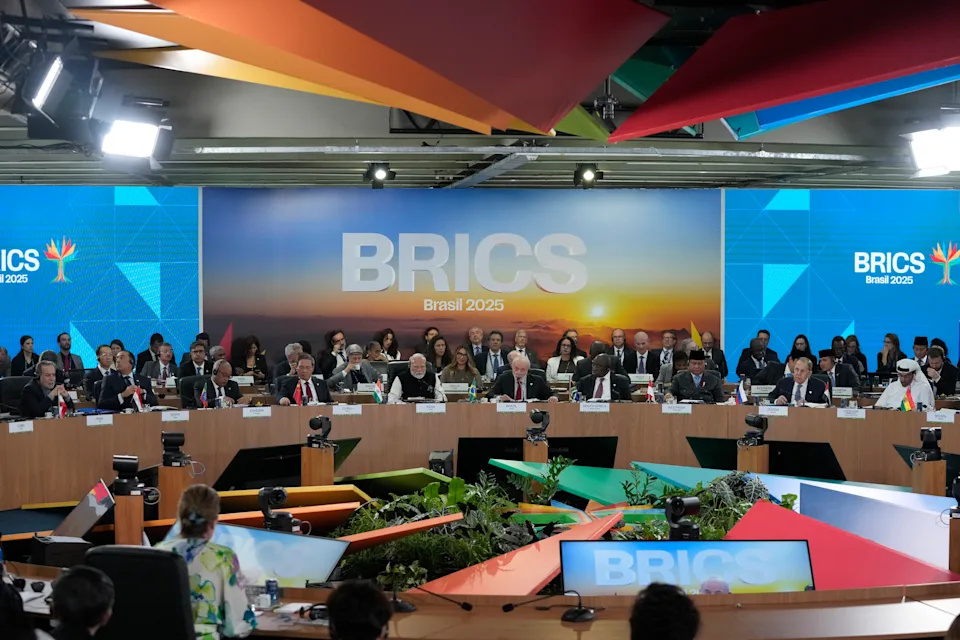
Popularly referred to as BRICS, the informal group of emerging-market economies (Brazil, Russia, India, China and South Africa), meeting in Rio de Janeiro, has outlined a new unprecedented multitude of goals to challenge unipolar system. In the context of rising uncertainty, BRICS has further set up new models to change the economic architecture through South-South cooperation.

Brazilian President Luiz Inacio Lula da Silva hosted early July BRICS summit in Rio de Janeiro, capital city of Brazil. U.S. President Donald Trump’s position on many sensitive issues has offered the association something of a dilemma. In a joint statement decried “the rise of unjustified unilateral protectionist measures” and the “indiscriminate raising” of tariffs. BRICS members all agree that “these tariffs are not productive,” Ambassador Xolisa Mabhongo, South Africa’s lead negotiator, or sherpa, said in an interview. “They are not good for the world economy. They are not good for development.”

President Luiz Inácio Lula da Silva has a raft of controversies with United States over the introduction of single BRICS currency, a suggestion he mooted in 2023. Besides that Brazil is currently facing steep economic challenges in the face of trade frictions with the United States. Majority of his citizens are facing deportation, it implies significant fallen in remittances and that would worsen social and financial standing of families across Brazil. It has had diverse criticisms, so are other new BRICS members with vastly different political and economic systems, and yet advocating for reshaping the global balance of power. Most of them are negotiating to be at discussion table, to straighten economic ties, with President Donald Trump.

On one hand, BRICS leaders seriously Trump’s “indiscriminate” import tariffs and other trade policies. On the other hand, Trump has also warned that countries which sideline with the policies of the BRICS alliance against United States interests will be hit with an extra 10% tariffs.

BRICS summit further called for strengthening multilateralism. China unreservedly underscored its desire to work with member states to “strengthen the BRICS strategic partnership and safeguard multilateralism,” Foreign Ministry spokesperson Mao Ning said in a briefing in Beijing. With noticeable policy  and economic disparities, its rapid expansion to include Egypt, Ethiopia, Iran, Indonesia and the United Arab Emirates bolstered its representation — the new BRICS accounts for about 40% of global GDP and roughly half the planet’s population.

BRICS policy to build a multipolar world has attracted developing countries. Trade among the five original BRICS nations grew 40% between 2021 and 2024 to US$740 billion a year, according to International Monetary Fund data.

Emerging Tasks from Rio de Janeiro

Brazil took over from Russia last year December, promised to put in complete order housekeeping issues — officially termed institutional development — on the agenda to better integrate new members and boost internal cohesion. With ten (10) partner members that includes Belarus, Cuba and Vietnam, BRICS plans to work ‘ad hoc practical cooperation’ basis. These partner states have absolutely no decision-making authority as full members. The enlarged bloc is now characterized by emerging potential opportunities but deepening frictions. BRICS is increasingly experiencing complexities based on their individual priorities and geopolitical orientations. Yet the bloc, often denying the unpredictable stage of stark realities, continues boasting of coherence and systemic efforts toward creating a multipolarity.

BRICS boasts of huge resources, and substantially claims to be ahead of other groups in this parameter, including G7 with US$57 trillion. Further to that, BRICS has many supporters in the Global South and East.

At the tail-end of the July 6th to 7th summit, BRICS reset new tasks, little achievements were highlighted by speakers, in addition to those previously rattled phrases such as BRICS leads ‘multipolar world’ and be guided as key centres of global governance and work collective towards economic growth, and further gravitate the development of markets in the Global South. The question of payment in local currencies was underscored while BRICS members emphasized reducing the use of dollar in currency transactions. In fact, several promising initiatives have, thus become future responsibilities of India, who takes up the BRICS Chairmanship.

Russia’s Achievements

During the final summit at Kazan, which was held in October 2024, Russia established a category of BRICS partner states. In addition, Russia proposed creating a whole new BRICS investment platform. The idea behind it is to jointly develop coordinated instruments to support and to bring in the funds from the economies of BRICS countries and from the Global South and Global East countries. It suggested launching a special mechanism for holding consultations on World Trade Organisation matters. The processes for creating a grain exchange, a climate research centre, a permanent logistics platform, and a sports cooperation programme in BRICS are moving forward.

There are other valuable ideas proposed by Russia, which include the formation of a carbon market partnership, an arbitration investment centre, a fair competition platform, and a permanent tax secretariat within BRICS.

In September, Moscow will host Intervision, a popular international television song contest which has got the attention of numerous performers from BRICS and BRICS partner countries who confirmed their willingness to participate in it. A humanitarian project of that magnitude is designed to promote universal, cultural, family, and spiritual values ​​shared by members.

India’s Proposals

With participation of BRICS members, partners and outreach invitees, India proposed the creation of BRICS Science and Research Repository to promote collaboration in critical areas, highlighted its initiatives in agri-biotech and digital education access, calling on BRICS to adopt a demand-driven approach and ensure long-term financial sustainability in New Development Bank (NDB) projects.

China’s Suggestions

Chinese Premier Li Qiang praised the complementary advantages and suggested broader forms of cooperation in such areas as digital economy, green economy, sci-tech innovation and aerospace. From notable indications, China stands ready to closely work with members and partners in enriching the dimensions both on bilateral basis and multilateral relations. China expressed high concerns over achieving concrete results, rather than mere high-quality rhetoric. Premier Li Qiang further talked about BRICS working within multilateral frameworks such as the United Nations, the G20 and the African Union (AU), Eurasia and the Community of Latin American and Caribbean States.

New Development Bank

The BRICS Bank President, Dilma Rousseff, has officially welcomed Colombia and Uzbekistan as new members. The membership now totalled 11 members, including Brazil, Russia, India, China, South Africa, Bangladesh, the United Arab Emirates, Egypt, and Algeria. “We have several other countries under observation and review, and they may join the bank in the future,” Rousseff stated at the briefing in Rio de Janeiro, Brazil.

The NDB, established in 2015 as a multilateral development bank, operates with full respect for the sovereignty and development priorities of its member countries. Based in Shanghai, the bank has already approved over 120 projects worth a total of US$40 billion, focusing on areas such as clean energy, transport infrastructure, environmental protection, and social infrastructure.

Final Declaration

After the plenary session the final Declaration of the 17th BRICS summit – “Rio de Janeiro Declaration” – was adopted on 6th July 2025. The document welcomed Indonesia as a new BRICS member, and the following Belarus, Bolivia, Kazakhstan, Cuba, Nigeria, Malaysia, Thailand, Vietnam, Uganda, and Uzbekistan as BRICS partner countries.

The 126 point-document passed on the Chairmanship to India in 2026 and the holding of the XVIII BRICS Summit in India. The document acknowledged the significance of (i) Strengthening Multilateralism and Reforming Global Governance (ii) Promoting Peace, Security and International Stability (iii) Deepening International Economic, Trade and Financial Cooperation (iv) Combating Climate Change and Promoting Sustainable Development (v) Partnerships for the Promotion of Human, Social and Cultural Development

Conclusion

Analysts say in a summarized comment that despite the glaring inconsistencies among the group, even as they have, somehow, managed to speak with one voice on major international issues, China and India both interested to lead the BRICS and the Global South as a whole. India Prime Minister Narendra Modi takes over the BRICS presidency for 2026, as he explained that the group’s diversity is its strength, and shares collective commitment to emerging multipolar world. Original members of the bloc Brazil, Russia, India, and China have been joined by South Africa and, more recently, by Saudi Arabia, Iran, the United Arab Emirates, Egypt, Ethiopia and Indonesia.

Kestér Kenn Klomegâh has a diverse work experience in the field of business intelligence and consultancy. His focused research interest includes geopolitical changes, foreign relations and economic development related questions in Africa with external countries. Klomegâh has media publications, policy monographs and e-handbooks


Advertisement
Click to comment

Leave a Reply

Your email address will not be published. Required fields are marked *

World

Russia Renews Africa’s Strategic Action Plan

Published

on

Russia Africa's Strategic Action Plan

By Kestér Kenn Klomegâh

At the end of an extensive consultation with African foreign ministers, Russian Foreign Minister, Sergey Lavrov, has emphasized that Moscow would advance its economic engagement across Africa, admittedly outlining obstacles delaying the prompt implementation of several initiatives set forth in Strategic Action Plan (2023-2026) approved in St. Petersburg during the Russia-Africa Summit.

The second Ministerial Conference, by the Russian Foreign Ministry with support from Roscongress Foundation and the Arab Republic of Egypt, marked an important milestone towards raising bilateral investment and economic cooperation.

In Cairo, the capital city of the Arab Republic of Egypt, Lavrov read out the final resolution script, in a full-packed conference hall, and voiced strong confidence that Moscow would achieve its strategic economic goals with Africa, with support from the African Union (AU) and other Regional Economic blocs in the subsequent years. Despite the complexities posed by the Russia-Ukraine crisis, combined with geopolitical conditions inside the African continent, Moscow however reiterated its position to take serious steps in finding pragmatic prospects for mutual cooperation and improve multifaceted relations with Africa, distinctively in the different sectors: in trade, economic and investment spheres, education and culture, humanitarian and other promising areas.

The main event was the plenary session co-chaired by Russian Foreign Minister Sergey Lavrov and Egyptian Minister of Foreign Affairs, Emigration, and Egyptians Abroad Bashar Abdelathi. Welcome messages from Russian President Vladimir Putin and Egyptian President Abdelhak Sisi were read.

And broadly, the meeting participants compared notes on the most pressing issues on the international and Russian-African agendas, with a focus on the full implementation of the Russia-Africa Partnership Forum Action Plan for 2023-2026, approved at the second Russia-Africa Summit in St. Petersburg in 2023.

In addition, on the sidelines of the conference, Lavrov held talks with his African counterparts, and a number of bilateral documents were signed. A thematic event was held with the participation of Russian and African relevant agencies and organizations, aimed at unlocking the potential of trilateral Russia-Egypt-Africa cooperation in trade, economic, and educational spheres.

With changing times, Africa is rapidly becoming one of the key centers of a multipolar world order. It is experiencing a second awakening. Following their long-ago political independence, African countries are increasingly insisting on respect for their sovereignty and their right to independently manage their resources and destiny. Based on these conditions, it was concluded that Moscow begins an effective and comprehensive work on preparing a new three-year Cooperation and Joint Action Plan between Russia and Africa.

Moreover, these important areas of joint practical work are already detailed in the Joint Statement, which was unanimously approved and will serve as an important guideline for future work. According to reports, the Joint Statement reflects the progress of discussions on international and regional issues, as well as matters of global significance.

Following the conference, the Joint Statement adopted reflects shared approaches to addressing challenges and a mutual commitment to strengthening multifaceted cooperation with a view to ensuring high-quality preparation for the third Russia-Africa Summit in 2026.

On December 19-20, the Second Ministerial Conference of the Russia-Africa Partnership Forum was held in Cairo, Egypt. It was held for the first time on the African continent, attended by heads and representatives of the foreign policy ministries of 52 African states and the executive bodies of eight regional integration associations.

Continue Reading

World

TikTok Signs Deal to Avoid US Ban

Published

on

Forex Advice on TikTok

By Adedapo Adesanya

Social media platform, TikTok’s Chinese owner ByteDance has signed binding agreements with United States and global investors to operate its business in America.

Half of the joint venture will be owned by a group of investors, including Oracle, Silver Lake and the Emirati investment firm MGX, according to a memo sent by chief executive, Mr Shou Zi Chew.

The deal, which is set to close on January 22, 2026 would end years of efforts by the US government to force ByteDance to sell its US operations over national security concerns.

It is in line with a deal unveiled in September, when US President Donald Trump delayed the enforcement of a law that would ban the app unless it was sold.

In the memo, TikTok said the deal will enable “over 170 million Americans to continue discovering a world of endless possibilities as part of a vital global community”.

Under the agreement, ByteDance will retain 19.9 per cent of the business, while Oracle, Silver Lake and Abu Dhabi-based MGX will hold 15 per cent each.

Another 30.1 per cent will be held by affiliates of existing ByteDance investors, according to the memo.

The White House previously said that Oracle, which was co-founded by President Trump’s supporter Larry Ellison, will license TikTok’s recommendation algorithm as part of the deal.

The deal comes after a series of delays.

Business Post reported in April 2024 that the administration of President Joe Biden passed a law to ban the app over national security concerns, unless it was sold.

The law was set to go into effect on January 20, 2025 but was pushed back multiple times by President Trump, while his administration worked out a deal to transfer ownership.

President Trump said in September that he had spoken on the phone to China’s President Xi Jinping, who he said had given the deal the go ahead.

The platform’s future remained unclear after the leaders met face to face in October.

The app’s fate was clouded by ongoing tensions between the two nations on trade and other matters.

Continue Reading

World

United States, Russia Resolving Trade Issues, Seeking New Business Opportunities

Published

on

Kirill Dmitriev, CEO (RDIF) and Russian Presidents Special Envoy to United States

By Kestér Kenn Klomegâh

Despite the complexities posed by Russia-Ukraine crisis, United States has been taking conscious steps to improve commercial relations with Russia. Unsurprisingly, Russia, on the other hand, is also moving to restore and normalise its diplomacy, negotiating for direct connections of air-routes and passionate permission to return its diplomats back to Washington and New York.

In the latest developments, Kirill Dmitriev, Chief Executive Officer of the Russian Direct Investment Fund (RDIF), has been appointed as Russian President’s Special Envoy to United States. This marked an important milestone towards raising bilateral investment and economic cooperation. Russian President Vladimir Putin tasked him to exclusively promote business dialogue between the two countries, and further to negotiate for the return of U.S. business enterprises. According to authentic reports, United States businesses lost $300+ bn during this Russia-Ukraine crisis, while Russia’s estimated 1,500 diplomats were asked to return to Moscow.

Strategically in late November 2025, the American Chamber of Commerce in Russia (AmCham) has awarded Kirill Dmitriev, praised him for calculated efforts in promoting positive dialogue between the United States and Russia within the framework decreed by President Vladimir Putin. Chief Executive Officer of Russian Direct Investment Fund (RDIF) Kirill Dmitriev is the Special Representative of the Russian President for Economic Cooperation with Foreign Countries. Since his appointment, his primary focus has been on United States.

“Received an American Chamber of Commerce award ‘For leadership in fostering the US-Russia dialogue,’” Dmitriev wrote on his X page, in late November, 2025. According to Dmitriev, more than 150 US companies are currently operating in Russia, with more than 70% of them being present on the Russian market for over 25 years.

In addition, Chamber President Sergey Katyrin and American Chamber of Commerce in Russia (AmCham) President Robert Agee have also been discussing alternatives pathways to raise bilateral business cooperation. Both have held series of meetings throughout this year, indicating the the importance of sustaining relations as previously. Expectedly, the Roscongress Foundation has been offered its platforms during St. Petersburg International Economic (SPIEF) for the American Chamber of Commerce (AmCham).

On December 9, Sergey Katyrin and Robert Agee noted that, despite existing problems and non-economic obstacles, the business communities of Russia and the United States proceed from the necessity of maintaining professional dialogue. Despite the worsening geopolitical conditions, Sergey Katyrin and Robert Agee noted the importance of preserving stable channels of trade and pragmatic prospects for economic cooperation. These will further serve as a stabilizing factor and an instrument for building mutual trust at the level of business circles, industry associations, and the expert community.

The American Chamber of Commerce (AmCham) will be working in the system of the Chamber of Commerce and Industry (CCI) in the Russian Federation, which currently comprises 57,000 legal entities, 130 regional chambers and a combined network of representative offices covering more than 350 points of presence.

According to reports obtained by this article author from the AmCham, promising sectors for Russian-American economic cooperation include healthcare and the medical industry, civil aviation, communications/telecom, natural resource extraction, and energy/energy equipment. The United States and Russia have, more or less, agreed to continue coordinating their work to facilitate the formation of a more favorable environment for Russian and American businesses, reduce risks, and strengthen business ties. Following the American-Russian Dialogue, a joint statement and working documents were adopted.

Continue Reading

Trending