

World
BRICS+ and G20: Competing or Collaborating for Global South

By Kestér Kenn Klomegâh
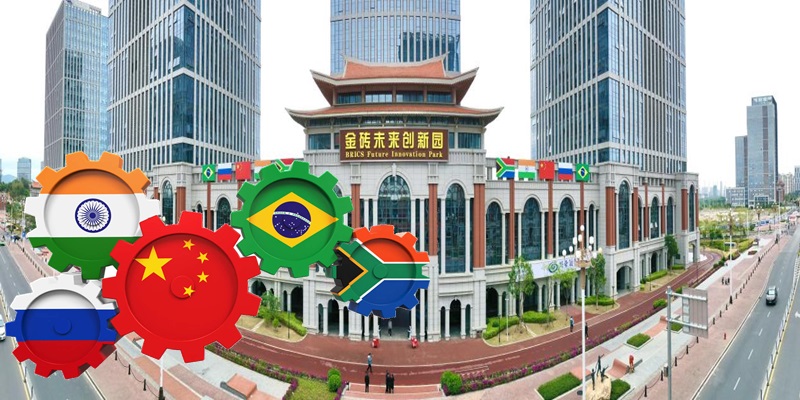
South Africa’s Cyril Ramaphosa heads G20, an intergovernmental forum comprising 19 sovereign countries, the European Union, and the African Union, while Brazil’s Luiz Inácio Lula da Silva chairs BRICS+, an association made of Brazil, Russia, India, China and South Africa with four new members and 13 partner states in a category mostly from developing countries.
At a quick glance, the G20 and BRICS+ are respectively chaired this year 2025 by South Africa and Brazil, both BRICS+ members, which makes it distinctively important development for the changing geopolitical world. In 2025, G20 and BRICS+ agenda features a pivotal role and pledge to continue making concerted strides, either in keen competition for economic revitalization or in close collaboration as development players, in the Global South.
Historically, G20 was created back in 1999 as a group of twenty of the world’s largest economies to deal primarily with multifaceted aspects of existing global economic, trade, health, climate change and political issues. Dissatisfied with the global dominance of the United States and the stack failure of leaders of developing countries, especially in Africa, to raise their economic status to an appreciable levels and improve standards of living for the largely impoverished population, BRIC appeared in 2009, in city of Yekaterinburg, Russia.
South Africa ascended in 2010, transforming it into BRICS. As popularly now referred to as BRICS+, its key objective aspiration is to support building a better economic architecture for the Global South. In addition, BRICS+, as a non-western association, operates against western hegemony and uni-polar, rules-based system. Its key priority aims at shaping a more equitable and a more balanced global order while collaborating with developing countries in raising their economic status in the Global South.
An insight into G20 and BRICS+ including its “partner states” category shows the huge economic structure, the natural and human resources necessary for the future of mankind. We have observed several discussions, at highest levels these several years, on intensifying whatever political dialogue and exchange of views, economic collaborations and interactions on bilateral and multilateral mechanisms for developing better conditions in the Global South. Bridging the economic and standards of living gap have been on the agenda for both G20 and BRICS+ during previous years.
Every year, the leaders of G20 members meet to discuss mainly economic and financial matters and coordinate policy on some other issues of mutual interest. Every year, BRICS+ members summit features extensive deliberations on the United States global dominance and hegemony, without adequately addressing economic lapses in the developing Global South. Several summit declarations have adopted in that directions, but remain purely as collective declarations.
G20 and BRICS+ agenda in 2025?
As geopolitical situation heightens, G20 and BRICS+ are championing its a fresh version of governance reforms in their ways, and further reviewing the current operations of multilateral institutions such as the United Nations, the World Trade Organization (WTO), International Monetary Fund (IMF)and the World Bank for developing countries in the Global South. Despite these common goals, G20 and BRICS+ still have the main points of discontention. BRICS+ shares, in its declarations, dissatisfaction over over-exploitation of resources in and rules-based approach towards developing world.
In the Ministry of International Relations and Cooperation’s media release in January 2025, titled “The G20 is made up of 13 Engagement Groups”, stated that “South Africa fully supports the approach of strengthening partnerships and expanding dialogue with a wide range of actors; including States, international organizations and civil society; to collectively shape the G20’s approach to issues requiring international cooperation.” (South Africa’s chairmanship of G20, Jan. 2025)
It further recognizes the significant strides made by the Brazilian G20 presidency (2024) in enhancing the G20 as a site of democratic global engagement. The South African presidency will continue this trajectory. In South Africa’s G20 presidency, further modalities will be developed to involve a wide range of stakeholders throughout the year, particularly on priority initiatives. Until the G20 Leaders’ Summit in November 2025, South Africa is expected to bring together representatives of the existing engagement groups and other segments of civil society that may offer meaningful contributions to the G20.
For the BRICS+ agenda, focus is placed on the need to reform the current international financial architecture to meet the global financial challenges. As already explained, the measures are to facilitate the development of the economy, international trade, and the achievement of the sustainable development goals.
In addition to the financial architecture, BRICS+ has agreed to discuss and study the feasibility of establishment of an independent cross-border settlement and depositary infrastructure, an initiative to complement the existing financial market infrastructure, as well as independent reinsurance capacity and the possibility of expanding innovative financial practices and approaches for projects and programmes, including finding acceptable mechanisms of financing in local currencies.
BRICS+ has reaffirmed its commitment to maintaining a strong and effective Global Financial Safety Net with a quota-based and adequately resourced IMF at its centre. On G20, BRICS+ recognized the importance of the continued and productive functioning of the G20, based on consensus with a focus on result-oriented outcomes. In other words, both would play complimentary role in the global economy, and appreciating efforts with a focus on development trends in the Global South.
South Africa Driving Development Goals
In accepting G20 chairmanship early December in Cape Town, South Africa explicitly indicated a number of practical ways forward in consolidating G20 on the world stage as it strives to gain additional significant momentum in 2025.
South Africa, however, insisted that G20’s relations have to be compatible with development gaols of the Global South. The main argument here is that the G20 comprises many of the world’s largest developing and developed economies. Therefore, G20 has to play a critical role in influencing policies and foster economic stability to have a direct impact on the lives of all members of the global community.
It has a wide agenda that now includes trade sustainable development, health, agriculture, energy, the environment, climate change and anti-corruption. These agenda initiatives are not only to drive economic progress but also to accelerate and support long-term investment opportunities across the continents especially in Africa.
The outlook for global economic growth remains unpredictable, and many economies carry the burden of unsustainable levels of debt. Geopolitical instability, conflict and war are causing further hardship and suffering. Across the world, billions of people are affected by under-development, inequality, poverty, hunger and unemployment.
Strengthening Economic Partnership
Working together with G20 members and building partnerships across society is one the surest pathways to confront the development challenges. Exploring the development pathways, without any geopolitical discrimination but with caution, to achieve more rapid, inclusive and economic growth for future generations.
The G20 provides us with a platform to pursue these collective goals. South Africa has adopted the theme ‘Solidarity, Equality and Sustainability’ for its G20 Presidency. Through solidarity, we can create an inclusive future that advances the interests of people at the greatest risk of being left behind.
Under South Africa’s leadership, the G20 leaders have to work seriously with African Union and European Union, through this year, until its final summit which will take place in Johannesburg in November 2025. South Africa’s presidency, for the first time an African country has presided over the G20, in line with above-mentioned theme, there is the necessity to strengthen and advance consistent efforts to achieve the Sustainable Development Goals by 2030.
Africa’s Noticeable Challenges
Until today, Africa faces multitude of challenges. The continent, comprising 55 States, was declared as politically independent in 1963 and yet is confronted with challenges of an excellent model of governance and exemplary leadership. Basic tenets of transfers as stipulated within framework of constitutions are usually marked by conflicts, opposition groups are frequently banned from operating in the country.
This is further simply compounded by economic under-development which impact heavily on living standards of majority of the population across the Africa. Despite huge untapped natural resources, tackling the economy requires finances which many African countries lack primarily due to inability to design national priority actions. Urban-rural development disparities have taken its characteristic shape in many geographic parts of Africa.
The local African, multilateral financial institutions, development banks and the private sector need to scale up, with a fairer and appropriate lending conditions to ensure debt sustainability for low-income countries.
In fact, Africa still needs more investment in infrastructure, healthcare, education and finance for sustaining many other development needs, and as well as to consider extending debt relief to developing economies. These are challenges for G20 and BRICS+ to champion their critical positions as engines for growth and development in Africa, and Global South.
In 2025, there is unshakeable (amplified) hope that both South Africa’s G20 directorship and Brazil’s BRICS+ chairmanship, focus would be on pursuing remarkable progress on cross-cutting development issues throughout Africa and across Global South.
Logical Expectations
In this fast-changing landscape characterized by forging new alliances, the practical implementation of the Russia’s initiatives, against the backdrop of escalated tensions, fostering cooperation not confrontation, will rather help effectively in addressing challenges. One more significant point is that there may be important linkages emerging between BRICS+ and G20. Undoubtedly, Brazil in 2025 is likely to base its priorities on some of the themes that were pursued in 2024 during its chairmanship in G20.
BRICS and G20, critical over global political developments and economic growth, but both could complement efforts as partners in tackling existing challenges, coordinate approaches and strategies. Particularly, Africa, as part of the developing Global South, has increasingly become the subject of deliberations at high-level summits and conferences, noting that more 60% of its population still wallow in abject poverty.
Understanding the puzzling paradox that Africa has huge untapped natural resources and adequate human capital to engage in development. Often asked rhetorical question why ‘the Asian tigers’ developed while ‘the African lions’ declined these past several years. South Africa, as the current G20 president, has to set the platform this 2025 for practical dialogue at G20, which includes BRICS members, to adopt collective towards Africa’s development goals including those in energy, industrialization, infrastructure and agriculture.
Logical Conclusion
As we mark the end of this first quarter century in 2025, it behoves on individual leaders, states and their stakeholders to act rather than engage in persistent criticisms and trading geopolitical rhetoric. On one hand, BRICS+ bloc is rapidly evolving as an alternative platform for global cooperation. For substantive continuity, BRICS+ apparently has to ensure that the initiatives raised during Russia’s presidency, and previous summits, members and the “partner states” maintain unwavering commitment towards their realization.
But on the other hand, G20 has to readjust and adapt its collective approach towards diverse perspectives, reform its models of operations to compliment and support development initiatives of the Global South. While appreciating in the final summary that G20 and BRICS+ platforms are created for driving global development and expected optimal economic growth, and further to engage in tackling challenges in order to register visible impact, it is highly necessary to emphasize the importance of trust and collaboration.
Moreover, the geopolitical implications are already known. But this, as a whole, becomes ultimately the greatest interest in their current deliberations. It is really a defining moment for Africa, and in general, for the Global South. Both G20 and BRICS+ have to subsequently demonstrate strategic steps in actualizing the aspirations as we move forward into the future.


