Connect with us

General

Lokpobori to Highlight Nigeria’s Oil, Gas Investment Gains at AEW 2026

Published

on

Heineken Lokpobiri oil fields dispute

By Adedapo Adesanya

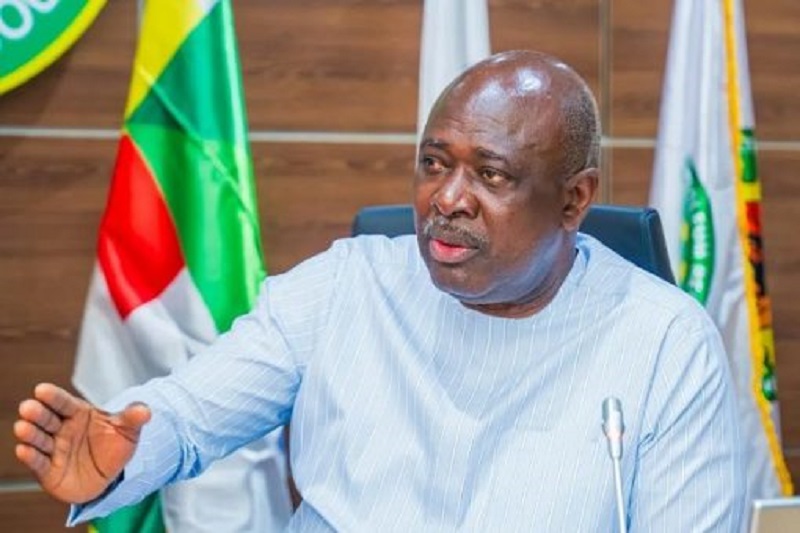
The Minister of State for Petroleum Resources (Oil), Mr Heineken Lokpobiri, is expected to outline Nigeria’s accelerating upstream transformation and its expanding role as one of Africa’s leading oil and gas investment destinations at the African Energy Week (AEW) 2026, scheduled to hold October 12-16 in Cape Town, South Africa.

Nigeria’s energy sector has recorded one of its strongest investment cycles in a decade, driven by regulatory reforms under the Petroleum Industry Act (PIA), improved fiscal incentives and renewed confidence from international oil companies (IOCs) and indigenous operators.

In 2025 alone, Nigeria approved 28 new Field Development Plans valued at $18.2 billion, unlocking an estimated 1.4 billion barrels of crude oil reserves, according to government disclosures. These approvals mark a decisive shift toward accelerating project execution timelines and reversing years of stalled upstream development.

Mr Lokpobiri has consistently credited this momentum to reforms under the PIA, alongside faster licensing processes and investment-friendly fiscal adjustments.

Speaking in Abuja earlier this year, he noted that Nigeria secured four of seven major Final Investment Decisions (FIDs) in Africa between 2024 and 2025, positioning the country as a leading upstream investment hub on the continent.

A central pillar of this resurgence is Shell’s Bonga deepwater complex, where the company has taken a $5 billion final investment decision on the Bonga North project, a subsea tie-back expected to add over 300 million barrels of recoverable resources and significantly boost long-term output from the FPSO hub. The development is widely viewed as a benchmark for Nigeria’s renewed deepwater competitiveness.

Meanwhile, ExxonMobil’s planned investment in the Usan deepwater oil field is expected to inject up to $1.5 billion between 2025 and 2027, supporting production revitalisation through new drilling and infrastructure upgrades.

Alongside IOC-led expansion, Nigeria’s indigenous producers are increasingly central to near-term output growth, with Heirs Energies targeting up to 100,000 barrels per day as it ramps up development across its onshore Niger Delta portfolio, including OML 17.

According to a statement from the African Energy Chamber (AEC), this momentum is complemented by Seplat Energy’s optimisation of its expanded onshore portfolio following the ExxonMobil acquisition, reinforcing the growing role of local operators in stabilising production and driving Nigeria’s short-term output gains.

Mr Lokpobiri is also expected to highlight Nigeria’s broader energy transition framework at AEW 2026, which seeks to balance oil production growth with gas monetisation, domestic refining expansion and increased local content participation. His policy messaging has consistently emphasised that Nigeria’s oil and gas sector is structured to accommodate both IOCs and a growing base of indigenous operators.

“Nigeria is once again proving what is possible when policy meets execution,” said NJ Ayuk, Executive Chairman of the African Energy Chamber. “Under leaders like Heineken Lokpobiri, we are seeing renewed seriousness about production, investment and getting projects across the line – from deepwater developments to indigenous-led growth. This is exactly the kind of momentum Africa needs: not promises, but barrels, projects, and bankable deals.”


Adedapo Adesanya is a journalist, polymath, and connoisseur of everything art. When he is not writing, he has his nose buried in one of the many books or articles he has bookmarked or simply listening to good music with a bottle of beer or wine. He supports the greatest club in the world, Manchester United F.C.

Click to comment

Leave a Reply

Your email address will not be published. Required fields are marked *

General

2027: Tinubu Retains Shettima as Vice Presidential Candidate

Published

on

tinubu shettima

By Dipo Olowookere

Nigeria’s Vice President, Mr Kashim Shettima, will run as the vice-presidential candidate of the All Progressives Congress (APC) in the 2027 presidential election.

President Bola Tinubu retained Mr Shettima as his running mate for re-election next year, according to the National Chairman of the APC, Mr Nentawe Yilwatda.

In a post on Friday on X, the ruling party chairman described this as “another significant milestone in the journey of our great party.”

He also said it reaffirms the party’s collective resolve to sustain the Renewed Hope Agenda and deepen the progress already being recorded across the country.

It was gathered that Mr Tinubu submitted his presidential nomination forms today through his Special Adviser on Political and Other Matters, Mr Ibrahim Masari.

The submission was done ceremony at the Continental Hotel, Abuja, attended by several party chieftains, including The event brought together an impressive array of leaders of our great party, including the Chairman of the Progressive Governors’ Forum and Governor of Imo State, Mr Hope Uzodimma; Governor Mai Mala Buni of Yobe State, Governor Nasir Idris of Kebbi State, Governor Abba Kabir Yusuf of Kano State, Governor Uba Sani of Kaduna State, Governor Babagana Umara Zulum of Borno State, Governor Ahmadu Umaru Fintiri of Adamawa State, as well as other governors, party executives and critical stakeholders from across the federation.

“The All Progressives Congress remains focused on strengthening its grassroots support, consolidating the achievements of the Renewed Hope Agenda and working together to build a more prosperous, secure and inclusive Nigeria for all,” the party leader stated.

Continue Reading

General

Abducted Oyo Pupils, Teachers Regain Freedom After 56 Days

Published

on

oriire kidnapping Oyo pupils teachers

By Adedapo Adesanya

The pupils and teachers abducted in Oriire Local Government Area of Oyo State have regained their freedom after 56 days in captivity.

The development was disclosed on Friday by the Special Adviser to the President on Information and Strategy, Mr Bayo Onanuga, on X. He revealed that eight of the kidnappers have been arrested and are now in the custody of the Department of State Services (DSS), while some others were neutralised during the operation.

“Finally, all the kidnapped pupils and teachers in Oriire, Oyo have been rescued by our security agencies,” he wrote.

He said no concession was made to the terrorists to secure the freedom of the abducted pupils and teachers.

Mr Onanuga explained that the kingpin whose release the kidnappers had demanded was neither freed nor spared, as he remains under prosecution for offences linked to his terrorist activities.

The abductions occurred on May 15, 2026, when armed men attacked three schools: Community Grammar School, Baptist Nursery and Primary School, and L.A. Primary School, in the Esiele and Yawota communities of Oriire Local Government Area.

No fewer than 39 pupils and seven teachers, including a principal, were taken during the attacks. During the attack, a teacher, Mr Joel Adesiyan, was killed while attempting to escape.

Another teacher, Mr Michael Oyedokun, was reportedly beheaded in the kidnappers’ den.

The terrorists holding the victims had reportedly made a four-point demand before agreeing to free the captives, including the release of detained terrorist commanders, payment of ransom, two Hilux vehicles and the implementation of Sharia-related law.

The Oyo State Government had consistently maintained that no ransom would be paid to secure the release of any victims.

The Nigeria Union of Teachers (NUT) embarked on a month-long strike in the state to press for the victims’ rescue before suspending the action in July.

It also drew federal intervention, with military and police authorities repeatedly assuring Nigerians that operations to secure the victims’ freedom were ongoing.

The President’s spokesperson said that security agencies would soon provide a comprehensive account of the operation.

Continue Reading

General

EBID Injects $260m Into Nigeria’s Cross-Border Highway Project

Published

on

ECOWAS Bank for Investment and Development

By Adedapo Adesanya

The board of the ECOWAS Bank for Investment and Development (EBID) has approved a $260 million financing package for the construction of a 123-kilometre section of the Trans-Saharan Highway in Nigeria as part of more than $417 million earmarked for strategic projects across West Africa.

The approval was granted during the bank’s 99th Ordinary Session, chaired by its President, Mr George Donkor, according to a statement issued after the meeting. It was noted that the total financing will support five public and private sector projects spanning infrastructure, healthcare, housing, mining, financial resilience and regional connectivity.

EBID said the approved investments underscore its commitment to funding high-impact projects that drive economic growth, create jobs and improve living standards across the sub-region.

“The projects approved during this 99th Board Session demonstrate EBID’s unwavering commitment to financing development solutions that directly improve the lives of West African citizens.

“From clean energy and transport infrastructure to healthcare, housing and financial sector resilience, these investments will strengthen regional competitiveness and support sustainable and inclusive growth across our community,” said Mr Donkor.

That of Nigeria is to improve connectivity, facilitate trade, reduce logistics costs and support economic integration; West African CFA franc (XOF) 10 billion in a line of credit to Banque de l’Habitat de Côte d’Ivoire (BHCI) to expand housing finance and support SMEs operating across the housing and construction value chain; €80 million for the design, construction, equipment and maintenance of the 150-bed Regional Hospital of Ferkessédougou in Côte d’Ivoire under a public-private partnership;

XOF 12.82 billion (West African CFA Franc) for the renovation, operation and maintenance of the Symphonie Building in Abidjan under a public-private partnership and $47.4 million for Azumah Resources Ghana Limited to finance the procurement of long-lead process plant equipment and critical early-stage development activities for the Black Volta Gold Project.

“These approvals advance EBID’s Growth, Resilience and Optimisation (GRO) Strategy, which prioritises transformative infrastructure, human capital development, private sector growth and regional integration. Through these investments, the Bank continues to promote sustainable development and shared prosperity across West Africa,” the statement said.

Continue Reading