Media OutReach
NIA Advances Strategic Plan to Empower Thai Innovation Businesses with Knowledge, Funding, and Global Networks to Drive Thai Innovation onto the World Stage
The agency has announced significant achievements in driving Thai innovation businesses towards global competitiveness through its ‘4G’ strategy: Groom, Grant, Growth, and Global. NIA now moves forward with new objectives: to foster innovations that deliver tangible positive impacts on the economy and society, supported by a strong innovation ecosystem. This includes financial support, the development of entrepreneurial capabilities, access to innovation infrastructure, and adaptation to the ongoing volatility of the global economic and social landscape.
The goal is to strengthen Thai entrepreneurs and create opportunities for them to expand their investments both domestically and internationally.
Dr. Krithpaka Boonfueng, Executive Director of the National Innovation Agency (Public Organization) (NIA), stated that Thailand’s innovation businesses hold several inherent strengths: from the readiness of national policies and infrastructure to the ability to blend culture and technology into creative products and services, leveraging diverse natural resources and the growing regional market that continues to attract foreign investors.
These factors have given Thai start-ups and SMEs the opportunity for exponential growth. As Thailand’s Focal Conductor of Innovation, NIA stands ready to link with partners both in Thailand and overseas to promote and support innovation-driven businesses across all dimensions, guided by the 4G framework: Groom: nurturing and developing innovation capability; Grant: providing financial support; Growth: creating opportunities to expand markets and access funding; and Global: propelling Thai innovations onto the international stage.
Over the past year, under the ‘Groom’ dimension, NIA has accelerated capability building through 16 innovation training programs delivered by NIA Academy, engaging more than 40,000 participants across youth, entrepreneurs, organizations, and emerging leaders. The agency has also promoted start-up development through the Thailand League Start-up Program, engaging over 250 teams from 50 universities nationwide, equipping students with entrepreneurial skills and perspectives to prepare them for the real-world start-up journey.
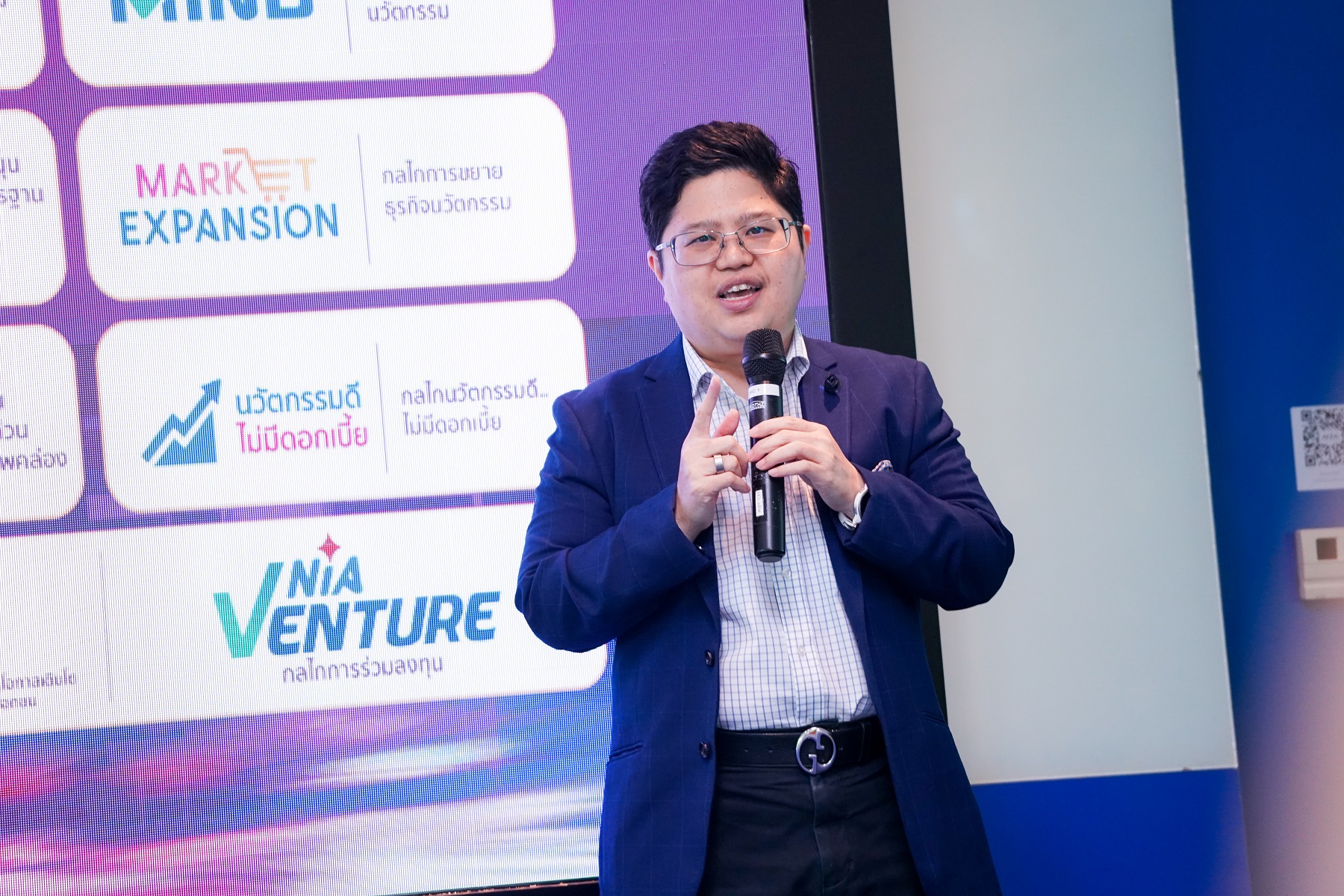
For start-ups, SMEs, and social enterprises looking to further develop and commercialize their innovations, NIA provides financial support under the ‘Grant’ dimension. This is structured into national development innovation funding and area-based innovation funding, supported by nine mechanisms designed to meet target group needs: Open innovation; Mission-driven innovation programs; Development of standards for innovation businesses; Partial interest support to enhance liquidity; Scaling regional innovation to wider markets; Innovation advisory services; Business expansion support; the ‘Good Innovation, No Interest’ initiative; and Co-funding and investment support, connecting entrepreneurs with public and private capital sources.
As of August, NIA has already supported 254 innovation projects this year, with funding exceeding 397 million baht.
In the ‘Growth’ dimension, NIA prioritizes expanding market access and funding opportunities both domestically and internationally, particularly in Thailand’s high-potential industries. To this end, the agency has developed acceleration programs for five priority sectors: agriculture, food, medical and healthcare, energy and environment, and tourism/soft power/society.
In 2026, NIA aims to accelerate growth for 100 start-ups, targeting innovation-driven revenues of 1 billion baht and attracting an additional 2 billion baht in investment. The agency also continues to highlight and disseminate success stories through the Nil Mangkorn (Blue Dragon) Project, now in its third year. Cohorts 1 and 2 of the projects have enabled more than 40 Thai innovation brands to achieve average revenue growth of 3.4 times, equivalent to an economic impact of over 530 million baht.
NIA also positions itself as a global start-up hub, providing services for both Thai start-ups aiming to expand overseas and foreign start-ups seeking to establish businesses in Thailand. Under the ‘Global’ dimension, support ranges from consultancy, market access, and investment facilitation to smart visas and tax measures. Thai start-ups with potential are guided into global markets through international market linkages, partnerships, and overseas business matching activities in countries such as the United States, Sweden, Finland, Qatar, China, Japan, Korea, and Hong Kong. To strengthen these efforts, NIA has also introduced programs to elevate innovation-based enterprises into international markets, including: Corporate Spark: fostering business matching with international start-ups possessing distinctive technologies or services; Global Market Link: creating opportunities to connect and expand markets overseas; and Global Investment Link: enhancing capabilities to attract investment from foreign investors.
Dr. Krithpaka added, “Looking ahead to 2026, NIA identifies four global innovation trends that will shape opportunities and challenges for Thai start-ups and SMEs alike. These are: (1) Technology trends such as AI, IoT, and automation; (2) Environmental trends, including alternative energy, energy efficiency, and carbon reduction; (3) Geopolitical trends, covering resource allocation, conflict situations affecting global supply chains, and trade tariffs between Thailand and the United States, all of which demand adaptability from Thai industry and entrepreneurs; and (4) Demographic trends, particularly the shrinking proportion of the working-age population, which will affect economic structures, productivity, health welfare, and demand for goods and services. These present both challenges and opportunities for Thai SMEs and start-ups to adapt and tap into new business prospects arising from such shifts.”
In response, NIA has outlined three flagship projects aligned with MHESI policy priorities: (1) the development of Thailand as a regional medical hub; (2) the application of agri-tech and agri-innovation by start-ups; and (3) the acceleration of deep-tech innovation enterprises. Additionally, NIA is advancing the NIA Innovation Journey & Dashboard 2026, a national database system consolidating information on innovation-based entrepreneurs, supported products and services, and growth trajectories. This platform will enable analysis of innovation dynamics to guide future policy direction and support mechanisms.
Dr. Krithpaka concluded that “NIA remains firmly committed to promoting and supporting innovations that deliver positive impacts on both the economy and society – what we call Impactful Innovation. This will serve as a driving force to propel Thailand towards becoming a true ‘Innovation Nation’ recognized on the global stage.”
Hashtag: #NIA #NationalInnovationAgency
The issuer is solely responsible for the content of this announcement.
Media OutReach
XTransfer Joins Forum Ekonomi Malaysia 2026
Signals Plan to Make Malaysia Regional Compliance Hub
KUALA LUMPUR, MALAYSIA – Media OutReach Newswire – 11 February 2026 – XTransfer, the world’s leading B2B cross-border financial platform, was honoured to be invited to join the Malaysia Economic Forum (Forum Ekonomi Malaysia 2026). Bill Deng, Founder and CEO of XTransfer, shared insights on how Malaysia can accelerate technology application and innovation to help micro, small and medium enterprises (MSMEs) scale exports under the 13th Malaysia Plan (13MP), during FEM 2026’s panel discussion, “Made by Malaysia: Accelerating Technology Applications & Innovation”.
Bill was honoured to join YB Tuan Liew Chin Tong, Deputy Minister of Finance of Malaysia, and Mr Ooi Ching Liang, Senior Director of Engineering at SkyeChip, for a discussion focused on strengthening high-growth, high-value industries, advancing R&D commercialisation, increasing productivity and competitiveness, and supporting MSMEs in global value chains.
Drawing on XTransfer’s work with MSMEs across markets, Bill noted that many Malaysian businesses are “able to export,” but face persistent barriers to scaling exports. The most common issues are trust, compliance, and scale, which often surface as payment delays, repeated documentation requests, FX uncertainty, and working capital pressure as orders grow.
“For B2B SMEs in foreign trade, the biggest constraint isn’t demand. It’s the operational complexity behind cross-border payments, foreign exchange, and compliance,” Bill said. “In particular, AML requirements can be difficult for both traditional banks and SMEs to manage efficiently, creating friction that slows down legitimate trade.”
Bill highlighted a structural shift in global trade flows from a single dominant corridor to non-U.S., intra-Asia, and broader South–South routes. This trend is increasingly clear in real SME transaction patterns. Bill shared, “In 2025, XTransfer’s average collection amount from Asia, Africa, and Latin America grew by 106% year-on-year, with Africa exceeding 270%, Latin America reaching 94%, and ASEAN reaching 82%.” YB Liew noted the trend and thinks it is a direction Malaysia should pursue.
XTransfer also said it plans to establish Malaysia as its regional compliance centre, citing Malaysia’s strong geographic and time-zone advantages, a mature regulatory environment, availability of talent in compliance and risk operations, and cost efficiency. “Malaysia gives us the talent, governance environment, and regional proximity to scale compliance as intra-Asia and emerging-market trade accelerates,” Bill added.
Hashtag: #XTransfer #Malaysia #SMEs #13MP #FEM2026
https://www.xtransfer.com
https://www.linkedin.com/company/xtransfer.cn
https://x.com/xtransferglobal
https://www.facebook.com/XTransferGlobal/
The issuer is solely responsible for the content of this announcement.
Media OutReach
CGTN: Little Chinese New Year opens big window to China’s soul
As the lunar calendar turns its final pages, China enters a period of joyful anticipation known as Xiaonian, or Little Chinese New Year. Often celebrated as the Festival of the Kitchen God, it marks the official start of the “busy year” – a traditional term for the intense, joyful period of preparing food, cleaning homes, and shopping for the upcoming Spring Festival.
The Spring Festival is a deeply significant time for family reunion. In 2024, UNESCO inscribed the “Spring Festival, social practices of the Chinese people in celebration of the traditional Chinese New Year” onto the Representative List of the Intangible Cultural Heritage of Humanity.
While daily routines continue to evolve, they remain anchored in rituals that provide a sense of normalcy and meaning. It is perhaps no wonder that in a climate of uncertainty, traditional Chinese lifestyles are finding a new audience beyond the country’s borders, with the Spring Festival chief among those unique traditions that are fast becoming a shared human experience.
Diverse traditions, shared aspirations
In a prelude to the broader celebrations, Xiaonian, observed on February 10 and 11 this year, kickstarts a focused period of preparation. According to ancient lore, families offer Zaotang, or sticky “Kitchen Candy,” to the Kitchen God to ensure he delivers a favorable report on the household’s conduct before he ascends to the heavens. This lighthearted tradition marks the beginning of several symbolic rituals aimed at welcoming a fresh start.
A key element of this transition is donning new clothes. In Chinese culture, the New Year represents a moment when “all things are renewed,” and wearing new garments symbolizes shedding the “dust” or misfortunes of the past to embrace auspicious energy for the year ahead. Alongside this personal renewal, families nationwide engage in “sweeping the dust,” a deep-cleaning ritual to purify the home and prepare it for new blessings.
Whereas these practices are universal, celebratory flavors vary by geography. In the north, families traditionally gather over steaming plates of dumplings, whereas in the south, the menu often features sweet rice cakes (Niangao) and glutinous rice balls (Tangyuan).
As Mao Qiaohui, a researcher at the Institute of Ethnic Literature at the Chinese Academy of Social Sciences, explains, these variations highlight the inclusive nature of Chinese civilization.
“Although folk customs differ between different regions across China, this diversity reflects the cultural pluralism within the Spring Festival tradition,” she notes. “Different regional identities contribute to a shared pursuit of harmony and reunion.”
The vitality of these traditions is also evident in local craftsmanship. In northern regions like Shandong and Henan, artisans are currently making Huamo, decorated steamed buns, featuring horse designs for the upcoming zodiac year. Meanwhile, in Shuozhou, Shanxi Province, intangible heritage inheritors are carving spirited stallions onto traditional gourds. These creations reflect the regional diversity of the festival and a collective desire for progress in the year ahead.
Cultural dialogue: From global stage to daily life
The festive atmosphere is reflected further in preparations for the Spring Festival Gala (Chunwan), produced by China Media Group.
Recent rehearsals show performances meshing traditional Chinese culture with international artistry. One performance piece combines the wooden clog dance of the Hani and Lisu ethnic groups with the rhythmic tap of Spanish Flamenco and Hungarian folk dance. And with global stars like Jackie Chan and Lionel Richie on the bill, the Gala’s stage is set to become a stage for the world to come together.
The reach of the gala has expanded far beyond a domestic audience. Through the “Spring Festival Gala Prelude” events held in the United States, Russia, France, Italy, and several African nations, the program has become a gateway to Chinese New Year customs and cultural exchange.
This interest extends beyond art and into the lives of people worldwide, as seen in the #BecomingChinese trend. This phenomenon features international social media users adopting elements of Chinese daily life – such as keeping a thermos of hot water handy, wearing quilted indoor slippers or practicing mindful movement with Baduanjin exercises.
The festival is no longer a distant event but a gateway to Chinese lifestyle, rooted in ancient wellness wisdom and constantly updated by modern convenience, and the first step to a journey of exploration into a culture that values ritual, safety and hospitality.
Whether through global broadcasts or shared daily habits, the Spring Festival increasingly strengthens a sense of cultural empathy between China and the rest of the world.
For more information, please click here:
Hashtag: #CGTN
The issuer is solely responsible for the content of this announcement.

Media OutReach
De Beers Group and Assouline Celebrate the Launch of “A Diamond Is Forever: The Making of A Cultural Icon 1926-2026”
Hashtag: #DeBeersGroup #NaturalDiamonds #diamonds #ADiamondIsForever #Assouline
https://www.debeersgroup.com/
https://www.linkedin.com/company/debeersgroup/posts/?feedView=all
https://www.facebook.com/DeBeersGroupOfCompanies
https://www.instagram.com/debeersgroup/
The issuer is solely responsible for the content of this announcement.

About De Beers Group
Established in 1888, De Beers Group is the world’s leading diamond company with expertise in the exploration, mining, marketing and retailing of diamonds. Together with its joint venture partners, De Beers Group employs more than 20,000 people across the diamond pipeline and is the world’s largest diamond producer by value, with diamond mining operations in Botswana, Canada, Namibia and South Africa. Innovation sits at the heart of De Beers Group’s strategy as it develops a portfolio of offers that span the diamond value chain, including its jewellery houses, De Beers Jewellers and Forevermark, and other pioneering solutions such as diamond sourcing and traceability initiatives Tracr and GemFair. De Beers Group also provides leading services and technology to the diamond industry in the form of education and laboratory services via De Beers Institute of Diamonds and a wide range of diamond sorting, detection and classification technology systems via De Beers Group Ignite. De Beers Group is committed to ‘
Building Forever,’ a holistic and integrated approach for creating a better future – where safety, human rights and ethical integrity continue to be paramount; where communities thrive and the environment is protected; and where there are equal opportunities for all. De Beers Group is a member of the Anglo American plc group. For further information, visit
www.debeersgroup.com.
-
Feature/OPED6 years agoDavos was Different this year
-
Travel/Tourism10 years ago
Lagos Seals Western Lodge Hotel In Ikorodu
-
Showbiz3 years agoEstranged Lover Releases Videos of Empress Njamah Bathing
-
Banking8 years agoSort Codes of GTBank Branches in Nigeria
-
Economy3 years agoSubsidy Removal: CNG at N130 Per Litre Cheaper Than Petrol—IPMAN
-
Banking3 years agoSort Codes of UBA Branches in Nigeria
-
Banking3 years agoFirst Bank Announces Planned Downtime
-
Sports3 years agoHighest Paid Nigerian Footballer – How Much Do Nigerian Footballers Earn