General
Oyetola Warns Budget Shortfall Threatens Operations of NPA, NIMASA, Others
By Adedapo Adesanya
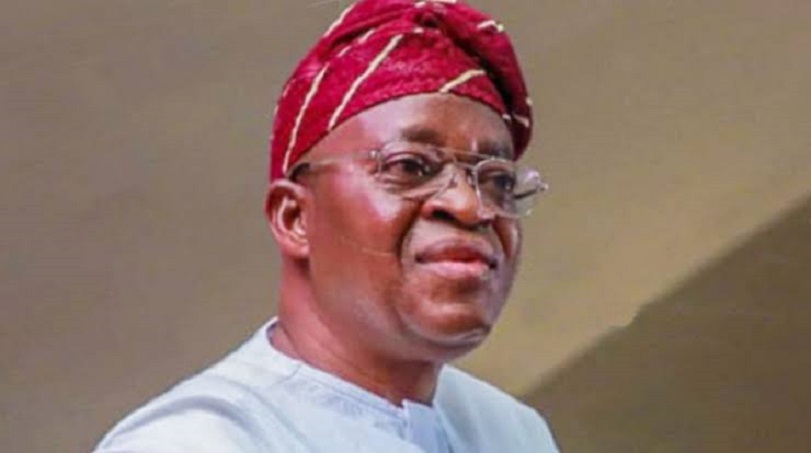
The Minister of Marine and Blue Economy, Mr Adegboyega Oyetola, has warned that operations of agencies under his ministry were being severely constrained by excessive deductions at source by the Office of the Accountant-General of the Federation.
He disclosed on Tuesday while presenting a N10.5 billion budget proposal for the Federal Ministry of Marine and Blue Economy for the 2026 fiscal year.
He lamented that the allocation was grossly insufficient to effectively execute the ministry’s wide-ranging mandate, critical to Nigeria’s trade, transport efficiency and food security.
Mr Oyetola while defending the ministry’s budget before a joint sitting of the Senate Committee on Marine Transport and the House of Representatives committees on Ports and Harbours; Maritime Safety, Education and Administration; Shipping Services; Inland Waterways; and Ocean and Fisheries, said the proposed budget, which comprises N8.24 billion for capital expenditure, N453.86 million for overheads and N1.81 billion for personnel costs, would only sustain minimal operational continuity rather than deliver meaningful reforms or sectoral growth.
The minister explained that the ministry oversees interconnected subsectors, including ports, shipping, inland waterways, fisheries and aquaculture, which collectively handle over 90 per cent of Nigeria’s international trade by volume, national food and nutrition security, and economic competitiveness.
He noted that while agencies such as the Nigerian Ports Authority (NPA), Nigerian Maritime Administration and Safety Agency (NIMASA) and Nigerian Shippers’ Council (NSC) were self-funding and made significant remittances to the Consolidated Revenue Fund, their operations were being severely constrained by excessive deductions at source by the Office of the Accountant-General of the Federation.
According to him, these deductions had weakened liquidity and reduced the operational flexibility of key agencies responsible for maritime safety, port efficiency and regulatory oversight, with far-reaching consequences including port congestion, higher logistics costs, delayed cargo movement, revenue losses and inflationary pressures.
He stressed that what appeared to be an accounting issue had become a national economic concern.
Mr Oyetola also said that the 2026 budget of the Council for the Regulation of Freight Forwarding in Nigeria (CRFFN) was wrongly placed by the Budget Office under the Federal Ministry of Transportation, even though it is an agency under the Federal Ministry of Marine and Blue Economy, saying the misalignment undermined clarity in oversight and policy coherence within the maritime logistics value chain.
On inland waterways, the Minister appealed for increased funding to curb accidents and loss of lives. He said water transport is globally recognised as significantly cheaper than road transport.
He noted that Nigeria’s heavy reliance on road haulage for over 80 per cent of freight movement had worsened road deterioration and increased the cost of goods, arguing that safer and more efficient inland waterways would ease pressure on roads and lower logistics costs.
On fisheries and aquaculture, Oyetola said Nigeria’s annual fish demand of over 3.6 million metric tonnes far exceeded domestic production of about 1.4 million metric tonnes, sustaining imports valued at more than one billion dollars annually.
He added that post-harvest losses of up to 30 per cent further reduced supply, despite fish being one of the most affordable sourNiger.
“As long as we hinder official trade, individuals will resort to informal channels. Currently, we estimate that up to 50 per cent of our domestic areas have resorted to illegal trade, while only about 30 per cent is conducted legally, which is detrimental to our security.”
He pointed out that “this situation is beneficial for the economies of both countries. It will positively impact our maritime sector, as we expect an increase in transit cargo passing through our ports to Niger, resulting in economic activities for our investors in the maritime industry.
“Additionally, this development will benefit Nigerians in border communities, many of whom are engaged in farming and other economic activities, providing them with opportunities to export goods to Niger.”
General
NDPC Laments Shortage of Data Protection Officers in Nigeria
By Adedapo Adesanya
The Nigeria Data Protection Commission (NDPC) has warned that the country faces a significant gap of 480,000 Data Protection Officers (DPOs), in spite of notable progress recorded in the last three years.
The National Commissioner of NDPC, Mr Vincent Olatunji, disclosed the opening of a one-week training for the second cohort of DPOs Training and Certification Programme in Abuja.
Mr Olatunji said there were still shortages even as the number of certified DPOs in Nigeria increased from fewer than 1,000 three years ago to over 10,000, while more than 27,000 professionals now operate within the broader privacy ecosystem.
However, he noted that the gap remained wide due to the increasing number of data controllers and processors in the country.
“We have identified over 500,000 data controllers and processors who require the services of data protection officers.
“At the moment, we have about 10,000 certified DPOs to work in that space.
“The gap of about 480,000 still exists, which underscores the need for sustained capacity building,” he said.
The NDPC boss said the commission was intensifying efforts to bridge the gap through continuous training programmes.
He said the initiative was aimed at positioning Nigeria as a hub for highly skilled and globally competitive data protection professionals in Africa.
“Our goal is to make Nigeria the go-to country when it comes to sourcing qualified data protection officers in Africa.
“The certification we offer meets global standards, enabling practitioners to operate not just locally but in any part of the world,” Mr Olatunji said.
He said the programme would also contribute to job creation within the digital economy, in line with the federal government’s priorities.
On her part, Mrs Tolu Fadipe, the commission’s Head of Research and Development, emphasised the critical role of data protection in the digital economy.
She said that responsible data handling was fundamental to the growth of digital systems and emerging technologies.
“As we move towards a digital economy, data becomes central and protecting that data is essential.
“This training is designed to build competence and ensure organisations comply with the Nigeria Data Protection Act,” she said.
General
Lagos Discontinues Manual Property Planning Permits System
By Modupe Gbadeyanka
The processing of planning permits for property owners in Lagos State is now fully digital, discontinuing manual and semi-digital processes.
The Special Adviser to the Governor on E-GIS and Urban Development, Mr Olajide Abiodun, said the new system is the Electronic Physical Planning Process System (EPPPS).
He described it as a transformative, web-based platform designed to completely modernise the operations of the Ministry of Physical Planning and Urban Development, which is transitioning from legacy, manual systems toward a highly efficient, transparent, and scalable digital framework.
“Lagos State has entered the dawn of a new era in digital processing of Planning Permissions, Authorisations to Commence Construction Works, Stage Certification, amongst other services,” he told newsmen recently.
Mr Abiodun noted that the full automation of the planning permit process commenced on April 1, 2026, stressing that anyone processing planning permits manually from the stated date is engaging in an illegal activity and that all applications must now go through the EPPPS platform exclusively.
The Governor Babajide Sanwo-Olu’s aide added that once one receives planning approvals via EPPPS, the journey is not over. The person should immediately apply for their Authorisation to Commence Construction Works and Stage Certifications through the EPPPS platform, amongst other services, adding that there will be a task force to monitor compliance with this activity.
While updating the citizens on other developments on Urban Development and Land Administration in the State, he said the state government has introduced CAP to further strengthen LASBCA’s capability in ensuring strict building development compliance.
According to him, CAP is a strategic Public-Private Partnership that allows accredited private professionals to work alongside LASBCA in monitoring building projects.
“This helps us ensure strict compliance with the state’s building codes. It will drastically reduce the risk of building collapses while accelerating project delivery. It is a win for safety, a win for the construction industry, and a win for Lagosians,” he said.
The Lagos State Government, in the journey of moving from the built environment to Land Administration, has actively decentralised its services to ease the burden on citizens, announcing that the e-GIS Regional Office in Ikeja has officially commenced operations.
“This is a dedicated, customer-facing hub designed specifically to handle your digitised land administration activities. Citizens will no longer need to travel all the way to Alausa for every land-related inquiry.
“The Ikeja office is fully equipped to serve residents efficiently at the grassroots level, as the Government is assuring that the remaining divisional offices across the state will also commence operations very soon,” he disclosed.
General
Oladiti Eyes NUPENG Presidency as Akporeha Bows Out
By Adedapo Adesanya
Mr Salimon Akanni Oladiti is in pole position to take over the presidency of the Nigeria Union of Petroleum and Natural Gas Workers (NUPENG).
According to reports, Mr Oladiti, who is the current National Trustee of the union, will take over from Mr Williams Akporeha, who is set to exit office at the end of April after eight years at the helm.
Mr Akporeha announced his departure at the weekend during the Quarterly National Executive Council meeting of the Petroleum Tanker Drivers (PTD) Branch in Warri, Delta State.
He noted that the union will elect a new president on April 24 in Lagos.
If Mr Oladiti, a former PTD National Chairman, emerges as the president of the union, it would be the first time a PTD member ascends to NUPENG’s top office.
The move gained momentum at the meeting, where Mr Joseph Okafor moved a motion for Mr Oladiti’s unanimous ratification, seconded by Mr Adekunle Akinlaja.
Mr Akporeha expressed gratitude to PTD members for their steadfast support throughout his tenure.
“Eight years ago, you stood by me in this same room. You didn’t only stand by me, you supported me. When things were tough, you were there through all the challenges.
“I want to appreciate all of you. If I stand to support one of your own as President, I have no apology. If I had done anything otherwise, my conscience would have troubled me. God used you to install me,” he said.
He urged members to rally behind Oladiti and the newly elected PTD National Chairman, Mathias Ote, to sustain the union’s stability and growth.
“By the grace of God, as I move along, I want to see a union stronger than I left it. I don’t want to see PTD go into disarray. The greatest favour you can do is to support this man whom you have elected today as your national chairman. Also support your own that will be the President, by the grace of God, on April 24,” he added.
On his part, the President of the Nigerian Association of Road Transport Owners (NARTO), Mr Lawal Yusuf Othman, commended NUPENG for steering a peaceful transition.
“I once again want to appreciate NUPENG. NARTO will continue to give you the necessary support,” he said.
-
Feature/OPED6 years agoDavos was Different this year
-
Travel/Tourism10 years ago
Lagos Seals Western Lodge Hotel In Ikorodu
-
Showbiz3 years agoEstranged Lover Releases Videos of Empress Njamah Bathing
-
Banking8 years agoSort Codes of GTBank Branches in Nigeria
-
Economy3 years agoSubsidy Removal: CNG at N130 Per Litre Cheaper Than Petrol—IPMAN
-
Banking3 years agoSort Codes of UBA Branches in Nigeria
-
Banking3 years agoFirst Bank Announces Planned Downtime
-
Sports3 years agoHighest Paid Nigerian Footballer – How Much Do Nigerian Footballers Earn