Connect with us

Economy

CBN Lifts Forex Ban on 41 Imported Items

Published

on

By Modupe Gbadeyanka

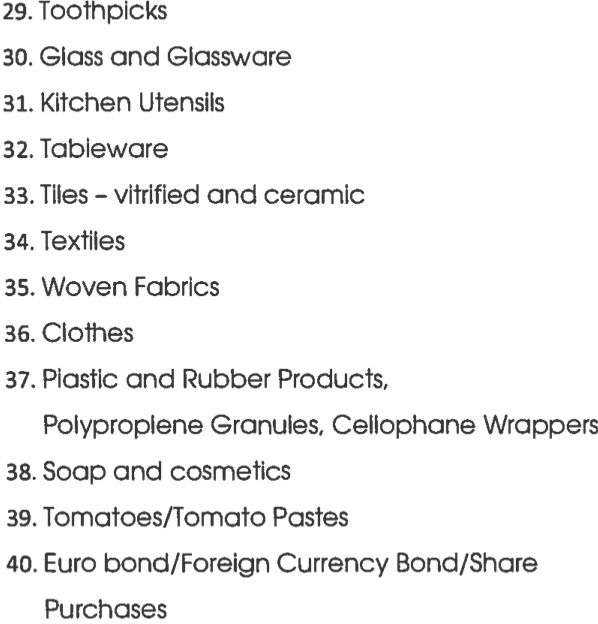
The foreign exchange ban earlier placed on the importation of 41 items by the Central Bank of Nigeria (CBN) has finally been removed.

The apex bank said in a circular that importers intending to bring any of the listed 41 items into the country will now have up to $20,000 allotted to them per quarter.

In 2015, the central bank, as a way of savaging the Naira and encouraging local manufacturers, placed an embargo on the importation of rice, furniture, soaps, toothpicks, cosmetics, cement, private jets, steel products, plastics and rubber, margarine, palm kernel/palm oil products/vegetables oils, meat and processed meat products, vegetables and processed vegetable products, poultry chicken, eggs, turkey and others.

The move was also brought about to save the country’s foreign reserves, which have increased lately.

Few days ago, the Vice President, Mr Yemi Osinbajo, hinted that the Federal Government may lift the ban on the 41 items.

The Vice President, while addressing a gathering on Tuesday, had said the government would consider the option in order to promote the local manufacturing of 41 items such as rice and toothpicks.

“In stabilizing the macroeconomic environment, we have focused on aligning fiscal with monetary policy and nudging the central bank toward the objective of more market-determined exchange rates,” Mr Osinbajo had said.

In the circular issued by the CBN a moment ago, it said, “Importers of items classified as not valid for forex with transactions value of $20,000 and below per quarter shall now qualify for allocation of foreign exchange.”


Modupe Gbadeyanka is a fast-rising journalist with Business Post Nigeria. Her passion for journalism is amazing. She is willing to learn more with a view to becoming one of the best pen-pushers in Nigeria. Her role models are the duo of CNN's Richard Quest and Christiane Amanpour.

Advertisement
Click to comment

Leave a Reply

Your email address will not be published. Required fields are marked *

Economy

Naira Trades N1,354 Per Dollar at NAFEX

Published

on

ATMs

By Adedapo Adesanya

The first trading of the week at the Nigerian Autonomous Foreign Exchange Market (NAFEX) ended bullish for the Naira as it gained N11.93 or 0.87 per cent against the US Dollar on Monday, February 9, to trade at N1,354.26/$1 compared with the previous day’s N1,366.19/$1.

It also appreciated against the Pound Sterling in the official market during the session by N12.03 to settle at N1,845.72/£1 versus last Friday’s closing price of N1,857.75/£1, but depreciated against the Euro by 69 Kobo to quote at N1,613.19/€1, in contrast to the N1,612.52/€1 it was exchanged last Friday.

At the GTBank forex desk, the Nigerian Naira appreciated against the Dollar yesterday by N4 to close at N1,379/$1 versus the previous rate of N1,383/$1, and at the parallel market, it was flat at N1,450/$1.

The fortification of the Nigerian currency in the currency market on Monday was driven by forex liquidity, strong oil receipts, and flows from foreign investors attracted by the high yields on the country’s debt market.

Speaking at a forum on Monday, the Governor of the Central Bank of Nigeria (CBN), Mr Yemi Cardoso, declared that the bank’s reforms have established economic stability, evidenced by a significant reduction in inflation and growing external reserves, which he stated stood at $49 billion as of February 5, 2026.

He also highlighted the stability of the FX market, noting that the CBN is now accumulating foreign exchange from the market to enhance sustainability.

“By that, I mean that we now allow the market to generally find its level; many times, the Central Bank itself goes in to buy foreign exchange. The premium between the official and parallel market rates has collapsed to under 2 per cent,” Mr Cardoso stated.

The CBN chief said the reforms of the monetary authority—anchored on disinflation, FX market normalisation, and financial-system resilience—are already strengthening real-sector confidence.

As for the cryptocurrency market, it was in a recovery mode as investors took advantage of the drop in prices to add to their portfolios.

The pullback followed a turbulent few days in which Bitcoin (BTC) plunged to as low as $60,000 before rebounding. It rose 0.5 per cent on Monday to $70,415.57, as Ethereum (ETH) gained 0.9 per cent to trade at $2,116.42.

Further, Ripple (XRP) improved by 1.4 per cent to $1.44, Litecoin (LTC) expanded by 0.8 per cent to $54.66, Solana (SOL) grew by 0.5 per cent to $87.11, and Cardano (ADA) added 0.2 per cent to settle at $0.2704.

On the flip side, Binance Coin (BNB) slumped 0.6 per cent to $638.34, and Dogecoin (DOGE) weakened by 0.3 per cent to $0.0963, while the US Dollar Tether (USDT) and the US Dollar Coin (USDC) remained unchanged at $1.00 apiece.

Continue Reading

Economy

Crude Oil Soars as US Cautions Vessels Near Iran

Published

on

Crude Oil Production

By Adedapo Adesanya

Crude oil gained more than 1 per cent on Monday after the United States issued an advisory to US-flagged vessels to stay as far as possible from Iranian territory while passing through the Strait of Hormuz and Gulf of Oman.

The price of Brent crude was up 99 cents or 1.5 per cent during the session to $69.04 a barrel, while the US West Texas Intermediate (WTI) crude rose 81 cents or 1.3 per cent to settle at $64.36 per barrel.

The US Department of Transportation (DOT) Maritime Administration yesterday noted that vessels going through the Strait of Hormuz and Gulf of Oman have historically faced the risk of being boarded by Iranian forces, including as recently as February 3.
The agency advised U.S.-flagged ships to stay close to Oman while eastbound in the Strait of Hormuz.

The move renewed concerns that tensions between the US and Iran could lead to oil supply disruptions. About a fifth of the oil consumed globally passes through the Strait of Hormuz between Oman and Iran.

US President Donald Trump has threatened to attack, citing possible executions of protesters, and saying “help is on its way.” He ordered the USS Abraham Lincoln aircraft carrier and a flotilla of accompanying ships to the region.

In June, the US attacked Iranian nuclear facilities at the end of a 12-day Israeli bombing campaign.

Iran’s foreign minister said on Saturday the country will strike US bases in the Middle East if attacked by American forces, which have built up their naval presence in the region.

Investors were also monitoring efforts by Western governments to curb Russia’s income from oil exports that support its war in Ukraine.

The European Commission has proposed a sweeping ban on any services that support Russia’s seaborne crude oil exports, in fresh efforts to reduce revenues that help Russia’s war against Ukraine.

Refiners in India, once the biggest buyer of Russian crude, are avoiding purchases for delivery in April. Market analysts noted that if India fully stopped purchasing this crude, it would boost oil prices.

Meanwhile, Tengiz oilfield in Kazakhstan has returned 60 per cent of its peak production and was pumping at a rate of 550,000 barrels per day as of Sunday, following a forced shutdown for half of January due to a fire.

Tengiz, which is operated by a consortium led by US supermajor Chevron, is expected to reach peak levels of oil output of about 950,000 barrels per day by February 23.

Continue Reading

Economy

Investors Begin New Week on NGX With N1.424trn Rise in Wealth

Published

on

ngx asi


By Dipo Olowookere

It was a positive start to the week for stock investors in Nigeria as they grew their wealth by 1.29 per cent on Monday amid a hunt for dividend-paying equities.

Business Post reports that three of the five sectoral indices ended in green, with the industrial goods space leading with a 4.76 per cent appreciation, and the energy counter up by 1.29 per cent, while the consumer goods index gained 0.74 per cent.

However, due to profit-taking in the financial services ecosystem yesterday, the banking counter went down by 0.04 per cent, and the insurance sector lost 0.03 per cent.

When the closing gong was struck, the All-Share Index (ASI) soared by 2,218.73 points to 173,946.22 points from 171,727.49 points, and the market capitalisation surged by N1.424 trillion to N111.659 trillion from N110.235 trillion.

The trio of May and Baker, CAP, and DAAR Communications improved by 10.00 per cent during the session to close at N43.45, N90.20, and N2.09 apiece, while RT Briscoe gained 9.98 per cent to trade at N13.89, with Deap Capital growing by 9.97 per cent to N7.50.

Conversely, Eunisell lost 9.98 per cent to settle at N134.85, Tripple Gee slumped by 8.90 per cent to N6.65, Abbey Mortgage Bank crashed by 8.03 per cent to N13.75, Austin Laz declined by 7.41 per cent to N5.00, and Haldane McCall slipped by 6.56 per cent to N3.99.

On the first trading day of the week, 59 stocks ended on the advancers’ log, and 26 stocks finished on the laggards’ table, representing a positive market breadth index and strong investor sentiment.

Despite the gains, the activity level waned on Monday as the trading volume and value decreased by 18.73 per cent and 35.27 per cent, respectively, while the number of deals increased by 29.32 per cent.

A total of 775.2 million equities worth N27.9 billion exchanged hands in 65,960 deals yesterday compared with the 953.8 million equities valued at N43.1 billion traded in 51,005 deals last Friday.

Access Holdings was the busiest stock for the session with a turnover of 67.1 million units worth N1.6 billion, Zenith Bank sold 46.2 million units valued at N3.4 billion, Secure Electronic Technology traded 43.9 million units for N47.9 million, Veritas Kapital exchanged 39.4 million units worth N91.6 million, and Mutual Benefits transacted 33.9 million units valued at N145.7 million.

Continue Reading

Trending