General
2027: Nigerians Will Remember Jonathan’s Dismal Record in Office–Presidency
By Modupe Gbadeyanka
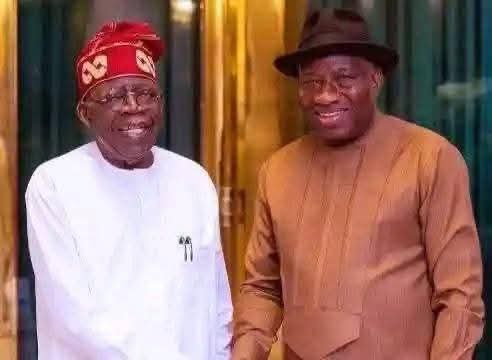
The presidency has boasted that President Bola Tinubu is not rattled by the idea of bringing former President Goodluck Jonathan into the 2027 presidential race.
In a statement issued by the Special Adviser to the President on Information and Strategy, Mr Bayo Onanuga, it was emphasized that Mr Jonathan was free to attempt to return to Aso Rock in 2027.
It was noted that Mr Tinubu has transformed the economy in his two years in office, stating that he was not perturbed by “the desperation of the opposition ganging up against President Bola Tinubu despite his glaring giant economic strides.”
Recall that recently, a former Minister of Information and National Orientation, Mr Jerry Gana, said Mr Jonathan would be drafted into the 2007 presidential race.
In the statement, Mr Onanuga cautioned Mr Jonathan to be wary of the People’s Democratic Party (PDP) sugar-coated cheerleaders, saying “politicians of Jerry Gana’s ilk merely want to lure him into the race to satisfy their personal, political, religious, and ethnic interests. They will abandon him midstream, as they did in 2015, and leave Gentleman Jonathan in the lurch.”
“Don’t get us wrong: President Jonathan reserves the right to run if he wishes. It is his inalienable right to contest the presidency again. President Tinubu will wholeheartedly welcome him if he decides to enter the race. But Jonathan will have his date in the court of the land. Indeed, the jury will determine whether Jonathan, who was sworn in twice as president, satisfies the constitutional requirements and is eligible to contest the presidency and be sworn in, if successful, for a third term in office.
“Shorn of all those selfish considerations for which some PDP big guns find his candidacy appealing, President Jonathan will also have his encounter with the people as to whether he has anything new to offer after his disastrous six years, for which they voted him out in 2015.
“Let us remind ourselves about Jonathan’s record. We cannot forget in a hurry how his regime, devoid of any clear economic agenda, engaged in frivolous spending, ran the economy aground and put the country in dire straits. The nation’s economic downturn, which President Tinubu is working very hard to overcome, actually began under President Jonathan. The Jonathan administration severely damaged the economy, and all key indicators declined under his watch. Under him, the so-called business moguls allocated foreign exchange to import fuel, simply pocketing the dollars without importing anything. Some of those big men still have court cases on the issue today.
“Jonathan and his National Security Adviser, Col. Sambo Dasuki (rtd), freely distributed security funds to friends and cronies.
“In 2010, President Jonathan inherited a total of $66 billion, of which $46 billion was in foreign reserves and $20 billion in the noble-but-abused Excess Crude Account. By 2015, when the people democratically removed him from office, the foreign reserves had fallen below $30 billion, and the Excess Crude Account had been depleted to $2 billion, despite generating record revenue from crude oil sales that the country had never achieved in more than 25 years combined.
“It is on record that between 2010 and 2013, crude oil sold for an average of $100 per barrel. By December 2014, however, the Jonathan-led Federal Government could no longer pay salaries to Federal Civil Servants. At least 28 states across the country owed workers huge salary arrears.
“In contrast, President Tinubu has taken bold decisions over the last 28 months to reset the economy, removing the ruinous fuel subsidy and abolishing multiple exchange rates, which paved the way for arbitrage to flourish. The President has stabilised the economy in slightly over two years in office. In 2025 Q2, the Gross Domestic Product grew by 4.23%, the highest in four years, outpacing the 3.4% projected by the International Monetary Fund. Inflation decreased to 20.12% in August 2025, the lowest level in three years. The foreign reserves stand presently at $42. 03 billion. The Naira has virtually stabilised. Investor confidence in our economy has been restored, and investors are betting on Nigeria.
“In plain language, the nation has turned the corner. And our people have started reaping the gains of the bold reforms instituted by the Tinubu administration. Road infrastructure is being boosted. Old roads are being reconstructed while new ones, like the Lagos-Calabar Coastal Highway and the Sokoto-Badagry Highway, among others, are springing up. The government is addressing security issues in some parts of the country.
“We can go on and on, reeling out the many macroeconomic gains of the Tinubu administration. However, the point is that the PDP and Jerry Gana’s co-travellers broke the economy; President Tinubu is fixing it.
“President Jonathan and others are welcome to the 2027 race. They broke the economy before, but millions of Nigerians, who will not easily forget the recent past, will not allow them to return and run it down again,” the statement noted.
General
British Prosecutors Accuse Diezani Alison-Madueke of Bribes for Contracts
By Adedapo Adesanya
British prosecutors alleged that former Nigerian oil minister, Mrs Diezani Alison-Madueke, took bribes, including luxury goods and high-end properties from industry figures interested in lucrative oil and gas contracts as her corruption trial began on Tuesday in London.
Proceedings in the alleged corruption trial of Mrs Alison-Madueke were stalled on Monday at the Crown Court in Southwark due to technical difficulties.
The 65 year old was Nigeria’s Minister of Petroleum Resources between 2010 and 2015 under then-president Goodluck Jonathan and was also briefly president of the Organization of the Petroleum Exporting Countries (OPEC), the first woman to hold either role.
Her tenure, however, has been dogged by multiple allegations of corruption, both locally and internationally, since she left office in 2015.
She was first arrested by British authorities in London in October 2015 as part of a major corruption investigation.
Since that arrest, Mrs Alison-Madueke has remained on bail while investigations continued, with the case drawing sustained attention due to its scale and the seniority of the individuals involved.
In 2023, the United Kingdom’s National Crime Agency (NCA) formally charged the Bayelsa State-born oil expert, accusing her of accepting bribes over a four-year period between 2011 and 2015. She was charged with five counts of accepting bribes and a charge of conspiracy to commit bribery, which she denies.
At the proceeding, Mrs Alison-Madueke sat in the dock alongside oil industry executive Mrs Olatimbo Ayinde, 54, who is charged with one count of bribery relating to Alison-Madueke and a separate count of bribery of a foreign public official. Her brother, former archbishop Doye Agama, is charged with conspiracy to commit bribery and is listening to the trial by video link for medical reasons.
Prosecutor Alexandra Healy told jurors at London’s Southwark Crown Court that Mrs Alison-Madueke “enjoyed a life of luxury in London”, where she often stayed.
The prosecutor also said this was provided by those interested in being awarded or retaining contracts with Nigerian state-owned companies, including the Nigerian National Petroleum Company (NNPC) Limited, then a corporation.
Ms Healy said Mrs Alison-Madueke was given the use of high-end properties and vast quantities of luxury goods by people who “clearly believed she would use her influence to favour them”.
She added that there was no evidence that the accused awarded contracts to someone who should not have had one, adding that given Mrs Alison-Madueke’s role “she should not have accepted benefits from those who were no doubt doing extremely lucrative business in oil and gas with government-owned entities.”
Other benefits named include the use of a chauffeur-driven car and a private jet, as well as expensive goods including some paid for in one extravagant 2013 shopping trip to Harrods, a renowned luxury department store located in London.
She is also alleged to have had her son’s school fees paid by Nigerian businessman Benedict Peters, who is named on the indictment but is not facing trial.
Her accomplice Mrs Ayinde is charged with bribing the defendant between 2012 and 2014 and also bribing the then-managing director of NNPC, Mr Emmanuel Ibe Kachikwu, who is also not on trial, in 2015.
Ms Healy said that, after President Jonathan was replaced by Muhammadu Buhari in 2015, Mrs Ayinde paid a “substantial bribe” to Mr Kachikwu to ensure her friend continued to work in the NNPC.
General
NYSC Records: Niger Delta Group Suggests Suspension of Tunji-Ojo
By Aduragbemi Omiyale
A group known as the Niger Delta Think Tank on Good Governance has called on President Bola Tinubu, to set up an independent panel to investigate the controversies surrounding the National Youth Service Corps (NYSC) records of the Minister of Interior, Mr Olubunmi Tunji-Ojo.
The organisation led by Mr Gregory Oritsetimihin noted that the demand was not an attempt to indict the Minister but a principled appeal for accountability, due process, and public confidence in Nigeria’s institutions.
Addressing journalists on Monday at a press conference, the group also recommended the suspension of the Minister pending the outcome of the probe, describing such a step as an administrative safeguard rather than a punitive action.
The organisation said it was worrying that the nothing concrete had been done by the inquiry by a notable media organisation, Premium Times, on the matter after invoking the Freedom of Information Act.
According to the group, an official response issued by the NYSC on August 8, 2023, confirmed that the Minister was mobilised for national service in 2006, absconded from the programme, and later resurfaced in 2019, when he was re-mobilised and redeployed to the Federal Capital Territory (FCT). The statement further noted that his Certificate of National Service was eventually issued in February 2023, several years after the expected completion period.
“These facts were not drawn from speculation or social media narratives but were provided directly by the NYSC itself,” the group stated.
The think tank also clarified that universities, rather than the NYSC, are responsible for the mobilisation of graduates, stressing that issues relating to mobilisation, redeployment, and certification are matters of serious institutional responsibility and require objective and transparent review.
It described absconding from the NYSC scheme as a violation of existing laws and civic obligations, warning that unresolved questions surrounding the programme especially involving a serving public official could damage public trust and reinforce perceptions of selective accountability.
While urging calm, the organisation appealed to the President to demonstrate leadership by constituting an independent panel to review the matter and make its findings public.
According to the group, a transparent review would protect the integrity of the Presidency, uphold the credibility of the NYSC, and safeguard the reputation of the Minister.
“Accountability is not persecution, and inquiry is not condemnation,” the think tank said, adding that Nigeria’s democracy is strengthened when issues are addressed openly and in line with due process.
General
NDIC Seeks EFCC Enhanced Support on Asset Tracing, Recovery
By Adedapo Adesanya
The Nigeria Deposit Insurance Corporation (NDIC) has sought an enhanced collaboration with the Economic and Financial Crimes Commission (EFCC) in areas including asset tracing, recovery, and management.
This was hinged on a recent visit by the chief executive of the corporation, Mr Thompson Oludare Sunday, to the chairman of the anti-graft agency, Mr Ola Olukoyede.
Speaking at the occasion, Mr Sunday stressed that the visit offered an opportunity for formal engagement with the EFCC for further collaboration between the two organizations.
“We aim to further strengthen our collaboration, deepen institutional synergy and explore additional avenues for mutual support in the pursuit of national financial system stability. The EFCC has been our partner and we want this to continue. We look forward to an expanded and more impactful partnership between our two esteemed institutions,” Mr Sunday said.
Further in his request, he stated that the NDIC sought to leverage on the EFCC’s technical expertise in asset tracing, recovery and management, particularly in cases involving debtors of banks in liquidation.
“Your experience has and will continue to greatly enhance our recovery efforts. Additionally, we have that strategic responsibility for prosecuting individuals whose actions contribute to the failure of banks. We therefore seek closer collaboration with the Commission in this critical area.”
On his part, Mr Olukoyede, remarked that both agencies of government have a longstanding record of collaboration, pledged to amplify the working relationship.
He emphasized that the NDIC and EFCC are like inseparable twins, working together for years. He reminded the NDIC’s boss that the EFCC had been supporting his agency in the area of investigation, while the NDIC had been supporting the EFCC in the area of training.
“So, there has been this mutually beneficial relationship between NDIC and EFCC and we never intend to stop. We’ll continue to take it to a higher level, and continue to strengthen it,” he said.
Mr Olukoyede reiterated that his policy directive was to stimulate the Nigerian economy with the anti-graft war, leverage productive entities and enhance the capacities of other government agencies through needful interventions.
“One of the things I promised when I resumed was to use the instrumentality of this work to stimulate the economy, not just to make noise all over the place; to strengthen and encourage the internal processes of entities that are doing well and design fraud risk assessment for them. That was what necessitated my establishing a new department called Fraud Risk Assessment and Control.
“We don’t have to always wait for money to be stolen. Let us work with you and stakeholders in the economy to fine tune our system and make sure that we clean our financial ecosystem. You’re a key player in that area, and we are always willing to collaborate with you,” he added.
-
Feature/OPED6 years agoDavos was Different this year
-
Travel/Tourism9 years ago
Lagos Seals Western Lodge Hotel In Ikorodu
-
Showbiz3 years agoEstranged Lover Releases Videos of Empress Njamah Bathing
-
Banking8 years agoSort Codes of GTBank Branches in Nigeria
-
Economy3 years agoSubsidy Removal: CNG at N130 Per Litre Cheaper Than Petrol—IPMAN
-
Banking3 years agoSort Codes of UBA Branches in Nigeria
-
Banking3 years agoFirst Bank Announces Planned Downtime
-
Sports3 years agoHighest Paid Nigerian Footballer – How Much Do Nigerian Footballers Earn