Connect with us

Feature/OPED

Richer Banks, Poorer Economy: The Hidden Crisis in Nigeria’s Financial System

Published

on

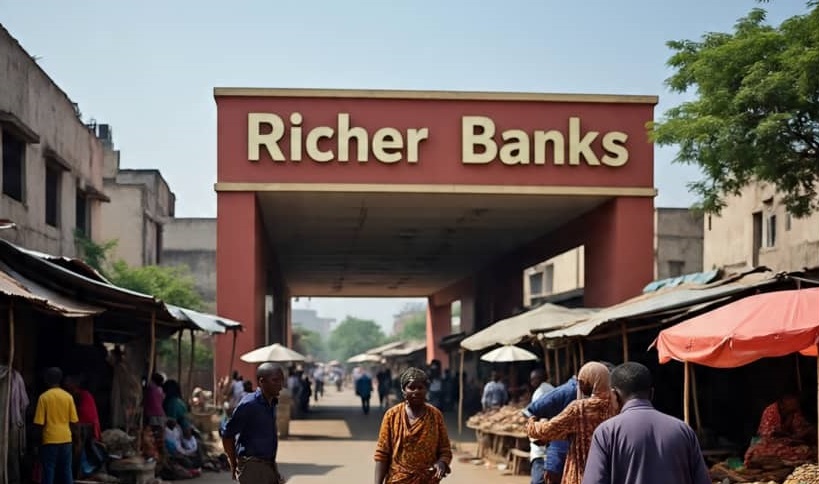
Richer Banks Poorer Economy

By Blaise Udunze

Across Africa, banks are getting bigger but not necessarily better. From South Africa’s Standard Bank to Morocco’s Attijariwafa and Egypt’s National Bank, financial institutions are boasting record balance sheets, higher Tier 1 capital, and growing regional footprints. According to African Business magazine’s 2025 ranking of the continent’s top 100 banks, Africa’s total Tier 1 capital climbed to $126 billion, up from $120 billion in 2024.

But behind this glowing façade of balance sheet expansion lies a troubling irony, especially in Nigeria. Despite being home to some of the continent’s most visible lenders, Nigeria is missing from the International Monetary Fund’s latest list of Africa’s fastest-growing economies. While Nigerian banks such as Access Bank, Zenith Bank, UBA, and FBN Holdings feature among Africa’s top 20 in assets, their impact on real economic growth remains painfully limited.

In simpler terms, Nigeria’s banks are becoming richer without making the economy stronger.

It is one of the defining contradictions of modern Nigerian finance, where a banking sector keeps ballooning in size even as the real economy struggles to breathe. The IMF projects Nigeria’s GDP growth at 3.9 percent in 2025, below the 6-8 percent threshold that defines Africa’s fastest-growing economies. Meanwhile, smaller nations such as Rwanda, Benin, and Côte d’Ivoire are racing ahead, driven by reforms, industrial growth, and investment-friendly policies.

So why is Africa’s largest economy growing so slowly even with “Africa’s biggest banks” at its helm? The answer lies in how these banks make their money and how little of it trickles into productive enterprise.

Nigeria’s leading banks have swollen their balance sheets largely through asset revaluations, foreign currency adjustments, and customer deposits that sit idle or are channeled into risk-free government securities. What looks like growth on paper often reflects inflationary asset repricing, not expanded lending to manufacturers, agribusinesses, or small and medium enterprises (SMEs).

Three quarters of the industry’s celebrated “assets” are actually liabilities owed to the public. These are deposits that banks temporarily hold, not capital they generated or invested productively. This dependency on depositors’ funds reveals a system that looks rich in assets but is, in essence, shallow in innovation and weak in capital depth.

A banking system overly reliant on deposits is inherently fragile. Deposits are short term and confidence sensitive and can flee quickly during periods of policy uncertainty. Unlike equity or long term capital, they offer little cushion against shocks. This overdependence creates a false picture of liquidity but hides structural weakness. Nigeria’s banks may look stable, but their foundations are vulnerable, like a tower built on shifting sands of depositor confidence rather than the rock of sustainable capital formation.

Loans to the manufacturing and agricultural sectors remain a small fraction of total credit, while lending rates often hover above 27 percent. Many small businesses that form the backbone of job creation and innovation still cannot access affordable financing. Instead, banks have mastered the art of financial intermediation without real interconnection, mobilizing deposits but not transforming them into engines of growth.

This disconnect reveals a deeper issue with weak capital efficiency. In a healthy financial system, deposits are converted into productive loans that stimulate investment, create jobs, and boost exports. But in Nigeria, the ratio of bank loans to GDP remains among the lowest in Sub-Saharan Africa. Banks appear more comfortable storing wealth than stimulating enterprise. Treasury bills and government bonds, with minimal risk and decent yields, have become the preferred playground for Nigeria’s banking giants. The result is a financial system that thrives on fiscal inertia rather than productive dynamism.

Contrast Nigeria’s sluggish growth with the dynamism in East Africa, where banks like Kenya’s Equity Group and KCB are expanding aggressively, driving credit to real sectors and supporting regional trade. East Africa now contributes 21 banks to Africa’s top 100, up from just 13 in 2022, reflecting genuine growth in financial inclusion and productive lending. While Nigeria’s banks chase continental rankings, Kenya’s and Rwanda’s banks are quietly fueling economic revolutions.

Nigeria’s exclusion from the IMF’s list of Africa’s fastest-growing economies is symbolic. It tells a story of a giant whose growth is increasingly superficial. The IMF praised countries like Rwanda and Benin for fiscal discipline, macroeconomic stability, and structural reforms, as these are all areas where Nigeria continues to struggle. Despite policy adjustments and modest improvements in non-oil sectors, Nigeria’s economy remains shackled by inflation, currency instability, and policy uncertainty. These same constraints discourage banks from taking real sector risks.

In effect, the financial system mirrors the broader economy and is large in size, yet underperforming in substance. When banks announce trillion-naira asset bases, it makes for good headlines but poor development economics. The irony is that asset expansion without capital productivity is like pumping air into a balloon, which is impressive in size but fragile in substance.

While the Central Bank of Nigeria’s Governor, Yemi Cardoso, insists that the nation’s economic reforms are “yielding visible results” and placing the country “on the path to stability, inclusiveness, and innovation-driven growth,” evidence on the ground paints a more sobering picture. The CBN’s optimism, though politically convenient, contrasts sharply with the structural realities of Nigeria’s financial system and the broader economy.

If reforms were truly delivering inclusive and innovation driven growth, it would be reflected in stronger credit access, industrial productivity, and improved living standards, not just in favourable rhetoric at global meetings. Yet, Nigeria’s banking sector remains dominated by balance sheet expansion rather than productive lending. Three quarters of the industry’s celebrated “assets” are actually liabilities to public deposits temporarily held, not capital generated through innovation or investment in the real economy.

This disconnect between financial growth and real-sector development underscores a deeper fragility. Banks continue to rely heavily on short-term deposits while shying away from financing manufacturing, agriculture, and small enterprises with the engines of inclusive growth. The result is an economy where the numbers look impressive on paper, but households and industries still struggle with high borrowing costs, limited credit, and declining purchasing power.

Far from demonstrating reform-driven resilience, Nigeria’s economic structure remains hollow at the core of a system rich in nominal assets but poor in capital depth and innovation. Macroeconomic stability cannot be claimed when inflation hovers around 18.02 percent, foreign investment inflows stagnate, and job creation lags far behind population growth.

In essence, what the CBN presents as progress is, in many respects, statistically false if stability is achieved through monetary tightening and exchange rate adjustments rather than genuine economic transformation. Until reforms translate into tangible outcomes of affordable credit, industrial renewal, and sustainable job creation, the claims of inclusiveness and innovation-driven growth will remain more aspirational than real.

For Nigeria’s regulators, analysts, and policymakers, the question is no longer how large the banks’ assets appear, but what those assets are doing for the economy. True strength must come from innovation in financial intermediation, capital efficiency, and credit diversification; support for real sector growth; and regional competitiveness on the African and global stage.

For Nigerian banks to translate asset expansion into real economic impact, the next frontier must be purposeful intermediation, where financial growth feeds productive enterprise, not just paper wealth. That begins with rethinking the credit model by lending based on business potential and cash flow viability, not just collateral. By partnering with fintechs and development institutions, banks can use data driven credit assessments to reach small manufacturers, agribusinesses, and innovators who drive job creation.

Beyond lending, true strength will come from building deeper capital bases and reducing dependence on short-term deposits. Banks must raise long-term funds through bonds, equity, and partnerships with pension and insurance institutions so they can finance industrial and infrastructure projects sustainably. Regulators, too, must align incentives with development by rewarding banks that channel credit into productive sectors and penalizing those that merely recycle deposits into government securities.

Ultimately, Nigeria’s banking future depends on a mindset shift from comfort in liquidity to confidence in innovation. The country does not need banks that only count wealth but those that create it. When balance sheet expansion begins to translate into accessible credit, inclusive growth, and industrial renewal, Nigeria’s banks will cease to be symbols of inflated success and become true instruments of national transformation.

Blaise, a journalist and PR professional writes from Lagos, can be reached via: bl***********@***il.com

Click to comment

Leave a Reply

Your email address will not be published. Required fields are marked *

Feature/OPED

The Kaduna Peace Model, HURIWA and Northern Governors: Promise, Proof or Anagnorisis?

Published

on

Sani Abdulrazak rural kaduna

By Sani Abdulrazak, PhD

The fundamentality of securing our lives and property, especially in Northern Nigeria, cannot be overemphasised. Any other responsibility comes after this for a responsible government. Sadly, for close to two decades, Northern Nigeria has been a gallows of despair, rape, and death. From banditry and freelance killings that scratch, pierce, and are ruining the North West, to the bloody insurgency that barks and bites in the North East, to farmers-herder conflicts in the North Central, leaving behind a scorching trail of rancour and sorrow of unimaginable proportion for millions, Kaduna State was one of the worst-hit states in terms of banditry and kidnappings, ethno-religious conflicts, and freelance killings.

But in the last three years, the state has metamorphosed into one of the most peaceful in the region via the Kaduna Peace Model. More so, the recent endorsement of the Kaduna Peace Model by the Human Rights Writers Association of Nigeria (HURIWA) deserves thoughtful examination rather than unquestioning acceptance. HURIWA’s position has brought renewed attention to Kaduna State’s approach to conflict management and peacebuilding. The endorsement raises an important policy question: Has Kaduna developed a governance model capable of reducing conflict in a sustainable manner, and if so, why have other northern states not moved to adapt it? These questions deserve answers rooted in facts rather than political loyalties.

The phrase “Kaduna Peace Model” does not point to or refer to a single law, policy document, or institutional framework. Rather, it describes an evolving approach that combines conventional security operations with community engagement, dialogue among stakeholders, collaboration with traditional and religious institutions, support for security agencies, conflict mediation, and development interventions in communities affected by violence. Instead of relying exclusively on military responses, the approach seeks to address some of the social and political conditions that often sustain insecurity. Whether this amounts to a distinct governance model remains open to debate. Nevertheless, it reflects a broader understanding that lasting peace requires more than the deployment of armed personnel. Security may suppress violence temporarily, but durable peace depends equally on trust, inclusion, justice, and economic opportunity.

The next question is unavoidable: Has the approach worked?

The evidence suggests that Kaduna today presents a different security picture from that of three years ago, although not an entirely peaceful one. Around 2023, the state remained one of Nigeria’s most violence-affected regions. Conflict trackers documented frequent attacks, kidnappings, and communal violence, with 85 recorded conflict incidents resulting in 261 fatalities in the final quarter of 2023 alone. Entire communities lived under constant fear, farming activities were disrupted in several local government areas, and many roads within the state became synonymous with insecurity.

Recent years, however, indicate a significant degree of improvement in almost all parts of the state. Some communities have resumed agricultural activities, commercial movement has improved along previously troubled corridors, and government engagement with local communities has become more visible. These developments suggest that violence has, in almost all areas of the state, reduced in intensity. Yet such observations should not be mistaken for a declaration of victory.

A meaningful assessment, however, goes beyond casualty figures alone. It must also consider whether displaced persons have returned home, whether schools operate without interruption, whether farmers cultivate their lands without fear, whether markets function normally, and whether citizens genuinely perceive improvements in their daily security. Peace, as we know it, is not merely the absence of gunfire; it is the restoration of ordinary life.

It is within this context that HURIWA’s endorsement should be understood.

Civil society organisations play an important role in recognising promising governance practices, encouraging innovation, and stimulating public debate. Their endorsements can influence policy conversations and encourage governments to learn from one another. However, endorsements are neither official certifications nor substitutes for independent evaluation. Every governance model, regardless of who praises it, must remain open to scrutiny, evidence, and continuous improvement.

The larger question, therefore, is whether the Kaduna experience can be replicated elsewhere across Northern Nigeria.

It is a fact that certain principles underlying the Kaduna approach are broadly applicable. Community dialogue, cooperation between government and traditional institutions, investment in local peacebuilding, and stronger collaboration with security agencies are strategies that have relevance beyond Kaduna’s borders. But due to the non-uniformity and complexity of the hydra-headed nature of insecurity across Northern Nigeria, it becomes almost impossible for the model to work across the whole of Northern Nigeria. The security dynamics of Kaduna differ from those of Zamfara, Katsina, Sokoto, Niger, Benue, Plateau, or Borno. Banditry, communal conflicts, terrorism, farmer-herder disputes, and transnational criminal networks vary significantly in their causes and manifestations. A strategy that succeeds in one environment cannot simply be copied into another without adjustment.

This probably explains why other northern governors have not simply adopted what is popularly described as the Kaduna Peace Model. Effective governance is context-specific. Every state possesses different demographic realities, institutional capacities, historical grievances, and security challenges. Replication without adaptation risks producing disappointing outcomes. If northern states are to draw lessons from Kaduna’s experience, several adjustments are necessary. Independent conflict assessments should precede policy adoption. Local governments must become stronger partners in peacebuilding. Traditional and religious leaders should be integrated into structured dialogue mechanisms rather than informal consultations alone. Reliable security data should guide decision-making, while transparent monitoring systems should measure outcomes beyond political narratives. Economic recovery, youth employment, and access to justice must complement security interventions if peace is to endure.

Despite its widely acknowledged contributions to reducing insecurity and fostering dialogue over the past three years, the Kaduna Peace Model is not without significant shortcomings. One of its most notable weaknesses is the absence of a clearly documented framework that defines its philosophy, guiding principles, operational structure, implementation strategy, monitoring indicators, and evaluation mechanisms. Consequently, much of what is described as the “Kaduna Peace Model” exists in practice rather than in a codified, replicable document, making independent assessment, institutional continuity, and adaptation by other jurisdictions difficult. Furthermore, the model remains heavily dependent on the commitment of the incumbent political leadership, raising concerns about its sustainability beyond the current administration. While it has contributed to stabilising many communities, it has yet to comprehensively address the underlying structural drivers of conflict, including competition over natural resources and historical grievances, and questions persist regarding transparency, measurable performance indicators, accountability, and the extent of participation by women, youth, victims, and other marginalised groups. These limitations suggest that although the model has demonstrated practical value, its long-term effectiveness would be strengthened through formal documentation, institutionalisation, a robust implementation framework, and regular independent evaluation.

Possibly the greatest lesson from Kaduna is not that it has discovered a perfect formula for peace. No society has. Rather, it demonstrates that conflict management increasingly demands governance approaches that extend beyond military deployments alone. Therefore, HURIWA’s endorsement should not be viewed as the conclusion of the conversation but as its beginning. Whether the Kaduna Peace Model becomes a genuine reference point for other states will depend less on public commendation than on rigorous evidence, independent evaluation, and its ability to produce durable improvements in the lives of ordinary citizens.

In governance, therefore, the true measure of peace is not the number of endorsements the Kaduna Peace Model receives. It is the number of lives it has protected, the communities restored, and the confidence with which citizens wake each morning believing that tomorrow will be safer than yesterday.

Sani Abdulrazak, PhD, is a writer, researcher and public affairs analyst based in Zaria, Kaduna State

Continue Reading

Feature/OPED

$40bn Net Reserves, Record Wealth, Relentless Poverty: Who Is Nigeria’s Economy Serving Today?

Published

on

Nigeria $40bn Net Reserves

By Blaise Udunze

No doubt, it was a welcome announcement that Nigeria’s net foreign exchange (FX) reserves have surged by an astonishing 1,233 per cent from about $3 billion to over $40 billion. This would ordinarily be the kind of economic milestone that inspires optimism, coupled with gross external reserves of about $52.52 billion, which are sufficient to finance roughly 11 months of imports of goods and services. Penultimate week, the Governor of the Central Bank of Nigeria (CBN), Olayemi Cardoso, presented the development at the end of the 306th meeting of the apex bank’s Monetary Policy Committee (MPC) as evidence that its reforms are working.

It is no surprise that around the same period, one would say that another important economic event occurred with the government sharing more money than ever before with the federal, state, and local governments, as the Federation Account Allocation Committee (FAAC) distributed a record N2.55 trillion, representing an increase of N250 billion over the N2.3 trillion shared in the preceding month.

Of course, the official figures are impressive numbers. Yes, anyone would conclude that the economy is becoming stronger, more stable and better positioned for growth. While this suggests stronger public finances, it also raises the question of whether these larger allocations are producing tangible improvements in the lives of ordinary Nigerians. More interesting is that another set of figures tells a completely different story.

According to the World Bank’s newly approved Country Partnership Framework for Nigeria, 61 per cent of Nigerians now live below the poverty line, while about 79 per cent are either poor or vulnerable to falling into poverty. More than 139 million Nigerians live below the poverty line. Over 86 million people lack access to electricity, while millions of young Nigerians enter the labour market every year with little prospect of decent employment.

The contradiction could not be starker. If reserves are rising, government revenues are increasing, and governments at all levels are receiving record allocations, why are the lives of ordinary Nigerians becoming more difficult?

This is the question policymakers must answer not with statistics, but with tangible improvements in the lives of citizens. If government agencies engineering these figures must know, these are not merely economic statistics; they are the lived realities by which citizens judge any government.

Foreign exchange reserves are not an economic trophy. They are a means to an end. Strong reserves are expected to stabilise the currency, reassure investors, strengthen the country’s ability to withstand external shocks and create an enabling environment for investment, production and employment.

But reserves alone do not feed families nor would they reduce their housing rents. They do not lower transport fares. They do not reduce school fees. They do not make healthcare affordable. Nor do they automatically create jobs.

Ultimately, this is to say that the success of macroeconomic reforms must be measured not by the strength of the CBN’s balance sheet but by the wellbeing of the Nigerian people.

Historically, unlike our dear country, countries that consistently build substantial foreign exchange reserves do so on the back of strong economic fundamentals. The fact is that they maintain sustained trade surpluses, export diversified products, attract large volumes of long-term foreign direct investment (FDI), develop globally competitive manufacturing industries and continuously improve productivity.

Nigeria, unfortunately, still struggles on nearly all these fronts. The country’s export earnings remain overwhelmingly dependent on crude oil. Non-oil exports remain relatively insignificant. Value-added manufacturing exports are weak. Another area that raises concern is agriculture, which continues to export mostly raw commodities rather than higher-value processed products despite being known previously as the country’s mainstay. With all these so-called developments, Nigeria still imports refined petroleum products, machinery, pharmaceuticals, industrial inputs and even food that could be produced locally.

This naturally raises an uncomfortable but legitimate question that requires an answer. Yes, it would be necessary to ask: How exactly has Nigeria grown and accumulated over $40 billion in net foreign exchange reserves without the structural fundamentals that typically support such reserve growth?

The apex bank has continued to credit exchange-rate reforms, improved transparency, stronger investor confidence and increased diaspora remittances. Well, it would be said that these achievements deserve recognition.

However, they do not completely explain the scale or, more importantly, the sustainability of the reserve accumulation.

Nigeria has not consistently recorded the large trade surpluses associated with countries that rapidly accumulate reserves. Oil production remains below historical capacity. Export diversification remains limited. Ease of doing business continues to be constrained by multiple taxation, infrastructure deficits, insecurity, policy uncertainty, logistics bottlenecks and unreliable electricity.

Without addressing these structural deficiencies, reserve accumulation risks becoming more financial than productive.

Equally important is the question of foreign direct investment. Governor Cardoso has argued that improved macroeconomic stability is attracting foreign investors. That may well be true. But confidence alone does not build factories.

The real question is how much fresh FDI has actually entered Nigeria’s productive sectors? How much has gone into manufacturing? How much into agro-processing? How much into export-oriented industries capable of generating sustainable foreign exchange earnings and creating jobs?

If reserve growth is being driven largely by short-term portfolio investments attracted by high interest rates rather than long-term productive investment, then Nigeria remains vulnerable. Portfolio investors can exit as quickly as they entered whenever global financial conditions change.

The unarguable fact is that foreign direct investment, by contrast, creates factories, expands production, develops supply chains and creates lasting employment. Nigeria desperately needs more of the latter.

The CBN also points to diaspora remittances as a growing source of reserve accumulation, projecting inflows of approximately $1 billion every month before the end of the year. Again, this is encouraging.

Again, the country will not be tired of asking questions because several of these questions deserve closer examination. How much of these remittances represent genuinely new inflows rather than funds previously routed through informal channels? Come to think of it, how much of these remittances finance productive investments instead of household consumption? Can diaspora remittances realistically become a permanent substitute for export competitiveness?

No economy has ever industrialised on remittances alone. A nation cannot sustainably depend on the sacrifices of its citizens abroad while failing to create opportunities for them at home.

Beyond the reserve figures lies another troubling contradiction. This is more disturbing because every month, FAAC distributes unprecedented sums to governments across Nigeria. Yet again, with daily regret, the average Nigerian struggles with deteriorating public services.

Honestly speaking, it has become so frustrating that the majority of the people who yearn for pleasant or attractive experiences are struggling as roads remain poor, public hospitals remain overstretched, schools continue to decline, electricity remains unreliable, water infrastructure remains inadequate, and youth unemployment remains widespread. Worst still, think of the cases as the nation continues to grapple with rising inflation, worsening poverty, declining purchasing power, struggling businesses and persistent insecurity.

One major contradiction is that if revenues continue rising while poverty deepens, then one unavoidable question must be asked: Where is the money going? Another pertinent question: How can the citizens be surrounded by water and still suffer from thirst or soap lather in their eyes?

This has been the predominant worry in the minds of many even as the World Bank itself acknowledges this disconnect. While praising recent macroeconomic reforms for improving fiscal stability, strengthening foreign reserves and restoring investor confidence, it concludes emphatically that the gains have not translated into meaningful improvements in living standards.

Ironically, despite the claims of declining inflation, it continues to erode purchasing power. Social protection remains weak. Most Nigerians remain trapped in low-productivity informal employment.

One contradicting and astonishing step taken recently is nowhere more evident than in the Central Bank’s monetary policy. Consider this: despite a marginal decline in headline inflation to 15.91 per cent in June 2026, the Monetary Policy Committee retained the benchmark Monetary Policy Rate (MPR) at 26.5 per cent, alongside a 45 per cent Cash Reserve Ratio (CRR) for commercial banks.

The decision reflects understandable caution. The CBN remains concerned that escalating geopolitical tensions in the Middle East could increase global energy prices, worsen imported inflation and reverse recent gains in price stability.

From a monetary policy perspective, this caution is defensible. But from the standpoint of businesses and households, the consequences are profound. An interest rate of 26.5 per cent inevitably translates into prohibitively expensive bank lending.

The ripple and adverse effects have led to manufacturers struggling to finance expansion. Another tough aspect is seeing the small and medium-sized enterprises, the backbone of employment generation, find access to affordable credit increasingly difficult. Entrepreneurs postpone investments. Factories delay expansion. Potential employers reduce hiring. Economic growth slows.

Ironically, while it is understandable that high interest rates may help stabilise inflation and attract foreign portfolio inflows that support reserves, it should be made known that they simultaneously suppress domestic investment, production and job creation.

In other words, the same policies helping strengthen the country’s macroeconomic indicators may also be constraining the real economy. Even the celebrated decline in inflation deserves closer scrutiny.

The national inflation rate may have eased marginally to 15.91 per cent, but this national average masks severe hardship across much of the country, which continues to create perpetual pain.

How best can this be figured out if data from the National Bureau of Statistics show that 19 states and the Federal Capital Territory recorded inflation rates exceeding 30 per cent, with Niger State above 42 percent and Kogi State exceeding 41 per cent?

Food inflation continues to rise, driven by increases in the prices of tomatoes, pepper, beef, yams, garri and other staple foods.

Businesses themselves remain unconvinced. The Organised Private Sector has welcomed the marginal moderation in inflation but insists that prices remain painfully high for both consumers and businesses.

Leaders of small business associations argue that market realities tell a different story from headline statistics. For millions of Nigerians, inflation is not measured by percentages. It is measured by empty shopping baskets. By reduced meal portions. By businesses shutting their doors. By families withdrawing children from school. By postponed medical treatments.

From a theoretical standpoint, macroeconomic stability is undoubtedly necessary. Without it, sustainable development is impossible. But it would also be agreed that macroeconomic stability alone is not sufficient. It can be argued further that economic reforms must eventually improve household incomes, reduce poverty, expand productive employment and raise living standards.

Otherwise, they risk becoming reforms that look impressive in economic reports but remain invisible in everyday life.

The truth remains that with the current situation, Nigeria therefore stands at a critical pivotal moment and the decisions taken now will determine its future.

The current reserve position should not become a destination for celebration but a foundation for deeper structural transformation. The country must diversify exports beyond crude oil. Strengthen manufacturing. Promote value-added agricultural exports. Improve electricity supply. Reduce the cost of doing business. Expand logistics infrastructure. Attract long-term productive investment.

In addition, support local industries with affordable financing. Strengthen institutions. Improve governance and ensure greater accountability for public spending. Only then will rising reserves translate into rising prosperity. Only then will record FAAC allocations produce visible development. Only then will macroeconomic stability become household stability.

The ultimate measure of economic success is not the number of dollars held in the Central Bank’s vaults. It is whether parents can afford school fees and housing rent. Whether young graduates can find decent jobs. Whether businesses can borrow, produce and expand. Whether families can afford food without sacrificing nutrition. Whether citizens feel that economic growth includes them.

Until those questions receive positive answers, one uncomfortable question will continue to linger. Who Is Nigeria’s Economy Serving Today?

Blaise, a journalist and PR professional, writes from Lagos and can be reached via: bl***********@***il.com  

Continue Reading

Feature/OPED

How Nigeria’s Banking Sector Can Maximise the Benefits of Recapitalisation

Published

on

Henry Obiekea FairMoney

By Henry Obiekea

Nigeria’s banking industry is entering one of the most significant transformation periods since the 2005 banking consolidation exercise. The Central Bank of Nigeria’s (CBN) ongoing recapitalisation programme is more than a regulatory requirement—it is a strategic investment in the country’s financial future. If implemented successfully, it has the potential to strengthen financial stability, deepen credit access, improve investor confidence, and support a more inclusive and resilient economy.

In March 2024, the CBN announced new minimum capital requirements for commercial, merchant and non-interest banks. Under the new framework, international commercial banks are required to maintain a minimum paid-up capital of ₦500 billion, national commercial banks ₦200 billion, and regional commercial banks ₦50 billion. Merchant banks are required to hold ₦50 billion, while national and regional non-interest banks are required to maintain ₦20 billion and ₦10 billion respectively. The policy reflects the realities of today’s economy, where inflation, currency depreciation and expanding financial demands have significantly altered the capital required to support sustainable banking operations.

Many institutions have responded through rights issues, public offers, private placements, mergers and acquisitions in pursuit of the revised capital requirements. Beyond regulatory compliance, the exercise is already encouraging stronger governance, better capital planning and increased investor participation within Nigeria’s financial markets.

The recapitalisation conversation, however, extends beyond deposit money banks. The CBN has also introduced revised capital requirements for microfinance banks, recognising the critical role they play in extending financial services to underserved individuals, nano businesses and small enterprises. As the financial landscape becomes increasingly digital, stronger capital bases will enable these institutions to invest in technology, cybersecurity, risk management and product innovation while maintaining public confidence.

For Nigeria’s rapidly growing fintech ecosystem, although they are subject to different licensing frameworks depending on their operations, the broader regulatory direction is equally clear. Institutions that facilitate payments, tech-enabled banking, lending and savings are expected to maintain governance, capital and consumer protection standards appropriate to their respective licensing frameworks. This evolution is essential as fintechs continue to account for a growing share of financial transactions and provide services to millions of previously underserved Nigerians. Collectively, these reforms present a unique opportunity to reshape Nigeria’s financial ecosystem.

A stronger banking sector creates stronger economic outcomes. Well-capitalised financial institutions are better positioned to finance infrastructure, manufacturing, agriculture, housing and technology. They possess greater capacity to absorb economic shocks, support long-term lending and withstand periods of market volatility. More importantly, they can extend larger volumes of prudently underwritten credit to businesses that create jobs and stimulate economic growth.

For small and medium-sized enterprises, which contribute significantly to Nigeria’s GDP and employment, improved access to financing remains one of the greatest growth enablers. Recapitalisation should not be assessed solely by stronger balance sheets, but also by the extent to which additional capital supports productive economic activity.

Despite remarkable progress over the last decade, millions of Nigerians remain underserved by formal financial institutions. Expanding financial inclusion requires complementary approaches across commercial banks, microfinance banks, fintechs and other regulated financial institutions. Achieving meaningful inclusion requires collaboration across commercial banks, microfinance banks, fintech companies and regulators. Each institution serves different customer segments, yet all contribute towards a common objective: bringing more Nigerians into the formal financial system.

At FairMoney Microfinance Bank, recapitalisation aligns with our continued investment in responsible lending, digital banking capabilities, sound risk management and financial inclusion. We believe technology can complement prudent credit assessment and help extend access to financial services for eligible individuals and businesses.

As the recapitalisation programme progresses, success should ultimately be measured by broader outcomes: stronger institutions, deeper financial inclusion, increased SME financing, enhanced consumer confidence and sustained economic growth. Capital itself does not transform economies; how that capital is deployed does.

The Federal Government and the Central Bank of Nigeria have introduced reforms aimed at strengthening the long-term resilience of the financial sector. Continued implementation of these reforms will be important in supporting financial stability and sustainable sector growth. These decisions require vision, consistency and regulatory discipline. While the adjustment process may present short-term challenges for some institutions, the long-term benefits for financial stability, investor confidence and economic development far outweigh the costs.

Nigeria possesses one of Africa’s most dynamic financial services sectors. With stronger capital foundations, responsible innovation and continued collaboration between regulators and financial institutions, the country is well positioned to build a banking ecosystem capable of supporting its development ambitions, empowering millions more individuals and businesses, and supporting inclusive economic development over the long term.

Henry Obiekea is the Managing Director of FairMoney Microfinance Bank

Continue Reading