General
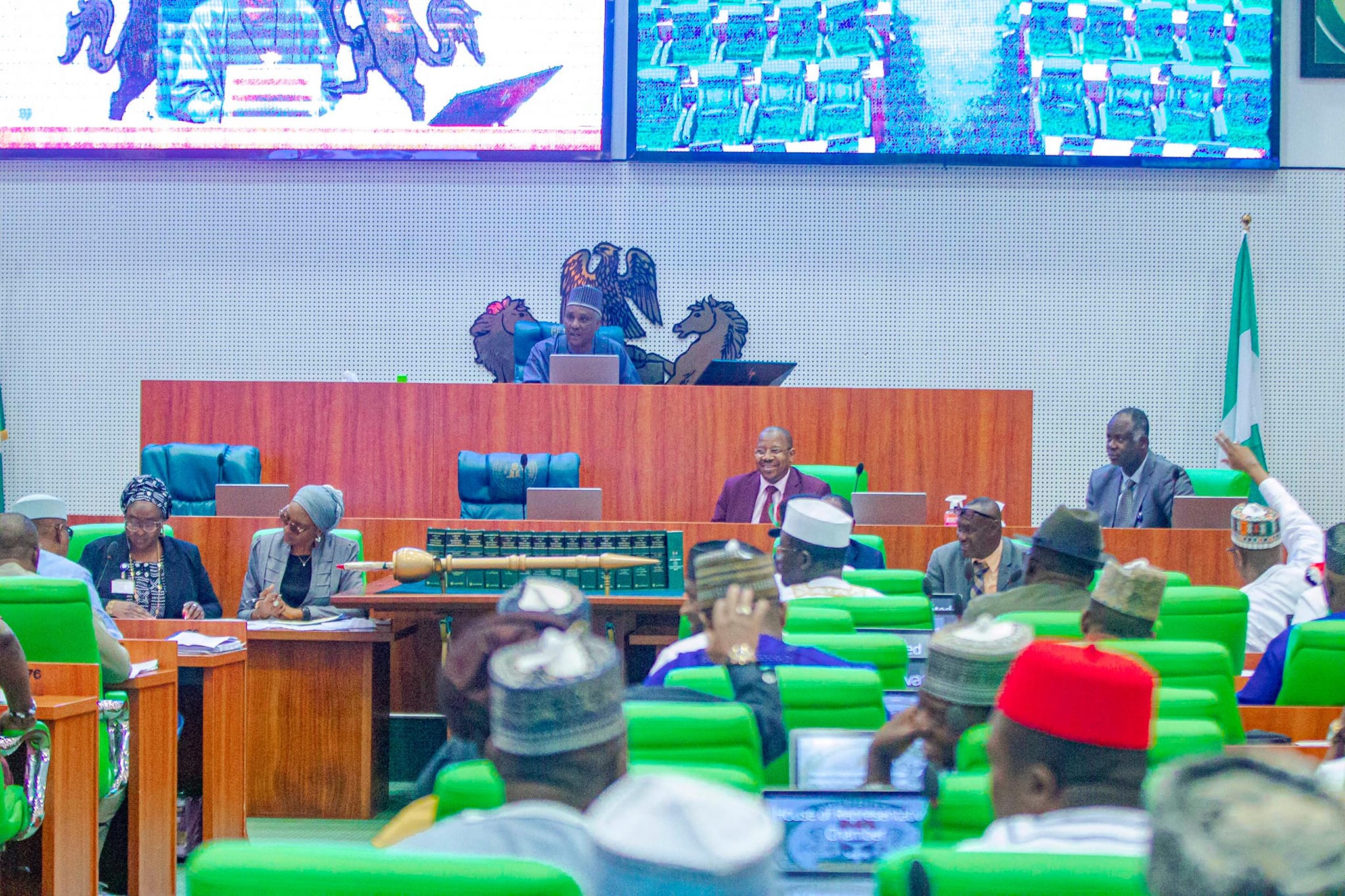
Reps Advise FG, States to Cap Annual Rent Increases at 20%
By Modupe Gbadeyanka
The federal government and the state governments have been advised by the House of Representatives to implement rent control measures to stop the exploitation of housing deficits in the country by landlords and real estate agents.
At the plenary on Thursday, the green chamber of the federal parliament said it was worried at the arbitrary hike in house rents by house owners in Nigeria, stressing steps must be taken to protect tenants.
The matter was put to debate at today’s session and most of the contributors lamented at the alleged exploitative natures of real estate agents, who were accused of conniving with house owners to charge exorbitant rates from tenants.
It was also claimed that some of the landlords increase their annual rents by more than 100 per cent, especially at this period many Nigerians are struggling to survive.
After speaking on the motion moved by Mr Bassey Akiba, the House charged the various tiers of government to enforce rent control measures across the country.
The lawmakers also tasked them to cap annual rent increases at no more than 20 per cent of existing rates to mitigate the financial burden on citizens.
Recall that some months ago, the Lagos State government, in a bid to stop the exploitation of tenants, declared that no agent or landlord should charge more than 10 per cent of the annual rent for tenancy agreement fees in the state, warning against illegal charges.
According to the Special Adviser to Governor Babajide Sanwo-Olu of Lagos State on Housing, Ms Barakat Odunuga-Bakare, any landlord or agent found demanding or collecting more than 10 per cent of the annual rent as agreement or legal fees is in direct violation of the state’s tenancy regulations.
Expressing concern over reports of unscrupulous practices, the Governor’s aide said, “We have been overwhelmed by reports of the activities of these unscrupulous elements making life hard for Lagosians with agreements and commissions that are like asking for an arm and a leg.
“We are calling on members of the public not to keep silent but to report such agents and landlords to us for the government cannot be everywhere, every time.”
General
NISO Blames Gombe Station Disturbance for Grid Collapse
By Adedapo Adesanya
The Nigerian Independent System Operator (NISO) has attributed Tuesday’s national grid collapse to a voltage disturbance at the Gombe transmission substation.
A statement issued by the system operator, while providing updates on repair and restoration efforts, stressed that the incident did not amount to a total system collapse, contrary to reports by some media organisations.
Recall that for the second time this year, the national grid recorded a disturbance that left all distribution companies unable to serve their franchise states. It followed a similar occurrence last Friday.
NISO said electricity supply across the affected areas has since been fully restored following immediate corrective actions by its technical teams, adding that the disturbance originated from the Gombe transmission substation before spreading to other parts of the network.
“The national grid has been fully restored, and electricity supply across the affected areas has since returned to normal.”
“The incident only affected part of the national grid, therefore not a total collapse,” NISO added.
“The event was accompanied by the tripping of some transmission lines and generating units, resulting in a partial system collapse.”
The system operator said restoration efforts commenced shortly after the disturbance and were completed within hours.
NISO disclosed that the voltage disturbance quickly propagated across the transmission network, affecting multiple substations.
The disturbance impacted power infrastructure beyond Gombe before stabilisation measures were implemented.
The voltage disturbance spread to the Jebba Transmission Substation, Kainji Transmission Substation was also affected, while the Ayede Transmission Substation experienced disruptions as the disturbance propagated.
According to NISO, although corrective actions were immediately deployed to stabilise the system and restore normal grid operations, some transmission lines and generating units tripped during the incident.
Nigeria’s power grid has continued to experience recurring disturbances in recent years, raising calls for alternative and proper power infrastructure in the country.
In 2025 alone, the national grid collapsed 12 times, with the last recorded incident occurring on December 29.
Tuesday’s incident represents the second grid collapse recorded in 2026, as well as the second in five days.
General
Manufacturers Kick Against NAFDAC’s Renewed Crackdown on Sachet Alcohol
By Adedapo Adesanya
The Manufacturers Association of Nigeria (MAN) has urged the federal government to intervene and restrain the National Agency for Food and Drug Administration and Control (NAFDAC) from renewing its enforcement of the ban on alcoholic beverages packaged in sachets and small PET bottles.
The Director-General of MAN, Mr Segun Ajayi-Kadir, who made the call in a statement, stressed that NAFDAC’s action contradicted directives from the Office of the Secretary to the Government of the Federation (SGF) issued on December 15, 2025, suspending the implementation of the ban.
Mr Ajayi-Kadir said the renewed enforcement also runs contrary to a March 14, 2024, resolution of the House of Representatives, which followed a public hearing with stakeholders, restrained NAFDAC from banning sachet and PET-bottled alcoholic beverages.
According to him, the conflicting directives from government institutions have created confusion among operators in the wines and spirits sector and are disrupting legitimate businesses, stating that sachet and PET-bottled alcoholic beverages were introduced to serve adult consumers with low purchasing power.
He added that smaller portions could help curb excessive consumption rather than encourage abuse.
Mr Ajayi-Kadir noted that locally produced sachet alcohol was manufactured under hygienic conditions and duly certified by regulatory agencies, including NAFDAC, warning that an outright ban could fuel the proliferation of illicit and unregulated products that pose greater health risks.
He also dismissed claims that the products promote underage drinking, saying such assertions had been contradicted by empirical research.
“We would like to further place on record that the untested assertion of abuse by minors as the basis for the ban has been debated by credible and empirical research that was independently conducted.
“The industry, on its own, has even gone further, notwithstanding the report of the survey, to initiate a series of campaigns in respect of responsible alcohol consumption to discourage underage abuse.
“This has so far cost the operators over a billion Naira in advertisements at all levels of media outreach across the federation.
“This has been very impactful in discouraging abuse by underage persons and has deepened the access restriction landscape,” he said.
Mr Ajayi-Kadir added that the ban threatened jobs, livelihoods and government revenue, while also encouraging smuggling and importation of unregulated alternatives.
He reaffirmed the commitment of MAN to working with regulatory agencies to ensure compliance with standards, while appealing to the Federal Government to direct NAFDAC to halt actions that disrupt members’ operations.
General
LWC Announces Water Supply Disruption in Agege, Ijora Olopa, Others
By Modupe Gbadeyanka
A temporary disruption in water supply to parts of Lagos State has been announced by the Lagos Water Corporation (LWC).
A statement signed by the Managing Director of the agency, Mr Temitope Mukhtaar, explained that the disruption was to enable the completion of critical repair and replacement works at the Adiyan I Water Treatment Plant.
According to him, engineers have been engaged to repair the facility to address a leakage on the ND1600mm Adiyan raw water pipeline located at the Akute Intake Station.
He said those to be affected by the cut in water supply include Akiode, Ikeja, Magodo, Oregun, Ketu, Ojota, Maryland, Aromire, Ogudu, Gbagada, Shomolu, Ojuelegba, Oyingbo, Ijora Olopa, Agege, and parts of Lagos Island.
The LWC chief further explained that the continuous leakage has been adversely affecting the ongoing construction of the Adiyan Phase II project.
“It was observed that the persistent water discharge from the leakage point is saturating the surrounding soil, thereby compromising ground stability and posing safety risks to heavy construction equipment, including cranes and excavators, currently deployed in the affected area,” he noted.
The GM further stated that the Adiyan I Water Treatment Plant will be shut down temporarily pending the completion of the repair and replacement works. This measure is to ensure the safe and effective execution of the Adiyan II intake construction works, assuring customers that efforts are being intensified to complete the works promptly, adding that water supply restoration is expected soon.
-
Feature/OPED6 years agoDavos was Different this year
-
Travel/Tourism9 years ago
Lagos Seals Western Lodge Hotel In Ikorodu
-
Showbiz3 years agoEstranged Lover Releases Videos of Empress Njamah Bathing
-
Banking8 years agoSort Codes of GTBank Branches in Nigeria
-
Economy3 years agoSubsidy Removal: CNG at N130 Per Litre Cheaper Than Petrol—IPMAN
-
Banking3 years agoSort Codes of UBA Branches in Nigeria
-
Banking3 years agoFirst Bank Announces Planned Downtime
-
Sports3 years agoHighest Paid Nigerian Footballer – How Much Do Nigerian Footballers Earn