Connect with us

Economy

Petrol, Diesel Prices to Rise as Tinubu Okays 15% Import Tariff

Published

on

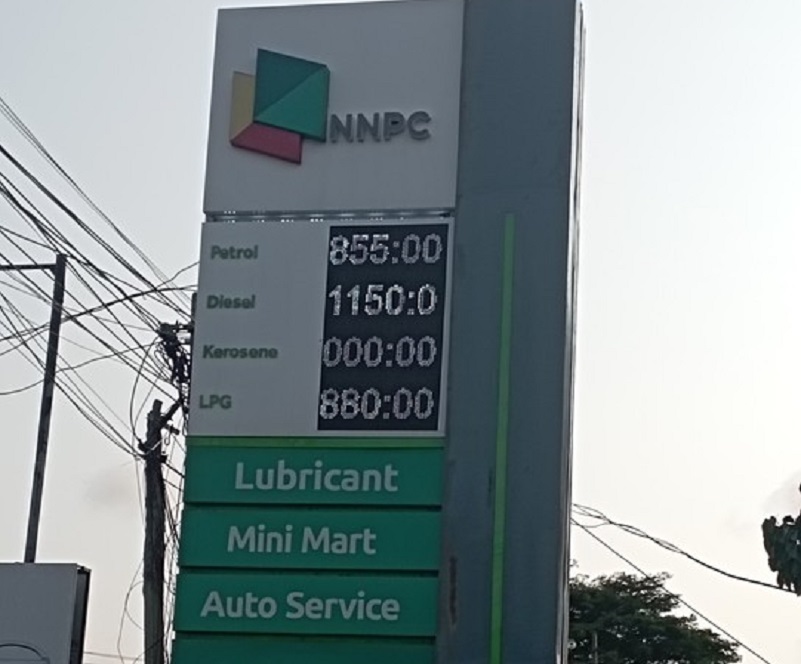
NNPC petrol N855 Per Litre

By Adedapo Adesanya

There are indications that Nigerians will begin to pay more for Premium Motor Spirit (PMS), otherwise known as petrol, after President Bola Tinubu approved a 15 per cent tariff on imported fuels.

According to reports, the President stated that the introduction of a ‘measured import tariff’ on Premium Motor Spirit (PMS) and Diesel, was aimed at reinforcing national energy security, safeguarding local refining capacity, stabilising the downstream market, and ensuring a fair and competitive pricing environment aligned with the the President’s agenda

However, the document stated that the impact will not exceed N100 addition per litre. At the moment, the PMS pump price is slightly above N900 per litre, while diesel is over N1,000 per litre.

The document noted: “While domestic refining of PMS has begun to increase, and local sufficiency in diesel production has been achieved, price instability persists, partly due to misalignment between local refiners and marketers.”

The framework introduces a 15 per cent ad-valorem duty on PMS and diesel, calculated on the Cost, Insurance, and Freight (CIF) value. “At current CIF levels, this represents an increment of approximately N99.72 per litre,” the document stated.

Even with the adjustment, pump prices are projected to average N964.72 per litre, still below regional averages in Senegal ($1.76), Côte d’Ivoire ($1.52), and Ghana ($1.37).

The policy is backed by Sections 71 and 72 of the Petroleum Industry Act, which empower the Nigerian Midstream and Downstream Petroleum Regulatory Authority (NMDPRA) to impose public service obligations to ensure energy security and economic stability.

Although the document initially proposed a 30-day transition period, President Tinubu directed immediate implementation, writing: “Approved as prayed for implementation immediately.”

There are, however, increased concerns that with Nigeria still importing over 60 per cent of its refined products as the Dangote Refinery is not at optimum production, the move could increase costs and heighten pressure on consumers.

The levy payments will be made into a designated Federal Government of Nigeria (FGN) revenue account under the Nigeria Revenue Service (NRS), with verification by the NMDPRA before discharge clearance.

In addition, an end-to-end digital verification will be linked to NMDPRA discharge clearance, to ensure that no cargo is released without proof of payment, while Customs and NMDPRA will update import templates, supported by a public compliance notice to minimise speculation and rumour-driven volatility.


Adedapo Adesanya is a journalist, polymath, and connoisseur of everything art. When he is not writing, he has his nose buried in one of the many books or articles he has bookmarked or simply listening to good music with a bottle of beer or wine. He supports the greatest club in the world, Manchester United F.C.

Economy

Naira Firms to N1,401/$1 at Official Market as Reforms Bear Fruits

Published

on

reject old Naira notes

By Adedapo Adesanya

The value of the Nigerian Naira appreciated against the US Dollar in the Nigerian Autonomous Foreign Exchange Market (NAFEX) on Tuesday, January 27 by N17.73 or 1.25 per cent to close at N1,401.22/$1, in contrast to the previous day’s value of N1,418.95/$1.

Also, the domestic currency improved its value against the Euro by N10.09 in the same market window yesterday to trade at N1,672.22/€1 versus the previous session’s N1,682.31/€1, but declined against the Pound Sterling by N4.72 to trade at N1,925.84/£1 compared with Monday’s closing price of N1,921.12/£1.

At the GTBank FX desk, the Naira appreciated against the greenback during the session by N4 to close at N1,426/$1 compared with the previous day’s N1,430/$1 and at the parallel market, it remained unchanged at N1,480/$1.

The Naira continues to align with projections and reforms. Analysts largely expect the local currency to remain within a relatively stable range in the medium term. Many projections suggest the currency will trade between N1,400/$1 and N1,450/$1 this year, supported by improved FX liquidity and ongoing macroeconomic reforms.

Nigeria’s external reserves have continued on a steady upward trajectory, providing additional support for the domestic currency. According to figures published by the CBN on its website, external reserves rose to $46.03 billion as of January 26, 2026, reflecting sustained inflows and improved confidence in the FX market.

Ongoing reforms in the oil sector that have buoyed investments, rising foreign capital inflows, and stronger diaspora remittances are also combining to underpin exchange rate stability and sustain confidence in the FX market.

Meanwhile, the cryptocurrency market rose on Tuesday and the US Dollar remained under pressure ahead of a closely watched Federal Reserve decision on Wednesday.

The weaker Dollar has fueled strong rallies in gold and silver, but crypto has so far lagged that trade.

Ethereum (ETH) gained 2.5 per cent to trade at $3,000.05, Dogecoin (DOGE) increased by 2.4 per cent to $0.1249, Solana (SOL) expanded by 2.3 per cent to $126.84, Binance Coin (BNB) added 2.1 per cent to sell for $900.33, Cardano (ADA) jumped by 1.6 per cent to $0.3568, Ripple (XRP) appreciated by 0.9 per cent to $1.91, Bitcoin (BTC) soared by 0.9 per cent to $89,016.63, and Litecoin (LTC) grew by 0.6 per cent to $69.69, while the US Dollar Tether (USDT) and the US Dollar Coin (USDC) traded flat at $1.00 apiece.

Continue Reading

Economy

Crude Oil Jumps 3% as US Winter Storm Affects Output

Published

on

Crude Oil Loan Facility

By Adedapo Adesanya

Crude oil appreciated by 3 per cent on Tuesday as a winter storm in the United States affected crude production and drove US Gulf Coast crude exports to zero over the weekend.

During the session, Brent crude futures went up by $1.98 or 3.02 per cent to $67.57 a barrel and the US West Texas Intermediate (WTI) crude futures grew by $1.76 or 2.9 per cent to trade at $62.39 a barrel.

US oil producers lost up to 2 million barrels per day or roughly 15 per cent of national production over the weekend as a severe winter storm swept across the country, straining energy infrastructure and power grids.

The severe weather has boosted crude futures, with short-term risks rising on fears of supply disruptions.

According to Reuters, the Permian Basin experienced the largest share of that decline at around 1.5 million barrels per day. Production losses eased on Monday, with Permian shut-ins estimated at about 700,000 barrels per day and production set to be fully restored by January 30.

The exports of crude oil and liquefied natural gas from US Gulf Coast ports tumbled to zero on Sunday amid frigid weather. However, this has rebounded in the last days.

Also boosting prices,  Kazakhstan’s biggest oilfield, Tengiz, is likely to restore less than half of its normal production by February 7 as it slowly recovers from a fire and power outage.

The slow pace of recovery of Tengiz’s production is keeping the oil market tighter while a weaker US Dollar also lended some support.

However, the CPC, which operates Kazakhstan’s main exporting pipeline, said it returned to full loading capacity at its terminal on the Russian Black Sea coast after maintenance was completed at one of its three mooring points.

On the geopolitical front, the US landed an aircraft carrier and supporting warships in the Middle East, adding to the slim chance of a military action against Iran.

President Donald Trump Trump had repeatedly threatened to intervene if Iran continued to kill protesters, but the countrywide demonstrations have since abated. The US president said he had been told that killings were subsiding and that he believes there is currently no plan for the executions of prisoners.

Meanwhile, the Organisation of the Petroleum Exporting Countries and its allies (OPEC+) is set to keep its pause on oil output increases for March at a meeting on February 1.

Continue Reading

Economy

Nigeria, Türkiye to Raise Trade Volume to $5bn from $2bn

Published

on

Nigeria Türkiye Trade Volume

By Modupe Gbadeyanka

Steps are now being taken by the Republic of Türkiye to increase its trade volume with Nigeria to $5 billion from the current $2 billion.

The President of Türkiye, Mr Recep Tayyip Erdogan, during a meeting with his Nigerian counterpart in Ankara on Tuesday, said the establishment of a Joint Economy and Trade Committee between the two countries would create opportunities to expand Turkish investments in Nigeria to realise the target.

The bi-continental nation presently exports aircraft, machinery, iron and steel, chemical products, fabrics, furniture and others to Nigeria, while the West African nation exports crude oil and agricultural products to Türkiye.

“Today, we conducted a comprehensive review of our relations with the esteemed President and his delegation in the fields of trade, investments, energy, education and defence industry.

“Firstly, we see that we have significant potential in the fields of trade and investment. In today’s meetings, our commitment is to the $5 billion trade volume target, and we discussed the steps needed.

“We also discussed opportunities to support our investments in Nigeria. We believe that the joint Economy and Trade Committee, which we agreed to establish today, will be instrumental in this regard,” Mr Erdogan told newsmen during a press conference yesterday.

He promised to assist Nigeria in tackling insurgency,  given its history with a similar problem, saying, “Terrorist organisations emerging, particularly in Africa’s Sahel region, unfortunately, pose a threat to the peace of the entire continent. We stand by the friendly people of Nigeria in their fight against terrorism under the leadership of President Tinubu.”

“In fact, today, we addressed opportunities for closer cooperation in the fields of military training and intelligence. We stated that we are ready to share our country’s significant experience in combating terrorism.

“Also, I believe that we will soon see positive outcomes from the meetings that Nigerian officials will hold with our leading defence industry companies during this visit,” he added.

In his remarks, Mr Tinubu thanked the Turkish leader for his willingness to collaborate in promoting global freedom, stability, and prosperity.

“What is very important to the countries being discussed, trade, business, no restrictions, giving opportunity to those who are ready to learn to work and prosper. How do we build an inclusive economy together? How do we reform the economy and involve vulnerable people? How do we ensure peace in the world?” he asked.

Continue Reading

Trending