Connect with us

Economy

Crude Oil Prices Rise Despite Growing Supply Worries

Published

on

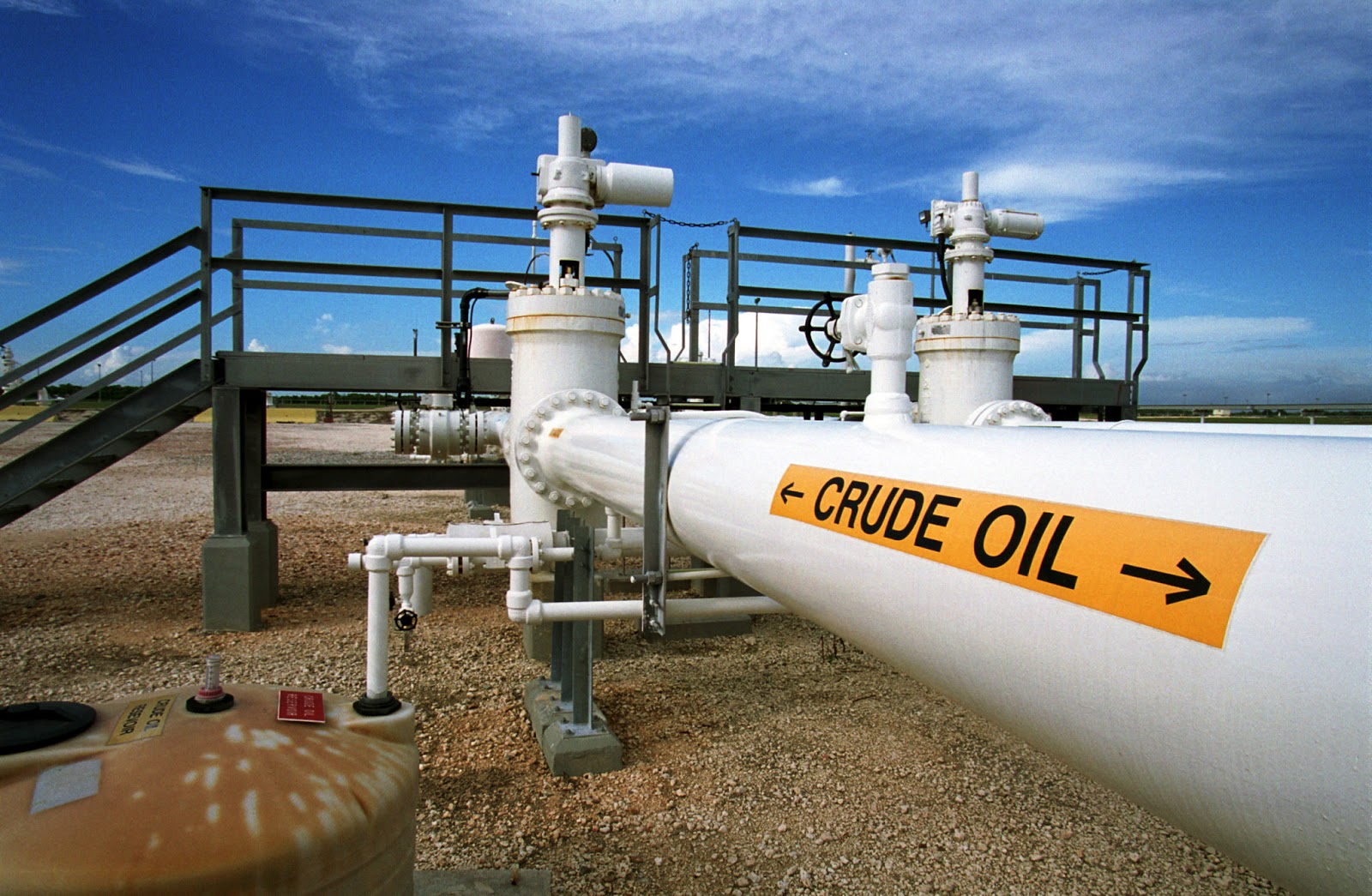
crude oil prices

By Adedapo Adesanya

Crude oil prices closed stronger on Monday despite predictions that rising supply will outweigh demand in the months ahead, while hopes of progress in ending a government shutdown in the United States raised investors’ risk appetite.

Brent crude futures increased by 26 cents or 0.4 per cent to trade at $63.89 a barrel and the US West Texas Intermediate (WTI) crude futures gained 23 cents or 0.4 per cent to finish at $59.98 a barrel.

The market keeps looking at expectations that crude oil supply will exceed demand in the months ahead due to higher production from the Organisation of the Petroleum Exporting Countries and allies (OPEC+) and record US output.

Earlier this month, OPEC+ agreed to increase output slightly by 137,000 barrels per day in December.

Market analysts noted that while the group also paused further hikes in the first quarter, that may not limit supplies enough to support prices.

Crude inventories are also on the rise in the US while the volume of oil stored aboard ships in Asian waters has doubled in recent weeks after tightening Western sanctions curtailed imports into China and India.

Oil from offshore Brazil, Guyana, Suriname, and Argentina’s Vaca Muerta shale play will be key sources of cost-competitive non-OPEC oil supply through 2030, Rystad Energy has predicted.

Rystad has predicted that global liquids demand will peak in the 2030s at around 107 million barrels per day, maintain a plateau above 100 million barrels per day through the 2040s before declining to around 75 million barrels per day by 2050. According to the Norwegian energy consultancy, non-OPEC+ supply will be key to balancing the global market, with cheap oil from South America helping to offset slower US shale growth.

Non-OPEC+ producers are expected to account for around 5.9 million barrels per day, or nearly 60 per cent, of new conventional oil currently under development through 2030 (total new capacity).

Doubts over the effectiveness of the latest US sanctions against Russia are also weighing on crude prices.

Russian oil producer Lukoil has declared force majeure at Iraq’s giant West Qurna-2 oilfield after Western sanctions on the Russian oil major hampered its operations. Lukoil’s operations faced mounting disruptions as a US deadline for companies to cut off business with the Russian company looms on November 21 and after an agreement to sell the operations to Swiss trader Gunvor collapsed.

Also, the US Senate moved forward on Sunday on a measure aimed at reopening the federal government and ending a shutdown. The move boosted investors’ risk appetite.


Adedapo Adesanya is a journalist, polymath, and connoisseur of everything art. When he is not writing, he has his nose buried in one of the many books or articles he has bookmarked or simply listening to good music with a bottle of beer or wine. He supports the greatest club in the world, Manchester United F.C.

Advertisement
Click to comment

Leave a Reply

Your email address will not be published. Required fields are marked *

Economy

Naira Trades N1,366/$1 at Official Market, N1,400/$1 at Black Market

Published

on

Black Market

By Adedapo Adesanya

The Naira continued to claw back some gains against the Dollar in the different segments of the foreign exchange (FX) market, as its value was strengthened on Friday.

In the black market, it gained N10 against the United States Dollar yesterday to close at N1,400/$1 compared with the preceding day’s rate of N1,410/$1, and at the GTBank forex counter, it chalked up N6 to close at N1,385/$1, in contrast to the N1,391/$1 it was traded a day earlier.

Similarly, in the Nigerian Autonomous Foreign Exchange Market (NAFEX), it appreciated against the greenback during the session by N5.28 or 0.38 per cent to quote at N1,366.23/$1 versus Thursday’s closing price of N1,371.51/$1.

It also improved its value against the Pound Sterling in the official market on Friday by N21.81 to settle at N1,812.99/£1 compared with the previous day’s N1,834.80/£1, and gained N13.86 against the Euro to sell at N1,568.03/€1 versus N1,581.89/€1.

Pressure eased further on the FX market as the Central Bank of Nigeria (CBN) continued interventionist operations this week, selling Dollars to banks to boost liquidity after a $500 million boost last week.

This was complemented by inflows from foreign investors, exporters and non-bank corporates, among others, while Nigeria’s gross external reserves remained above $50 billion, the highest since 2009.

The Governor of the apex bank, Mr Yemi Cardoso, also eased fears of a Naira devaluation, saying the country’s financial system has been strengthened by reforms.

Regardless, external pressure looms as the US Dollar strengthened globally due to its war with Iran, now ongoing for three weeks.

Meanwhile, the cryptocurrency market was largely down as traders and investors continue to align with current realities.

The market is adapting to the conflict in real time. Early in the war, every headline produced an outsized reaction because nobody could price the tail risk. Now, traders have a framework where strikes happen, oil spikes and bitcoin dips only to recover again.

Cardano (ADA) depreciated by 3.8 per cent to $0.2623, Dogecoin (DOGE) lost 1.7 per cent to finish at $0.0948, Ripple (XRP) slumped 1.5 per cent to $1.39, Solana (SOL) dropped 1.4 per cent to sell for $87.33, Binance Coin (BNB) went down by 1.3 per cent to $653.58, Bitcoin (BTC) declined by 1.1 per cent to $70,670.63, and Ethereum (ETH) decreased by 0.9 per cent to $2,078.78.

However, TRON (TRX) appreciated by 1.7 per cent to $0.2941, while the US Dollar Tether (USDT) and the US Dollar Coin (USDC) remained unchanged at $1.00 apiece.

Continue Reading

Economy

Oil Stays Above $100 as Strait of Hormuz Traffic Stalls

Published

on

Oil Prices fall

By Adedapo Adesanya

The price of the major crude oil grade, Brent crude oil, closed above $100 on Friday for the second consecutive session, as the Iran war heads toward its third week, with oil tanker traffic through the Strait of Hormuz still effectively at a standstill.

It gained 2.67 per cent or $2.68 during the trading day to close at $103.14 per barrel, while the US West Texas Intermediate (WTI) crude oil grade appreciated by 3.11 per cent or $2.98 to settle at $98.71 per barrel.

Brent futures were up about 10 per cent for the week following the 27 per cent rise seen last week, which marked the biggest weekly gain in oil prices since the COVID-19 pandemic in 2020. WTI futures, which saw their best week since 1983 last week, ended the week more than 8 per cent higher.

US President Donald Trump said American forces launched a major bombing raid on Iran’s strategic Kharg Island, targeting military facilities on the key Persian Gulf outpost while warning Iran that its vital oil infrastructure could be destroyed if shipping in the Strait of Hormuz is disrupted.

The terminal accounts for roughly 90 per cent of Iranian crude shipments, loading millions of barrels per day onto tankers bound largely for Asian markets.

The US and Israel’s strikes in the conflict have largely targeted Iranian military and nuclear infrastructure. Oil facilities elsewhere in Iran have been hit, but Kharg’s massive storage tanks, jetties, and pipelines had remained untouched until the latest strike.

Iran’s new supreme leader, Mojtaba Khamenei, vowed to keep fighting in a message delivered via state television.

There have been a number of attacks on foreign ships in or near the Strait, feeding into concerns that a prolonged war could translate to a global economic shock.

Prices are rising despite the US and its allies rolling out some measures to keep a lid on energy costs.

The International Energy Agency (IEA) has agreed to release 400 million stockpiled barrels, the largest such action in history.

The US has issued a 30-day waiver for India to purchase sanctioned oil from Russia. President Donald Trump is considering loosening rules under the Jones Act that require American ships to transport goods between domestic ports, including oil and gas, in an effort to lower costs.

Traders are continuing to monitor developments in the Middle East.

Continue Reading

Economy

NGX Market Cap Swells by N962bn as Investors Ignore Middle East Tension

Published

on

NSE market capitalisation stock value

By Dipo Olowookere

The escalating tension in the Middle East as a result of the attacks on Iran by the duo of the United States and Israel had little or no effect on the Nigerian Exchange (NGX) Limited on Friday.

The domestic stock market witnessed bargain-hunting yesterday, as investors mopped up equities that could experience price appreciation in the coming days.

Customs Street was up by 0.76 per cent during the trading day, with four of the five major sectors closing in green territory.

The industrial sector appreciated by 3.06 per cent, the banking sector increased by 0.84 per cent, the consumer goods index grew by 0.51 per cent, and the energy segment rose by 0.08 per cent, while the insurance counter lost 0.50 per cent.

When the closing gong was beaten to signal the close of trading activities, the All-Share Index (ASI) advanced by 1,498.54 points to 198,407.30 points from 196,908.76 points, while the market capitalisation gained N962 billion to close at N127.361 trillion compared with Thursday’s N126.399 trillion.

University Press appreciated by 10.00 per cent to N5.50, Guinness Nigeria also soared by 10.00 per cent to N385.00, Royal Exchange jumped 10.00 per cent to N1.87, May and Baker surged by 9.93 per cent to N41.50, and BUA Cement improved by 9.18 per cent to N270.00.

Conversely, RT Briscoe lost 9.17 per cent to trade at N10.40, Learn Africa depreciated by 8.33 per cent to N8.25, NGX Group crashed by 6.12 per cent to N176.50, Haldane McCall moderated by 5.78 per cent to N3.91, and AXA Mansard shed 5.63 per cent to close at N14.91.

Market participants exchanged 591.0 million shares for N35.0 billion in 53,066 deals during the session versus the 549.8 million shares valued at N44.7 billion traded in 55,465 deals in the previous session, representing a spike in the trading volume by 7.49 per cent, and a cut in the trading value and number of deals by 21.70 per cent and 4.33 per cent, respectively.

The activity chart showed that First Holdco, after the sale of 70.8 million units worth N3.5 billion, Access Holdings traded 67.2 million units valued at N1.7 billion, GTCO exchanged 33.6 million units worth N4.0 billion, Ellah Lakes transacted 27.1 million units for N329.2 million, and Sterling Holdings sold 25.2 million units worth N194.6 million.

Continue Reading

Trending