Banking
CBN Stops Special Authorisation to Withdraw Above N5m
By Adedapo Adesanya
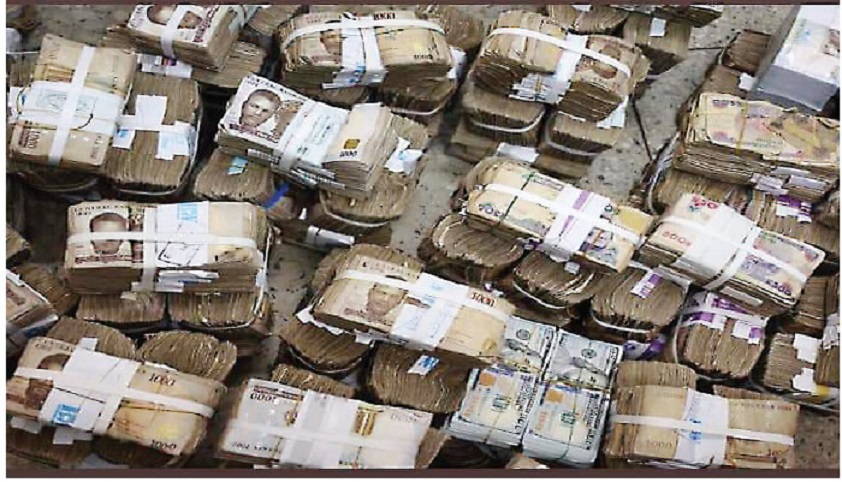
The Central Bank of Nigeria (CBN) has revised its cash withdrawal rules, discontinuing the special authorisation previously permitting individuals to withdraw N5 million and corporates N10 million once monthly, effective January 2026.
The new set of cash-related policies are designed to reduce the cost of cash management, strengthen security, and curb money laundering risks associated with the economy’s heavy reliance on physical currency.
This was contained in a circular released on Tuesday, December 2, 2025, and signed by the Director of the Financial Policy and Regulation Department of the central bank, Ms Rita I. Sike.
The apex bank explained that previous cash policies had been introduced over the years in response to evolving circumstances. However, with time, the need has arisen to streamline these provisions to reflect present-day realities.
“These policies, issued over the years in response to evolving circumstances in cash management, sought to reduce cash usage and encourage accelerated adoption of other payment options, particularly electronic payment channels. With the effluxion of time, the need has arisen to streamline the provisions of these policies to reflect present-day realities,” the CBN stated.
So, effective January 1, 2026, individuals will be allowed to withdraw up to N500,000 weekly across all channels, while corporate entities will be limited to N5 million.
Withdrawals above these thresholds will attract excess withdrawal fees of 3 per cent for individuals and 5 per cent for corporates, with the charges shared between the CBN and the financial institutions.
Daily withdrawals from Automated Teller Machines (ATMs) will be capped at N100,000 per customer, subject to a maximum of N500,000 weekly. These transactions will count toward the cumulative weekly withdrawal limit.
The special authorisation previously permitting individuals to withdraw N5 million and corporates N10 million once monthly has been discontinued.
The CBN also confirmed that all currency denominations may now be loaded in ATMs, while the over-the-counter encashment limit for third-party cheques remains at N100,000. Such withdrawals will also form part of the weekly withdrawal limit.
Deposit Money Banks (DMBs) are required to submit monthly reports on cash withdrawals above the specified limits, as well as on cash deposits, to the relevant supervisory departments.
They must also create separate accounts to warehouse processing charges collected on excess withdrawals.
Revenue-generating accounts of federal, state, and local governments, along with accounts of microfinance banks and primary mortgage banks with commercial and non-interest banks, are exempted from the new withdrawal limits and excess withdrawal fees.
However, exemptions previously granted to embassies, diplomatic missions, and aid-donor agencies have been withdrawn.
The apex bank clarified that the circular is without prejudice to the provisions of certain earlier directives but supersedes others, as detailed in its appendices.
This is the latest move by the apex bank to strengthen the Nigerian financial ecosystem. In October, the CBN issued a directive requiring all financial institutions to submit detailed monthly reports on the activities of their Point-of-Sale (POS) agents.
In the circular signed by the Director of the CBN’s Payments System Policy Department, Mr Musa Jimoh, it was stated that the reports must include comprehensive data on the nature, value, and volume of transactions conducted by agents.
The circular also stated that POS agents are restricted to a maximum of N1.2 million per day, while individual customers are limited to N100,000 in daily transactions.
CBN said these limits are intended to curb misuse, enhance financial integrity, and protect consumers within the agent banking framework.
Banking
Onafriq, PAPSS to Launch Wallet-Based Outbound Payments from Nigeria to Ghana
By Modupe Gbadeyanka
A platform to enable cross-border intra-Africa payments for individuals, merchants, and traders in Nigeria and Ghana is being designed by Onafriq Nigeria Payments Limited in partnership with the Pan-African Payment and Settlement System (PAPSS).
The platform, currently in its pilot stage, is the first wallet-based outbound payments scheme, which is fully in Naira and instant, without relying on hard currency conversion.
The parties are working together with banks and mobile money operators in the West Africa nations.
The Central Bank of Nigeria (CBN) has already approved this initiative, which will benefit small and medium enterprises (SMEs), the real engine of intra-African trade, as they will now have access to a faster, cheaper way to reach customers and suppliers across the border.
By reducing barriers to cross-border trade, the new service will allow these businesses to grow their addressable markets and activity. From December 1, this service will be fully operational for a 6-month period.
Through the partnership with PAPSS, Onafriq, which is a CBN licensed payment service provider, is supporting the operationalization of the Africa Continental Free Trade Area (AfCFTA) mandate. The mandate itself is driving tariff-free trade for the 54 member states of AfCFTA. Within the partnership itself, Onafriq provides the mobile money rails, with an ecosystem consisting of over 1 billion mobile wallets.
Meanwhile, PAPSS brings a network of over 160 commercial banks, representing an ecosystem of more than 400 million bank accounts across its 19 African countries of operation. The two partners are essentially seamlessly connecting two worlds: mobile money and banking. As a consequence, intra-African trade transactions will take place more easily and opportunities will be created.
Currently, Africa is made up of bank and mobile-led markets, with siloes often inhibiting transactions between these economies. However, this partnership will remove these boundaries. With over one billion mobile wallets and 500 million bank wallets across Africa, this partnership will allow for cross-border collaboration at scale.
This partnership builds on Onafriq and PAPSS’ existing partnership for payments into Ghana, announced earlier this year.
“Our work with PAPSS shows what collaboration at scale can unlock—seamless, secure connections between banking systems and mobile money ecosystems. This is how we open bi-directional trade corridors, reduce costs for businesses, and give African enterprises the rails they need to trade with confidence in their own currencies. The vision is continental, but it starts with practical steps like this one,” the Managing Director for Anglophone West Africa, Mxolisi Msutwana, said.
The Chief Information Officer for PAPSS, Ositadimma Ugwu, added, “Too often, African businesses and individuals see borders as roadblocks instead of opportunities. With this step, we’re challenging that mindset, giving Nigerians the ability to send value next door with the same ease as sending a text message. Our vision is simple: make Africa’s borders invisible to payments. This pilot makes that a reality, moving us closer to a continent where payments don’t pause at the border.”
Banking
Access Bank Appoints Ifeyinwa Osime as Board Chair
By Adedapo Adesanya
Mrs Ifeyinwa Osime has been appointed as the chairman of the board of Access Bank Plc, following the retirement of Mr Paul Usoro on January 29, according to a statement to the Nigerian Exchange (NGX) Limited.
Mrs Osime, an accomplished legal practitioner, joined Access Bank’s board in November 2019 as an independent non-executive director and had chaired the Board Human Resources and Sustainability Committee and the Governance, Nomination, and Remuneration Committee.
This role made her contribute significantly to bank’s corporate governance, leadership development, and sustainability initiatives.
In addition to her role at Access Bank, Mrs Osime is a Director at Ebudo Trust Limited and a Partner at McPherson Legal Practitioners, where she advises on corporate and commercial matters and contributes to strategic leadership.
She is also a member of the Nigerian Bar Association, Women Corporate Directors, Nigeria Chapter, and Chartered Institute of Directors Nigeria, where she serves on the Executive Committee of the Women Sectorial Group.
Beyond her professional responsibilities, Mrs Osime is committed to mentoring youths and is actively involved in the Autism and Developmental Delays Support Community, reflecting her dedication to inclusion and social impact.
Speaking on her appointment, the chairman of Access Holdings, Mr Aigboje Aig-lmoukhuede, said: “Mrs Osime is a principled and experienced leader with a deep understanding of the Bank’s strategy and values.
“She has demonstrated strong commitment to the Bank’s vision and mission, and I am confident that, under her leadership, the Bank will continue to advance its strategic objectives of delivering sustainable value to shareholders and other stakeholders in the pursuit of its vision to become the world’s most respected African Bank.”
He also congratulated Mr Usoro on the completion of his tenure and for his exemplary leadership, dedication and significant contribution to the Group, saying he remains a valued member of the Access Bank family.
Banking
Africa Energy Bank to Start Operations June as Nigeria Hands Over Headquarters
By Adedapo Adesanya
The African Energy Bank (AEB), a pan-African financial institution established to mobilise capital for the continent’s energy development and strengthen regional energy value chains, will begin operations in June 2026.
This came as Nigeria officially handed over the headquarters of bank at a ceremony held on the sidelines of the ongoing Nigeria International Energy Summit (NIES).
The president of the African Petroleum Producers’ Organisation (APPO) and Côte d’Ivoire’s Minister of Mines, Petroleum and Energy, Mr Mamadou Colibaly, praised Nigeria for its leadership in bringing the initiative to fruition, as he disclosed the bank was expected to commence operations in four months’ time.
“We are committed to launching this bank no later than June. I sincerely thank our partners for providing the headquarters and office that make this take-off possible. The African Energy Bank represents Africa’s commitment to finance, develop, and secure its own energy future by Africans, for Africans,” he said.
The African Energy Bank is a joint initiative of APPO member states and the African Export-Import Bank (Afreximbank), established to mobilise domestic and regional capital for Africa’s energy infrastructure, reduce dependence on external financing, and align energy investments with the continent’s long-term development and industrialisation agenda.
While performing the handover, Nigeria’s Minister of State for Petroleum Resources (Oil), Mr Heineken Lokpobiri, said the country had fulfilled all its responsibilities as host nation.
“Nigeria has met every obligation as host. The headquarters is ready, strategically located, and fully equipped, and we are prepared for immediate take-off.”
The ceremony highlighted a growing consensus among African leaders on the need for the continent to take greater ownership of its vast natural resources.
Through tailored financial instruments, the bank is expected to support projects across the energy value chain, including exploration, refining, renewable energy integration, and local content development, with a focus on job creation and economic value addition.
The African Energy Bank has been touted as not just another financial institution, but a strategic pillar in Africa’s quest for economic independence and long-term energy security
The African Energy Bank is a pan-African financial institution jointly promoted by APPO member states and Afreximbank to provide tailored financing solutions for energy projects across the continent, strengthen regional energy markets, and support sustainable development through improved access to capital.
-
Feature/OPED6 years agoDavos was Different this year
-
Travel/Tourism9 years ago
Lagos Seals Western Lodge Hotel In Ikorodu
-
Showbiz3 years agoEstranged Lover Releases Videos of Empress Njamah Bathing
-
Banking8 years agoSort Codes of GTBank Branches in Nigeria
-
Economy3 years agoSubsidy Removal: CNG at N130 Per Litre Cheaper Than Petrol—IPMAN
-
Banking3 years agoSort Codes of UBA Branches in Nigeria
-
Banking3 years agoFirst Bank Announces Planned Downtime
-
Sports3 years agoHighest Paid Nigerian Footballer – How Much Do Nigerian Footballers Earn