

Connect with us

Media OutReach

HKDPB announces key findings of “Hongkongers’ Sense of Security in Savings” Survey for eighth consecutive year

Published

on

Hongkongers’ average monthly savings rise to a record HK$10,100, while parents with a habit of saving aim to set aside an average of HK$2.26 million per child to feel sufficiently secure

HONG KONG SAR – Media OutReach Newswire – 17 December 2025 – The Hong Kong Deposit Protection Board (HKDPB) has conducted its “Hongkongers’ Sense of Security in Savings” survey for the eighth consecutive year. According to the survey results of this year, the average monthly savings of Hongkongers have topped HK$10,000 for the first time, reaching HK$10,100, marking a 3% growth from last year and a new record since the survey began. More than 67% of respondents said that they had a habit of saving, similar to last year, while 75% put their money in savings accounts or time deposits with banks. The survey also reveals that more than 20% of respondents with a saving habit had set a yearly saving target of HK$279,000 on average. Another finding is that 89% of young respondents, aged 18 to 29, had a habit of saving, with 32% of them having set saving goals; both figures mark the highest rates across all age groups, showing that young people were particularly proactive about saving. Among respondents with a saving target, 54% were confident of meeting their goals. Nearly 40% of respondents who had a habit of saving said that their savings were intended to meet “unexpected needs” (37%), followed by “preparing for retirement” (31%).

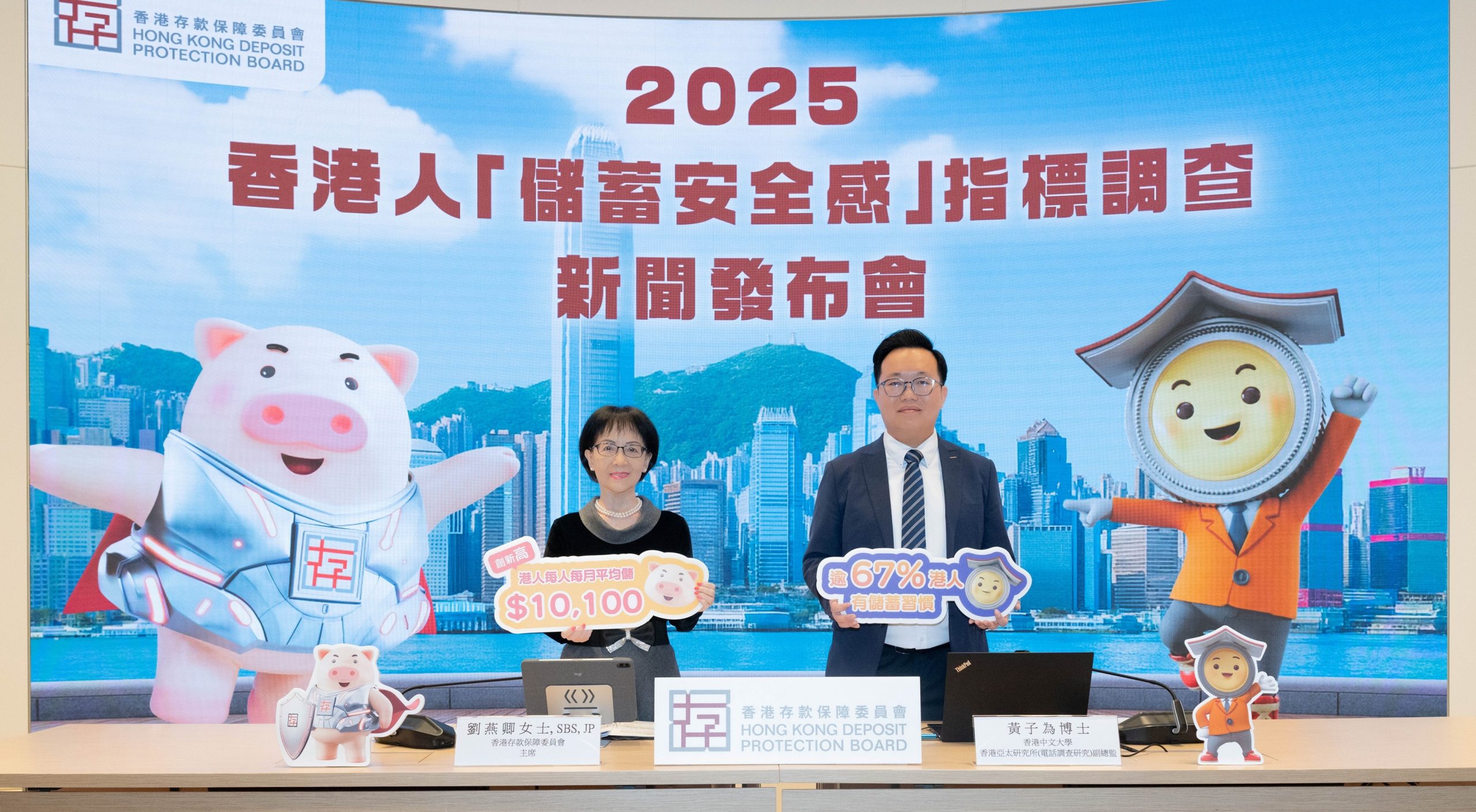
Ms Connie Lau Yin-hing, SBS, JP, Chairman of the HKDPB (left), and Dr Kevin Wong Tze-wai, Associate Director (Telephone Survey Research Laboratory), HKIAPS, CUHK (right), announce findings of the “Hongkongers’ Sense of Security in Savings 2025” survey.

In terms of Hongkongers’ “sense of security” as provided by their current savings, the score edged up to 54.3 marks from 53.5 last year, marking the highest in the past four years. About 76% of respondents rated their “sense of security” in savings at 50 marks or above, a slight increase of 2 percentage points from the previous year, while 16% rated it at 80 marks or above, similar to last year. The survey also shows that, to maintain their current living standards for one year, Hongkongers generally needed an average of HK$1.02 million in savings to gain a sufficient “sense of security”, close to last year’s HK$1.03 million.

Parents saving more actively with education as priority

An in-depth poll was conducted again this year, following a similar study in 2020, to analyse changes in saving habits among Hong Kong parents who had at least one child aged 10 or below. The results for this year reveal that nearly 80% of such parents had a habit of saving, about 3 percentage points higher than 2020. Each parent saved HK$12,100 on average a month, a significant increase of 40% from the HK$8,600 five years ago. Additionally, these parents perceived a need to maintain HK$1.16 million in savings on average to gain a sufficient “sense of security”, 14% higher than the HK$1.02 million recorded in the general public.

The survey also finds that 60% of parents were putting aside additional savings for their children. Their average target was an extra HK$2.26 million per child to gain a sufficient sense of security, in particular, for their educational expenses (77%), including “local studies” (66%) and “overseas studies” (27%). Their most common way of saving was through “opening bank accounts for children” (48%), followed by “purchasing savings insurance” (45%). More than 56% of parents said that they had encouraged their children to develop saving habits, primarily by “providing fixed pocket money to children” (29%) and “requesting children to save for their desired items” (22%).

Rising trends in Hongkongers’ savings awareness and parents’ early financial planning

Ms Connie Lau Yin-hing, SBS, JP, Chairman of the HKDPB, said, “We can see from the survey results that Hongkongers are keeping up a strong momentum in saving. Average monthly savings are at a new high; not only that, but more than 67% of the public consistently maintain saving habits. These findings show that savings is a vital source of ‘sense of security’. At the same time, a clearer trend has emerged among the public to adopt prudent and stable saving methods, such as bank deposits. Another finding is that 89% of young respondents, aged 18 to 29, have a habit of saving, with 32% of them having set saving goals; both figures mark the highest rates across all age groups, showing that young people are particularly proactive about saving. Additionally, the Deposit Protection Scheme (DPS) automatically provides up to HK$800,000 statutory protection for each depositor, helping everyone save with more confidence.”

Ms Lau further stated: “As the saying goes, ‘Raise a child for a hundred years, and worry for ninety-nine.’ This survey confirms that raising the next generation plays an important role in parents’ financial planning. For example, compared to five years ago, parents now are saving more actively, significantly increasing the amount they save. Coupled with their ‘sense of security’ savings needs, the overall amount is also higher than that of the general public. As for financial education for children, parents often play a key role. The survey also reflects that many parents are cultivating good savings habits in their children. We hope that through the HKDPB’s diverse public awareness campaigns and community education activities, the public will further recognise the importance of saving. At the same time, the DPS will continue to safeguard everyone’s bank deposits, providing robust deposit protection so that all can save with peace of mind.”

Other highlights of the survey results:

  • Regular savers made up 89% of respondents aged 18 to 29, with 32% of them having set saving targets for the year; both statistics were the most among all age groups, indicating young people’s commitment to saving. They saved HK$10,900 on average per month, 8% higher than the general public and also scored 56.9 marks on their “sense of security” regarding savings, ranking second among all age groups.
  • Respondents aged 30 to 39 topped the list of yearly saving targets by averaging HK$369,000, the highest among all age groups and also 32% more than the general public.
  • Respondents aged 40 to 49 saved the most per month, averaging HK$11,900 per person, which was 18% higher than the general public, showing the strongest saving capacity across all age groups.
  • Respondents aged 50 to 59 perceived savings of HK$1.33 million as being necessary for a sufficient “sense of security”, topping all age groups. It is believed that members of this age group are starting to prepare for retirement and thus need more savings for peace of mind.

Based on returns submitted by Scheme members of the DPS, i.e., licensed banks in Hong Kong, the aggregate amount of relevant bank deposits under DPS protection reached HK$3,492 billion in 2024. According to the statistics provided by Scheme members, more than 92% of depositors were fully covered by the DPS.

The HKDPB commissioned the Hong Kong Institute of Asia-Pacific Studies (HKIAPS) at the Chinese University of Hong Kong (CUHK) to conduct the “Hongkongers’ Sense of Security in Savings 2025” survey. From 1 September to 2 October 2025, the survey randomly selected and polled a total of 1,047 Hongkongers aged 18 or above by telephone, then carried out a more in-depth study on a total of 301 Hong Kong parents with at least one child aged 10 or below.

Hashtag: #HKDPB

The issuer is solely responsible for the content of this announcement.

About Hong Kong Deposit Protection Board

The Hong Kong Deposit Protection Board is a statutory body established under the Deposit Protection Scheme Ordinance to oversee the operations of the Deposit Protection Scheme. The objectives of the Scheme are to protect depositors and to help maintain the stability of Hong Kong’s banking system ().

Media OutReach

Global Wellness Forum 2026 Set for June 23 in Kuala Lumpur as Malaysia’s Nutraceutical Industry Embarks on Next-Gen Transformation

Published

on

KUALA LUMPUR, MALAYSIA – Media OutReach Newswire – 16 June 2026 – Malaysia’s wellness market is moving beyond traditional competition over ingredients, dosage, and pricing toward product-format experience, sustained use, and differentiated innovation. The Global Wellness Consumer & Product Trends Forum 2026 will hold a forum on June 23, 2026, in Kuala Lumpur. Under the theme “Defining the Next Generation of Health Industry,” the event will bring together Malaysian trade associations, leading distribution channels, and Taiwanese R&D teams to jointly explore market opportunities.

As a core component, James Pereira, general manager of MADSA, will share insights on Malaysian health industry regulations. Adrian Toh, CEO & Executive Director of R Pharmacy, will provide frontline retail channel observations regarding shifting consumer demands. Alex Liao, General Manager of Welbloom Bio-Tech, will represent Taiwan to share how format innovation effectively responds to brand differentiation, consumption experiences, and market compliance needs.

Faced with brands’ attention toward differentiated experiences, Welbloom Bio-Tech will showcase its proprietary, Halal-certified FRESH-Jelly® technology on-site, demonstrating the innovative application to make supplements more food-like. Through ingredient payload capacities, zero- or low-sugar designs, and customized flavor development, FRESH-Jelly® allows supplements to maintain functionality while becoming more enjoyable to consume regularly, providing Malaysian brands with a distinctive option beyond capsules and tablets.

With the rapid rise of Malaysia’s wellness consumer market, its mature distribution channels and exceptional potential for regional expansion are accelerating the country’s growth as a critical hub for the Southeast Asian health industry. Welbloom Bio-Tech states that this forum is a bridging platform connecting Taiwan’s manufacturing capabilities with Malaysian market insights, aiming to unlock commercially viable partnerships for both regions.

The event is organized by The PAGE, co-organized by Welbloom Bio-Tech and SEAbizs, and supported by NTBSA, MATRADE, R Pharmacy, and MADSA.

Event Information】
Time: June 23, 2026, 09:30 – 14:00
Venue: The Zenith – Connexion Conference & Event Centre, Kuala Lumpur

Hashtag: #WelbloomBioTech

The issuer is solely responsible for the content of this announcement.

About Welbloom Bio-Tech

Welbloom Bio-Tech focuses on health supplement R&D, manufacturing, and dosage form innovation. Through forward-looking market foresight and robust R&D technologies, it provides one-stop services from formulation design and flavor development to manufacturing, assisting clients in Malaysia and Singapore to build highly competitive health supplements.

To learn more, please search “Welbloom” or click the link:

Continue Reading

Media OutReach

Doing Good Index 2026: Asia’s US$753 Billion Philanthropic Potential Remains Unrealized

Published

on

In the 2026 edition of its flagship policy report the Doing Good Index, the Centre for Asian Philanthropy and Society (CAPS) finds that Asia’s capacity to deploy private capital for social good is not keeping pace with its potential.

  • Asia’s social sector is under strain: 78% of the 2,166 social delivery organizations (SDOs) surveyed report insufficient domestic funding.
  • Asia is one of the fastest-growing regions for wealth creation, yet the policies and incentives needed to channel it toward social good are not keeping pace.
  • Singapore has become the first economy to enter the “Doing Excellent” category, demonstrating what alignment across regulations, tax incentives, government partnerships and efforts to create a culture of giving can achieve.
  • 84% of Asian SDOs surveyed apply the UN Sustainable Development Goals (SDGs) in their operations, pointing to their enduring value as a shared framework for coordination and collective action beyond 2030.

HONG KONG SAR – Media OutReach Newswire – 16 June 2026 – Asia’s social needs are intensifying, and official development assistance is declining. Yet, while the region’s wealth is growing dramatically, the policies, incentives and partnerships needed to channel private capital toward social good are not keeping pace. That is a key finding of the Doing Good Index 2026, the fifth edition of CAPS’s flagship policy report, which assesses the enabling environment for private social investment across 17 Asian economies.

The report finds that while the enabling environment for private social investment is in place across much of the region, its effectiveness remains uneven. Improvements in registration processes and accountability mechanisms have been accompanied by persistent barriers, including restrictions on foreign funding, regulatory complexity, and inconsistent government engagement. In many cases, policies exist on paper but are not fully implemented in practice, limiting their impact.

At the same time, although trust in SDOs remains high across the region, broader ecosystem conditions, such as media sentiment, talent pipelines, and institutional support, are showing signs of strain. 81% of SDOs struggle to secure unrestricted funds for their work, while 73% report difficulty recruiting staff, constraining the sector’s ability to turn trust into impact.

“Asia has the wealth, the will, and in many economies, the foundations of a strong enabling environment. What is needed now is concerted, aligned effort to bring them together. The potential is enormous,” said Ruth Shapiro, Co-Founder and CEO, Centre for Asian Philanthropy and Society.

Unlocking Asia’s US$753 Billion Philanthropic Potential

Even as Asia’s wealth continues to grow, the region faces significant and intensifying challenges across climate, education and health. Official development assistance is declining, and there is increasing pressure on domestic resources at precisely the moment demand for social services is rising.

If Asian economies were to contribute just 2% of GDP to philanthropy, as the United States does, it could generate an estimated US$753 billion annually for social good. That represents 15 times the official development assistance flowing into the region, and almost half the financing needed to hit the UN’s SDGs in Asia. But realizing that potential depends on strengthening the policies, incentives and partnerships that enable private capital to flow toward social good. The Doing Good Index 2026 finds that across much of Asia, those conditions are not yet in place.

“The world has changed dramatically, and Asia can no longer rely on others to address its social challenges. The Doing Good Index 2026 shows the region has the potential to meet this moment, but only if governments and philanthropists act together to build the conditions that make it possible,” said Ronnie Chan, Chairman, Centre for Asian Philanthropy and Society.

Singapore Shows What Alignment Can Achieve
Singapore has, for the first time, entered the top “Doing Excellent” category in the Doing Good Index 2026, reflecting years of deliberate effort to build a strong culture of philanthropy and civic engagement. Clear regulations, generous tax incentives, openness to foreign funding, and close collaboration between government and the social sector have created a strong enabling environment.

Singapore’s achievement demonstrates that when regulations, fiscal policy, ecosystem conditions and procurement work in concert, the outcomes are stronger. While no two economies will follow the same path, Singapore’s experience highlights the conditions that matter, such as the active promotion and alignment of philanthropy and giving across the whole of society.

The SDGs: Falling Short but Still Relevant in Asia
In the run-up to 2030, global progress toward the SDGs has fallen short of ambition, and Asia is no exception. Yet the Doing Good Index 2026 finds that 84% of SDOs continue to apply the SDGs in their work. Further, the rise of Environmental, Social and Governance (ESG) reporting has not displaced them, because most SDOs see the two frameworks as complementary rather than competing.

As the deadline approaches, the Index points to their enduring value not as a target but as a shared framework for strategy, coordination and collective action in the years ahead.

Other Findings from the Report

  • Talent shortages persist for Asia’s social sector: more than 70% of SDOs face difficulty recruiting and retaining staff across Asia.
  • AI adoption is happening, but usage remains limited: only 13% of surveyed SDOs report using AI regularly.
  • 39% of SDOs say claiming tax benefits is difficult, suggesting administrative barriers may be limiting the impact of existing incentives for giving.

Hashtag: #CAPS #DoingGood #PrivateCapital #PublicGood #Philanthropy #Impact

The issuer is solely responsible for the content of this announcement.

About the Doing Good Index

Released biennially and now in its fifth edition, the Doing Good Index is CAPS’s flagship policy research that assesses the enabling environment for doing good in Asia: the systems, policies and practices that facilitate or constrain philanthropic giving and the deployment of this capital.

CAPS’s research team surveyed 2,166 social delivery organizations (SDOs) and conducted 132 interviews with sector experts across 17 Asian economies to provide a comparative, evidence-based view of where environments are supportive, where gaps persist, and how systems can be strengthened to better mobilize private resources for public good.

The Index looks at indicators under four sub-indexes: regulations, tax and fiscal policy, ecosystem, and government procurement, which provide an understanding of the specific measures economies have taken to catalyze philanthropic giving and promote social sector development.

Since its inception, the Index has been an essential resource for policymakers, philanthropists, and nonprofit leaders seeking to understand and improve the conditions for giving across the region.

For more information, and visit .

About the Centre for Asian Philanthropy and Society (CAPS)

Established in 2013 and working across more than 17 economies in Asia, the Centre for Asian Philanthropy and Society (CAPS) is a nonprofit organization committed to improving the quantity and quality of philanthropic and private giving throughout Asia. Our mission is to maximize private capital for public good, conducting research, advisory, convening and capacity building to engage philanthropists, foundations, family offices, corporates, government bodies, social sector organizations and experts on best practices, models, policies and strategies to facilitate private giving and social investment in the region. For more information, visit and .

Continue Reading

Media OutReach

Frost & Sullivan White Paper Names Phancy Rise vGPU a Tier 1 Leading Platform

Published

on

Rise vGPU + ModelHub Power China’s AI into the Heterogeneous Orchestration Era

HONG KONG SAR – Media OutReach Newswire – 15 June 2026 – Frost & Sullivan, a globally renowned growth consulting firm, has released its “2026 AI Infrastructure Orchestration Platform White Paper”. The report recognizes Phancy Group’s Rise vGPU as a Tier 1 Leading Platform, the highest maturity tier in heterogeneous GPU orchestration. Phancy’s ModelHub also achieved the highest Overall Score in the enterprise-grade model management platform evaluation. This marks a significant endorsement of Phancy’s technological capability in heterogeneous AI infrastructure.

According to the white paper, as large model applications scale rapidly, China’s AI industry is facing structural challenges stemming from multi-chip coexistence. These include hardware heterogeneity, fragmented software stacks, persistently low GPU utilization (generally below 30%), and rising model adaptation complexity — all of which have become major bottlenecks for enterprise-scale AI deployment.

The report highlights a fundamental shift in AI infrastructure competitiveness – moving away from “single-chip performance” toward “cluster-scale system coordination.” At this critical juncture, Phancy has positioned itself as a leader in advanced orchestration through its full-stack AI infrastructure platform, offering a proven solution to heterogeneous compute challenges and helping drive China’s AI industry from “compute accumulation” into a new era of “compute orchestration.”

Phancy Rise vGPU: Tier 1 Leading Platform

In its assessment of mainstream AI infrastructure platforms, Frost & Sullivan defined Tier 1 criteria across three core dimensions: heterogeneous support, fine-grained control, and production-grade execution. Phancy Rise vGPU meets all three standards and has been recognized as a Tier 1 Leading Platform.

Rise vGPU transforms AI infrastructure from fragmented, low-efficiency device-level management to a unified software-defined control plane. Its key technology breakthroughs include:

  • Comprehensive Heterogeneous Management: Unified onboarding and management across more than 10 mainstream GPU/NPU vendors, including NVIDIA, Ascend, Cambricon, Hygon, and others.
  • Ultra-Fine Resource Partitioning: Industry-leading sub-GPU level compute and MB-level memory granularity slicing.
  • Significant Utilization Improvement: Through safe oversubscription and time/space multiplexing, GPU utilization is increased from industry averages below 30% to 70%-90%.
  • Intelligent Precision Scheduling: Multi-dimensional scheduling algorithms based on priority, topology, load, and resource awareness to achieve optimal compute allocation.
  • Production-Grade SLA Assurance: The Deterministic Execution Layer delivers committed and auditable SLA guarantees for critical inference workloads.
  • Full Lifecycle Operability: Comprehensive monitoring, metering, and cost allocation capabilities that turn GPU resources into truly operable digital assets.

Model Hub: Highest Overall Score in Model Management Platform Evaluation

Beyond compute orchestration, the report underscores the strategic importance of enterprise-grade model management platforms. As a powerful complement to Rise vGPU, Phancy ModelHub enables enterprises to build a complete full-stack AI infrastructure — from compute to models and from resource scheduling to business delivery.

The white paper notes that Phancy ModelHub delivers leading performance in key areas such as Model & Chip Compatibility, Execution Stability & Performance, and Model-GPU Coordination & Scheduling, achieving the highest Overall Score. Through its unified model management and execution platform, ModelHub creates a seamless closed-loop process covering model onboarding, deployment optimization, inference services, and version governance — significantly lowering the barrier to model deployment and accelerating AI innovation.

Dr. Dai Wenyuan, Founder & CEO of Phancy, said: “The Frost & Sullivan white paper accurately captures the inflection point in AI infrastructure development. The recognition of Rise vGPU as a Tier 1 Leading Platform and ModelHub’s top Overall Score provide important authoritative validation of Phancy’s technology strategy and product strength. As a full-stack AI cloud service platform, Phancy believes the next wave of competitiveness in the AI industry will come from systematic improvements in compute orchestration efficiency. We will continue to focus on heterogeneous compute unified scheduling and model ecosystem operations, working closely with customers and industry partners to advance China’s AI industry from ‘compute accumulation’ to a true ‘compute orchestration’ era.”

Hashtag: #PhancyGroup

The issuer is solely responsible for the content of this announcement.

About Phancy Group

Phancy Group (6682.HK) is a leading full-stack AI cloud services platform, providing comprehensive solutions for the AI 2.0 era. Our offerings include Rise vGPU, ModelHub and SageAIOS, delivering efficient and scalable AI infrastructure with end-to-end capabilities. We provide a complete solution from heterogeneous compute resource management and optimization to the deployment of intelligent agent models. These solutions empower digital transformation across a wide range of industries, supporting our vision of building a large-scale and efficient “Token Factory.”

Guided by the mission of “AI for Everyone” and positioned as the “Navigator of AI,” Phancy Group is committed to becoming a global leader in Artificial General Intelligence.

Continue Reading

Trending

