Connect with us

Economy

Nigeria to Begin Gas Export from AKK Pipeline Early 2026

Published

on

AKK Gas Pipeline

By Adedapo Adesanya

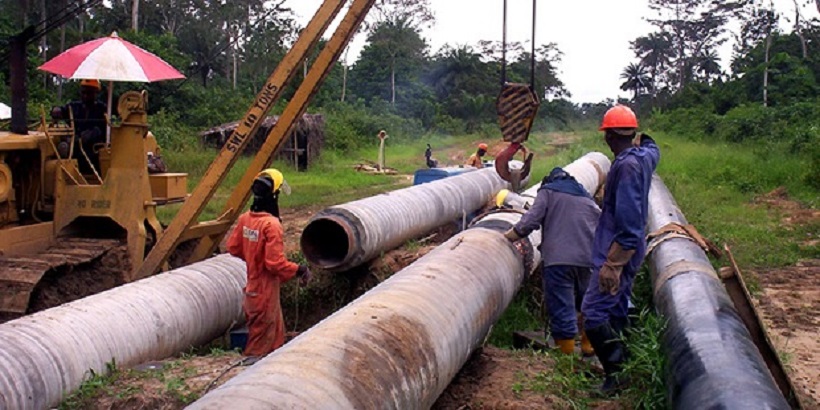
The chief executive of the Nigerian National Petroleum Company (NNPC) Limited, Mr Bashir Ojulari, has said the country would begin to export gas from the $2.8 billion Ajaokuta-Kaduna-Kano (AKK) pipeline from early 2026.

First conceived in 2008, the AKK pipeline is central to Nigeria’s ambition to leverage its vast gas reserves for economic growth. Its completion could transform the north, where chronic power shortages and a lack of energy infrastructure have stifled manufacturing for decades.

Speaking after briefing President Bola Tinubu on Sunday, he noted that the company has completed welding the main line of the pipeline, including the critical River Niger crossing which has stalled progress for years.

He said the milestone has cleared the way for connecting the pipeline early next year, noting that once activated, the project will “bring gas in its full form into the northern part of Nigeria.”

“This is not just about energy,” Mr Ojulari said, “It’s about industrialisation – fertiliser plants, power generation, and gas-based industries in Kaduna, Kano, Abuja, and Ajaokuta. We expect to see industrial parks spring up.”

Mr Ojulari also revealed NNPC’s production targets: oil output is expected to rise to 1.8 million barrels per day in 2026, up from about 1.7 million this year, while gas production will continue to climb, crediting structural reforms under the Petroleum Industry Act for enabling NNPC to operate as a profit-driven company, no longer reliant on federal allocations.

He said President Tinubu reaffirmed his push for $30 billion in new investments by 2030 and oil output of 2 million barrels per day by 2027, adding that upon completion, the pipeline network will deliver economic opportunities, boost power supply, and drive national industrialisation, ushering in a new era of energy and economic security for the country.

The AKK Gas Pipeline, spanning over 614 kilometers, is designed to deliver natural gas to power plants, industries, and CNG facilities, providing a major boost to Nigeria’s energy infrastructure and positioning the country as a regional energy hub.


Adedapo Adesanya is a journalist, polymath, and connoisseur of everything art. When he is not writing, he has his nose buried in one of the many books or articles he has bookmarked or simply listening to good music with a bottle of beer or wine. He supports the greatest club in the world, Manchester United F.C.

Economy

Traders Transact 2.876 billion Stocks Worth N63.832bn in Three Trading Days

Published

on

inject funds into stocks

By Dipo Olowookere

The Nigerian Exchange (NGX) Limited opened its doors to traders for three trading sessions last week due to the public holidays declared by the federal government on Thursday, December 25 and Friday, December 26, 2025, to commemorate the Christmas celebration.

In the week, investors transacted 2.876 billion stocks worth N63.832 billion in 80,229 deals versus the 9.849 billion stocks valued at N305.843 billion traded in 126,584 deals a week earlier.

The financial services industry led the activity chart with 1.984 billion shares valued at N32.680 billion in 31,632 deals, contributing 68.99 per cent and 51.20 per cent to the total trading volume and value, respectively.

The investment sector followed with 208.695 million equities worth N2.264 billion in 640 deals, and the conglomerates landscape sold 147.002 million stocks for N6.085 billion in 1,676 deals.

Abbey Mortgage Bank, VFD Group, and Custodian Investment accounted for 1.471 billion units worth N14.684 billion in 1,093 deals, contributing 51.15 per cent and 23.00 per cent to the total trading volume and value apiece.

Business Post reports that the All-Share Index (ASI) appreciated by 0.97 per cent to 153,539.83 points and the market capitalisation grew by 1.98 per cent to N97.890 trillion.

Similarly, all other indices finished higher except the premium, insurance, MERI Growth, and Lotus II indices, which dropped 0.51 per cent, 2.13 per cent, 0.23 per cent, and 0.62 per cent, respectively, while the energy and the sovereign bond indices closed flat.

The biggest price gainer was Aluminium Extrusion after it gained 32.39 per cent to sell for N16.35, Austin Laz expanded by 32.23 per cent to N3.20, International Breweries improved by 20.83 per cent to N14.50, Mecure Industries soared by 18.55 per cent to N65.20, and First Holdco jumped by 17.91 per cent to N53.00.

The heaviest price loser was Legend Internet after it gave up 11.71 per cent to close at N4.90, Champion Breweries slipped by 11.50 per cent to N15.00, NEM Insurance depleted by 8.37 per cent to N24.10, AXA Mansard tumbled by 7.14 per cent to N13.00, and ABC Transport retreated by 6.57 per cent to N3.27.

When the bourse ended for the week last Wednesday, 44 equities appreciated versus 55 equities in the previous week, 30 stocks depreciated versus 36 stocks a week earlier, and 73 shares remained unchanged versus 55 shares of the previous week.

Continue Reading

Economy

US Airstrike Won’t Distabilise Nigerian Financial Markets—Edun Assures

Published

on

Nigerian Financial Markets

By Adedapo Adesanya

The Minister of Finance and Coordinating Minister for the Economy, Mr Wale Edun, has assured investors that the country’s recent joint security operation with the United States in Sokoto will not destabilise the financial markets, but rather reinforce economic confidence.

Speaking via a statement on Sunday, Mr Edun emphasised that the operation, conducted on Christmas Day, was intelligence-led and targeted solely at terrorist elements threatening national stability and communities.

On Christmas day, the United States launched an airstrike on Islamic State West African Province (ISWAP) targets in Jabo, Sokoto State, as part of established counter-terrorism cooperation between both countries.

The strike reignited fears that had previously spooked the markets in November, when US President Donald Trump threatened military action in Nigeria.

In the statement, Mr Edun stressed that Nigeria was not at war with itself or any other country, and that the action is part of ongoing efforts to safeguard citizens and protect economic activity.

“The operation in question was precise, intelligence-led, and focused exclusively on terrorist elements that threaten innocent lives, national stability, and economic activity. Far from destabilising markets or weakening confidence, such actions strengthen the foundations of peace, protect productive communities, and reinforce the conditions required for sustainable growth. Security and economic stability are inseparable; every effort to safeguard Nigerians is, by definition, pro-growth and pro-investment,” he said.

He also underscored Nigeria’s solid macroeconomic performance, noting GDP growth of 3.98 per cent in the third quarter of 2025, following a 4.23 per cent expansion in Q2, adding that inflation has continued its downward trend for the eighth consecutive period, falling below 15 per cent reflecting improving price stability.

“Our financial markets remain resilient. Domestic and international debt markets are stable and functioning efficiently, supported by prudent fiscal management. Over the past year, Nigeria has received credit rating upgrades from Moody’s, Fitch, and Standard & Poor’s—clear, independent endorsements of the strength of our reforms and the credibility of our economic direction. We have maintained fiscal discipline, prioritised efficiency, and protected macroeconomic stability—demonstrating resilience in the face of external shocks,” he noted.

“As President Bola Tinubu noted in his address last week, our overarching objective for 2026 is to consolidate the gains of 2025, strengthen Nigeria’s economic resilience, and continue building a sustainable, inclusive, and growth-oriented economy.

“The actions we take today—on security, reforms, and fiscal discipline—are aligned with that goal. As markets reopen on Monday, 29 December 2025, investors can be confident that Nigeria remains focused, reform-driven, and committed to stability. The fundamentals are strengthening, the policy direction is clear, and the resolve of this administration—to protect lives, secure prosperity, and grow the economy—is unwavering.”

Continue Reading

Economy

Companies Raise N753bn Commercial Paper in Six Months

Published

on

Commercial Papers

By Aduragbemi Omiyale

Over N753 billion was raised in Commercial Paper (CP) from the Nigerian capital market in between April and October 2025.

The debt instrument was issued by corporates in the period to support short-term funding needs across diverse sectors.

Speaking in an interview, the Director General of the Securities and Exchange Commission (SEC), Mr Emomotimi Agama, said the issuance of CPs by organisations underscores strong investor confidence and the resilience of the market.

“Commercial paper issuance remained vibrant, with over N753 billion raised to support short-term funding needs across diverse sectors, from manufacturing to energy and agriculture,” the SEC chief stated.

He added that the debt market also recorded landmark transactions, including the N500 billion Climate Funding Special Purpose Vehicle and the N200 billion Elektron Finance bond issuance, reflecting increasing appetite for infrastructure and sustainable finance investments.

“These figures are not just numbers; they represent confidence in our regulatory framework and the resilience of our market architecture,” he declared.

According to him, the strong performance of the commercial paper segment formed part of broader capital-raising activities approved by the agency across debt, equity and short-term instruments during the review period.

“Since our last meeting, the Nigerian capital market has demonstrated remarkable depth and adaptability. Between April and October 2025, the commission approved significant transactions across debt, equity, and commercial paper segments, underscoring the market’s capacity to mobilize capital for growth.

“These achievements are essential as we work to position the Nigerian capital market as a catalyst for sustainable economic growth,” Mr Agama said.

He also pointed to recent macroeconomic improvements, including Nigeria’s sovereign credit rating upgrade and removal from the Financial Action Task Force (FATF) grey list, describing them as signals of renewed investor confidence.

“These achievements are not mere milestones; they signal renewed confidence in our economy. They will attract greater investment and enhance capital inflows, reinforcing the stability and growth prospects of our financial markets,” he said.

On inflation, the DG said easing price pressures created opportunities for market innovation, urging operators to move from policy to execution.

“This is a call to action for market operators. Innovation cannot remain on paper. We must translate these frameworks into real products and accessible platforms that meet the needs of today’s investors,” he stressed.

“The time for passive observation is over. Our collective responsibility is to activate these opportunities and position the Nigerian capital market as a true engine of inclusive growth,” he added.

He acknowledged the sharp market downturn recorded in November, when the Nigerian Exchange lost about N6.54 trillion in market capitalisation, attributing it to profit-taking ahead of the proposed 30 per cent Capital Gains Tax, weak banking stock sentiment and global uncertainties.

However, the capital market expert said the market rebounded following policy reassurances.

“Importantly, despite November’s volatility, the Exchange remains significantly positive year-to-date, with strong gains that reflect the underlying robustness of our market,” he noted.

He further highlighted the recent migration of the equities settlement cycle from T+3 to T+2, describing it as a major reform aligned with global best practices.

“By shortening the settlement period, we have enhanced liquidity, reduced counterparty risk, and accelerated the reinvestment of capital,” Mr Agama said, adding that the SEC plans to move to T+1 and ultimately T+0.

“These changes, combined with ongoing efforts to deepen commodity trading and expand bond market participation, will position Nigeria as a leading investment destination in Africa,” he added.

Continue Reading

Trending