Economy
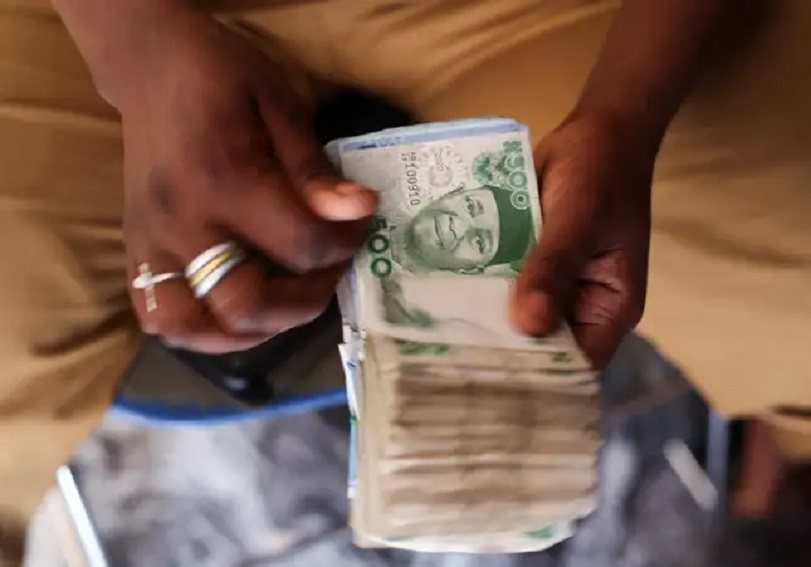
Naira Closes 2025 at N1,435/$1 at Official Market
By Adedapo Adesanya
The last trading day of 2025 at the Nigerian Autonomous Foreign Exchange Market (NAFEX) segment of the forex market favoured the Naira as its value improved against the United States Dollar on Wednesday by 0.69 per cent or N9.92 to trade at N1,435.76/$1 compared with the N1,445.68/$1 it was traded on Tuesday.
Equally, the domestic currency improved its value against the Pound Sterling in the same market window yesterday by N17.42 to settle at N1,934.25/£1, in contrast to the N1,951.67/£1 it ended a day earlier, and gained N12.39 on the Euro to close at N1,687.88/€1 versus the previous session’s closing price of N1,700.27/€1.
The Nigerian currency, however, maintained stability against the US Dollar in the parallel market and the GTBank FX counter during the session at N1,480/$1 and N1,452/$1, respectively.
The appreciation at the market came as demand eased in a year that the Central Bank of Nigeria (CBN) strengthened aggregate supply as well as ensure that Nigeria’s economy remained stable.
The apex last week stepped up FX intervention with $150 million and this week, sold $50 million to banks again in an unending intervention to stabilise the exchange rate.
In its latest outlook, the central bank expects external reserves to hit $51.04 billion in 2026, up from $45 billion in 2025. The reserves are expected to be boosted by reduced pressure in the FX market based on the anticipated rise in oil earnings, sovereign bond issuance, and diaspora remittance inflows.
Come 2026, the CBN said monetary conditions are expected to be relatively loose in view of the macroeconomic stability observed in 2025, as inflation and exchange rate risks continue to subside.
As for the cryptocurrency market, low liquidity and decline in risk appetites weakened price levels among benchmarked tokens, with Cardano (ADA) shedding 4.5 per cent to trade at $0.3358, and Dogecoin (DOGE) declining by 3.8 per cent to $0.1182.
Further, Ripple (XRP) went south by 1.5 per cent to $1.84, Litecoin (LTC) depreciated by 1.4 per cent to $77.11, Bitcoin (BTC) shrank by 1.0 per cent to $87,504.02, Solana (SOL) dropped 0.8 per cent to end at $124.70, and Binance Coin (BNB) lost 0.5 per cent to sell for $860.67.
However, Ethereum (ETH) appreciated by 0.1 per cent to $2,972.66, while the US Dollar Tether (USDT) and the US Dollar Coin (USDC) closed flat at $1.00 each.
Economy
Stock Market Nears N100trn Valuation After 0.37% Surge
By Dipo Olowookere
The Nigerian Exchange (NGX) Limited inched closer to N100 trillion on Wednesday after it gained 0.37 per cent on the last trading day of 2025.
The growth recorded by the local stock market was driven by bargain-hunting in the financial services sector, according to data obtained by Business Post.
Yesterday, the insurance space grew by 2.17 per cent, the banking index improved by 1.40 per cent, and the consumer goods sector expanded by 0.20 per cent.
However, three other major sectors witnessed profit-taking, with the energy counter shedding 0.55 per cent, the commodity industry losing 0.31 per cent, and the industrial goods segment declining by 0.14 per cent.
The losses posted by the trio could not bring down Customs Street, as the All-Share Index (ASI) closed higher by 578.31 points to 155,613.03 points from 155,034.72 points and the market capitalisation increased by N533 billion to N99.376 trillion from N98.843 trillion.
Aluminium Extrusion was the biggest price gainer with an appreciation of 9.90 per cent to trade at N21.65, Austin Laz gained 9.82 per cent to close at N4.25, Meyer jumped by 9.75 per cent to N12.95, C&I Leasing soared by 9.60 per cent to N6.85, and Union Dicon advanced by 9.52 per cent to N6.90.
Conversely, Neimeth lost 9.37 per cent to sell for N5.80, Tantalizers declined by 6.72 per cent to N2.50, International Breweries crumbled by 4.44 per cent to N14.00, NPF Microfinance Bank depreciated by 3.13 per cent to N3.71, and Vitafoam slumped by 3.06 per cent to N92.00.
Investor sentiment remained bullish after the bourse finished with 47 price gainers and 16 price losers, representing a positive market breadth index.
Market participants transacted 1.2 billion equities worth N35.1 billion in 27,884 deals yesterday compared with the 4.7 billion equities valued at N38.9 billion traded in 34,852 deals on Tuesday, showing a shortfall in the trading volume, value, and number of deals by 74.47 per cent, 9.77 per cent, and 19.99 per cent apiece.
Chams led the activity chart with 710.3 million units sold for N2.6 billion, Zenith Bank traded 58.8 million units worth N3.7 billion, Access Holdings exchanged 57.6 million units valued at N1.2 billion, FCMB transacted 44.1 million units for N516.3 million, and Tantalizers traded 39.9 million units worth N100.1 million.
Economy
Brent, WTI End 2025 in Red
By Adedapo Adesanya
The prices of the two major crude oil grades depreciated on Wednesday, the final trading session of 2025, as expectations of oversupply increased in a year marked by wars, higher tariffs, increased output by the Organisation of the Petroleum Exporting Countries and its allies (OPEC+) and sanctions on Russia, Iran and Venezuela.
Brent futures settled at $60.85 a barrel after it went down by 48 cents or 0.8 per cent and the US West Texas Intermediate (WTI) crude fell by 53 cents or 0.9 per cent to $57.42 a barrel.
Brent crude futures shed about 19 per cent in 2025 while the US crude benchmark logged an annual decline of almost 20 per cent.
Market analysts noted that prices will remain down before recovering to $60 a barrel for the rest of 2026 as supply growth normalises and demand stays flat.
It is expected that the supply from shale producers will be more consistent and insensitive to price movements in the new year.
Already, oil production in the US hit a record in October, according to the latest data from the US Energy Information Administration (EIA).
Crude inventories fell by 1.9 million barrels to 422.9 million barrels in the week ended December 26, the EIA said. US gasoline (petrol) stocks rose by 5.8 million barrels in the week to 234.3 million barrels while distillate stockpiles, including diesel and heating oil, rose by 5 million barrels to 123.7 million barrels.
In recent weeks, OPEC’s biggest producers, Saudi Arabia and the United Arab Emirates, have become locked in a crisis over Yemen. However, the latest public spat between the two OPEC players over Yemen created just a temporary blip in crude prices.
In the end, the UAE said it would pull out its remaining forces out of Yemen.
The market was also watching US President Donald Trump ordering a blockade on Venezuelan oil exports and his threat of another strike on Iran.
OPEC+ is due to meet on January 4 to look at the next decision after the alliance paused oil output hikes for the first quarter of 2026 after releasing some 2.9 million barrels per day into the market since April.
Economy
Court Okays Implementation of Nigeria’s New Tax Regime from January 1
By Adedapo Adesanya
An Abuja High Court has cleared the way for the implementation of Nigeria’s new tax regime scheduled to commence tomorrow, Thursday, January 1, 2026, as it dismissed a suit seeking to halt the exercise.
The ruling gives the federal government, the Federal Inland Revenue Service (FIRS) and the National Assembly full legal backing to proceed with the take-off of the new tax laws.
The suit was filed by the Incorporated Trustees of African Initiative for Abuse of Public Trustees, which dragged the Federal Republic of Nigeria, the President, the Attorney-General of the Federation, the President of the Senate, the Speaker of the House of Representatives and the National Assembly before the court over alleged discrepancies in the recently enacted tax laws.
In an ex parte motion, the plaintiff sought an interim injunction restraining the federal government, FIRS, the National Assembly and related agencies from implementing or enforcing the provisions of the Nigeria Tax Act, 2025; Nigeria Tax Administration Act, 2025; Nigeria Revenue Service (Establishment) Act, 2025; and the Joint Revenue Board of Nigeria (Establishment) Act, 2025, pending the determination of the substantive suit.
The group also asked the court to restrain President Bola Tinubu from implementing the laws in any part of the federation pending the hearing of its motion on notice.
However, in a ruling delivered on Tuesday, Justice Kawu struck out the application, holding that it lacked merit and failed to establish sufficient legal grounds to warrant the grant of the reliefs sought.
The court ruled that the plaintiffs did not demonstrate how the implementation of the new tax laws would occasion irreparable harm or violate any provision of the Constitution, stressing that matters of fiscal policy and economic reforms fall squarely within the powers of government.
Recall that Mr Tinubu had ignored suspension calls and insists the new tax laws will take off tomorrow.
Justice Kawu further held that once a law has been duly enacted and gazetted, any alleged errors or controversies could only be addressed through legislative amendment or a substantive court order, noting that disagreements over tax laws cannot stop the implementation of an existing law.
Consequently, the court affirmed that there was no legal impediment to the commencement of the new tax regime and directed that implementation should proceed as scheduled from January 1, 2026.
The new tax regime is anchored on four landmark tax reform bills signed into law in 2025 as part of the Federal Government’s broader fiscal and economic reform agenda aimed at boosting revenue, simplifying the tax system and reducing leakages.
The laws — the Nigeria Tax Act, 2025, Nigeria Tax Administration Act, 2025, Nigeria Revenue Service (Establishment) Act, 2025, and the Joint Revenue Board of Nigeria (Establishment) Act, 2025 — consolidate and replace several existing tax statutes, including laws governing companies income tax, personal income tax, value added tax, capital gains tax and stamp duties.
Key elements of the reforms include the harmonisation of multiple taxes into a more streamlined framework, expansion of the tax base, protection for low-income earners and small businesses, and the introduction of modern, technology-driven tax administration systems such as digital filing and electronic compliance monitoring.
The reforms also provide for the restructuring of federal tax administration, including the creation of the Nigeria Revenue Service, to strengthen efficiency, coordination and revenue collection across government levels.
The Tinubu administration has said the reforms are critical to stabilising public finances and funding infrastructure and social services, however recent allegations of discrepancies between the versions passed by the National Assembly and those later gazetted has raised a few eyebrows including former Vice President Atiku Abubakar and the Nigerian Bar Association (NBA).
-
Feature/OPED6 years agoDavos was Different this year
-
Travel/Tourism9 years ago
Lagos Seals Western Lodge Hotel In Ikorodu
-
Showbiz3 years agoEstranged Lover Releases Videos of Empress Njamah Bathing
-
Banking8 years agoSort Codes of GTBank Branches in Nigeria
-
Economy3 years agoSubsidy Removal: CNG at N130 Per Litre Cheaper Than Petrol—IPMAN
-
Banking3 years agoFirst Bank Announces Planned Downtime
-
Banking3 years agoSort Codes of UBA Branches in Nigeria
-
Sports3 years agoHighest Paid Nigerian Footballer – How Much Do Nigerian Footballers Earn