Economy
Nigeria’s New Tax System Looking Like Extortion—Peter Obi
By Aduragbemi Omiyale
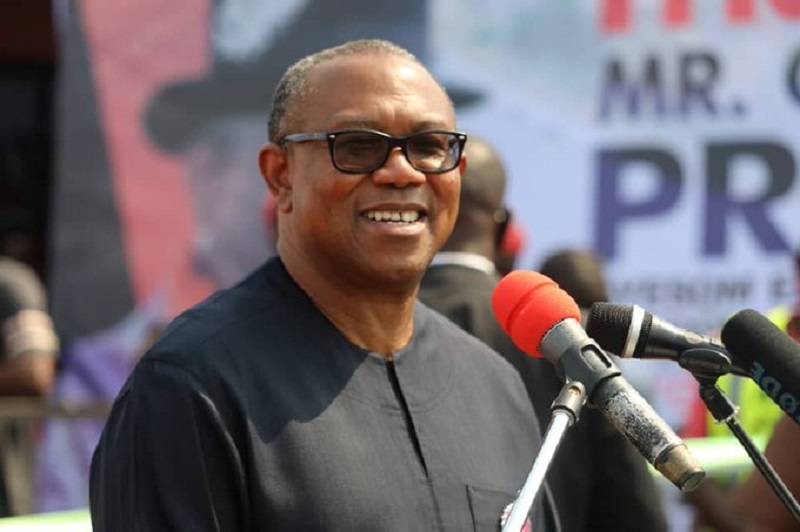
The presidential candidate of the Labour Party in the 2023 general elections, Mr Peter Obi, has likened Nigeria’s new tax system to extortion because it fails to clearly state how it intends to deliver “tangible benefits to citizens.”
In a post on X, formerly Twitter on Tuesday, the former Anambra State Governor, therefore, called for the suspension of the implementation of the tax laws, most especially after a renowned global accounting firm, KPMG, highlighted some errors in the laws.
Last week, KPMG Nigeria in a note on its website pinpointed some issues in the new laws, warning that they could discourage investments in the country.
However, the government reacted via the chairman on the Presidential Committee on Fiscal Policy and Tax Reforms, Mr Taiwo Oyedele, saying the agency misunderstood the laws.
This week, officials of KPMG had a meeting with the chairman of the National Revenue Service (NRS), Mr Zacch Adedeji, on the issue.
For Mr Obi, “The fact that it took private meetings between the National Revenue Service and KPMG for these serious issues to be acknowledged” makes it more alarming.
He posited that, “It is now undeniable that the tax laws have been fundamentally altered, and even a firm as esteemed as KPMG has pinpointed 31 critical problem areas, from drafting errors to glaring policy contradictions and administrative gaps. This revelation should prompt every responsible government to take immediate action.”
“If experts require closed-door discussions to navigate the complexities of our tax laws, what hope does the average Nigerian have of comprehending the obligations being imposed on them?
“Taxation transcends mere fiscal policy; it represents a social contract between the government and its citizens. You cannot enforce a social contract that isn’t understood or trusted.
“Globally, tax policies are justified by delivering tangible benefits to citizens: improved healthcare, better educational systems, job opportunities, infrastructure development, and social safety nets. This is what the social contract signifies.
“In Nigeria, the narrative is all about how much more the government seeks to extract, rather than what it is prepared to offer in return. A tax system devoid of clear public benefits isn’t reform; it is, quite frankly, extortion,” he stated.
Speaking further, he said, “Typically, months, if not years, are dedicated to consulting with businesses, workers, and civil society before tax drafts are presented for public discussion, with the ramifications clearly explained. People must be informed not only about their financial contributions but also about the benefits that will ensue. This is how legitimacy is cultivated. Yet, in Nigeria, we have seen no such public consultations or discussions regarding the final tax laws, leaving ordinary citizens completely in the dark about both the regulations and the benefits of the taxes they’re expected to pay.
“We have hastily pursued collection without securing a consensus and imposed enforcement without providing adequate explanations. Even after the removal of subsidies, Nigerians remain in limbo, waiting for tangible benefits or relief. Instead, they are grappling with skyrocketing food prices, exorbitant transport costs, dwindling purchasing power, and escalating poverty levels.
“Before we have even begun to address these issues, we are being thrust into an expansive new tax regime, riddled with inconsistencies and producing 31 alarming red flags from a leading global accounting firm. This is not the hallmark of responsible governance.
“Without trust, taxation feels like punishment. Without clarity, it breeds confusion. Without evident public value, it amounts to robbery.
“Nigeria cannot afford to place further burdens on its already struggling citizens. What we need is a government that listens, communicates effectively, and prioritises building national consensus. This is the only viable path to genuine reform, unity, growth, and shared prosperity.”
Economy
Coronation Sees February 2026 Inflation Cooling to 14.12%
By Aduragbemi Omiyale
Analysts at Coronation Research are projecting the inflation rate for February 2026 to moderate by 0.98 per cent to 14.12 per cent from the 15.10 per cent recorded in the preceding month.
The National Bureau of Statistics (NBS) is expected to release the inflation numbers today, Monday, March 16, 2026.
In a note released over the weekend, Coronation Research disclosed that the fall in the average prices of goods and services for last month would be impacted by a decline in the prices of food items.
“Our projection is supported by favourable base effects, easing food price pressures, and slight appreciation of the Naira,” a part of the report sighted by Business Post read.
The organisation revealed that the ongoing government interventions in the agricultural sector to improve food supply conditions are beginning to ease pressures within the food component of the consumer basket.
It further stated that “appreciation of the Naira to N1,363.40/1$ from N1,386.55/1$ in January is expected to reduce the cost of imported food items.”
However, it stressed that the ongoing US/Israel-Iran war was capable of reversing the deflationary trends because of the rising global energy prices.
“Also, the $200 million financing approved by the African Development Bank (AfDB) Group to scale up priority agricultural investments is expected to be disbursed in March, but its impact is likely to materialise in the medium to long term, with limited immediate effects on food supply and prices,” it said.
Coronation Research also disclosed that the recent energy market developments could keep core inflation sticky in the near term, as average Bonny Light crude oil prices rose to $72.33 per barrel in February 2026 from $68.04 per barrel in January.
Economy
SERAP Calls for Investigation into NNPC’s N5.9bn Rebranding
By Adedapo Adesanya
The Socio-Economic Rights and Accountability Project (SERAP) has called on President Bola Tinubu to order an investigation into the alleged N5.9 billion rebranding cost of the old Nigerian National Petroleum Corporation into the Nigerian National Petroleum Company (NNPC) Limited.
In a Sunday statement, SERAP urged Mr Tinubu to direct the Attorney General of the Federation and Minister of Justice, Mr Lateef Fagbemi, alongside anti-corruption agencies, to look into the matter.
The group further urged the President to direct the panel to identify and invite officials who authorised the payment and contractors who handled the project for questioning.
“We’ve urged President Bola Tinubu to urgently direct the Attorney General of the Federation and Minister of Justice, Mr Lateef Fagbemi, SAN, and appropriate anti-corruption agencies to promptly investigate the alleged expenditure of about ₦5.9 billion reportedly spent on the rebranding of the Nigerian National Petroleum Corporation (NNPC) to the Nigerian National Petroleum Company Limited (NNPCL).
“We also urged him to direct the Economic and Financial Crimes Commission (EFCC) and the Independent Corrupt Practices and Other Related Offences Commission (ICPC) to identify the officials who approved and paid the amount, and the contractor(s) who collected the money, and to invite them for questioning,” the organisation stated.
SERAP further alleged that the NNPC reportedly paid N2.9 billion for incorporation expenses from petroleum product proceeds, while the National Petroleum Investment Management Services (NAPIMS) also charged N2.9 billion against crude oil revenue for the same purpose.
The group argued that the total cost was valued at about N5.9 billion, which was spent by the NNPCL for the rebranding.
“There ought to be full transparency and accountability regarding the reported ₦5.9 billion spent on rebranding NNPC to NNPCL.”
SERAP emphasised that Nigerians have the right to know who approved the expenditure, who received the money, and whether due process was followed.
“Any investigation into the rebranding project should determine whether the N5.9 billion represents value for money, lawful spending of public funds, and compliance with transparency and accountability requirements,” the statement concluded.
Business Post reports that NNPC became a limited liability company on July 1, 2022, under the Companies and Allied Matters Act (CAMA) in line with the implementation of the Petroleum Industry Act (PIA), which was signed into law on August 16, 2021, by late President Muhammadu Buhari.
Economy
NASD Market Falls 1.18% to Extend Losing Streak
By Adedapo Adesanya
The NASD Over-the-Counter (OTC) Securities Exchange extended its stay in the south for the fourth consecutive session after it shed 1.18 per cent on Friday, March 13.
The unlisted securities market recorded a loss despite closing without a price decliner, and ending with two price gainers led by Geo Fluids Plc, which gained 1o Kobo to sell at N3.10 per share compared with the previous day’s N3.00 per share. Industrial and General Insurance (IGI) Plc appreciated during the session by 2 Kobo to trade at 54 Kobo per unit versus Thursday’s closing price of 52 Kobo per unit.
When the market closed for the day, the market capitalisation lost N29.83 billion to close at N2.489 trillion compared with the N2.519 trillion it finished a day earlier, and the NASD Unlisted Security Index (NSI) crashed by 49.84 points to 4,160.46 points from 4,210.31 points.
Market activity improved yesterday, as the volume of transactions rose 179.5 per cent to 10.4 million units from 3.7 million units, but the value of trades declined by 68.4 per cent to N29.9 million from N95.0 million, while the number of deals weakened by 11.5 per cent to 46 deals from 52 deals.
Central Securities Clearing Systems (CSCS) Plc remained the most active stock by value on a year-to-date basis with 38.4 million units worth N2.4 billion, Okitipupa Plc followed with 6.4 million units traded at N1.1 billion, and FrieslandCampina Wamco Nigeria Plc transacted 6.3 million units for N584.3 million.
Resourcery Plc ended the trading session as the most traded stock by volume on a year-to-date basis with 1.1 billion units valued at N415.6 million, trailed by Geo-Fluids Plc with 130.8 million units valued at N504.5 million, and CSCS Plc with 38.4 million units worth N2.4 billion.
-
Feature/OPED6 years agoDavos was Different this year
-
Travel/Tourism10 years ago
Lagos Seals Western Lodge Hotel In Ikorodu
-
Showbiz3 years agoEstranged Lover Releases Videos of Empress Njamah Bathing
-
Banking8 years agoSort Codes of GTBank Branches in Nigeria
-
Economy3 years agoSubsidy Removal: CNG at N130 Per Litre Cheaper Than Petrol—IPMAN
-
Banking3 years agoSort Codes of UBA Branches in Nigeria
-
Banking3 years agoFirst Bank Announces Planned Downtime
-
Sports3 years agoHighest Paid Nigerian Footballer – How Much Do Nigerian Footballers Earn