

Connect with us

General

Kaduna Community Releases Names of 177 Kajuru Church Abductees

Published

on

kajuru church attack

By Modupe Gbadeyanka

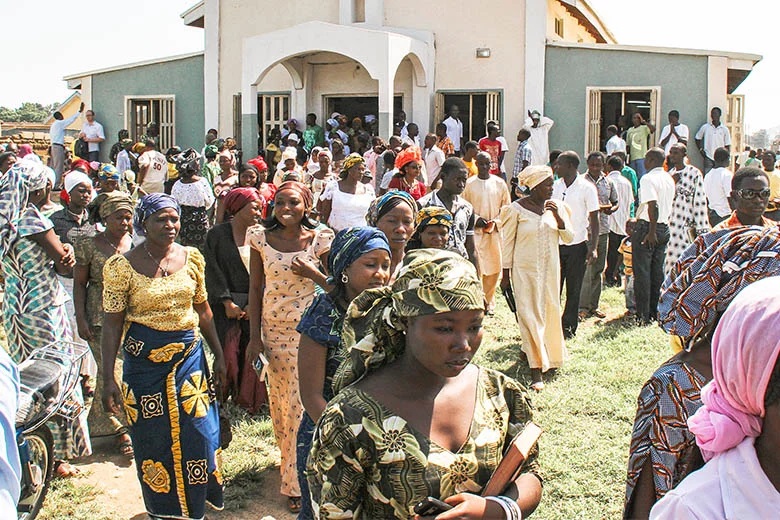
Last Sunday, scores of worshippers were kidnapped in three churches in the Kajuru area of Kaduna State.

The police and the government authorities earlier denied the incident, describing those who raised an alarm on the kidnapping as “conflicts merchants,” but they later made a U-turn, admitting that some terrorists actually raided the churches to forcefully go away with some worshippers at ECWA Church and Cherubim and Seraphim Churches 1 and 2.

As rescue efforts intensify, the community affected by this adoption, Kurmin Wali, has released the names of about 177 persons still in captivity as it was gathered that some victims had earlier escaped.

According to reports, entire households were abducted, with families such as the Jonathan household having 12 members kidnapped.

Further, the Amos family had 13; the Markus/Makudis had 10, the Ishayas and Danisas have seven each, the Bawas with six, the Danjumas and the Musas having five each.

Other families saw four, three, or two members taken away. The oldest victim is 71-year-old Augustina Matthew, while the youngest, Salvation Idris, is a child of six.

Other children include Likita Amos, 6; Jumota Idris, 7; Tessy Amos, 8; Yahaya Joshua, 9; and several 10-year-olds, including Sussana Idris, Synthah Amos, Hezibah and Hezikaiah Jonathan.

The list also includes;

  1. Zahaya Joshua
  2. Nabilah Makudi
  3. Hajara Makudi
  4. Rebecca Hosea
  5. Ahmad Ahmad
  6. Liyu Ezekiel
  7. Vivian Ezekiel
  8. Goodluck Ezekiel
  9. Beauty Ezekiel
  10. Matina Maiyashi
  11. Bridget Maiyashi
  12. Vivian Linus
  13. Mary Amos
  14. Hamid Amos
  15. Patricia Amos
  16. Hamisu Amos
  17. Luka Amos
  18. Tacy Amos
  19. Cynthia Amos (guessed)
  20. Mercy Isaac
  21. Augustine Makudi
  22. Matthew Samaila
  23. Adam Musa
  24. Malika Sule
  25. Abu Ahmad
  26. Hussein Lucky (guessed)
  27. Akinyi Sadiu
  28. Dangata Amos
  29. Helen Jonathan
  30. Asinwa Jonathan
  31. Faith Joseph
  32. Gloria Kennet
  33. Happiness Danisa
  34. Fidelis Jacob
  35. Tobias Markus
  36. Istu Paul
  37. Hassana Paul
  38. Charity Chindo
  39. Christiana Danisa
  40. Everest Danima
  41. Thomas Philip
  42. Catrina Danbosi
  43. Halima Hassan
  44. Hassan Lukumi
  45. Mary Sadiu
  46. Franca John
  47. Henry Danbiyi
  48. Genesis Lawal
  49. Ayuba Lawal
  50. Solomon Ayuba
  51. Theophilus Danlami (guessed)
  52. Charles Sambo
  53. Rahila Charles
  54. Gambo Danisa
  55. Talent Danisa
  56. Nehemiah Danjuma
  57. Maijima Shekarau
  58. Matina Maijima
  59. Laraba Maijima
  60. Musa Danjuma
  61. Ishaya Danima
  62. Lulu Danisa
  63. Clement Ahmad
  64. Destiny Ahmad
  65. Nehemiah Ishaya
  66. Simon Ishaya
  67. Nasty Muku
  68. Helena Joseph
  69. Joseph Bawa
  70. Sarah Joseph
  71. Bulus Mariya
  72. Musa Samaila
  73. Bulus Bawa
  74. Halima Bawa
  75. Beture Hosea
  76. Sati Hosea
  77. Titus John
  78. Dogara Bawa
  79. Lories Bawa
  80. Adamu Aminu
  81. Ezekiel Adamu
  82. Tenah Markus
  83. Tina Danbosi
  84. Patricio Bawa
  85. Janet Tsuda
  86. Amina Danjuma
  87. Sandra Danbosi
  88. Bridget Sunday
  89. Saphat Innocent (guessed)
  90. Alex Sunday
  91. Beauty Peter
  92. Samisa Paul
  93. Joy Joseph
  94. Methole Johanna
  95. Genesis Johanna
  96. Maria Johanna
  97. Merozdu Adonu
  98. Karimi Jangbe
  99. Sunday Martela
  100. Santina Hershinga
  101. Keuna Michael
  102. Hassan Bulus
  103. Marzeta Maisoni
  104. Mainwa Dominic
  105. Godwin Karimi
  106. Amos Akijo
  107. Nathan Amos
  108. Joseph Chindo
  109. Lydia Godwin
  110. Hamna Maiyangi
  111. Toletu Maiyangi
  112. Esther Godday
  113. Godswill Godday
  114. Godlive Samson
  115. Goodluck Aliga
  116. Madaki Tabawa
  117. Tabawa Abba
  118. Tabawa Iyamye
  119. Samuel Amos
  120. Daniel Amos
  121. Deborah Amos
  122. Ruth Amos
  123. Emmanuel Danjuma
  124. Joshua Danjuma
  125. Rejoice Danisa
  126. Blessing Danisa
  127. Ibrahim Lawal
  128. Zainab Lawal
  129. Sadiq Ahmad
  130. Aisha Ahmad
  131. Yakubu Musa
  132. Suleiman Musa
  133. Rahama Musa
  134. Daniel Jonathan
  135. Samuel Jonathan
  136. Peter Jonathan
  137. Grace Jonathan

Modupe Gbadeyanka is a fast-rising journalist with Business Post Nigeria. Her passion for journalism is amazing. She is willing to learn more with a view to becoming one of the best pen-pushers in Nigeria. Her role models are the duo of CNN's Richard Quest and Christiane Amanpour.

Advertisement
2 Comments

2 Comments

  1. Pingback: Church Confirms Release Of 151 Abducted Members in Kaduna | Business Post Nigeria

  2. Pingback: Kaduna Community Releases Names of 177 Kajuru Church Abductees | – Business Post Nigeria – Herald Today
Leave a Reply

Your email address will not be published. Required fields are marked *

General

Oceangate Engineering Oil to Appeal Assets Forfeiture Judgment

Published

on

Oceangate Engineering

By Modupe Gbadeyanka

Oceangate Engineering Oil and Gas Limited has concluded plans to challenge the Federal High Court judgment directing the forfeiture of its assets to the federal government.

The energy firm, in a statement on Thursday by its scribe, Ms Nnenna Onyeaso, denied any wrongdoing in the matter taken to court by the Economic and Financial Crimes Commission (EFCC).

Justice Emeka Nwite of the Federal High Court in Abuja ordered the final forfeiture of $13 million linked to a Lagos socialite, Ms Aisha Achimugu, and her company, Oceangate, after ruling that the EFCC established that the foreign currency was proceeds of fraud and unlawful activities.

The judge dismissed the claims that the $13 million was gifts received into the Oceangate Engineering Company by Ms Achimugu, adding that the woman never came to the court to show cause why the huge amount of money should not be forfeited to the government.

Reacting to the issue in the statement, Oceangate described the court’s decision as a civil asset forfeiture order based on suspicion rather than proof, stressing that the judgment did not establish any criminal liability against the organisation.

The organisation emphasised that it has already directed its legal team to file an appeal, expressing confidence in the judicial process and the outcome of a thorough review of the case.

“To be clear, this ruling is a civil asset forfeiture order with no finding of wrongdoing against Oceangate or its leadership.

“The court’s decision rested on a legal standard of suspicion, not proof, and it is one we intend to pursue fully through the appeals process,” Ms Onyeaso said in the statement.

The firm secretary also said that Oceangate has reiterated its belief in the rule of law, noting that the appellate system exists to address such outcomes, adding that the firm remained confident that the facts of the case will ultimately affirm its integrity and business practices.

She stressed that the company’s operations remained unaffected, stating that it continues to provide employment to many Nigerians while contributing to the country’s energy sector and broader economy.

“We have always believed in the ability of the judicial process, and that belief has not wavered,” she added, saying the organisation expressed appreciation to its employees, partners, and clients for their continued support amid the development, assuring stakeholders of its commitment to transparency and accountability.

“We remain committed to the continued growth of our business and the communities we serve as we are optimistic that justice will prevail at the end of the legal process,” Ms Onyeaso stated.

Continue Reading

General

Investigation Links Late Herbert Wigwe to 106 London Properties

Published

on

herbert wigwe Access Bank

By Adedapo Adesanya

The late Herbert Wigwe, former chief executive of Access Bank, has been linked to 106 properties in London, a new investigation by a British paper found.

The investigation by The Londoner examined 32,611 properties across the British capital owned by overseas entities, traced foreign-held properties through shell companies and offshore structures. The findings were made possible by a UK legal reform requiring overseas entities to declare their beneficial owners.

However, the publication emphasised that the report documents ownership and does not allege any wrongdoing.

Mr Wigwe, who died in a helicopter crash alongside his wife, son, and friend in California in February 2024, was one of Africa’s most prominent banking executives, having helped transform Access Bank into one of Nigeria’s largest financial institutions.

The investigation found him in connection with 106 London-based properties, which underscores the scale of his presence in one of the world’s most expensive real estate markets.

Previously, UK company records had linked Mr Wigwe to an address on The Bishops Avenue in north London, one of the city’s most exclusive streets.

He was listed in 2012 as a director of Carmel Gate Ltd, with a correspondence address at Flat 7, Allingham Court, 44 The Bishops Avenue. The new investigation suggests his property interests in London were far wider than previously known.

Mr Wigwe also served as director of Access Bank UK Limited from 2008 until his death. Documents from Access Holdings show that he and the current Access Bank CEO, Mr Roosevelt Ogbonna, were the only shareholders when the holding company was incorporated in 2021, each holding 4,000,000 ordinary shares.

The Londoner noted that foreign ownership in London stretches from Oxford Street and Camden Market to luxury residential towers and landmark commercial sites, often held through companies in Jersey, Guernsey, and the British Virgin Islands.

The development came on the back of British legislation in 2022, which mandated that any overseas entities that owned UK real estate had to register their real ownership with UK authorities.

The Londoner reported that among others found to own properties include the Private Department of the President of the UAE, the Qatar Central Bank, as well as the Libyan Investment Authority, the sanctioned sovereign wealth fund based in Tripoli.

Continue Reading

General

Tunnel Greenhouse Grow Tents in Modern Controlled Environment Cultivation

Published

on

greenhouse technology

Controlled environment agriculture has become an important part of modern food production and facility management in the United States. Agricultural producers, research institutions, and industrial property operators often require protected growing areas to ensure stable plant development. Greenhouse systems allow operators to manage temperature, moisture, and airflow while protecting crops from environmental stress.

One example of this approach is the Tunnel Greenhouse Grow Tent w/12 Mil Ripstop Leno Mesh Cover. Tunnel greenhouse structures create enclosed growing spaces that support plant cultivation while maintaining airflow and natural light exposure. These systems are used in small agricultural operations as well as in institutional and facility management programs.

Market Context and Importance in the United States

Demand for reliable plant cultivation systems has increased due to changing climate patterns and expanding urban development. Many organizations require predictable plant production for landscaping, research, and food supply programs. Controlled environment greenhouse structures allow operators to extend growing seasons and reduce crop losses.

Tunnel greenhouses are widely used because they are easier to install than large permanent structures and can be adapted to different locations.

Basic Structure and Functional Design

Tunnel greenhouse grow tents use a curved frame structure covered with durable protective material. The covering allows sunlight to enter while protecting plants from wind and heavy rainfall.

Key structural elements include:

  • Steel frame that supports the structure
  • Protective mesh or plastic covering
  • Roll up windows for airflow control
  • Ground anchoring system for stability
  • Entry door for maintenance access

Operational Applications

Tunnel greenhouse systems support several types of cultivation and facility management operations.

  • Vegetable and fruit cultivation
  • Seedling propagation programs
  • Landscape plant preparation
  • Agricultural research and testing
  • Protected growing environments in cold regions

Efficiency and Productivity Considerations

Greenhouse structures improve productivity by providing consistent environmental conditions. Controlled growing spaces help operators maintain plant health and improve production planning.

  • Reduced crop loss from weather exposure
  • Improved control of temperature and moisture
  • Extended growing seasons
  • More predictable plant development cycles

Technical Infrastructure Considerations

Successful greenhouse operation requires attention to environmental and structural factors. Operators must ensure that the structure can withstand local climate conditions while supporting plant growth requirements.

  • Proper anchoring for wind resistance
  • Sunlight exposure throughout the day
  • Ventilation management through windows or vents
  • Reliable water supply for irrigation
  • Monitoring of temperature and humidity levels

Safety Practices and Maintenance

Regular inspection helps maintain safe operation and structural stability of greenhouse systems.

  • Inspect frame connections and anchors
  • Replace damaged covering materials
  • Maintain safe electrical connections for ventilation equipment
  • Keep walkways clear during maintenance work

Related Equipment and Accessories

Greenhouse systems often operate together with other tools that support plant cultivation.

  • Irrigation systems
  • Plant benches and racks
  • Ventilation fans
  • Environmental monitoring devices
  • Supplemental lighting equipment

Advantages and LimitationsAdvantages

  • Flexible installation in different locations
  • Protection from environmental conditions
  • Improved plant growth stability
  • Lower cost compared with permanent structures

Limitations

  • Performance influenced by local climate conditions
  • Requires routine maintenance of covering materials
  • Limited insulation compared with permanent greenhouse buildings

Example from a Small Agricultural Operation

A small vegetable farm in the northeastern United States installed tunnel greenhouse structures to extend the growing season for leafy crops. By using protected cultivation space, the farm was able to begin seedling development earlier in the spring and continue production later in the autumn. This approach improved crop availability while reducing the impact of seasonal weather changes.

Conclusion and Future Industry Trends

Tunnel greenhouse grow tents provide a practical solution for controlled environment cultivation in agricultural and institutional settings. Their flexible design and relatively simple installation make them suitable for many types of plant production programs.

Future developments in greenhouse technology may include improved covering materials, automated ventilation systems, and advanced environmental monitoring tools. As interest in reliable plant production continues to grow, controlled cultivation systems will remain an important part of modern agricultural and facility management practices.

Continue Reading

Trending

