

Connect with us

Technology

Entries Open for 2026 Google for Startups Accelerator Africa

Published

on

2026 Google for Startups Accelerator Africa
By Aduragbemi Omiyale

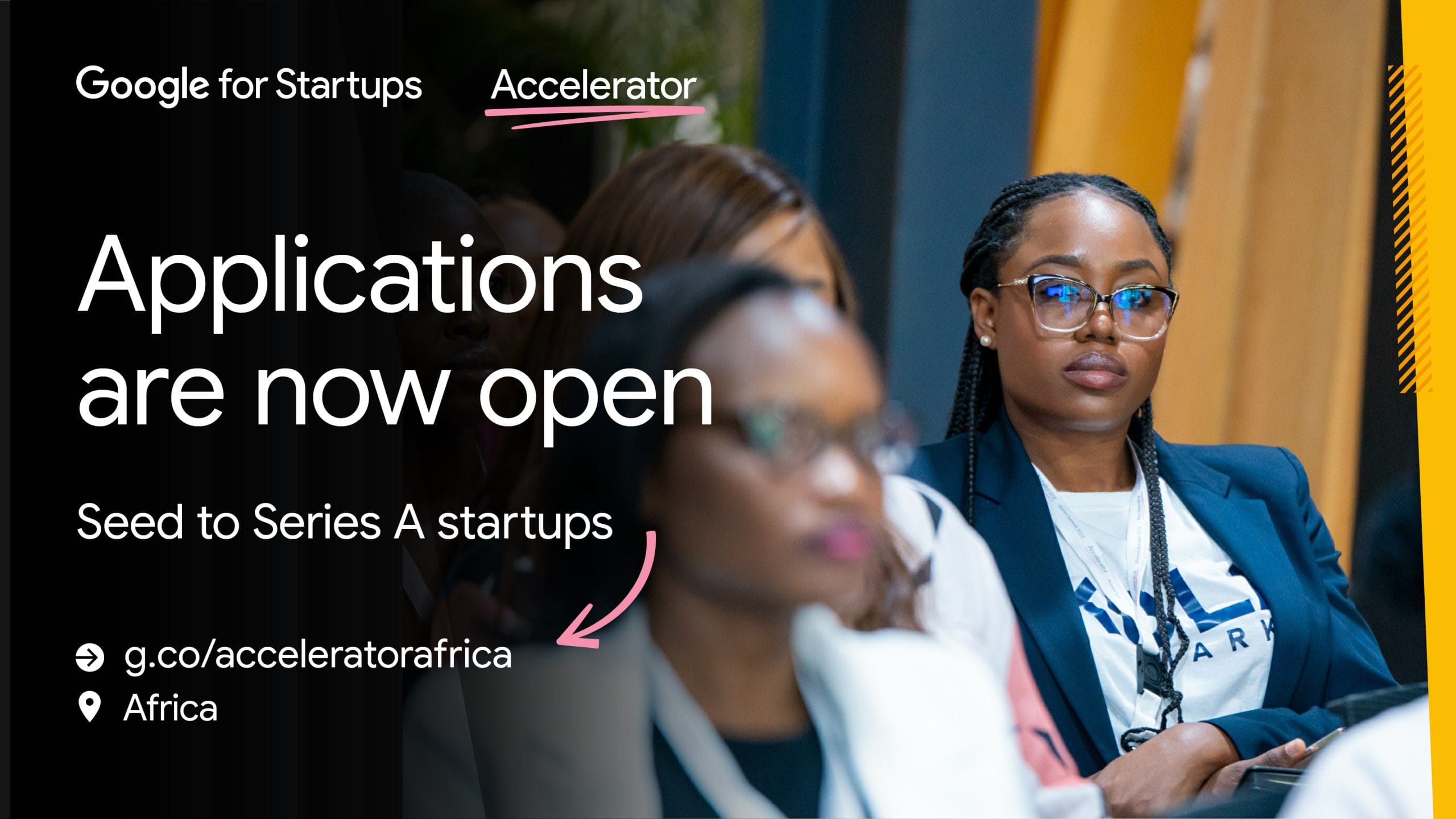
Applications for a 12-week AI First hybrid programme, designed for Series A startups based in Africa or building Africa-centric solutions with AI and machine learning, have opened at g.co/acceleratorafrica.

This is an initiative of Google and it reenforces the tech giant’s commitment to accelerating AI-driven scientific and technological breakthroughs across the continent.

The programme, known as the Google for Startups Accelerator Africa, is in its 10th edition in 2026 and it is targeted as AI-driven scientific breakthroughs.

Entries for the cohort began today, Thursday, February 5, 2026, and will close on Wednesday, March 18, 2026, with the hybrid programme starting in April 2026 for 12 weeks.

A statement from the organisers disclosed that participants will benefit from access to Google’s AI expertise and technical resources, alongside mentorship from seasoned AI professionals and invaluable networking opportunities.

Since its inception in 2018, the Google for Startups Accelerator: Africa program has supported 180+ startups from 17 African countries. Collectively, these startups have raised over $350 million in funding and created more than 3,700 direct job opportunities in the region.

“Africa’s tech landscape is seeing a vibrant shift toward deep-tech innovation. For Class 10, we are focusing on the potential of AI to drive health and societal benefits, providing the infrastructure and expertise to turn these startups into the research labs of the continent,” the Head of Startup Ecosystem for Africa, Folarin Aiyegbusi.


1 Comment

1 Comment

  1. Pingback: Entries Open for 2026 Google for Startups Accelerator Africa – Herald Today

Leave a Reply

Your email address will not be published. Required fields are marked *

Technology

Nigeria Urges Africa to Align Ahead of Global Telecom Policy Talks

Published

on

NCC International Termination Rate

By Adedapo Adesanya

The Nigerian Communications Commission (NCC) has pushed for greater collaboration among African countries on telecommunications and digital economy policies, stressing that the continent must present a unified voice at major global regulatory forums.

The executive vice chairman of the NCC, Mr Aminu Maida, gave this charge on Monday in Abuja, while declaring open the 7th Ordinary Session of the Conference Preparatory Committee (CPC-26) of African Telecommunications Union (ATU) ahead of the ATU Conference of Plenipotentiary (CPL-26), where the committee will also consider reports for the International Telecommunications Union (ITU) Plenipotentiary conference which will take place in Doha, Qatar in November 2026.

The NCC chief said the continent needs greater alignment ahead of the ITU Plenipotentiary Conference, a practical mechanism for collaboration between former conferences and a stronger commitment to sustained technical participation in ITU processes.

“Africa must prepare together, work together between meetings and arrive at a global forum from positions that are both coherent and technically compelling,” he said.

He noted that CPC-26 will determine the direction and priorities of the continental union, while ITU PP26 will determine the direction, leadership, and priorities of the global union.

He said, “Our work here must serve purposes, clearly strengthening ATU as Africa’s coordinating institution while ensuring that Africa is well-prepared to participate effectively at the ITU.

“Africa’s influence in the international forum does not depend on the size of our delegations or the number of interventions we make, but it depends on the quality of our preparations, the coherence of our positions and the consistency with which we advance them.

“We must reconcile different perspectives and build technically sound positions. Africa’s voice carries greater weight, but if that preparation is delayed our influence will inevitably reduce.”

Mr Maida explained that issues around telecommunications and the digital economy are increasingly complex and interconnected; therefore, Africa must demonstrate capacity in spectrum harmonisation across borders, the governance of Artificial Intelligence (AI) and autonomous systems, and a data protection framework that can support African digital trade.

He also emphasised universal access in communities where commercial investment alone may not be sufficient and urged concerted efforts to address cybersecurity threats that cross national boundaries.

“No administration can address these challenges effectively in isolation. Our regulatory cooperation must become more continuous, more technical and more institutionalised. Coordination should not begin only when a conference agenda is circulated, and it should not end when delegates leave the room.

“Our objective as Africa is not to resist global standards; it is to help shape standards that are globally sound and sufficiently informed by African realities. Africa is one of the world’s most dynamic digital regions. The scale of mobile adoption, the innovation we have seen in digital financial services and the number of young people coming online mean that decisions on spectrum, digital identity, AI, connectivity and digital trust will have profound consequences across our continent, he said.

The NCC boss commended the Secretary General of ATU, Mr Joseph Omo, for coordinating Africa’s positions during his eight-year tenure, where he supported a more coherent voice within the ITU and other international forums, adding that such achievement came through diligent work patiently built and through the difficult work of reconciling national perspectives around common continental interests.

He assured that Nigeria remains a consistent and dependable partner of the ATU, and pledged the country’s continued contribution in technical expertise and shared regulatory experience.

Continue Reading

Technology

NITDA Hands Over PKI Framework to NIMC to Strengthen Digital Identity

Published

on

NIMC

By Adedapo Adesanya

The National Information Technology Development Agency (NITDA) has transferred its Public Key Infrastructure (PKI) framework to the National Identity Management Commission (NIMC) in a move aimed at strengthening the security of Nigeria’s digital identity ecosystem.

According to a statement issued by NITDA’s Director of Corporate Communications and Media Relations, Mrs Hadiza Umar, the transfer was announced during a formal handover ceremony at NITDA’s headquarters on Thursday.

PKI is a digital security system that helps verify people’s identities online and protects information shared over the internet. It uses encrypted digital certificates to confirm that an individual, business, or government agency is genuinely who they claim to be before sensitive information is exchanged.

It helps prevent identity theft, impersonation, and fraud by ensuring that online transactions and communications are encrypted and can only be accessed by authorised parties.

The handover is expected to provide the technology needed to securely verify the identities of Nigerians as the government expands digital public services under the newly amended NIMC Act.

NITDA’s Director General, Mr Kashifu Inuwa Abdullahi, said the move reflects the agency’s commitment to supporting government institutions using technology to drive national development.

He said NITDA had carried out extensive foundational work on both Public Key Infrastructure and Digital Public Infrastructure (DPI), adding that the agency would work closely with NIMC to ensure a seamless transition of the technology.

“NITDA’s role extends beyond regulation to enabling technology adoption across the country. We will continue to support NIMC and other government institutions embarking on digital transformation initiatives,” he said.

According to him, Digital Public Infrastructure is as important to economic growth as physical infrastructure and must remain secure, reliable, and accessible to all Nigerians.

He added that NITDA remains committed to fostering collaboration, supporting innovation, and ensuring that digital solutions are inclusive.

The handover of the PKI follows the signing of the National Identity Management Commission (NIMC) Act 2026 into law by President Bola Tinubu.

The new Act gives NIMC expanded powers to oversee Nigeria’s digital identity infrastructure as the Commission is now designated as the Root Certification Authority for Nigeria’s National Public Key Infrastructure (PKI) and Digital Public Infrastructure (DPI), placing it at the centre of the country’s digital identity, authentication, and electronic trust framework.

The NIMC Act also seeks to harmonise identity databases across government agencies and establish the National Identification Number (NIN) as the primary means of identity verification and authentication for public service delivery.

On her part, NIMC Director General and Chief Executive Officer, Mrs Abisoye Coker Odusote, described the amended NIMC Act as a major milestone in Nigeria’s identity management journey.

She said the legislation replaces the framework that had been in place since 2007 and provides the legal foundation for transitioning from a traditional identity database to a modern digital identity ecosystem.

According to her, the new system is designed to enable seamless interoperability, improved security, and greater efficiency across both public and private sector platforms.

Mrs Coker Odusote said the transition moves Nigeria away from traditional card-based identity systems toward secure digital credentials built around the principle of “one person, one identity,” giving every Nigerian a unique and verifiable digital identity.

She added that NIMC would implement the transition in carefully planned phases to safeguard citizens’ data and maintain public trust.

Both agencies said the collaboration will help accelerate Nigeria’s digital transformation agenda, with NIMC providing the country’s identity infrastructure while NITDA focuses on regulation, ecosystem development, and expanding technology adoption across the economy.

Continue Reading

Technology

Building Mods in Minecraft (And Where to Talk About Them)

Published

on

Building Mod Minecraft

Vanilla building is fine. But after your tenth dirt house, you want more.

That’s where a minecraft building mod comes in. More blocks. Better tools. Fancy features.

Here’s what actually helps.

What Is a Building Mod Minecraft?

A building mod minecraft is just… a mod for building. Adds new blocks. New ways to place them. Sometimes entire new mechanics.

Could be as simple as more colors of concrete. Could be as complex as machinery that builds for you.

Some popular ones:

  • Chisels & Bits — lets you carve blocks into tiny pieces
  • Create — gears, contraptions, moving parts
  • MrCrayfish’s Furniture Mod — couches, tables, kitchen stuff

I use Chisels & Bits for detailed work. Create cool moving doors. Furniture mod for interiors.

Building Mod Minecraft

Why Use Minecraft Building Mods?

Vanilla has limits. 16 colors of wool. Basic stairs. No furniture.

Minecraft building mods break those limits. Suddenly you have:

  • Slopes and curves (not just blocks)
  • Furniture that actually looks like furniture
  • Micro-blocks for tiny details
  • Schematics — copy and paste builds

It’s not cheating. It’s just more options.

But fair warning — mods can lag. Especially on weak computers. And servers need to install them too.

Finding Good Mods

CurseForge is the main spot. Also Modrinth. Both have tons of minecraft building mods.

Here’s how I pick:

  • Check downloads. More downloads usually means it works
  • Read recent comments. If people say “crashes on 1.20” — skip it
  • Look at screenshots. Does it actually look good?
  • Check the last update. Abandoned mods break on new versions

I avoid anything that hasn’t been updated in a year. Minecraft changes. Old mods die.

Installing Stuff

You need a mod loader. Forge or Fabric. Pick one.

Some mods support multiple loaders, but many are made specifically for Forge, NeoForge, or Fabric. Always check before downloading.

Steps:

  1. Install Forge or Fabric
  2. Download the mod .jar file
  3. Drop it in the mods folder
  4. Launch the game
  5. Done

If it crashes, you probably got the wrong version. Or missed a required library. Read the error. Google it. Fix it.

My Favorite Builds With Mods

Last month I made a working elevator with Create. Gears, pulleys, the whole thing. It took three hours. Broke five times. Worth it.

Also built a modern house with furniture mods. Couch, TV, kitchen sink. Actually, it looked like a real house. Not a dirt box with windows.

And a castle with Chisels & Bits. Carved stone faces into the walls. Tiny details you can’t do in vanilla.

That’s the thing — minecraft building mods let you make stuff that actually looks good. Without being a god-tier builder.

Minecraft building mod

The Community Side

Building alone is fine. But showing people? Better.

I post on Reddit sometimes. r/feedthebeast for modded builds. r/Minecraftbuilds for anything.

But the real talk happens in Discord servers. Specific mod communities. Or general minecraft hosting discussion for communities where people share server ideas.

That’s where you find modpack recommendations. Troubleshooting help. People to play with.

Hosting Modded Servers

Want everyone in the same world? Then you’ll need a server for that. And modded servers are heavier than vanilla.

More mods = more RAM. More CPU. More potential crashes.

That’s why minecraft hosting discussion for communities matters. People share which hosts actually handle modpacks well.

Some hosts advertise “mod support” but lag with 5 mods. Others run 200 mods smoothly. Real user reviews tell the truth.

What to ask:

  • How much RAM for my modpack?
  • SSD or HDD? (SSD, always)
  • Do they help with mod setup?
  • What’s their actual uptime?

Common Mod Problems

I’ve hit all of these.

Version mismatch. Mod is for 1.19, you’re on 1.20. Crash.

Missing dependency. Mod needs another mod to work. Read the description. Install the required stuff.

Conflicting mods. Two mods change the same thing. Hard to fix. Remove one.

Server-client mismatch. You have mods the server doesn’t. Or vice versa. Exact same mod list on both sides. Every time.

Lag. Too many mods. Or one bad mod. Test by removing half. See if lag stops. Repeat.

Modpacks vs Individual Mods

Downloading mods one by one sucks. You forget dependencies. Version mix. Headache.

Modpacks fix this. Curated collections. Everything tested together. One download.

Examples:

  • FTB Academy — teaches mods gradually
  • All the Mods — huge collection, everything included
  • Create: Above and Beyond — focused on Create mod with progression

I use modpacks for multiplayer. Individual mods for single player when I want specific stuff.

The Future of Building Mods

1.21 changed some things. New block formats. Mods had to adapt.

But the community is fast. Most popular minecraft building mods updated within weeks.

NeoForge vs Forge split affects things too. Some mods only support one. Check before you install anything.

Fabric is lightweight and full of performance mods, while Forge and NeoForge still support many of the biggest content-heavy modpacks.

Bottom Line

Building in vanilla is fine. But a good building mod minecraft makes it way better. More blocks. More detail. More fun.

Find mods on CurseForge. Test them. See what fits your style.

Join minecraft hosting discussion for communities if you need server advice. Real people, real experience. That’s it. Go download something and build weird stuff.

Continue Reading

