Connect with us

Showbiz

Valentine’s Day in Nigeria: Love, Heartbreak, and Connection

Published

on

Spotify Valentine’s Day in Nigeria

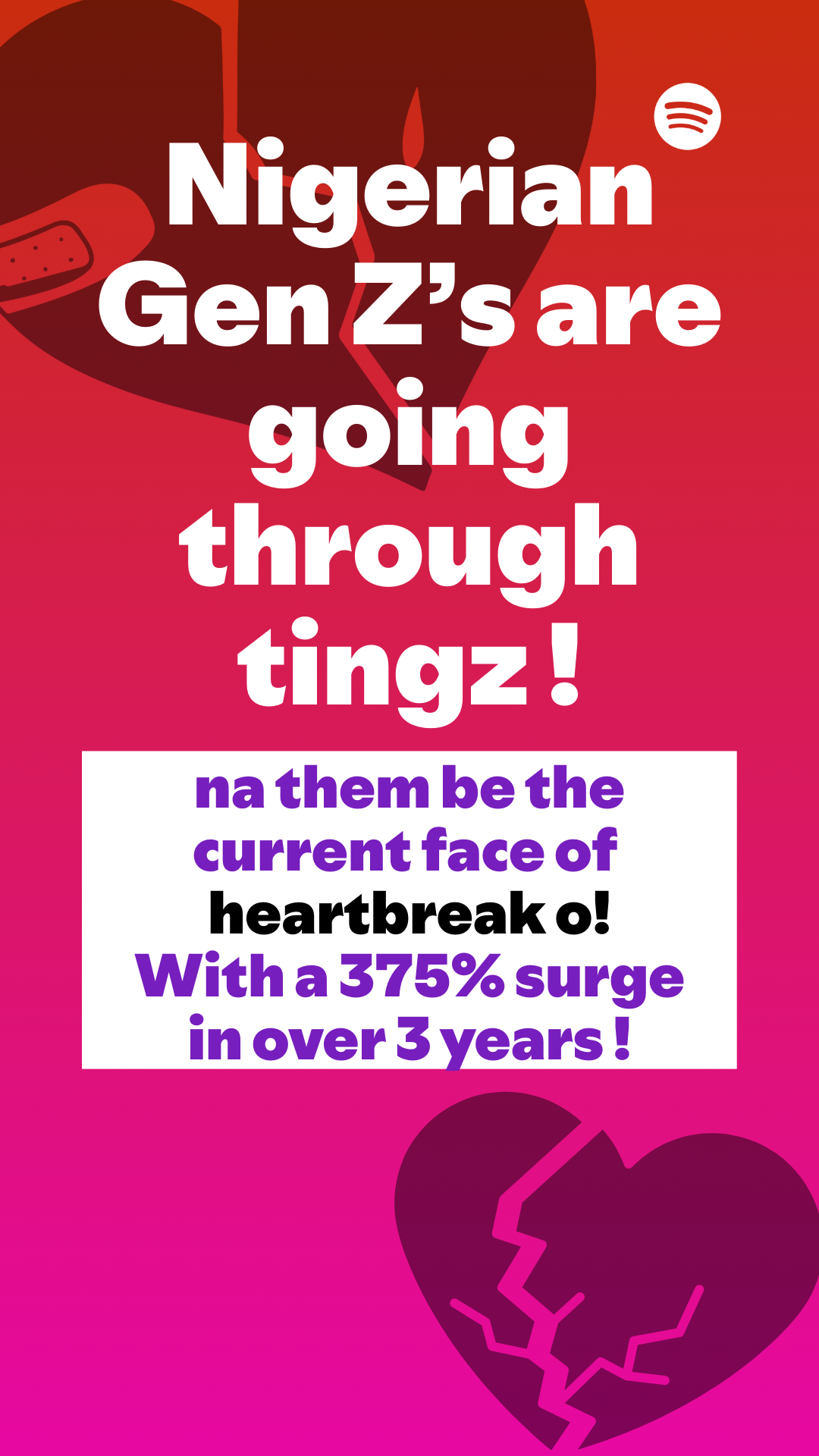
Spotify’s latest Valentine data signals that Nigerian listening is becoming more emotionally expansive, not more predictable. Across the Jan 1 to Feb 4 comparison window, Nigeria saw strong growth in mood-led playlist creation from 2024 to 2025, with rizz up +58%, simp up +66%, and yearn up +305%. From 2025 to 2026, we could see rizz up +82% and yearn up +170%. Together, these shifts point to a culture that is naming attraction, vulnerability, and longing in real time.

A New Language for Modern Love

On Valentine’s Day, Nigerian listeners moved between local and global love soundtracks, with Burna Boy, John Legend, and Billie Eilish appearing in the same emotional universe. What stands out is not one dominant mood but the growth of multiple moods at once. Using rizz and simp as love-coded signals, and yearn as a heartbreak-coded signal, Spotify data shows both sides rising sharply. Love-coded playlist, rizz behaviour grew by +58%  to +82% from 2024 to 2026, while heartbreak-coded behaviour yearn grew by +305% and then +170% over those same periods.

This is emotional literacy in action, with listeners using playlists to process what they feel without having to flatten it into one story.

Nigerian Gen Z is driving this change. Data points to a generation building a working vocabulary for modern relationships, one that allows confidence, tenderness, and uncertainty to exist side by side.

The Duality Generation

Among 18 to 24-year-olds on Valentine’s Day, nearly 60% of listeners skewed heartbreak, while almost 40% leaned into love. They are not choosing one emotion over another. They are holding both at once and building listening habits that reflect that complexity.

The pattern is visible across gender, too. Men accounted for over 65% in heartbreak and 61% in love song streaming, while women represented just over a third in both cases, showing that both groups are actively engaging the full emotional spectrum on the day.

Geographically, heartbreak listening is concentrated in urban centres, with Lagos leading, followed by Abuja, Port Harcourt, Ibadan, and Benin. The map is culturally telling. Young Nigerians in major cities are using music as a live emotional archive of romance, ambiguity, and recovery.

Sharing the Feeling

Nigerians are not processing these emotions in isolation. Valentine’s Day 2025 was the “Blendiest” day in the preceding year, signalling peak shared listening behaviour through Spotify Blend. Partners, friends, and crushes used collaborative playlists to merge Afrobeats, street-pop, and R&B into shared mood spaces.

Top Blend tracks on the day included  Fido’s Awolowo, Smur Lee’s, Shallipopi, ODUMODUBLVCK’s JUJU (with Smur Lee & Shallipopi),  BNXN, Rema’s “Fi Kan We Kan,” and Rema’s “OZEBA.” In direct song shares, listeners chose emotionally direct records such as Future’s “WORST DAY,” Drake’s “GIVE ME A HUG, Asake’s “WHY LOVE”,  Rema’s “Baby (Is it a Crime)”, and Drake’s “NOKIA”. The signal is clear: sharing is not just social behaviour, it is emotional communication.

Beyond Romance: Community, Friendships, and Faith

Valentine’s listening also shows Nigerians broadening the meaning of connection. Globally, Galentine playlist creation rose by over +70% year on year, with +20% growth already recorded this year. In Nigeria, this aligns with how friendship and peer support are increasingly central to how young listeners mark the day.

The podcast picture adds another cultural layer. Faith-based voices remained highly visible on 14 February, alongside relationship-centred conversations, reflecting a listening culture where romance, spirituality, and community wisdom coexist rather than compete.

Spotify also recorded a +20% increase in Valentine’s Day playlist creation globally in the latest comparable seasonal window, reinforcing that this period remains one of the strongest emotional moments in the listening calendar.

“Valentine’s Day in Nigeria is no longer a single-note romance moment. We are seeing listeners embrace love and heartbreak as equally valid emotional realities, and use music to move through both with honesty. What stands out is the confidence to name complex feelings and the willingness to share them with others,” says Phiona Okumu, Spotify’s Head of Music for Sub-Saharan Africa.

This year’s Valentine’s data presents a portrait of a generation redefining connection: emotionally fluent, culturally hybrid, community-oriented, and unafraid of contradiction.


Showbiz

Carnival Calabar to Unveil 2026 Theme May 31 in Lagos

Published

on

Carnival Calabar

By Aduragbemi Omiyale

The theme for the 2026 edition of the prestigious Carnival Calabar will be unveiled on Sunday, May 31, at the Eko Hotel Convention Centre, Lagos.

This theme-unveiling event is being organised by the Cross River State Carnival Commission.

The theme guides the bands in their choreography and the presentation of the whole carnival. It also allows the state to engage with stakeholders, sponsors, and the diplomatic community as part of preparations for the yearly programme.

For this year’s unveiling event, Ambassador Gautier Mignot of the European Union (EU) is expected to be the special guest of honour, with Ambassador Paulo Santos of Portugal as the guest of honour.

As part of the activities leading up to the unveiling event, the Chairman of Carnival Calabar, Dr Gabe Onah, paid a strategic visit to Multichoice Nigeria Canal + Company. He was accompanied by the Lead Marketing Consultant of Carnival Calabar, Mrs Mary Ephraim Egbas.

The delegation was received by the chief executive of Multichoice Nigeria Canal + Company, Ms Kemi Okunola, and the Executive Director, General Entertainment, Multichoice Nigeria, Dr Busola Tejumola.

The delegation briefed Multichoice on plans for digital transformation and streaming to a global audience for this year’s event, as well as this Sunday’s event.

Carnival Calabar is the biggest Street Dance Parade in Africa, held every December in Cross River State. It is one of the biggest tourism events in West Africa, drawing millions of visitors to Cross River every year.

Continue Reading

Showbiz

The Evolution of Home Viewing in Nigeria

Published

on

Home Viewing in Nigeria

There was a time in Nigeria when watching movies at home wasn’t strictly a “home” experience. People rented VHS tapes and later DVDs from local video clubs around the neighbourhood, and in many cases, viewing extended to video centres or where groups gathered to watch films and sports. It was a shared setup shaped by access, availability, and a very communal way of consuming entertainment.

As time went on, analogue television became the main form of home viewing. Families would gather around a single TV set in the living room, with limited channels and fixed programming schedules. Content was not really something you chose; it was something you aligned your day around. Antenna adjustments were part of the routine, and despite the limitations, TV became a central part of everyday household life.

The introduction of satellite and pay-TV services marked a major shift. Viewers suddenly had more control, more variety, and more access. Local and international content expanded significantly, covering movies, sports, news, and entertainment in a way that changed viewing habits from passive scheduling to active choice.

This is where platforms like GOtv became relevant in the Nigerian context. By making premium entertainment more affordable and widely accessible, GOtv helped bridge the gap between content quality and everyday households. It wasn’t just about more channels; it was about making consistent access to entertainment more realistic for a wider audience.

Today, home viewing has become more flexible and audience-driven. People are no longer tied to fixed schedules; viewing is now based on preference, timing, and convenience. At the same time, shared viewing still exists, especially around live sports and major TV moments, where entertainment becomes a collective experience again, just in a more modern form.

From rented tapes and video centres to satellite TV and now more structured, accessible entertainment platforms, the evolution of home viewing in Nigeria has been a steady shift toward more choice and control. Throughout that journey, GOtv has remained part of the ecosystem, supporting how everyday audiences access and experience entertainment at home.

Continue Reading

Showbiz

How Far Would You Go For the People You Love? Stripped Answers This

Published

on

Africa Magic Stripped

Five episodes in, and Africa Magic’s limited series, Stripped, has quietly got people talking. Not because of the stripping, though yes, that is very much part of it, but because of what sits underneath all of it. The guilt. The shame. The quiet, suffocating pressure of being a man in Lagos who is supposed to have it all together but simply does not.

The premise sounds simple. Five friends, all broke, all stuck, all too proud to say it out loud, stumble into a stripping gig at an upscale club called Trabaye after its sharp and seductive owner, Yvonne (Constance Owoyemi) spots them at a birthday party and sees something worth paying for. What follows is anything but simple.

Kelechi “Kel” Okere (Daniel Etim Effiong) is the one carrying the most weight. A former marketing executive now driving Uber to keep his wife and children afloat, Kel is the kind of man who will smile through a crisis so nobody worries. His wife, Ada (Future Lolo Lamai), thinks he is still closing big deals. His children need school fees. The rent is overdue. And every night he comes home, the lie gets a little heavier.

Bolaji (Mofe Duncan), who is loud, charming and energetic, watches his cafe dream bleed out quietly. Suppliers want cash; customers want credit, and charm, it turns out, cannot patch a leaking roof.

Damina (Efa Iwara) is the cool bachelor whose carefully constructed life collapses the moment his pregnant ex walks back through the door. Mensah (Ian Wordi) is a Ghanaian-Nigerian architect and youth pastor caught in a relationship that is slowly erasing him. And Voke (Kunle Remi) is running out of time to free his imprisoned father, one clever scheme at a time.

Their first night at Trabaye is overwhelming. The music, lights, money, and the strange, intoxicating feeling of being wanted. They laugh in the car afterwards and call themselves “Strip Gawds.” For one night, the bills don’t exist. But nothing in Lagos stays clean for long.

Bolaji’s wandering eye pulls the group into dangerous territory. Voke’s schemes start bleeding into the club’s shadier edges. Kel finds himself dangerously close to a line he cannot cross, pulled back only by the sound of his wife’s voice on the phone. And Mensah quietly wonders how many layers of himself he can strip away before there is nothing left worth keeping.

The show’s most devastating moment comes in Episode 4, when Kel has a panic attack. There is no dramatic score, just a man cracking under the weight of everything he has been holding alone. Viewers have not stopped talking about it since. It is the kind of scene that does not just tell you about a character; it shows you something true about the world.

Etim Effiong, who also serves as executive producer, said it plainly. “Men need to catch a break. It’s a really tough world for men, and we deserve some credit.” Episode 5 offers a brief exhale before the walls begin closing in again. The money is good. But the shadows are getting closer.

Stripped is no longer just a show about five men taking their clothes off for money. It is about what men carry in silence, what friendship costs when survival is on the line, and whether the things you do to save your life can also be the things that cost you your soul.

If you have not started watching, you should start now. Catch up on all five episodes now on DStv Stream, and tune in for the final episode this Sunday at 8 PM on Africa Magic Showcase, DStv Channel 151, and GOtv Channel 8.

Continue Reading

Trending